Disclosure: This post contains affiliate links and I will be compensated if you make a purchase after clicking through my links. Learn More
DCEP vs DCEN welding polarity comes down to the process: use DCEP (electrode positive) for MIG, most stick rods and gas-shielded flux core, and use DCEN (electrode negative) for TIG on steel and stainless and for many self-shielded flux core wires. DCEP usually digs deeper, and DCEN runs cooler on the electrode.
Polarity is the direction current flows between the electrode and the work clamp. On a DC machine you set it by choosing which socket the torch or stinger lead plugs into, marked + or -.
The wrong polarity gives a spattery, unstable arc, poor fusion or a melted tungsten. The fix is often just swapping 2 leads.
DCEP vs DCEN Welding Polarity at a Glance
DCEP puts the electrode on positive and DCEN puts it on negative. That one swap changes penetration, electrode heat and which processes run well.
| Feature | DCEP (Electrode Positive) | DCEN (Electrode Negative) |
|---|---|---|
| Old names | Reverse polarity, DCRP | Straight polarity, DCSP |
| Electrode lead | Positive (+) socket | Negative (-) socket |
| Work clamp | Negative (-) socket | Positive (+) socket |
| Stick penetration | Usually deeper | Usually less |
| Burn-through risk on thin metal | Higher | Lower |
| Main processes | MIG, most stick rods, gas-shielded flux core | TIG (DC), many self-shielded flux core wires, plasma cutting |
A handy memory trick from TWI is PANiC: Positive Anode, Negative Cathode.
What Is DCEP?
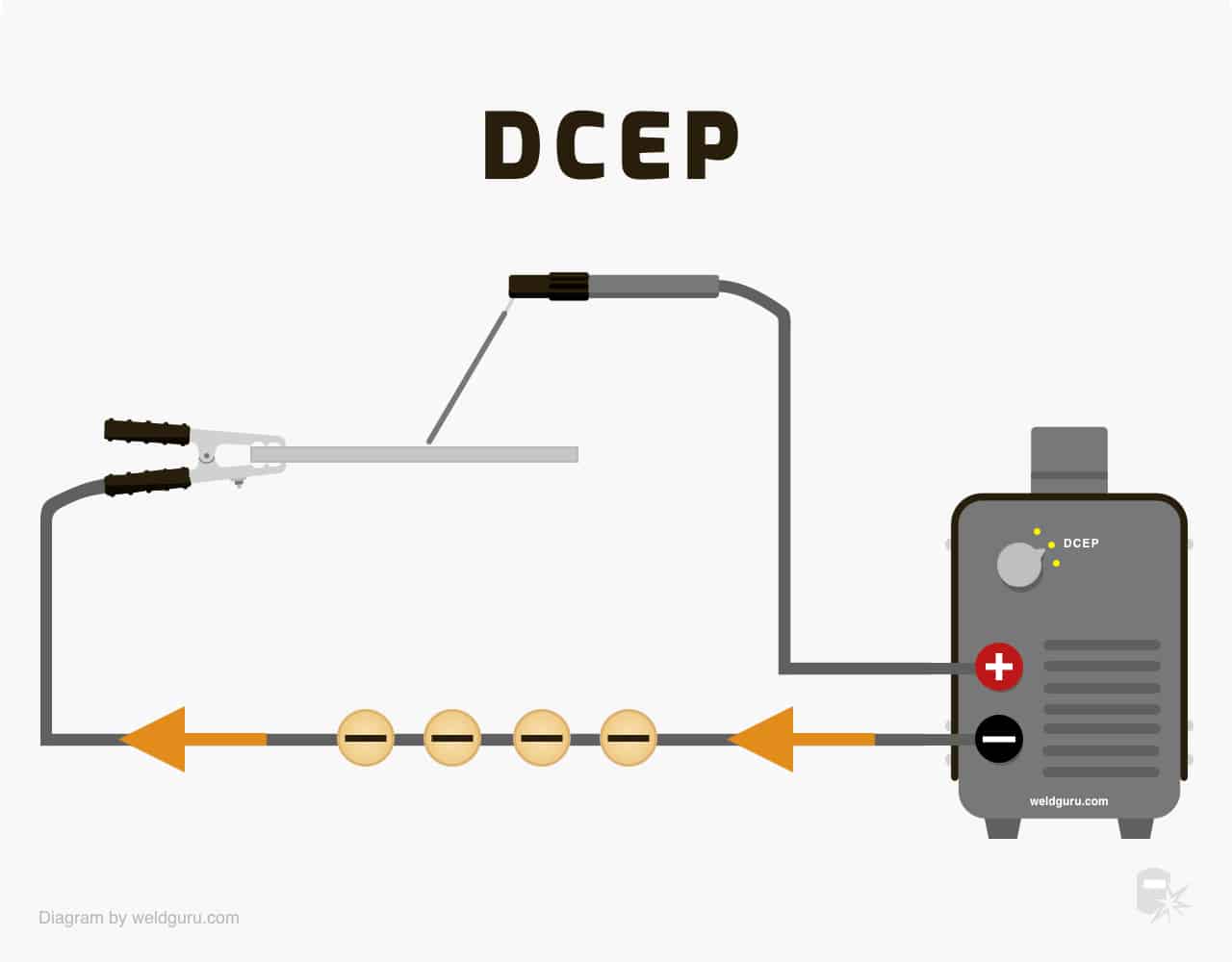
Credit: weldguru.com
DCEP means direct current electrode positive. The stinger, MIG gun or torch connects to the positive terminal and the work clamp connects to negative. It is also called reverse polarity or DCRP.
TWI says DCEP usually gives greater penetration in stick welding and lowers the risk of lack of fusion. That is why most electrodes for stick welding and solid MIG wire run on DCEP.
What Is DCEN?
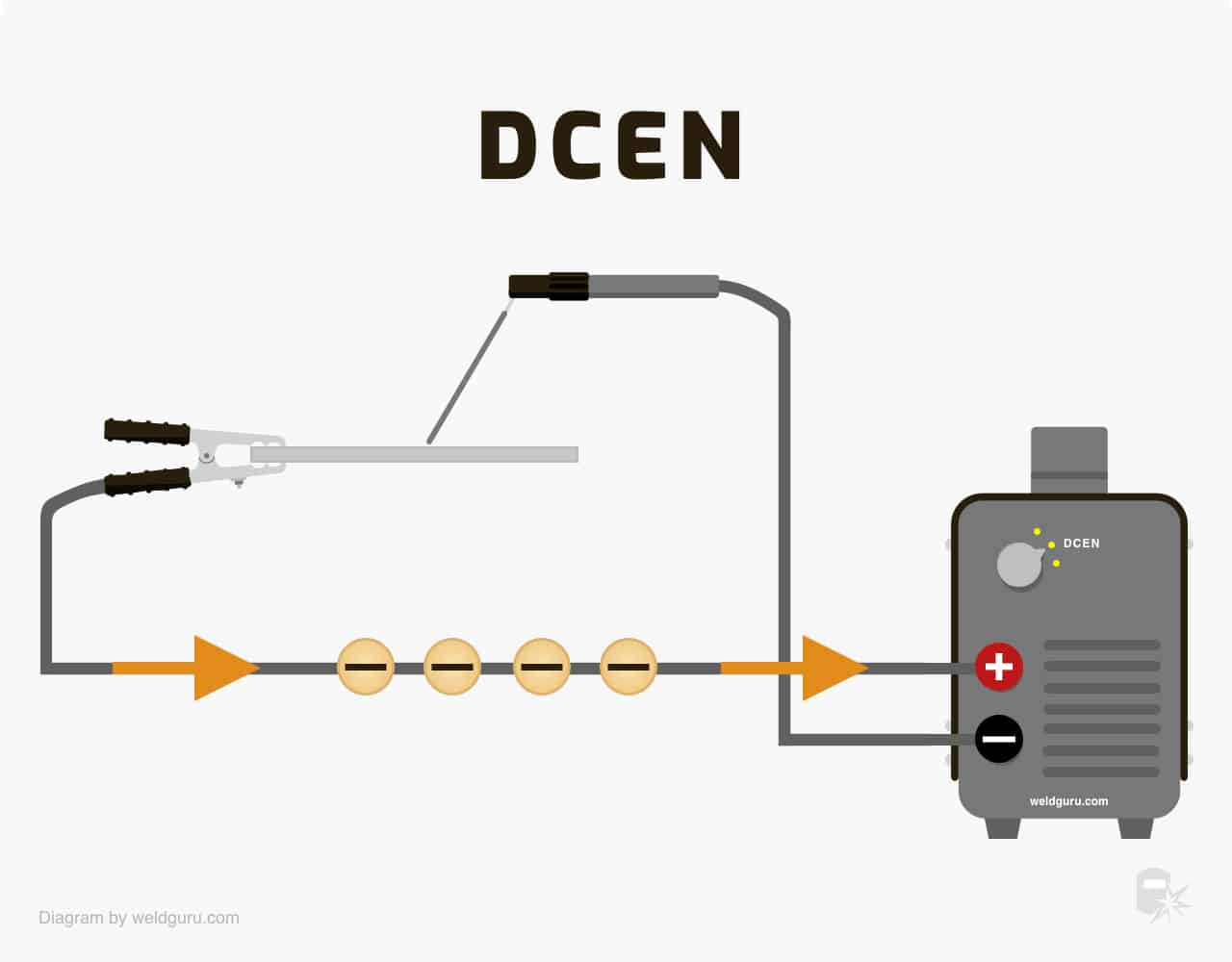
Credit: weldguru.com
DCEN means direct current electrode negative. The electrode or torch connects to the negative terminal and the work clamp connects to positive. It is also called straight polarity or DCSP.
In stick welding, TWI notes DCEN reduces penetration and dilution, so it suits open root runs, thin sheet and surfacing where burn-through is the bigger risk. In TIG welding, DCEN keeps most of the heat in the work and off the tungsten.
Key Differences Between DCEP and DCEN
Heat and Penetration
In TIG welding, TWI puts about 2/3 of the arc heat at the positive side. With DCEN the work is positive, so the part gets most of the heat and the tungsten stays cool.
Stick welding is less clear cut. TWI says polarity does not control heat as strongly in stick welding because metal transfers from the rod to the work. Still, DCEP usually gives more penetration and DCEN less.
Burn-Through and Thin Metal
DCEN is the safer choice on thin sheet and open roots because it limits penetration. DCEP is the better choice when lack of fusion on thicker steel is the main worry.
Electrode and Wire Rules
For stick, the rod’s flux coating decides the polarity. TWI points to AWS A5.1 and the maker’s data for the permitted current, and not every rod runs on both.
- Lincoln Fleetweld 5P+ (AWS E6010): DC+ (DCEP) only, per the Lincoln product listing.
- E6011: runs on AC, DCEP or DCEN, per Tulsa Welding School. See 6011 vs 6013 for how it compares.
- Self-shielded flux core: often needs DCEN. Lincoln Innershield NR-211-MP, an AWS E71T-11 wire, is a common gasless example; check the polarity on the spool label.
Arc Behavior
DC in either polarity gives a steadier arc than AC, which helps out of position. Tulsa Welding School notes AC is the go-to fix for arc blow on magnetized steel, and TWI agrees.
Where Each Polarity Fits by Process
| Process | Usual polarity | Notes |
|---|---|---|
| MIG (GMAW), solid wire | DCEP | Nearly always DCEP |
| Flux core, gas-shielded (FCAW-G) | DCEP | Check the wire data sheet |
| Flux core, self-shielded (FCAW-S) | Often DCEN | Check the spool label |
| Stick (SMAW) | Mostly DCEP | Some rods also run AC or DCEN |
| TIG (GTAW), steel and stainless | DCEN | Torch on the negative socket |
| TIG, aluminum | AC | AC breaks up the oxide layer |
| Plasma cutting | Electrode negative only | Positive damages the torch, per Everlast |
For wire-by-wire settings, our MIG welding polarity settings chart covers solid and flux core wire.
Polarity Tips by Process
MIG and Flux Core
Check your welder manual for where the polarity leads connect. Solid wire with gas goes on DCEP. Gasless flux cored arc welding wire often needs DCEN, so swap the leads when you change wire type.
Stick Welding Polarity
Read the polarity printed on the rod box before you strike. If a DCEP rod spatters badly and will not hold an arc, check that the stinger is on the + socket.
TIG Welding Polarity
Everlast says the TIG torch always goes on the negative socket, even in AC mode. Running TIG welding on DCEP overheats the tungsten fast, so steel and stainless stay on DCEN and aluminum moves to AC.
Which One Should You Choose?
Choose DCEP If
- You MIG weld with solid wire and shielding gas.
- You run gas-shielded flux core wire.
- Your stick rod box lists DC+ or DCEP, such as E6010 rods.
- You need more penetration on thicker steel and want less risk of lack of fusion.
Choose DCEN If
- You TIG weld steel or stainless with a DC machine.
- Your self-shielded flux core wire calls for DC- on the label.
- You run an open root or thin sheet with a rod rated for DCEN and want less burn-through.
- You use a plasma cutter (it is electrode negative only).
Welding Polarity Safety Notes
Turn the welder off and unplug it before you open the side panel or swap leads. Make sure lead connections are tight, since a loose lug heats up. Wear dry gloves and never touch the electrode and work at the same time.
Frequently Asked Questions
What Is the Difference Between DCEP and DCEN?
DCEP means the electrode connects to the positive terminal, and DCEN means it connects to negative. DCEP usually gives deeper penetration and runs MIG and most stick rods. DCEN keeps the electrode cooler and suits TIG on steel, many self-shielded flux core wires and thin sheet work.
Is Stick Welding DCEP or DCEN?
Most stick welding runs on DCEP, but the rod decides. E6010 rods such as Lincoln Fleetweld 5P+ are DC+ only, and E6011 can run on AC, DCEP or DCEN. Always check the polarity printed on the rod box, since the flux coating sets what the electrode accepts.
Is Flux Core Welding DCEN?
Self-shielded flux core wire often runs on DCEN, and gas-shielded flux core wire usually runs on DCEP. The wire type decides it, so read the spool label or data sheet. When you switch from solid wire to gasless wire, you may need to swap the leads.
Why Does TIG Welding Use DCEN?
TIG welding uses DCEN because the positive side of the arc takes about 2/3 of the heat. With the work on positive, the part gets most of the heat and the tungsten stays cool. DCEP would overheat the tungsten quickly on a steel or stainless job.
What Happens If You Weld With the Wrong Polarity?
Wrong polarity usually gives a harsh, unstable arc, heavy spatter, poor fusion and an ugly bead. On TIG it can melt the tungsten, and on plasma it can damage the torch. Turn the machine off, swap the leads to the correct sockets and test on scrap first.
Final Words
DCEP vs DCEN welding polarity is a process choice more than a preference. MIG, gas-shielded flux core and most stick rods want DCEP, and TIG on steel, many gasless flux core wires and plasma cutting want DCEN.
When in doubt, the rod box, wire spool or machine door chart has the final word. Set the leads to match, run a test bead on scrap and check that the arc sounds smooth before the real weld.