Disclosure: This post contains affiliate links and I will be compensated if you make a purchase after clicking through my links. Learn More
What is metal cored welding wire? It is a tubular MIG wire with a steel sheath filled mostly with metal powders, such as iron and alloys, instead of slag-forming flux. It runs with shielding gas like solid wire, but it deposits metal faster and leaves only a few small silicon islands on the bead.
Welders call the process GMAW-C or MCAW (metal cored arc welding). You’ll see it most on robotic lines, heavy equipment, railcars and structural shops where travel speed pays the bills.
Lincoln Electric Metalshield MC-6, an AWS A5.18 E70C-6M-H4 wire, is one of the best-known examples and is our reference wire for specs.
What Is Metal Cored Welding Wire: Sheath and Core
Metal cored wire is a hollow metal sheath filled with metallic powders and alloys, including iron. The Fabricator describes the core as predominantly metal powders with small amounts of arc stabilizers and little or no slag-forming ingredients.
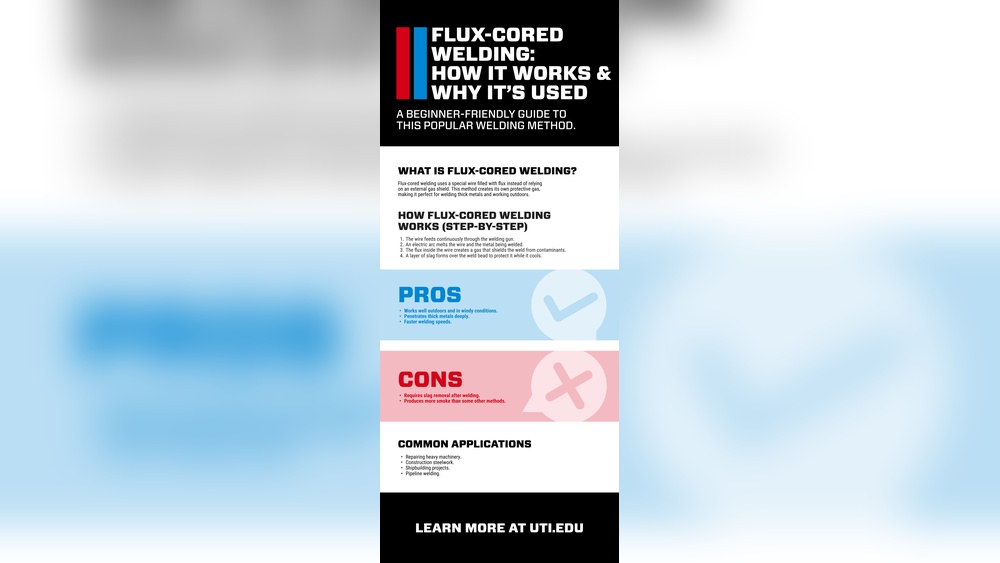
That fill is the key difference from flux cored wire. A flux cored wire carries a core of fluxing agents that form a slag blanket. A metal cored wire carries mostly the same metal you want in the joint, so almost all of it ends up in the weld.
Efficiency figures from The Fabricator show the gap clearly: solid GMAW wire runs 95 to 98%, metal cored wire 92 to 95%, and flux cored wire 85 to 89%.
How Metal Cored Wire Works
Welding current travels through the outer sheath, because the powder core carries very little of it. That smaller current path raises current density at the same amperage.
The result is a broad, cone-shaped arc with a wide penetration profile.
Higher current density also speeds up burn-off, so the wire melts faster. TWI notes this effect for cored wires as a group.

Credit: www.youtube.com
Shielding Gas and Transfer Mode
Metal cored wire always needs an external shielding gas. For spray transfer, The Fabricator recommends a gas mix with at least 75% argon.
Lincoln Electric lists its Metalshield MC-6 wire for mixed gas. Its AWS A5.18 test gas is 75 to 80% argon with the balance CO2, and Lincoln’s operating table uses 90% argon and 10% CO2.
Power Source and Polarity
Run metal cored wire on a constant voltage (CV) power source, the same type you use for solid MIG wire. Lincoln’s MC-6 data uses DC+ (DCEP) polarity.
For vertical-up work, you need a pulse-capable machine or a CV machine set to the short-circuit range. Flat, horizontal, vertical-down and overhead welds run in standard CV spray.
Metal Cored vs Solid vs Flux Cored Wire
Metal cored wire sits between solid wire and gas-shielded flux cored wire. It welds like solid wire but deposits metal more like a cored wire.
| Feature | Solid MIG wire | Metal cored wire | Flux cored wire |
|---|---|---|---|
| Core | None (solid) | Mostly metal powders | Mostly flux |
| Slag | None | A few silicon islands | Full slag cover |
| Shielding gas | Required | Required | Gas-shielded or self-shielded types |
| Deposition efficiency | 95 to 98% | 92 to 95% | 85 to 89% |
| Cost per pound | Lowest | Higher than solid | Higher than solid |
Sources: The Fabricator (Myers, Hensley) and TWI. Costs change by supplier, so compare current prices from your distributor.
How to Read a Metal Cored Wire Label
Every metal cored wire carries an AWS classification. Many also meet ABS, API or DNV approvals for marine, oil and offshore work.
Lincoln Metalshield MC-6 is a good example. It conforms to AWS A5.18 E70C-6M-H4 and is also listed under the newer AWS A5.36 as E70T15-M21A4-CS1-H4.
- 70: the A5.18 minimum tensile strength of 70 ksi (480 MPa). The yield minimum is 58 ksi (400 MPa) with 22% elongation.
- M: tested with mixed gas, 75 to 80% argon with the balance CO2.
- H4: the diffusible hydrogen designator, a low hydrogen rating.
Lincoln’s typical as-welded tensile for MC-6 is 91 ksi in 90/10 gas and 81 to 85 ksi in 75/25 gas. Always check the data sheet for the exact wire you buy.
Advantages of Metal Cored Wire
- Faster travel speed: The Fabricator reports up to a 30% increase over solid wire in automatic and robotic welding.
- High deposition: Lincoln lists 17.5 lb/hr for 0.045 in MC-6 at 700 in/min wire feed in 90/10 gas.
- Less cleanup: very little spatter and slag, with only a few silicon islands to brush off.
- Gap bridging: it handles poor fit-up better than solid wire.
- Mill scale and rust tolerance: it can weld through light scale, which can cut grinding and degreasing steps.
- Low hydrogen: TWI groups metal cored wire with rutile and basic flux cored wires as very low hydrogen.
Fewer cleanup steps matter most on multi-pass welds. TWI notes that metal cored wire is common in fully automated, multi-pass jobs for this reason.
Disadvantages and Limits
- Higher wire cost: metal cored wire costs more per pound than solid wire because the tube takes more steps to make.
- Gas required: you need a cylinder and a breeze-free area, the same as solid MIG wire.
- Poor fit for sheet metal: The Fabricator does not recommend it for thin sheet.
- Vertical-up speed: deposition in vertical-up is about the same as solid wire and lower than flux cored wire.
- More fumes: cored wires usually make more fume than other continuous wire processes.
Safety note: weld with local exhaust or a fume extractor, and wear a respirator when ventilation can’t keep fumes out of your breathing zone. Follow the Safety Data Sheet for the wire you use.
Where Metal Cored Wire Is Used
Metal cored wire shows up wherever travel speed and low cleanup save money. Common jobs from The Fabricator and Lincoln include:
- Robotic and hard automation cells
- Automotive chassis, wheels and exhaust systems
- Agricultural and heavy equipment
- Railcars and structural fabrication
- Process piping and pressure vessels
Metal cored wires come in mild steel, low-alloy and stainless versions. The Fabricator names car exhaust systems as one of the most widespread robotic uses.

Credit: www.youtube.com
When to Choose Metal Cored Wire
Pick metal cored wire when you weld thick steel in flat or horizontal positions, run a robot or semi-auto gun all day, and want to skip slag removal between passes.
Stay with solid wire for sheet metal, short jobs and the lowest wire cost. Pick self-shielded flux core when you weld outside in wind without a gas bottle.
Check your machine first. Metal cored wire comes in sizes from 0.035 to 0.093 in, and Lincoln’s MC-6 table runs 170 to 370 amps for its sizes, so your feeder and power source need to match.
Frequently Asked Questions
Can You Use Metal Cored Wire in a Regular MIG Welder?
Yes, if the machine is a constant voltage MIG welder with enough amperage for the wire size. You need shielding gas, knurled or cored-wire drive rolls and the right contact tip. Lincoln’s MC-6 data runs 170 to 370 amps, so check your machine’s output and the wire’s data sheet first.
Does Metal Cored Wire Need Gas?
Yes. Metal cored wire has no self-shielding flux, so it always needs an external shielding gas. Lincoln Metalshield MC-6 runs on argon and CO2 mixes such as 75/25 and 90/10. For spray transfer, The Fabricator recommends at least 75% argon in the mix.
Is Metal Cored Wire the Same as Flux Cored Wire?
No. Both are tubular wires, but a flux cored wire is filled mostly with flux that forms a slag cover. A metal cored wire is filled mostly with metal powders, so it leaves only a few silicon islands and puts more of the wire into the weld.
What Polarity Does Metal Cored Wire Use?
Most mild steel metal cored wires run on DC electrode positive (DCEP), also called reverse polarity. Lincoln’s operating data for Metalshield MC-6 uses DC+. Always confirm polarity on the data sheet for your exact wire before you strike an arc on a new spool.
Why Is Metal Cored Wire More Expensive?
Making a tubular wire takes more steps than drawing solid wire, so the price per pound runs higher. Shops often accept that cost because faster travel speed, higher deposition and less grinding or slag removal can lower the total labor cost per foot of weld.
Final Words
Metal cored welding wire gives you solid-wire handling with faster deposition and almost no slag. It shines on thick steel, robotic cells and multi-pass welds where cleanup time adds up.
It costs more per pound and needs gas, so it rarely suits sheet metal or outdoor hobby work. Read the AWS class and the data sheet, match your gas and polarity, and test it on scrap before a production run.