Disclosure: This post contains affiliate links and I will be compensated if you make a purchase after clicking through my links. Learn More
What is dual shield welding? Dual shield welding is gas-shielded flux cored arc welding (FCAW-G), where a flux-filled tubular wire and an external shielding gas both protect the weld. The flux makes a slag and some gas inside the arc, and a cylinder supplies the second shield.
Welders love it for thick steel, fast fill passes and out-of-position work. You get the speed of a wire feeder with a slag that holds the puddle in place.
Here’s how the process works, which gases and wires it uses, where it fits, and how it compares with gasless flux core and solid wire MIG.
What Is Dual Shield Welding in Simple Terms?
Dual shield welding is flux core welding with a gas bottle hooked up. The wire’s flux core forms a protective slag, and the shielding gas covers the arc from the outside, so the molten metal gets two layers of protection.
TWI, the UK welding research body, describes flux cored arc welding as a process “also known as dual shield welding.” The name comes from ESAB, which sells its gas-shielded flux cored wires under the Dual Shield brand. Lincoln Electric calls its gas-shielded line Outershield.
It’s one of the two main forms of flux cored arc welding. The other form, self-shielded FCAW (FCAW-S), runs without any gas bottle.
How Dual Shield Welding Works
The wire is a metal tube with a powdered flux and alloy core. Lincoln Electric explains that the wire’s main alloy content sits in that powder inside a thin steel sheath.
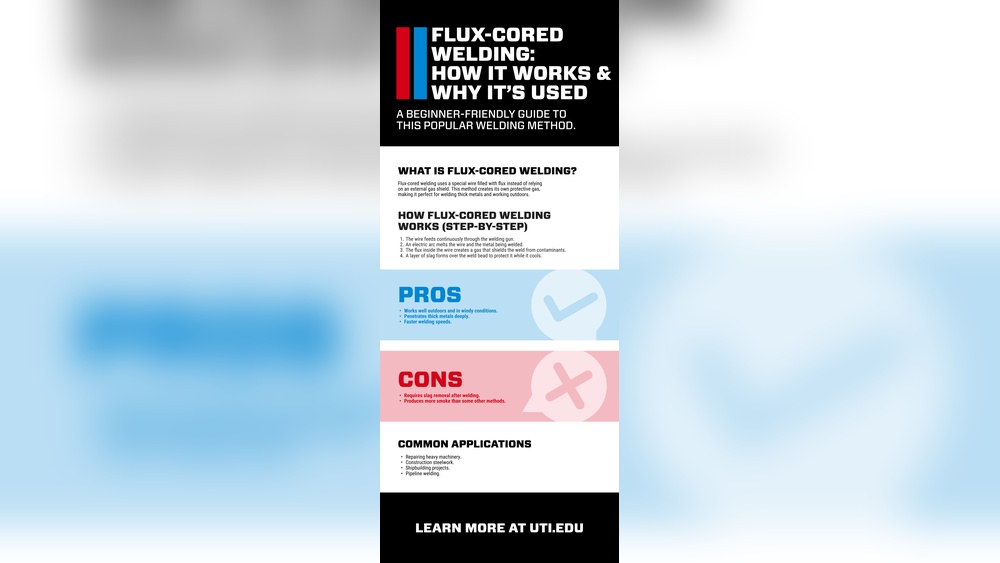
- The wire feeder pushes the tubular wire through the gun, just like MIG.
- The arc melts the sheath and the flux core together.
- Shielding gas from the cylinder flows through the nozzle and covers the arc and puddle.
- The melted flux floats up and forms a thin slag layer over the bead.
- The slag freezes fast and holds the puddle, then you chip or brush it off after each pass.
ESAB notes that the small current path in a tubular wire gives the arc a columnar shape. That arc shape is why dual shield wire digs in with deep penetration.
Most gas-shielded flux cored wires run on DC electrode positive (DCEP). Lincoln Electric says most wires in the class “run best on electrode positive,” but always check the polarity printed on your wire’s spool or data sheet.
Shielding Gas for Dual Shield Wire
Lincoln Electric lists gas options from 100% CO2 to two-part argon and CO2 mixes, plus some three-part mixes. TWI reports that the most common blend is 75% argon and 25% CO2, often sold as C25.
| Gas | What It Does | Good For |
|---|---|---|
| 100% CO2 | Deepest penetration, per ESAB; cheaper gas | Thick plate, fill passes |
| 75% argon / 25% CO2 | Smoother arc and less spatter | Shop work, cosmetic caps |
| Three-part mixes | Tuned for certain wires | Only when the wire maker lists them |
Wire makers mark the approved gas in the AWS classification. A wire like E71T-1C is rated for CO2, and an E71T-1M wire is rated for an argon mix. Run the gas the label names, because the wrong gas changes the bead and the weld metal properties.

Credit: www.youtube.com
Dual Shield vs Self-Shielded Flux Core
Both use a tubular flux cored wire. The big split is the gas bottle, and that one change decides where each process works best.
| Factor | Dual Shield (FCAW-G) | Self-Shielded (FCAW-S) |
|---|---|---|
| Shielding gas | Yes, from a cylinder | No, the core makes its own shield |
| Wind and outdoor work | Poor in wind, per TWI | Works outdoors and in wind |
| Spatter | Very little, per ESAB | Usually more |
| Portability | Needs a gas bottle and regulator | Just the welder and wire |
| Typical setting | Shops and fab floors | Field and site work |
Gasless wire suits a hobby welder fixing a trailer outside. So the answer to does flux core need gas depends on which of these two wires sits on the spool.
Don’t run dual shield wire without gas. The core is built to work with external shielding, and without it you can expect porosity and a weak weld.
Dual Shield vs Solid Wire MIG
Solid wire MIG (GMAW) leaves no slag and makes cleaner beads on thin sheet. Dual shield lays down more metal per hour and handles vertical and overhead joints on thick steel with less fuss.
TWI says flux cored welding allows higher production rates than solid wire or stick. ESAB credits the high deposition to the wire’s high current density.
The wire build drives most of the gap. The solid wire vs flux core wire choice changes slag, spatter and how the bead looks.
Pros and Cons of Dual Shield Welding
Pros
- High deposition rates for fast fill and cap passes on thick plate.
- All-position welding, since the fast-freezing slag holds the puddle.
- Deep penetration, best with 100% CO2.
- Very little spatter and a smooth bead, per ESAB.
- Faster than stick, because the wire feeds without stopping to change rods.
Cons
- You must remove slag before each new pass.
- Heavier fumes than solid wire MIG in some cases, per the American Welding Society.
- Flux cored wire can cost more per pound than solid wire.
- You need a gas cylinder and regulator, so it’s less portable.
- Wind blows the gas away, so it’s a poor pick for outdoor work.
- TWI does not recommend flux cored welding on metal thinner than 20 gauge, and it can’t weld aluminum.
Where Dual Shield Welding Is Used
Lincoln Electric says FCAW-G shows up in virtually every major industry that needs high deposition and all-position welding. TWI notes it was developed for structural steel and is widely used in construction.
- Structural steel and bridges
- Shipbuilding and offshore platforms
- Pipelines and pressure vessels
- Heavy equipment repair
- Hardfacing and surfacing work
The American Welding Society lists these jobs for flux cored welding as a whole. Dual shield takes the indoor share of that work, and self-shielded wire covers windy field jobs.

Credit: www.youtube.com
How to Choose and Set Up Dual Shield Wire
- Match the gas to the class: a C wire wants CO2, and an M wire wants an argon mix.
- Check the position rating: pick an all-position wire for vertical and overhead joints.
- Set polarity: most of these wires run DCEP, but follow the spool label.
- Use the right drive rolls: knurled rolls grip tubular wire without crushing it.
- Start from the maker’s chart: use the wire data sheet or the chart inside your machine’s door for voltage and wire speed.
Gas and moisture problems show up as holes in the bead. Low gas flow, wind, a dirty nozzle and damp wire are the usual causes of flux core porosity.
Safety Notes
Flux cored welding makes heavy smoke and fumes. Use local exhaust ventilation or a fume extractor, and keep your head out of the plume.
Chain or strap the gas cylinder upright, and close the valve when you finish. Wear a proper auto-darkening helmet, leather gloves and flame-resistant clothing, because the slag and spatter stay hot after the arc stops.
Frequently Asked Questions
Is Dual Shield the Same as Flux Core?
Dual shield is one type of flux core welding. It uses flux cored wire plus an external shielding gas. Plain “flux core” often means self-shielded wire with no gas. Both fall under flux cored arc welding (FCAW), but the wires are different and you can’t swap them freely.
What Gas Do You Use for Dual Shield Welding?
Most dual shield wires run on 100% CO2 or a 75% argon and 25% CO2 mix. CO2 gives deeper penetration and costs less. The argon mix gives a smoother arc with less spatter. Always use the gas your wire’s AWS classification and spool label call for.
Can You Run Dual Shield Wire Without Gas?
No, you shouldn’t run dual shield wire without gas. Its flux core is made to work with external shielding gas. Without the gas, the weld picks up air and you get porosity and poor strength. If you need gasless welding, switch to a self-shielded flux cored wire instead.
Is Dual Shield Welding Stronger Than MIG?
Weld strength comes from the filler metal rating and a sound joint, not the process name. An E71T-1 wire and an ER70S-6 MIG wire both carry a 70 ksi tensile rating. Dual shield wins on penetration and fill speed on thick steel, and MIG wins on thin sheet.
Can You Do Dual Shield With a MIG Welder?
Yes, many MIG welders can run dual shield wire if they reach the amperage your wire needs. Set the polarity the wire calls for, fit knurled drive rolls and a matching contact tip, and hook up the right gas. Check your welder’s manual for its flux cored wire limits.
Final Words
Dual shield welding pairs flux cored wire with shielding gas, so you get deep penetration, low spatter and fast deposition in all positions. It’s a shop process for thick steel, and it struggles in wind.
Pick the wire by its AWS class, run the gas the label names, and plan for slag cleanup between passes. For outdoor jobs, a self-shielded wire or a look at flux core vs stick welding will point you to a better fit.