Disclosure: This post contains affiliate links and I will be compensated if you make a purchase after clicking through my links. Learn More
What is pulse MIG welding? It is a MIG process where the welder switches the current between a high peak and a low background level many times per second. Each peak pinches off one droplet of wire and sprays it into the joint, and each low phase lets the puddle cool. You get the clean, low-spatter look of spray transfer with far less heat, so thin sheet, aluminum and stainless steel are easier to weld without burn-through.
Pulse MIG is a machine feature. You use the same gun and the same solid wire, so if you already know basic MIG welding, you already know most of what you need. This guide covers how pulse works, the gas it needs, where it beats regular MIG, and whether a home welder needs it at all.
What Is Pulse MIG Welding?
Pulse MIG welding is a controlled form of spray transfer. The power source jumps above the spray transition current to release a droplet, then drops to a low background current that keeps the arc lit without adding much heat. The wire never touches the puddle, so there is almost no spatter.
You may also see it called pulsed MIG, pulsed spray or GMAW-P (gas metal arc welding, pulsed). They all mean the same process.
How Pulse MIG Welding Works
A pulse machine repeats one cycle over and over. Lincoln Electric describes the pulse as happening several hundred times per second, and most machines run somewhere between about 30 and 400 pulses per second.
| Setting | What It Does | What You Notice |
|---|---|---|
| Peak current | Pushes the arc above the spray transition point and pinches off a droplet | More penetration |
| Background current | Keeps the arc alive at low amps between droplets | Less heat in the part |
| Pulse frequency | Number of pulses per second | Higher frequency gives a narrower, tighter arc |
| Peak time (pulse width) | How long each peak lasts | Longer peaks add heat and bead width |
Because metal only transfers during the peaks, the average current sits well below what steady spray transfer needs. That lower average is where the heat savings come from.
Most pulse welders are synergic. You pick the wire type, wire size and gas, then set wire feed speed or material thickness, and the machine fills in peak, background and frequency for you. Non-synergic machines make you set each value by hand.
Pulse MIG vs Regular MIG: Short Circuit and Spray Transfer
Regular MIG uses either short circuit or spray transfer. Pulse sits between them: the low heat of short circuit with the clean finish of spray. If you need a refresher on the first 2 modes, see our guide on short circuit vs spray transfer.
| Feature | Short Circuit | Spray Transfer | Pulse MIG |
|---|---|---|---|
| Heat input | Low | High | Low to medium |
| Spatter | Moderate to high | Very low | Very low |
| Thin metal | Good | Poor (burns through) | Good |
| Positions | All | Flat and horizontal | All |
| Gas | 75/25 or 100% CO2 works | 80%+ argon | 80%+ argon |
| Machine | Any MIG welder | Higher-amp MIG welder | Pulse-capable machine |
Standard spray arc MIG welding runs too hot for thin sheet and drips out of position. Pulse fixes both problems by cooling the puddle between droplets.
Single Pulse vs Double Pulse
Single pulse is the standard peak and background cycle described above. It covers most pulse MIG welding on steel, stainless and aluminum.
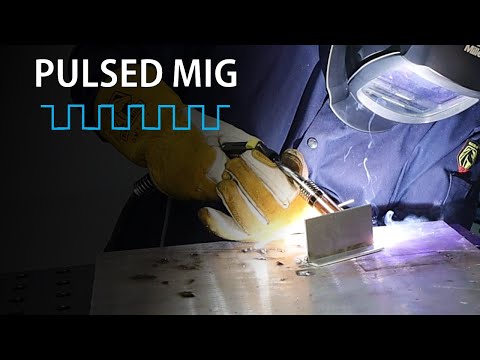
Double pulse (also called pulse-on-pulse) adds a second, slow cycle that switches between a high and a low pulse setting, often from about 0.5 to 5 times per second. The slow cycle moves the puddle in and out like a TIG welder dabbing filler, which leaves the “stacked dimes” bead many people want on aluminum. It also gives even more heat control on thin parts.
Credit: www.youtube.com
What Shielding Gas Does Pulse MIG Need?
Pulse MIG needs an argon-rich gas with at least 80% argon, because spray transfer will not form below that level. This is the most common setup mistake. The popular 75/25 mix (C25) is only 75% argon, so it will not give you true pulse spray.
| Metal | Common Pulse MIG Gas | Note |
|---|---|---|
| Mild steel | 90/10 or 92/8 argon/CO2 | Mixes from 82/18 to 92/8 work |
| Stainless steel | 98/2 argon/CO2 | Keeps color and corrosion resistance |
| Aluminum | 100% argon | Argon/helium blends add heat on thick parts |
Self-shielded flux core wire is not used for pulse spray. Stick with solid wire (or the metal-cored wire your machine’s pulse programs list) and the gas the program asks for.
Where Pulse MIG Welding Works Best
- Aluminum: Aluminum soaks up heat fast and then puddles all at once. Lincoln Electric notes pulse helps most on aluminum about 1/4 inch and thinner. If you are new to MIG welding aluminum, a pulse program makes the puddle much easier to control.
- Stainless steel: Lower heat means less warping and less blue or brown discoloration.
- Thin sheet and auto body: Fewer blow-throughs on 18 to 22 gauge panels.
- Vertical and overhead welds: The cooler puddle stays put, so you get spray-quality welds out of position.
- Welds people will see: Railings, frames and show parts need almost no grinding.
Pros and Cons of Pulse MIG Welding
Pros
- Almost no spatter, so cleanup takes minutes instead of an hour
- Lower heat input, which cuts distortion and burn-through
- Works in every position
- Fewer fumes than steady spray transfer
Cons
- A pulse machine costs more than a standard MIG welder with the same amp rating
- Needs argon-rich gas, which costs more than 75/25 or CO2
- Non-synergic machines take time to set up
- On thick mild steel, the gain over regular MIG is mostly looks
Do You Need a Pulse MIG Welder at Home?
Most home welders who work on mild steel 1/8 inch and thicker do not need pulse. A good short circuit MIG welder and 75/25 gas handle that work fine. Pulse pays off when your projects lean toward aluminum, stainless or thin sheet.
| Your Usual Work | Pulse Worth It? | Why |
|---|---|---|
| Farm repairs, trailers, brackets (mild steel 1/8 in and up) | No | Short circuit MIG or flux core does the job for less |
| Auto body panels and exhaust | Maybe | Helps on thin sheet, but stitch welding with short circuit also works |
| Aluminum boats, trailers, intake parts | Yes | Biggest gain in puddle control and bead looks |
| Stainless railings, food equipment, exhaust | Yes | Less warping and discoloration |
| Paid side jobs where looks sell the work | Yes | Clean beads with almost no grinding |
How to Set Up Pulse MIG for the First Time
- Load solid wire that matches the job (ER70S-6 for mild steel, ER308L for stainless, ER4043 or ER5356 for aluminum).
- Hook up an argon-rich gas from the table above.
- Choose the pulse program for that wire, size and gas.
- Set wire feed speed or material thickness and let the synergic program set the rest.
- Hold a slightly longer stickout than short circuit, about 5/8 inch, with a 10 to 15 degree push angle.
- Run a test bead on scrap and adjust trim (arc length) in small steps.
For starting numbers by metal and thickness, use our pulse MIG welding settings chart.
Pulse MIG vs Pulsed TIG
Both processes pulse the current to control heat, but they suit different jobs. Pulse MIG is faster and better for long welds and production work. Pulsed TIG is slower but gives finer control on very thin parts and tight joints.
Safety Tips for Pulse MIG Welding
Pulse arcs are bright and run hot at peak current. Use an auto-darkening helmet rated ANSI Z87.1 (shade 10 to 13 for most MIG work), leather gloves and a flame-resistant jacket. Weld with good ventilation, and use a respirator on stainless or galvanized steel, which give off harmful fumes.
Frequently Asked Questions
What Is the Difference Between MIG and Pulse MIG Welding?
Regular MIG holds a steady voltage and transfers metal by short circuit or steady spray. Pulse MIG switches between a high peak and a low background current, sending one droplet per pulse. The result is spray-quality welds with less heat, almost no spatter and control in every position.
Is Pulsed MIG Worth It?
Pulsed MIG is worth it if you weld aluminum, stainless steel or thin sheet often, or sell work where bead looks matter. For mild steel 1/8 inch and thicker, a standard MIG welder does the same job for less money, so most hobby welders can skip it.
When Should You Use Pulse MIG Welding?
Use pulse MIG welding on aluminum, stainless steel, thin sheet metal and vertical or overhead joints. It also helps on visible welds that need little grinding. Switch back to short circuit or steady spray for thick mild steel, where pulse adds cost without much gain in strength or speed.
Is Pulse Welding Strong?
Yes. A pulse weld with correct settings fuses just like a standard spray weld, because metal transfers in spray mode during each peak. Strength still depends on joint prep, clean metal, the right filler wire and enough penetration, so always test on scrap before welding the real part.
Can You Use 75/25 Gas for Pulse MIG?
No, 75/25 gas is a poor choice for pulse MIG. Spray transfer needs at least 80% argon, and C25 has only 75%. Use 90/10 or 92/8 argon/CO2 for mild steel, 98/2 for stainless steel and 100% argon for aluminum to get a stable pulse arc.
Final Words
Pulse MIG welding gives you the clean finish of spray transfer with far less heat. That makes aluminum, stainless steel and thin sheet much easier to weld well, in any position.
If most of your work is thick mild steel, a standard MIG welder is still the better buy. If aluminum or stainless is on your list, a pulse-capable machine and an argon-rich gas will save you hours of grinding.