Disclosure: This post contains affiliate links and I will be compensated if you make a purchase after clicking through my links. Learn More
Welding aluminum is always a challenge, even for skilled workers. Aluminum is light, conducts heat very well, and melts quickly. This makes it easy to burn through or warp if you do not control the heat carefully. Many welders now use pulsed TIG welding to solve these problems. This process allows more control over heat and arc, leading to better welds and fewer mistakes.
Pulsed TIG is not just for experts. Beginners can use it to get good results, once they know how it works. This article explains what pulsed TIG is, why it helps with aluminum, and how you can use it for strong, clean welds.
You will learn about the process, settings, equipment, and common mistakes. Practical tips and real examples help you understand each step. Whether you work on cars, bikes, boats, or projects at home, you will find clear advice here.
What Is Pulsed Tig Welding?
Pulsed TIG welding is a type of tungsten inert gas welding where the power supply quickly switches between high and low amperage. Instead of a steady current, the welder sends short bursts of high energy, followed by low energy or background current. This pulse action gives you more control over the heat input.
With standard TIG, the current stays the same. With pulsed TIG, you set two levels:
- Peak current: The high amperage used for a short time to melt the metal.
- Background current: The low amperage that keeps the arc stable but does not melt much.
The machine switches between these two levels many times each second (called pulse frequency). You can adjust the frequency, peak current, background current, and how long each pulse lasts. This lets you fine-tune the weld for thin metals like aluminum.
Why Use Pulsed Tig For Aluminum?
Aluminum is different from steel and other metals. It melts at a lower temperature, and its surface forms an oxide that melts at a much higher temperature. This oxide makes welding harder and can lead to weak joints. Aluminum also conducts heat very fast, so it is easy to burn through or make the metal warp.
Pulsed TIG helps in several ways:
- Less heat: By pulsing the current, you use enough energy to melt the aluminum but not so much that you overheat it.
- Better control: You can pause the heat with background current, giving time for the metal to cool slightly.
- Cleaner welds: Pulsed TIG can help break up surface oxides and give a smoother, shinier weld bead.
- Less warping: Lower heat means the metal changes shape less, which is important for thin sheets.
- Easier on tricky joints: If you weld corners, edges, or thin sections, pulsed TIG gives you better results.
How Pulsed Tig Works For Aluminum
Pulsed TIG for aluminum relies on a few key settings. Each one changes how the arc and heat affect the metal. Here is how it works in practice:
- You start with AC (alternating current) because aluminum needs cleaning action. DC (direct current) does not work well for aluminum.
- Set pulse parameters: Choose pulse frequency (how many times per second), peak current, background current, and pulse duration.
- As you weld: The machine switches between peak and background current. The high pulse melts the metal, while the low pulse keeps the arc going but cools things down.
- You move the torch: As you travel along the joint, the pulsing helps you manage tricky spots and thin sections.
For example, if you weld a thin 1. 5mm aluminum sheet, standard TIG could burn through or warp the metal. Pulsed TIG lets you focus the heat, melt the joint, and then cool quickly before you damage the surrounding area.
Main Settings For Pulsed Tig On Aluminum
Understanding the main settings is key for success. Here are the most important ones:
Pulse Frequency
- Definition: How many times per second the machine switches between high and low current.
- Units: Hertz (Hz).
- Typical range: 0.5 Hz to 500 Hz, but most aluminum welding uses 1-200 Hz.
Low frequency (1-10 Hz) gives a noticeable “blip” or rhythm. High frequency (100+ Hz) makes the arc feel smoother and more stable. Most welders use 30-100 Hz for thin aluminum.
Peak Current
- Definition: The high amperage used to melt the metal during each pulse.
- Typical value: About 1.5 times the thickness in amps (e.g., 90 amps for 1.5mm sheet).
Peak current must be high enough to melt aluminum but not so high that you blow through.
Background Current
- Definition: The lower amperage between pulses.
- Typical value: 10-50% of the peak current.
Lower background current means less heat overall, but if it is too low, the arc can become unstable.
Pulse Width (duty Cycle)
- Definition: How much of each pulse is at the high current (expressed as a percentage).
- Example: 40% pulse width means the arc is at peak current for 40% of the time.
A lower duty cycle reduces heat, while a higher duty cycle melts more metal.
Ac Balance
- Definition: Controls how much time the current spends on cleaning (electrode positive) versus penetration (electrode negative).
- Typical setting: 65-75% EN (penetration), 25-35% EP (cleaning).
Too much cleaning can erode your tungsten. Too little can leave oxides.
Ac Frequency
- Definition: How often the current switches from positive to negative per second.
- Typical range: 60-200 Hz for most TIG welders.
Higher AC frequency gives a tighter arc and better focus, which is useful for thin aluminum.
Comparison Of Main Pulsed Tig Settings
Below is a summary of common pulsed TIG settings for welding aluminum sheets of different thicknesses:
| Sheet Thickness (mm) | Pulse Frequency (Hz) | Peak Current (A) | Background Current (%) | Pulse Width (%) |
|---|---|---|---|---|
| 1.0 | 50 | 60 | 30 | 30 |
| 1.5 | 80 | 90 | 30 | 35 |
| 2.0 | 100 | 120 | 40 | 40 |
| 3.0 | 120 | 180 | 50 | 45 |
These settings are a starting point. Always adjust for your machine, joint design, and welding position.
Benefits Of Pulsed Tig For Aluminum
Using pulsed TIG offers several advantages for aluminum welding:
- Reduces heat input: Lower heat means less risk of burn-through, especially on thin material.
- Limits distortion: Less heat means the metal does not bend or warp as much.
- Improves weld appearance: Pulsing helps make a consistent, shiny bead.
- Better control in corners and edges: You can slow the heat at tricky spots, reducing mistakes.
- Less cleaning required: The pulsing action helps break up oxides for a cleaner weld.
- Lower chance of porosity: Controlled heat reduces gas pockets in the weld.
- Saves filler rod: You use only as much filler as needed.
- Works with manual and automated systems: Both hand welders and robotic arms benefit.
- Easier to learn for beginners: The pulse gives you time to react and adjust.
- Good for out-of-position welding: If you need to weld overhead or vertical, pulsed TIG helps prevent drips.
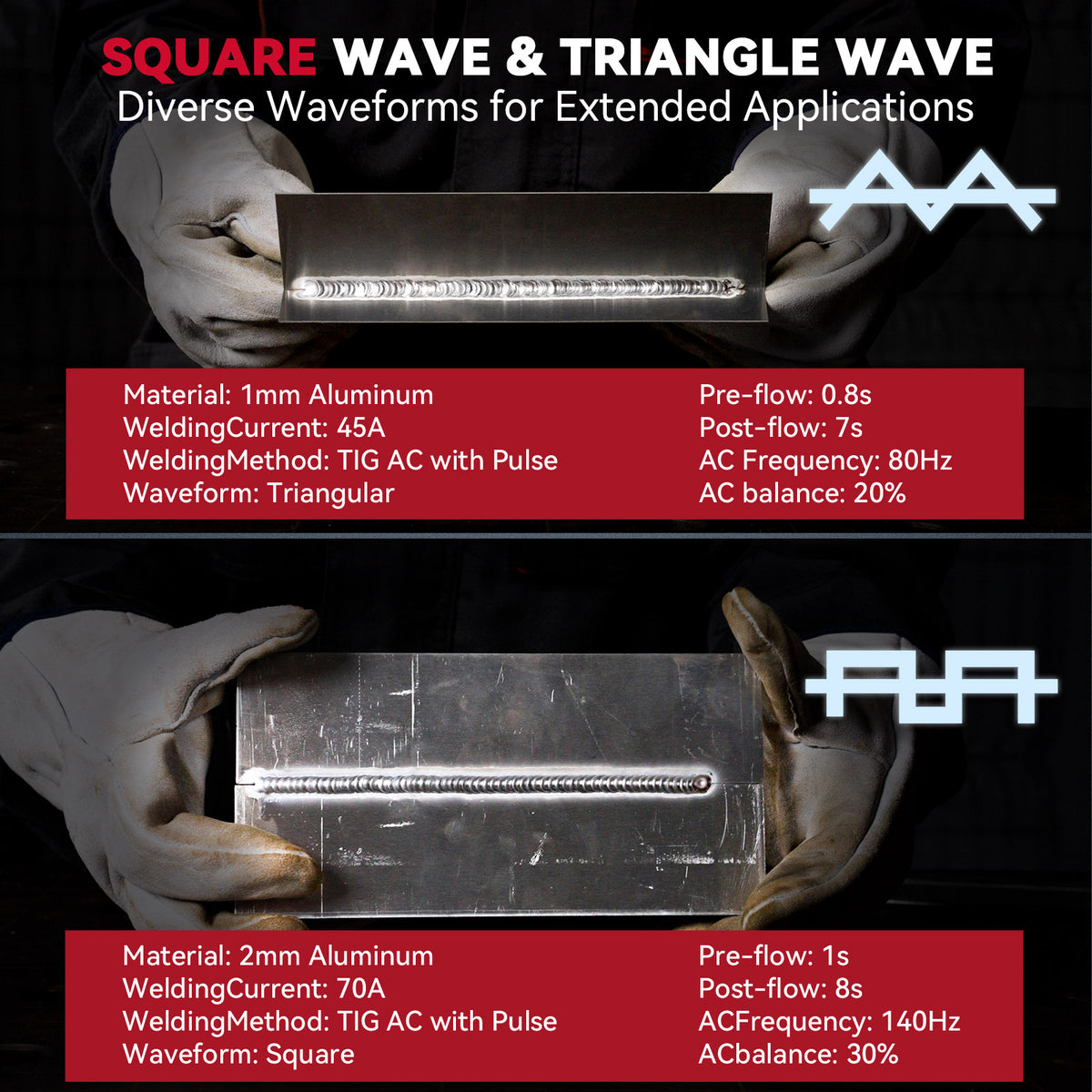
Credit: www.arccaptain.com
Equipment Needed For Pulsed Tig On Aluminum
Not all TIG welders have pulse features. Here is what you need:
- AC/DC TIG welder with pulse function: Make sure your machine has adjustable pulse settings.
- High-quality torch: Air or water-cooled torches both work.
- 100% argon shielding gas: Use pure argon for most aluminum jobs.
- 2% lanthanated or pure tungsten electrode: Sharpen to a slight point or rounded tip.
- Aluminum filler rod: Use ER4043 or ER5356 for most work.
- Clean workpiece: Remove oil, paint, and oxide with a stainless steel brush.
- Protective gear: Welding helmet, gloves, jacket, and safety glasses.
Setting Up The Tig Welder For Pulsed Aluminum Welding
Follow these steps for a safe and effective setup:
- Clean the aluminum: Wipe with acetone and scrub with a stainless steel brush. Even tiny bits of oil or oxide can cause problems.
- Select the correct tungsten: Use a 2% lanthanated or pure tungsten. Grind to a blunt point.
- Install the right cup: A larger ceramic cup (#7-#10) gives better gas coverage.
- Set gas flow: 12-15 liters per minute is enough for most jobs.
- Choose AC mode and pulse: Set the welder to AC, turn on pulse, and enter your starting values.
- Adjust pulse settings: Begin with the recommended settings, then fine-tune as you weld.
- Check your ground clamp: Attach it to clean, bare metal.
Best Practices For Pulsed Tig On Aluminum
Control Heat With Travel Speed
Move the torch steadily but not too slowly. If you linger in one spot, you can still overheat the metal even with pulsed TIG. Watch the puddle and keep a steady pace.
Add Filler At The Right Time
Always add filler rod when the arc is at peak current. This helps the filler melt into the joint without creating cold laps or weak spots.
Keep The Arc Short
Hold the tungsten close to the work, but do not touch. A short arc gives better control and focus.
Use Two Hands
Rest your torch hand on the table or use both hands for stability. Aluminum welds need smooth, steady motion.
Clean Between Passes
If you make multiple passes, brush the weld with a stainless steel brush between each one. This removes oxides and keeps the next pass clean.
Watch For Color Changes
If the weld turns gray or black, you probably have too much heat or poor shielding. Adjust your settings or gas flow.
Key Differences: Pulsed Tig Vs. Standard Tig On Aluminum
Understanding the difference helps you decide which method to use.
| Feature | Pulsed TIG | Standard TIG |
|---|---|---|
| Heat Control | Excellent, due to pulse | Good, but less flexible |
| Weld Appearance | Smoother, more uniform | Can be less consistent |
| Thin Metal | Very suitable | Higher risk of burn-through |
| Learning Curve | Easier for beginners | Needs more practice |
| Equipment Cost | Usually higher | Lower (basic TIG) |

Credit: yeswelder.com
Common Problems And How To Fix Them
Even with pulsed TIG, you may run into issues. Here are some common ones and how to solve them:
Burn-through
- Why it happens: Too much heat, slow travel, or high peak current.
- Solution: Lower peak current, increase travel speed, or raise background current.
Dirty Welds Or Black Beads
- Why it happens: Not enough cleaning action, poor gas coverage, or dirty metal.
- Solution: Increase AC balance cleaning, check gas flow, or clean the workpiece again.
Porosity (tiny Holes)
- Why it happens: Contaminated filler, poor shielding gas, or drafts.
- Solution: Use fresh filler rods, adjust gas flow, and block wind.
Unstable Arc
- Why it happens: Wrong tungsten, too low background current, or dirty tip.
- Solution: Use the right tungsten, raise background current, and regrind the tip.
Cracking
- Why it happens: Wrong filler rod, rapid cooling, or poor technique.
- Solution: Use ER4043 for castings, preheat thick parts, and slow your movement.
Advanced Tips For Better Results
Even experienced welders can improve their results with pulsed TIG. Here are some less obvious tips that help:
- Preheat thick aluminum: Use a propane torch to warm pieces thicker than 6mm. This keeps the puddle flowing and reduces cracking.
- Avoid starting at the edge: Start the arc a short distance from the very edge, then move back to fill gaps. This stops burn-back and gives a stronger start.
- Use a foot pedal: If your machine allows, use a pedal to adjust amperage as you weld. This gives even more control.
- Test on scrap first: Always check your settings on a piece of scrap aluminum. Each batch can behave differently.
- Keep a steady hand: Use a wrist rest or a block to support your arm. This leads to smoother beads.
Comparing Pulsed Tig To Other Aluminum Welding Methods
Many people ask how pulsed TIG compares to other ways to weld aluminum, like MIG or standard TIG.
| Method | Best For | Pros | Cons |
|---|---|---|---|
| Pulsed TIG | Thin sheets, detailed work | Clean, precise, less distortion | Slower, needs skill |
| Standard TIG | Thicker parts, simple joints | Flexible, good for all metals | More heat, risk of warping |
| MIG (GMAW) | Thick aluminum, long welds | Fast, good for production | More spatter, less control |
For most home or repair jobs on aluminum, pulsed TIG offers the best mix of quality and control.
Safety For Pulsed Tig Aluminum Welding
Aluminum welding is bright and creates strong UV rays. Always protect your skin and eyes. Key points:
- Wear a welding helmet with a good auto-darkening filter.
- Use gloves and a full jacket to avoid burns.
- Work in a ventilated area to avoid breathing fumes.
- Keep a fire extinguisher nearby, as aluminum dust is flammable.
- Let hot parts cool before touching.
Real-world Example: Repairing A Boat Hull
Suppose you need to repair a thin aluminum boat hull with pulsed TIG. The metal is 2mm thick and has a small crack near a rivet. Here is how you approach it:
- Clean the area: Remove paint and oxide with a wire brush and acetone.
- Set up the welder: AC mode, 90 amps peak, 35% background, 80 Hz pulse, 35% pulse width.
- Fit the joint: Use clamps to hold the crack closed.
- Weld in short bursts: Pulse the arc, add filler at the peak, and let the area cool between passes.
- Check for leaks: After welding, fill the hull with water to test for leaks.
This method gives a strong, clean weld with less risk of further damage.
Practical Insights Beginners Miss
Two important points beginners often overlook:
- Cleanliness matters more than you think. Even small amounts of oil, oxide, or dirt can ruin a weld. Spend extra time cleaning before you start.
- Pulse settings are not universal. Machines, rods, and parts all change how the weld behaves. Always test and adjust your settings, even if you have welded aluminum before.
Where To Learn More
If you want more details on aluminum welding or wish to see practical demonstrations, visit Wikipedia: Gas Tungsten Arc Welding for extra resources and diagrams.
Frequently Asked Questions
What Is The Main Advantage Of Pulsed Tig For Aluminum?
Pulsed TIG gives better control over heat input, which is critical for aluminum. It helps prevent warping, burn-through, and makes for cleaner welds, especially on thin sheets.
Can I Use Pulsed Tig On All Types Of Aluminum?
Yes, pulsed TIG works on almost all types of aluminum alloys. Always choose the correct filler rod for the alloy you are welding to avoid cracking or weak joints.
Do I Need Special Gas For Pulsed Tig On Aluminum?
No, you do not need special gas. Use pure argon for almost all pulsed TIG aluminum welding. Mixed gases are rarely used and are more common in MIG welding.
Is Pulsed Tig Harder To Learn Than Standard Tig?
Pulsed TIG is not harder to learn. In fact, beginners often find it easier because the pulse gives more time to adjust torch movement and filler rod addition.
Can I Upgrade My Standard Tig Welder For Pulsed Tig?
Some newer welders allow firmware or hardware upgrades to add pulsed TIG functions. If your machine does not support pulse, you may need to buy a new model with this feature.
Welding aluminum with pulsed TIG is a smart choice for anyone who wants strong, clean results. With the right setup and a focus on detail, even beginners can get professional-quality welds. The extra control pulsed TIG offers makes aluminum welding less stressful and more successful.

Credit: www.youtube.com