Disclosure: This post contains affiliate links and I will be compensated if you make a purchase after clicking through my links. Learn More
Self-shielded flux core welding is popular with hobbyists, repair shops, and field workers. One reason is that you do not need an external shielding gas. The wire itself contains chemicals that create a protective gas as it melts. But many people get confused about the correct polarity to use for self-shielded flux core welding. This is not just a small detail. If you use the wrong polarity, you can get weak welds, more spatter, and other problems. Understanding the right polarity gives you better weld quality, less frustration, and safer work.
Polarity is one of the first settings you need to check before starting to weld. Even experienced welders sometimes forget to switch their machine when changing between solid wire and flux core. This article explains everything you need to know about polarity for self-shielded flux core welding. You will learn what polarity is, why it matters, how it affects your welds, and how to set your machine correctly. You will also see practical examples, mistakes to avoid, and answers to the most common questions.
What Is Polarity In Welding?
Polarity in welding describes the direction that electricity flows from your welding machine to your workpiece. In simple words, polarity decides which part is positive and which is negative during welding.
When you set up a welding machine, you connect two cables: one to the workpiece (ground clamp) and one to the electrode (your welding gun or stinger). The direction of electrical flow changes how heat is distributed and how the weld forms.
There are two main types:
- DCEN (Direct Current Electrode Negative), also called straight polarity.
- DCEP (Direct Current Electrode Positive), also called reverse polarity.
Each welding process and wire type needs a specific polarity. Using the wrong one can cause many problems.
Why Does Polarity Matter In Flux Core Welding?
Flux core wires are different from solid wires. Inside the wire, there is a chemical mix (flux) that releases gas and forms a slag to protect your weld. The way the electricity flows (polarity) controls how the flux reacts and how the weld forms.
With self-shielded flux core, the wire makes its own shielding. If you use the wrong polarity, the gas does not form correctly, and the weld becomes weak or porous. You may also see too much spatter, poor penetration, or even wire burning back into the tip.
Polarity affects:
- Penetration depth: How deep the weld goes into the base metal.
- Bead shape: How the weld looks.
- Spatter level: How much melted metal sprays around.
- Porosity: Small holes inside the weld from trapped gas.
- Slag formation: The protective layer after welding.
What Polarity To Use For Self Shielded Flux Core
The correct polarity for self-shielded flux core welding is DCEN (Direct Current Electrode Negative). This means you connect the welding gun to the negative terminal and the work clamp (ground) to the positive terminal.
Why Dcen?
- Flux Activation: The flux inside the wire needs the right heat balance to create enough gas and slag. DCEN delivers more heat to the workpiece, which helps the flux react as it should.
- Penetration: DCEN gives deeper penetration, which is important for strong welds, especially when welding outside or on thick metal.
- Spatter Reduction: Using DCEN with self-shielded flux core usually results in less spatter compared to DCEP.
How To Set Dcen Polarity On Your Welder
Most modern welders have a simple way to switch polarity. Look for two terminals on your machine, often labeled “+” (positive) and “–” (negative).
- Wire Feed Gun Lead (the cable that feeds the flux core wire): Connect this to the “–” (negative) terminal.
- Work Clamp (the cable with the clamp that goes on your work): Connect this to the “+” (positive) terminal.
Always double-check your connections before you start welding. Many machines have a diagram inside the cover or in the manual.
Common Mistake: Using Dcep By Accident
Solid wire MIG (GMAW) uses DCEP (Electrode Positive). Many people switch from MIG to flux core and forget to change the polarity. If you use DCEP with self-shielded flux core wire:
- You get lots of spatter.
- The weld sits on the surface, with poor penetration.
- The wire may burn back into the tip.
- You may see porosity or holes in the weld.
It is easy to make this mistake, especially on multi-process welders. Always check your settings and connections.
Self-shielded Flux Core Vs. Gas-shielded Flux Core: Polarity Differences
Flux core wire comes in two main types:
- Self-Shielded Flux Core (FCAW-S): No gas bottle needed. The wire protects the weld.
- Gas-Shielded Flux Core (FCAW-G): Needs a gas bottle (usually CO₂ or a mix). The gas and flux both protect the weld.
The polarity is different for each type.
| Wire Type | Polarity | Shielding Method | Common Use |
|---|---|---|---|
| Self-Shielded Flux Core (FCAW-S) | DCEN (Electrode Negative) | Flux in wire | Outdoor, field repairs |
| Gas-Shielded Flux Core (FCAW-G) | DCEP (Electrode Positive) | Gas + flux in wire | Shops, production |
Self-shielded flux core always uses DCEN. Gas-shielded flux core always uses DCEP, like solid wire MIG. Mixing up these settings can ruin your weld.
Why Do Manufacturers Choose These Polarity Settings?
The inside of a flux core wire is designed for a specific polarity. The way the chemicals react depends on where the heat goes. With self-shielded wires, the weld needs more heat in the base metal (workpiece). DCEN pushes about 70% of the heat into the work and 30% into the wire.
If you reverse the polarity:
- The wire gets too hot, melts too fast, and may burn back.
- The base metal does not get hot enough.
- The flux does not protect the weld properly.
Manufacturers test their wires to work best with a set polarity. Always check the label or the technical data sheet for your specific wire. Most brands print the correct polarity on the spool or package.
Step-by-step: Setting Up For Self Shielded Flux Core Welding
Setting up your machine for self-shielded flux core is simple if you follow these steps:
- Check the Wire: Make sure you have self-shielded flux core wire. Look for “FCAW-S” or product names like E71T-11 or E71T-GS. These are common self-shielded wires.
- Select the Right Polarity: Set your machine to DCEN. Connect the gun to negative (–), the work clamp to positive (+).
- Set Wire Feed Speed and Voltage: Start with the wire manufacturer’s recommended settings. Adjust as needed based on test welds.
- Prepare the Metal: Clean off rust, paint, or oil. Flux core is more forgiving than MIG, but clean metal always welds better.
- Welding Position: Self-shielded flux core works well in all positions, even vertical or overhead.
- Do a Test Weld: Weld on scrap metal first. Check for good bead shape, penetration, and minimal spatter.
Troubleshooting Table: Common Problems From Wrong Polarity
Here is how using the wrong polarity affects your weld:
| Problem | Likely Cause | Fix |
|---|---|---|
| Heavy spatter | Polarity set to DCEP | Switch to DCEN |
| Shallow weld, poor penetration | Polarity set to DCEP | Switch to DCEN |
| Wire burns back into tip | Polarity set to DCEP | Switch to DCEN |
| Porosity (holes in weld) | Polarity set to DCEP or dirty metal | Switch to DCEN, clean metal |
| Slag does not chip off easily | Wrong polarity or low heat | Check polarity and increase voltage |
Practical Examples: What Happens With Wrong Polarity?
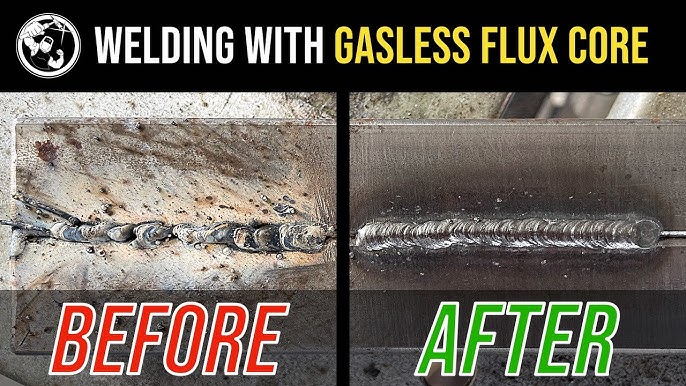
Imagine welding a piece of 1/4″ (6mm) steel with self-shielded flux core, but your machine is set to DCEP. You will see:
- The weld bead sits high and does not melt into the base metal.
- The slag is hard to remove.
- You see lots of sparks and metal balls flying.
- The inside of the weld looks full of holes (porosity).
If you repeat the same weld with DCEN, you get:
- A smooth, flat bead that melts into the steel.
- Easy-to-remove slag.
- Low spatter.
- Strong, clean weld.
Many beginners do not check their polarity when switching wires. Even professionals sometimes forget after using MIG for a long time. Always check before you start.
How To Identify Your Flux Core Wire Type
Some people get confused about which wire they have. Check your spool or box. Look for:
- E71T-11: Common self-shielded (use DCEN).
- E71T-GS: Common self-shielded (use DCEN).
- E71T-1M: Gas-shielded (needs DCEP and gas).
If you are unsure, search the product code or check the manufacturer’s website. You can also ask your welding supplier for advice.
Credit: www.youtube.com
Tips For Getting The Best Results With Self-shielded Flux Core
- Always Set DCEN Polarity: Double-check each time you change wire or machine.
- Keep Your Contact Tip Clean: Flux core wires produce more slag and spatter, which can clog your tip.
- Use the Correct Drive Roll: Knurled drive rolls grip the soft flux core wire better than smooth ones.
- Maintain Stickout: Keep the wire stickout (distance from tip to work) about 3/4 inch (19mm) for best results.
- Work in a Well-Ventilated Area: Flux core wires make fumes. Use a fan or wear a respirator if needed.
- Store Wire Properly: Moisture can ruin flux core wire, causing porosity. Keep it dry.
Non-obvious Tips Many Beginners Miss
- Do Not Use MIG Tips With Flux Core: Flux core wires are usually larger and softer. Use tips sized for your wire type.
- Check Polarity After Machine Repairs: If someone else used your welder or if you had repairs done, your polarity may have changed.
Self-shielded Flux Core Polarity Across Different Welding Machines
Not all welders are the same. Some entry-level machines make it harder to change polarity. Here is how to handle different types:
1. Dedicated Flux Core Welders
Most small “flux core only” machines come pre-wired for DCEN. You do not need to switch anything.
2. Multi-process Welders
These machines can do MIG, flux core, stick, or TIG. You must switch the polarity each time you change process.
- Open the cover.
- Move the cables from positive to negative (or vice versa) as needed.
- Some machines have quick-connect plugs; others require a wrench.
3. Older Welders
Some older machines only offer AC (alternating current) or do not let you change polarity. These do not work well for self-shielded flux core. You need DC output and the ability to set DCEN.
If you cannot set DCEN, your welds will have the same problems as using the wrong polarity.

Credit: www.youtube.com
The Science Behind Polarity And Weld Quality
Why does DCEN work better for self-shielded flux core? It is about where the heat goes.
With DCEN:
- The workpiece (your metal) gets about 70% of the heat.
- The wire (electrode) gets about 30%.
This extra heat in the base metal melts the steel well and helps the flux react to protect the weld. The gas bubble forms smoothly, and the slag covers the weld bead. The wire melts at the right speed to keep a steady arc.
With DCEP:
- The wire gets hotter than the base metal.
- The flux does not protect as well.
- The wire may melt too fast, causing burnback.
That is why using the right polarity is so important.
How Polarity Affects Welding Positions
Self-shielded flux core is popular for vertical and overhead welding. DCEN polarity helps the weld bead “freeze” quickly, reducing the risk of molten metal falling or sagging.
If you use DCEP by mistake in a vertical or overhead position, you will notice:
- The bead does not freeze fast enough.
- Metal drips or sags.
- You lose control of the weld pool.
Sticking to DCEN helps you weld in any position with better control and safety.

Credit: www.lincolnelectric.com
Example: Outdoor Welding With Self-shielded Flux Core
Welding outdoors is hard with MIG because the wind blows away the shielding gas. Self-shielded flux core works well outside because the flux protects the weld, even in a breeze. Many construction sites, farmers, and repair crews use this process for fences, gates, and machinery.
If you need to repair a gate in a windy field:
- Use self-shielded wire with DCEN polarity.
- Clamp your work lead well.
- Set your voltage and wire speed.
- Weld with confidence, knowing the wind will not ruin your weld.
Trying to use DCEP or a gas-shielded wire outdoors will give you poor results.
Advanced Tip: Using Polarity To Control Weld Appearance
While DCEN is correct for self-shielded flux core, you can slightly adjust your voltage and wire speed to control bead shape. If you want a flatter bead, increase voltage a bit. For a taller bead, lower voltage. But always keep DCEN polarity.
Changing polarity to “tune” the bead is not recommended. It causes too many other problems.
What Happens If You Ignore The Label?
Some people use whatever wire they find, not checking the label or settings. This is risky. Using the wrong wire or wrong polarity can cause:
- Welds that look good but break easily.
- Internal holes you cannot see.
- Slag that traps moisture, leading to rust.
Always read the label. Manufacturers spend years testing the best settings for each wire.
Polarity And Welding Codes
If you weld for a living, you may need to follow welding codes (like AWS or ASME). These codes require specific wire types and polarity for safety reasons. For example, bridges, pipelines, and structural steel all have strict rules. Failing to use the right polarity could mean failed inspections or dangerous welds.
Checking Your Welds For Correct Polarity
After welding, you can often spot wrong polarity by looking for:
- Excessive spatter around the bead.
- Beads that do not melt into the base metal.
- Hard-to-remove slag.
- Holes or bubbles in the weld.
If you see these signs, stop and check your machine settings before continuing.
Summary Table: Polarity By Process
Here is a quick summary for common wire types and their required polarity:
| Process | Wire Type | Polarity |
|---|---|---|
| MIG (GMAW) | Solid Wire | DCEP (Electrode Positive) |
| Flux Core (FCAW-S) | Self-Shielded | DCEN (Electrode Negative) |
| Flux Core (FCAW-G) | Gas-Shielded | DCEP (Electrode Positive) |
| Stick (SMAW) | Depends on Electrode | Check Electrode Type |
Frequently Asked Questions
What Happens If I Use The Wrong Polarity With Self-shielded Flux Core Wire?
Using the wrong polarity (DCEP instead of DCEN) causes weak welds, excess spatter, poor penetration, and can make the wire burn back into the tip. The weld may look bad and could easily fail under stress.
Can I Use Solid Mig Wire With Dcen Polarity?
No, solid MIG wire needs DCEP (Electrode Positive). Using DCEN with MIG wire will cause poor arc stability, lack of fusion, and low penetration.
How Do I Know If My Wire Is Self-shielded Or Gas-shielded?
Check the product label or spool. Self-shielded wires often say “FCAW-S”, “E71T-11”, or “E71T-GS”. Gas-shielded wires say “FCAW-G” or “E71T-1M” and require an external gas supply.
Is It Possible To Weld Stainless Steel With Self-shielded Flux Core?
Yes, but you need special self-shielded flux core wire made for stainless steel. Set polarity to DCEN, just like with mild steel.
Where Can I Find More Technical Data About Flux Core Wires?
You can check technical data sheets from wire manufacturers or visit the Lincoln Electric Welding How-To for detailed guides and charts.
Final Thoughts
Choosing the correct polarity for self-shielded flux core welding is simple but vital. Always use DCEN (Direct Current Electrode Negative) for self-shielded wires. This setting gives you strong, clean welds with less spatter and trouble. Check your machine connections every time you change wire or process. Read the label on your wire and follow manufacturer instructions. With the right polarity, self-shielded flux core is reliable, even for tough jobs outdoors or on dirty metal. Taking a few moments to check your settings can save you hours of frustration and ensure your welds are strong and safe.