Disclosure: This post contains affiliate links and I will be compensated if you make a purchase after clicking through my links. Learn More
Flux core vs stick welding comes down to the job: flux core is faster and easier to learn on thin to medium steel, and stick is the better pick for thick, rusty or dirty steel and field repairs on a simple machine. Neither process needs a gas bottle, so both keep working outdoors in a breeze.
Pick flux core if you weld sheet metal, trailers and long seams in a garage. Pick stick if you fix farm gear, weld structural steel thicker than 1/2 inch, or want the cheapest machine that will last for decades.
Flux Core vs Stick Welding at a Glance
| Feature | Flux Core (FCAW-S) | Stick (SMAW) |
|---|---|---|
| Filler metal | Hollow wire on a spool, fed by the gun | Coated rod, changed by hand |
| Shielding gas | None (self-shielded wire) | None (the rod coating makes it) |
| Thinnest steel (Miller guidance) | About 24 to 26 gauge | About 18 gauge |
| Thick steel | Up to 5/16 inch with .030 or .035 Lincoln NR-211-MP; 1/2 inch with larger NR-211-MP sizes | 1/2 inch and up with multiple passes |
| Electrode efficiency | About 85% | About 55% to 65% |
| Bead length per start | 2 to 3 feet or more | About 4 to 8 inches per rod |
| Learning curve | Easier (pull the trigger, arc starts) | Harder (strike and hold the arc) |
| Rust and dirt | Forgiving | Most forgiving |
| Wind | Good | Good |
| Machine | DC wire feeder | AC, DC or AC/DC; AC transformer machines cost the least |
| Polarity | Usually DCEN for self-shielded wire | DCEP or AC for most rods (6011, 7018) |
| Cleanup | Slag plus some spatter | Slag plus more spatter |
What Is Flux Core Welding?
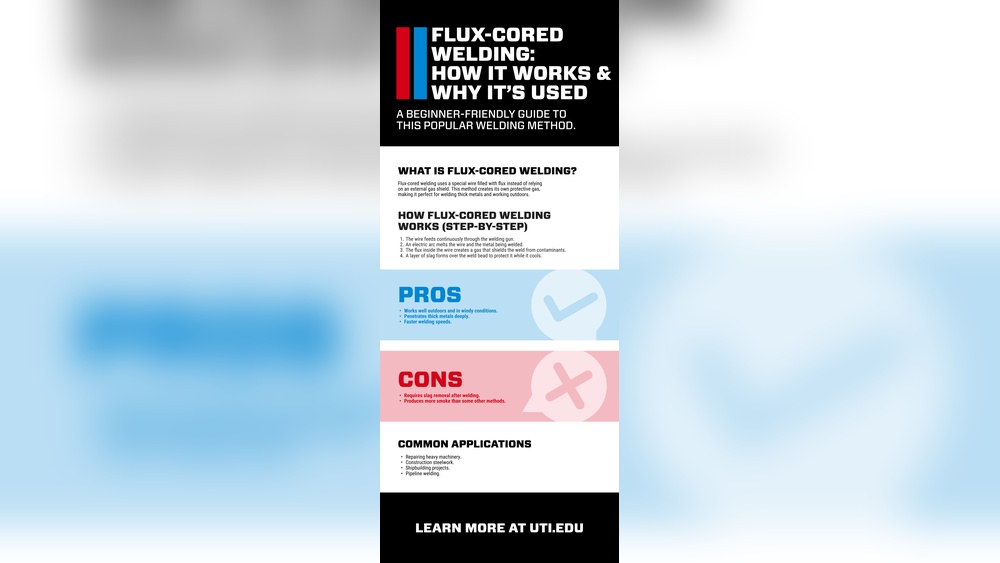
Flux core welding (FCAW) runs a hollow wire through a wire-feed gun. The core of the wire holds flux. When the arc melts the wire, the flux burns and makes its own gas shield and a thin slag layer over the bead.
Most home machines run self-shielded wire (FCAW-S), such as Lincoln Innershield NR-211-MP (AWS E71T-11). There’s also gas-shielded “dual shield” wire, but that one needs a bottle and a bigger machine. Here, flux core means the self-shielded kind.
What Is Stick Welding?
Stick welding (SMAW, shielded metal arc welding) uses a metal rod covered in a hard flux coating. You clamp the rod in a stinger, strike an arc, and feed the rod down into the joint as it burns.
The coating makes the gas shield and the slag. Rods are named by their AWS number, so a 6011 digs through rust and a 7018 lays smooth, strong, low hydrogen beads. Each rod lasts under a minute of arc time, then you stop and swap it.
Key Differences Between Flux Core and Stick
Speed and Deposition
Flux core wins on speed. Renttech SA (quoted in African Fusion) puts self-shielded flux core at about 85% electrode efficiency and stick at 55% to 65%, because a rod leaves a stub and burns part of its coating. That means 20% to 30% more weld metal from the same weight of filler.
Arc time matters more. A stick rod lays about 4 to 8 inches of bead before you stop. A flux core gun keeps going for 2 or 3 feet, so you get fewer stops, fewer restarts and fewer cold starts in the weld.
Skill Level
Flux core is easier to learn. The machine feeds the wire for you, so you only hold the gun angle, distance and travel speed. Miller calls wire welding the easiest process to learn and says stick is harder, mostly because striking and holding the arc takes practice.
With stick, the rod gets shorter as you weld. Your hand has to move down at the same rate the rod burns, or the arc goes out or the rod sticks to the work.
Metal Thickness
Flux core handles thin steel better; stick handles thick steel better. Miller says wire processes join steel as thin as 26 gauge, and stick is limited to about 18 gauge and up. Burning through thin sheet with a rod is easy.
On the thick side, Lincoln rates NR-211-MP in .030 and .035 sizes for steel up to 5/16 inch, and the larger 5/64 and 3/32 inch sizes up to 1/2 inch. Stick with 1/8 or 5/32 inch 7018 rods and multiple passes goes well past that on a 225 amp machine.
Rusty, Dirty and Painted Metal
Stick is the most forgiving. Miller lists stick as able to make a good bond on rusty or dirty metal, and it calls flux core more forgiving than MIG on dirty steel. A 6011 rod has a strong, digging arc that burns through light rust and mill scale.
Grind to bright metal when you can with either process. Paint and galvanizing give off toxic fumes when they burn, so remove them first.
Wind and Outdoor Work
This one is close to a tie. Both processes make their own shield, so a breeze that ruins a MIG weld with gas won’t stop either one. Miller rates stick as better suited for windy, outdoor conditions, and it also recommends self-shielded flux core for outdoor and windy jobs.
Stick pulls ahead far from the shop. A stick lead can run a long way from the machine, and there’s no wire feeder to drag around or protect from rain and dirt.
Machine and Power Supply
Stick machines are simpler. A stick welder can be AC only, DC only or AC/DC. AC transformer welders such as the Lincoln AC-225 are the cheapest way into stick, and they have very few parts to fail.
Flux core needs a DC wire-feed welder. Plenty of 120V flux core machines plug into a household outlet, and most MIG welders also run flux core wire. Self-shielded wire usually runs on DCEN (electrode negative), so check the lead setup when you switch from gas MIG.
Weld Quality and Cleanup
Both leave slag, and stick leaves more spatter. You chip and brush both beads before the next pass or paint. A clean 7018 bead is smooth, and a good flux core bead looks close to a MIG bead under the slag.
Strength comes from the filler class and good fusion. E71T-11 flux core wire and E7018 rods are both 70,000 psi tensile filler metals under their AWS classes. E71T-11 is a general purpose wire, so for code or structural work, follow the wire maker’s data sheet for multi-pass limits.
Where Each One Fits
- Auto body and sheet metal (18 gauge and thinner): flux core, or MIG with gas for the cleanest result.
- Trailer frames and utility trailers: flux core for speed on 1/8 to 1/4 inch steel.
- Farm equipment, plows and loader buckets: stick with 6011 or 7018.
- Fence posts and gates outdoors: either one; stick if the steel is rusty.
- Structural steel thicker than 1/2 inch: stick with 7018.
- Long fillet welds on clean mild steel: flux core.
- Repairs far from a power outlet: stick on an engine-driven welder.
If you are torn between a wire welder with gas and a stick machine, the MIG vs stick question follows most of the same rules, with gas MIG winning on thin, clean metal indoors.
Cost Breakdown
Stick is cheaper to start. A basic AC stick welder costs less than most wire feeders, and a box of rods is the only consumable. We don’t list fixed prices because they change often, so check current prices on the machines you are comparing.
Flux core costs more per pound of filler, but it wastes less (about 85% efficiency against 55% to 65% for rods) and finishes long seams faster. Plan for these running costs:
- Flux core: wire spools, contact tips, nozzles and the gun liner.
- Stick: rods, a rod oven or sealed storage for 7018, and the stub you throw away from each rod.
- Both: grinding discs, a chipping hammer, a wire brush and PPE.
Safety Notes for Both Processes
Flux core and stick both make heavy smoke, because the flux burns in the arc. Weld with good ventilation or fume extraction, keep your head out of the plume, and follow OSHA 1910.252 for fire watch and hot work rules.
- Wear an ANSI Z87.1 helmet set to the right shade from a welding shade number chart for your amperage.
- Wear dry leather gloves. A stick electrode holder is live whenever the machine is on, so never change rods with wet gloves or when you stand in water.
- Chip slag with safety glasses on under the helmet. Hot slag flies.
- Keep a fire extinguisher close and clear sparks from sawdust, rags and fuel.
Which One Should You Choose?
Choose flux core if:
- You are new to welding and want good beads sooner.
- You weld steel from 24 gauge to 1/4 inch most of the time.
- You run long seams and want fewer stops.
- You have a 120V outlet and want a machine that can also run gas MIG later.
Choose stick if:
- You fix rusty farm gear, trailers and equipment outdoors.
- You weld steel thicker than 1/2 inch.
- You want the cheapest machine with the fewest parts to wear out.
- You weld far from the machine or off an engine-driven welder.
Many home shops end up with both: a wire welder for thin and medium work, and a stick machine for the heavy, dirty jobs. If you are choosing between wire processes instead, the flux core vs MIG split depends on whether you weld indoors with a gas bottle.
Frequently Asked Questions
Is Flux Core Stronger Than Stick Welding?
No, they’re about equal. Common E71T-11 flux core wire and E7018 rods are both 70,000 psi tensile filler metals under AWS rules. Real strength depends on penetration, fusion and joint prep. A stick weld with poor fusion is weaker than a good flux core weld, and the reverse is true.
Is Flux Core Easier Than Stick Welding?
Yes. Flux core is easier because the gun feeds the wire and the arc starts when you pull the trigger. Stick asks you to strike the arc and lower the rod as it burns. Miller rates wire welding as the easiest process to learn and stick as harder.
Can Flux Core Weld as Thick as Stick?
Not on a small machine. Lincoln rates .030 and .035 inch NR-211-MP wire for steel up to 5/16 inch and its larger sizes up to 1/2 inch. A stick welder with 1/8 or 5/32 inch 7018 rods and several passes handles thicker structural steel, so stick wins above 1/2 inch.
Which Is Better for Outdoor Welding, Flux Core or Stick?
Both work outdoors because neither needs shielding gas. Stick has the edge for remote repairs: the machine is simpler, the leads can run far, and rods tolerate rust and dirt best. Self-shielded flux core handles wind well too and is faster on long, clean seams near a power outlet.
Can a MIG Welder Do Flux Core and Stick?
Most MIG welders run flux core wire after you swap the polarity and drive rolls. Stick needs a stinger and a constant current output, so only multi-process machines do all three. Check the manual or data plate: if it lists SMAW or stick mode, the machine can run rods.
Final Words
Flux core vs stick welding has a clear split. Flux core is faster, wastes less filler and is easier to learn on thin and medium steel. Stick is cheaper to start, burns through rust and dirt, and handles thick steel and remote repairs best.
Match the process to the steel you weld most. If most of your jobs are clean steel under 1/4 inch near an outlet, start with flux core. If they’re thick, rusty or out in the field, start with stick.