Disclosure: This post contains affiliate links and I will be compensated if you make a purchase after clicking through my links. Learn More
To start a TIG arc, you either let high frequency (HF) jump the gap with the tungsten held off the metal, touch the tungsten down and lift it (lift arc), or brush it across the metal like a match (scratch start). Which way you use depends on your machine, and HF start is the cleanest because the tungsten never touches the work.
Most home and hobby TIG machines use HF or lift arc. A stick welder running a valve torch uses scratch start. The steps below cover all 3, plus the fixes when the arc won’t light.
| Time | 5 minutes to set up, a few practice starts on scrap |
| Difficulty | Easy (HF), moderate (lift arc), hard (scratch start) |
| Tools needed | TIG torch, sharpened tungsten, argon, ground clamp, clean scrap steel, welding helmet and gloves |
How to Start a TIG Arc: The 3 Methods
You can start a TIG arc 3 ways: HF start, lift arc start and scratch start. Your machine decides which one you get, so check the front panel or the manual first.
| Method | Tungsten touches the metal? | Tungsten contamination | Works on AC (aluminum)? | Where you find it |
|---|---|---|---|---|
| HF start | No | Very low | Yes, the usual choice | AC/DC TIG machines, many DC TIG inverters |
| Lift arc | Yes, at very low current | Low, not zero | Poor choice for aluminum | DC TIG and stick/TIG inverters (Miller calls it Lift-Arc) |
| Scratch start | Yes, at full current | High | No | Stick welders with a gas valve TIG torch |
Sources: Everlast and Red-D-Arc descriptions of each start method. Everlast calls HF “the only acceptable choice” for aluminum because aluminum and tungsten stick together easily on a touch start.
What You’ll Need
- TIG torch with a cup, collet and collet body that match your tungsten size.
- Sharpened tungsten, ground lengthwise to a point. Match the tungsten electrode size to your amperage range.
- Pure argon on a regulator/flowmeter. Argon is the standard TIG welding gas for steel, stainless and aluminum.
- Clean scrap steel, wire brushed or ground to bright metal, with the ground clamp on clean metal.
- Helmet, gloves and long sleeves. TIG gives off strong UV even with almost no spatter.
How to Start a TIG Arc With HF Start: Step by Step
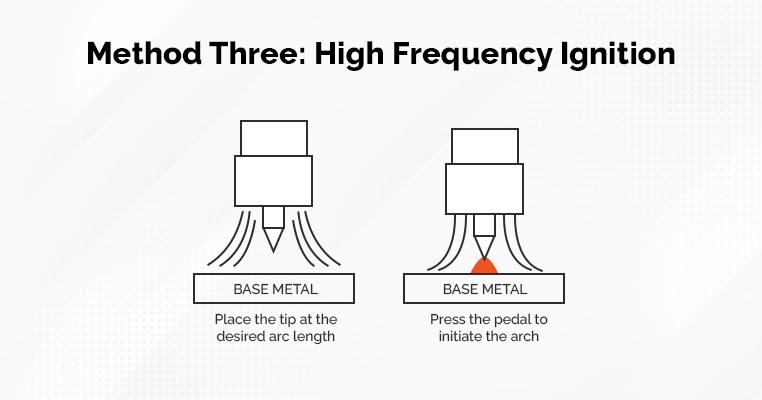
HF start is the easiest TIG arc start. The machine sends a high-voltage, high-frequency spark across the gap, so you only hold the torch steady and press the pedal or trigger.
Step 1: Set the Start Mode
Pick HF (sometimes labeled “HF Start” or “HF TIG”) on the panel. Set polarity to DCEN for steel and stainless, or AC for aluminum.
Step 2: Hold the Tungsten Off the Metal
Bring the tip close to the joint. A good gap is about the diameter of your tungsten or a little less, so roughly 1/16 to 3/32 inch with a 3/32 inch tungsten.
Step 3: Press the Pedal or Trigger
The gas starts, the HF fires and the arc lights. On a foot pedal, press lightly, then add heat once the puddle forms.
Credit: blog.red-d-arc.com
How to Start a Lift Arc TIG Weld: Step by Step
Lift arc starts the arc by touching the tungsten to the metal at a tiny current, then lifting. The machine senses the break and ramps up to your weld amps.
Step 1: Open the Gas
On a valve torch, open the torch valve. On a machine with a gas solenoid, confirm the bottle and flowmeter are on. Starting with no gas burns the tungsten right away.
Step 2: Rest the Cup at 45 Degrees
Set the edge of the cup on the metal with the torch tilted about 45 degrees. Line up the tungsten over your start point without touching it down yet (UNIMIG procedure).
Step 3: Roll the Tungsten Down to Touch
Rock the torch up on the cup until the tungsten tip just kisses the metal. If your machine has a pedal or trigger, press it now. Miller’s CST 250 manual says to hold the electrode on the work for 1 to 2 seconds.
Step 4: Lift Slowly
Lift the tungsten off in one smooth move, about 1/8 inch (UNIMIG gives roughly 3 mm). The arc forms as the tip leaves the metal. Lift too far and the arc snaps out before it settles.

Credit: blog.red-d-arc.com
How to Scratch Start a TIG Arc
Scratch start means flicking the tungsten across the metal like striking a match, then holding the gap. Use it only when your machine has no lift arc or HF, such as a DC stick welder with a valve torch.
- Open the gas valve on the torch.
- Hold the torch at a low angle with the tungsten just above the joint.
- Brush the tip quickly across the metal for a short stroke.
- Pull back to arc length the moment it lights, and hold it there.
Start on a scrap tab or at the very edge of the joint. Red-D-Arc notes that scratch starts can leave bits of tungsten in the weld as inclusions, so keep that first spot out of anything that matters.
Why Your TIG Arc Won’t Start: Quick Fixes
A TIG arc that won’t start is usually a bad ground or the wrong start mode. Check those 2 before you touch any settings.
| Symptom | Likely cause | Fix |
|---|---|---|
| Nothing happens on HF | Ground clamp on paint, rust or mill scale | Clamp to bright metal close to the joint |
| Lift arc tungsten sticks | Pushed down too hard, or the machine is set to scratch mode | Kiss the tip lightly and check the start mode |
| Arc lights, then goes out | Lifted too far, or amps set too low | Lift only about 1/8 inch and raise the amps a little |
| Arc wanders off the tip | Contaminated or dull tungsten | Regrind the tungsten lengthwise |
| Tungsten balls up or turns black | No gas, or wrong polarity (DCEP) | Open the gas and set DCEN for steel |
| HF sparks but no arc | Gap too wide | Hold the tip closer, about one tungsten diameter |
If the tungsten does stick or dips into the puddle, stop. Regrind the tungsten and grind out the contaminated spot before you restart, as UNIMIG advises. A dull, discolored tip after the weld is a different problem, usually gray tungsten from poor gas coverage.
Common Mistakes to Avoid
- Too much tungsten stickout. Everlast suggests about 1/8 to 1/4 inch past the cup for most work. More than that wobbles on a lift start.
- Jabbing the tungsten down. A lift start needs a light touch. Pressing hard bends the tip and welds it to the plate.
- Lift arc on aluminum. Touch starts on aluminum contaminate the tungsten fast. Use AC with HF.
- Starting in the middle of the joint. Start at the edge so any start defect sits where you can grind it.
- Pulling away at the end. Hold the torch over the weld as postflow runs, so the hot tungsten and bead stay shielded.
TIG Arc Start Safety
Starting a TIG arc carries shock, UV and electronics risks. Keep these in mind:
- HF can bite. Wear dry gloves and keep your hands off the tungsten and collet when the machine is on.
- HF noise affects electronics. Red-D-Arc warns it can disrupt cell phones, radios and nearby computers. Keep laptops and chargers away from the leads.
- Pacemakers. Miller’s manual warns that magnetic fields can affect pacemakers and tells wearers to consult their doctor first.
- Eye protection. OSHA 1910.252 lists shade 8 as the minimum for TIG under 150 amps and shade 10 from 150 to 500 amps. Check the welding shade chart for the suggested shade at your amps.
- Argon in tight spaces. Argon pushes out oxygen. Weld with ventilation and shut the bottle off when you finish.
Frequently Asked Questions
How Far Should the Tungsten Be From the Metal to Start a TIG Arc?
Hold the tungsten about one tungsten diameter from the metal, or a little closer. With a 3/32 inch tungsten that is roughly 1/16 to 3/32 inch. On lift arc you touch first, then lift about 1/8 inch. A longer gap makes the arc wide and hard to control.
Can You Start a TIG Arc Without High Frequency?
Yes. Lift arc and scratch start both work without high frequency. Lift arc is the better of the 2 because the machine keeps the current very low until you lift. Scratch start works on a stick welder with a valve torch, but it leaves more tungsten in the weld.
Why Does My Tungsten Stick When I Start the Arc?
Your tungsten sticks because you pressed it down too hard, held it too long, or the machine is in scratch mode instead of lift. Touch the tip lightly, lift smoothly about 1/8 inch, and check the start mode setting. Regrind the tungsten after any stick.
Is Lift Arc Good Enough for TIG Welding Aluminum?
Lift arc is a poor choice for aluminum. Aluminum needs AC, and touch starts contaminate the tungsten quickly on aluminum. Most DC lift arc torches are not built for AC work. For aluminum, use an AC TIG machine with HF start so the tungsten never touches the metal.
Does High Frequency Start Damage Electronics?
High frequency start can disrupt nearby electronics. It throws off electrical noise that can interfere with radios, cell phone signals and computers close to the welder. Keep sensitive gear away from the torch and leads, and use lift arc where HF is not allowed.
Final Words
To start a TIG arc cleanly, use HF if your machine has it, lift arc if it doesn’t, and scratch start only as a last resort. The cleaner the start, the less tungsten ends up in your weld.
Practice 20 or 30 starts on clean scrap before your real joint. Once the start feels automatic, you can put your focus on the puddle and filler rod, which is where TIG welding gets fun.