Disclosure: This post contains affiliate links and I will be compensated if you make a purchase after clicking through my links. Learn More
What size welding gas cylinder do I need? For most hobby MIG and TIG welders, an 80 cu ft cylinder is the right size, and a 125 cu ft cylinder pays off once you weld every weekend. Airgas rates its 80 size argon cylinder at about 85 cubic feet, which gives roughly 3.4 hours of gas flow at 25 CFH.
Pick a 40 cu ft tank only if you weld a few times a year or carry the welder to jobs. Shops that weld every day step up to a 300 size cylinder. Flow rate, process and how often you can get to a gas supplier move the answer more than anything else.
If you’re still deciding whether you need a gas tank for a home welder at all, self-shielded flux core wire runs with no cylinder. Everything here is for MIG with solid wire and for TIG, which both need shielding gas.
Welding Gas Cylinder Size Chart
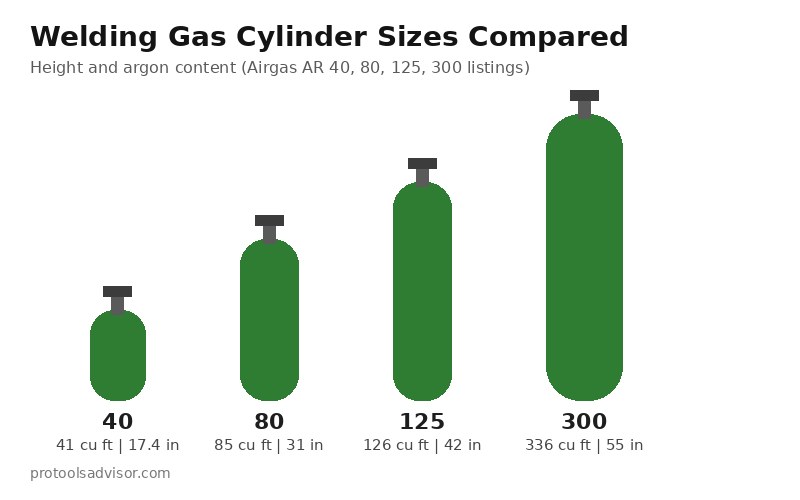
This welding gas cylinder size chart compares the 4 sizes most welding suppliers stock. Runtime is continuous gas flow, so it counts only the time gas is flowing.
| Cylinder size | Gas content (argon) | Height x diameter | Empty weight | MIG at 25 CFH | TIG at 15 CFH | Best for |
|---|---|---|---|---|---|---|
| 40 | About 41 cu ft | 17.4 x 6.7 in | 22 to 24 lbs | 1.6 hrs | 2.7 hrs | Occasional repairs, mobile work |
| 80 | About 85 cu ft | 31 x 7 in | 39 to 47 lbs | 3.4 hrs | 5.7 hrs | Hobby MIG or TIG |
| 125 | About 126 cu ft | 42 x 7 in | 51 to 65 lbs | 5.0 hrs | 8.4 hrs | Weekly welding, side jobs |
| 300 | About 336 cu ft | 55 x 9.25 in | Not listed | 13.4 hrs | 22.4 hrs | Daily welding, fab shops |
Sources: gas content and dimensions from the Airgas industrial argon listings (AR 40, AR 80, AR 125, AR 300). Empty weights are the typical ranges published by WeldGuru. Runtime = gas content ÷ flow rate, rounded.
The size number is a nominal name. Fill pressure varies by supplier and cylinder, so ask your supplier for the cubic feet in the cylinder you’re buying or swapping.
How Long Does Each Cylinder Size Last?
Divide the cylinder’s gas content by your flow rate. Runtime (hours) = cubic feet in the cylinder ÷ flow rate in CFH.
- 80 size at 25 CFH: 85 ÷ 25 = 3.4 hours of gas flow
- 125 size at 25 CFH: 126 ÷ 25 = about 5 hours
- 80 size at 15 CFH (TIG): 85 ÷ 15 = about 5.7 hours
Gas only flows when you pull the trigger or press the TIG pedal, plus TIG pre-flow and post-flow. So shop time stretches much longer than the math shows. Worked example: if you get about 30 minutes of trigger time per weekend session (an assumption, so track your own), an 80 lasts about 6 to 7 sessions and a 125 lasts about 10.
Flow Rate Changes the Answer Most
Gas supplier WestAir lists 10 to 15 CFH for MIG on mild steel indoors with no draft, and 30 to 35 CFH outdoors. TIG usually runs about 15 to 20 CFH. Set your number from a MIG gas flow rate chart and your nozzle size, then fine-tune with the chart inside your welder’s door.
Doubling the flow rate cuts runtime in half. To estimate argon gas consumption per weld, add the pre-flow and post-flow seconds to the arc time. Leaks at fittings and purging new hoses also drain the cylinder.
What Size Welding Gas Cylinder Do You Need for MIG or TIG?
Match the cylinder to how often you weld and how far you are from a gas supplier. An 80 suits most home shops, and a 125 suits anyone who would rather swap less often.
| How you weld | Cylinder size | Why |
|---|---|---|
| A few repairs a year, welder rides in the truck | 40 | Under 18 inches tall and the lightest to lift |
| Weekend hobby MIG or TIG | 80 | About 3.4 hours of MIG gas, still easy to move |
| Every weekend or small paid jobs | 125 | About 48% more gas than an 80 for 11 more inches of height |
| Daily welding or a fab shop | 300 | About 4 times the gas of an 80; needs a sturdy cart or a wall chain |
Cylinder Size for MIG Welding
Most home MIG welders run C25 (75% argon, 25% CO2) on mild steel. Picking 75/25 vs 100% CO2 changes spatter and penetration, and both come in the same cylinder sizes. A 125 is a good MIG size if you weld thicker steel, because higher wire speeds often go with higher flow rates.
Cylinder Size for TIG Welding
TIG on steel, stainless and aluminum runs on pure argon, and the TIG welding gas must be a separate cylinder from your MIG mix. TIG flow is lower, so an 80 of argon lasts longer on TIG than the same size of C25 lasts on MIG.
Argon and argon mixes use the same CGA 580 valve, so one regulator fits both cylinders. Use a separate argon cylinder for TIG, since C25 in a TIG torch contaminates the tungsten.
CO2 Cylinders Are Sized by Weight
CO2 sits in the cylinder as a liquid, so suppliers sell it by weight in pounds. One pound of CO2 makes about 8.7 cubic feet of gas at 70°F.
| CO2 cylinder | Approx. gas volume | MIG at 25 CFH |
|---|---|---|
| 5 lb | About 44 cu ft | About 1.8 hrs |
| 10 lb | About 87 cu ft | About 3.5 hrs |
| 20 lb | About 175 cu ft | About 7 hrs |
| 50 lb | About 437 cu ft | About 17.5 hrs |
CO2 cylinders use a CGA 320 valve, so an argon regulator won’t fit without the right adapter or a CO2 regulator. Keep CO2 cylinders upright so the regulator draws from the gas space at the top. At high flow the regulator can frost up; a heated CO2 regulator fixes that on long welds.
Buy, Lease or Swap: How Ownership Changes the Size Choice
Most welding suppliers run an exchange program: you hand in an empty cylinder and leave with a full one of the same size. Ask which sizes your local store keeps on the shelf before you buy, since a size they rarely stock means waiting for a fill.
- Owned cylinders: you pay once, then pay for gas. Some suppliers only swap cylinders that carry a current test date and a clean valve.
- Leased cylinders: you pay rent, and the supplier handles testing and repairs.
- Used cylinders from online listings: check the test date stamped on the shoulder before you pay.
Steel high-pressure welding cylinders need a hydrostatic retest under DOT rules (49 CFR 180.209): most DOT 3AA cylinders every 5 years, or 10 years when the test date carries a star mark. A supplier won’t refill an out-of-date cylinder until it passes a new test.
Bigger Cylinder Trade-Offs: Height, Weight and Storage
A 125 stands 42 inches tall and a 300 stands 55 inches, so measure your welding cart’s cylinder rack and chain height before you upsize. A full argon cylinder holds over 2,000 PSI, so a cart that tips is a real hazard.
Welding Gas Cylinder Safety
- Chain or strap every cylinder upright, at the cart or at a wall.
- Keep the valve cap on when you move or store the cylinder.
- Open the valve slowly and stand to the side of the regulator.
- Argon and CO2 push out oxygen in a closed space. Don’t store cylinders in a closed car, a sealed closet or a pit, and ventilate the area if you suspect a leak.
- For oxy-fuel setups, OSHA 1910.253 requires stored oxygen cylinders to sit 20 feet from fuel-gas cylinders or behind a 5-foot noncombustible barrier.
The same rules carry over to storage. To store gas cylinders safely in a home workshop, keep them upright, chained and away from heat, sparks and electrical panels.
Common Mistakes When Choosing a Cylinder Size
- Buying a 40 for weekly TIG work: about 2.7 hours of argon at 15 CFH means frequent trips to the supplier.
- Buying a 300 for a small garage: 55 inches tall and hard to move, with gas sitting unused for months.
- Buying a used cylinder with an expired test date: the retest adds cost before the first fill.
- Using an argon regulator on CO2: CGA 580 and CGA 320 valves don’t match.
- Running a high flow rate to be safe: too much flow wastes gas and can pull air into the shield.
Frequently Asked Questions
How Long Does an 80 Cu Ft Argon Tank Last?
An 80 cu ft argon tank lasts about 3.4 hours of gas flow at 25 CFH and about 5.7 hours at 15 CFH. Airgas rates its 80 at about 85 cubic feet. Since gas flows only during the weld, that usually covers several weekend sessions.
Is an 80 or 125 Cu Ft Tank Better for a Hobby Welder?
An 80 suits most hobby welders who weld a few weekends a month. A 125 holds about 48% more gas and stands 42 inches tall, so pick it if you weld every weekend, run higher flow rates or live far from your gas supplier.
Can I Use One Gas Cylinder for MIG and TIG?
You need 2 cylinders for that. MIG on steel uses C25 or CO2, and TIG needs pure argon. Argon and C25 cylinders share the CGA 580 valve, so one regulator fits both, and you swap it between them when you change processes.
Should I Buy or Lease a Welding Gas Cylinder?
Buy if you weld often and plan to keep the welder for years, since you only pay for gas after that. Lease if you weld rarely or want the supplier to handle hydrostatic testing. Ask which cylinder sizes your local supplier swaps before you decide.
What Size CO2 Tank Do I Need for MIG Welding?
A 20 lb CO2 tank suits most home MIG welders. It holds about 175 cubic feet of gas, which is about 7 hours of flow at 25 CFH. A 50 lb tank holds about 437 cubic feet but is heavy, so it fits a fixed shop setup better.
Final Words
The right welding gas cylinder size for most home shops is an 80, with a 125 as the step up when refills start to feel frequent. A 40 makes sense for portable or rare use, and a 300 belongs in a shop that welds daily.
Do the math with your own flow rate: cubic feet ÷ CFH. Then ask your local supplier which sizes they swap, check the test date on any used cylinder, and chain whatever you buy upright.