Disclosure: This post contains affiliate links and I will be compensated if you make a purchase after clicking through my links. Learn More
TIG welding with AC (alternating current) is the top method for welding aluminum and magnesium. The tungsten electrode you choose directly affects arc stability, weld quality, and your overall experience. Many beginners get confused about which tungsten type is best for AC TIG welding.
Some pick the wrong one and struggle with arc wandering, contamination, or poor penetration. This article will give clear guidance, real-world examples, and practical comparisons. You will learn what matters most when choosing tungsten for AC TIG, the strengths and limits of different types, and tips for getting clean, strong welds every time.
What Is Tig Welding With Ac?
TIG (Tungsten Inert Gas) welding uses a non-consumable tungsten electrode to create an arc. This melts the base metal and, often, a filler rod. AC TIG is mainly used for welding metals like aluminum and magnesium. These metals form an oxide layer that DC cannot remove.
AC alternates between positive and negative cycles. This helps break up the oxide layer and allows a strong weld.
Using the correct tungsten makes AC TIG welding easier, more stable, and helps the tungsten last longer.
Why Tungsten Type Matters For Ac Tig
Many people think any tungsten will work, but that is not true. The wrong tungsten can cause:
- Unstable arc
- Poor cleaning action
- Contamination in the weld
- Fast wear or melting of the electrode
AC TIG requires a type of tungsten that can handle both cleaning and penetration cycles. The correct choice gives you a focused arc, less spitting, and a shiny, clean weld bead.
Main Tungsten Types For Ac Tig Welding
Several tungsten types are available. The American Welding Society (AWS) codes and colors help you identify them. Let’s look at the main types used for AC TIG welding:
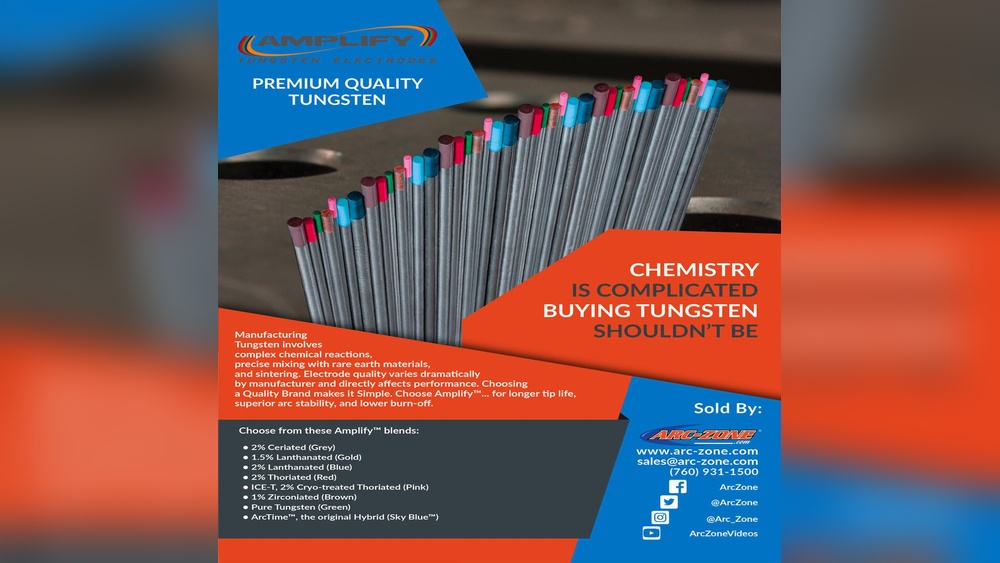
1. Pure Tungsten (green, Aws Ewp)
Pure tungsten is the oldest and most basic type. It is 99.5% tungsten with no added oxides. Many textbooks still mention it, but fewer professionals use it today.
Strengths:
- Forms a large, round ball at the tip under AC, which helps spread the arc.
- Handles high amperage without breaking.
- Low cost.
Weaknesses:
- Not as stable as newer types.
- Can spit or lose shape at higher currents.
- Wears down faster and is less efficient.
Best uses: Basic AC welding for aluminum, especially on older machines without advanced features.
Example: If you use a very old transformer TIG machine, pure tungsten might be your only good choice. It forms the round ball tip needed for traditional AC welding.
2. 2% Thoriated Tungsten (red, Aws Ewth-2)
Thoriated tungsten contains about 2% thorium oxide. It is mostly used for DC TIG welding (like steel or stainless), not for AC.
Strengths:
- Excellent arc starting.
- Stable arc on DC.
Weaknesses:
- Not recommended for AC welding.
- Radioactive (thorium content).
- Does not form a good ball tip under AC.
Best uses: DC welding only. Avoid for AC TIG on aluminum.
Example: Many welders who switch from steel to aluminum make the mistake of using leftover thoriated tungsten. The arc is unstable, and the tungsten forms a pointed tip that can split or erode.
3. Zirconiated Tungsten (white, Aws Ewzr-1)
Zirconiated tungsten contains 0.8–1.2% zirconium oxide. This type is made for AC TIG welding, especially on aluminum.
Strengths:
- Forms a stable, rounded ball tip.
- Resists splitting and contamination.
- Handles higher amperage than pure tungsten.
- Good arc stability and cleaning action.
Weaknesses:
- Not as common as other types.
- Costs more than pure tungsten.
Best uses: Modern AC TIG welding on aluminum, especially for critical or high-amperage jobs.
Example: If you weld thick aluminum plates (over 1/4 inch) and need a smooth, stable arc, zirconiated tungsten is a very reliable choice.
4. Ceriated Tungsten (grey, Aws Ewce-2)
Ceriated tungsten contains about 2% cerium oxide. It works for both AC and DC, but with some limits.
Strengths:
- Easy arc starting.
- Works at low to medium amperage.
- Good for thin aluminum.
Weaknesses:
- The tip can split at high amperage.
- Not as stable as lanthanated tungsten for AC.
Best uses: Low-amperage AC welding, thin aluminum sheets, or when you want to use one tungsten for both AC and DC.
Example: If you mostly weld thin aluminum tubing (under 1/8 inch), ceriated tungsten can give you a small, focused arc.
5. Lanthanated Tungsten (blue, Aws Ewla-2)
Lanthanated tungsten has about 1–2% lanthanum oxide. It is considered the best all-around tungsten for both AC and DC TIG welding.
Strengths:
- Stable arc at low and high amperage.
- Keeps a sharp or slightly balled tip.
- Lasts longer and resists splitting.
- Works well with inverter TIG machines.
Weaknesses:
- Slightly higher price than pure tungsten.
- May not ball as well as zirconiated on very old AC machines.
Best uses: Modern AC TIG welding, both thin and thick aluminum, and when you want one tungsten for all jobs.
Example: On an inverter TIG welder with advanced settings, 2% lanthanated tungsten gives a tight, focused arc and makes it easy to switch between aluminum and steel.
6. Rare Earth Tungsten (gold, Aws Ewg)
Rare earth tungsten is a mix of different oxides (like lanthanum, yttrium, zirconium, or cerium). The exact mix depends on the brand.
Strengths:
- Very stable arc.
- Long life.
- Handles high and low amperage.
Weaknesses:
- Can vary between brands.
- Not as predictable as lanthanated or zirconiated tungsten.
Best uses: All-around use if you find a brand that works well with your machine.
Example: Some welders find certain rare earth tungstens give a very clean arc on AC, but you may need to test a few brands.
Tungsten Type Comparison For Ac Tig
To help you see the differences, here is a direct comparison of the most common tungsten types used for AC TIG welding aluminum.
| Tungsten Type | Color Code | Best For AC TIG? | Arc Stability | Tip Formation | Common Problems |
|---|---|---|---|---|---|
| Pure | Green | Acceptable | Medium | Large ball | Fast wear, spitting |
| Zirconiated | White | Excellent | High | Stable ball | Less common, cost |
| Lanthanated | Blue | Excellent | Very high | Small ball/point | Higher price |
| Ceriated | Grey | Good (low amps) | Medium | Small ball | Tip splits at high amps |
| Thoriated | Red | Poor | Low | Sharp/pointed | Radioactive, poor AC arc |
Why Modern Welders Prefer Lanthanated Or Zirconiated Tungsten
In the past, people used pure tungsten for AC TIG welding because old transformer machines needed a ball tip. Today, most welders use inverter TIG machines. These machines can use a pointed or small balled tip. This makes lanthanated and zirconiated tungsten the best choice.
Lanthanated tungsten is the top pick for many modern welders because it offers:
- Easy arc start
- Stable arc at all amperages
- Less electrode wear
- Good for both AC and DC
Zirconiated tungsten is still the best for very high-amperage AC welding or if you use a classic transformer machine. It forms a round, stable ball that does not split.
Non-obvious insight: Many beginners do not realize that lanthanated tungsten can keep a nearly pointed tip, even on AC. This gives a focused arc and precise welds, especially on thin aluminum.
How To Identify The Right Tungsten For Your Machine
Check your TIG machine’s manual first. Most inverters recommend lanthanated or zirconiated tungsten for AC. If you have an old transformer machine, pure or zirconiated tungsten is better.
Tip: If you notice the tungsten tip is melting unevenly or the arc wanders, you are probably using the wrong type.
Non-obvious insight: Some inverter machines let you adjust the AC balance. If you set more cleaning (EN), you can use a smaller ball. This works best with lanthanated or zirconiated tungsten.
How To Prepare Tungsten For Ac Tig Welding
The tip shape of your tungsten affects the arc and the weld. Here’s how to prepare it based on the type:
Balling The Tip (for Pure And Zirconiated Tungsten)
- Grind the end flat.
- Use AC current to form a ball at the tip. Set the current about 5–10% higher than your actual welding amperage.
- Do not let the ball grow larger than the diameter of the tungsten.
Why: A ball that is too large will make the arc unstable and can drop into the weld.
Pointed Or Blunted Tip (for Lanthanated, Ceriated, Rare Earth Tungsten)
- Grind the tungsten to a point, then blunt the very end.
- The point should be about 2–2.5 times the electrode diameter.
- For AC TIG, the tip may round off slightly during welding, but do not let a large ball form.
Why: A pointed or small rounded tip gives a focused arc, better penetration, and less risk of tungsten falling into the weld.
Choosing Tungsten Size For Ac Tig
The size (diameter) of the tungsten matters for the amperage and metal thickness.
- 1/16 inch (1.6 mm): Good for 20–90 amps (thin aluminum)
- 3/32 inch (2.4 mm): Good for 70–150 amps (most jobs)
- 1/8 inch (3.2 mm): Good for 130–250 amps (thick aluminum)
Tip: Using too small a tungsten will cause the tip to overheat and may melt into the weld. Too large a tungsten can make arc starts harder and the arc less focused.

Credit: bakersgas.com
How Tungsten Type Affects Weld Quality
The tungsten affects:
- Arc stability: A stable arc means less spatter and a neater weld bead.
- Cleaning action: Good cleaning removes the oxide layer from aluminum.
- Electrode life: Some tungstens last longer, saving money and time.
- Contamination risk: The right tungsten reduces the chance of tungsten inclusions (tiny bits of tungsten in the weld).
Example: If you use pure tungsten on a modern inverter TIG, you may see the arc dancing around or the electrode tip breaking down quickly. This leads to dirty welds and wasted time.
Tungsten Type And Ac Tig Settings
Your tungsten choice can change the settings you use:
| Tungsten Type | Best AC Frequency | Best AC Balance | Effect on Penetration | Effect on Cleaning |
|---|---|---|---|---|
| Pure | 60 Hz | 65–70% EN | Medium | Good |
| Zirconiated | 80–120 Hz | 70–75% EN | High | Very Good |
| Lanthanated | 100–150 Hz | 70–80% EN | Very High | Excellent |
Note: EN means electrode negative (more penetration), EP means electrode positive (more cleaning).
Common Mistakes When Choosing Tungsten For Ac Tig
- Using thoriated tungsten: Many make this mistake because thoriated is popular for steel. It does not work well for AC aluminum and can be unsafe due to radioactivity.
- Wrong size: Too small melts, too large makes the arc hard to control.
- No tip preparation: Welding with a sharp point or a very large ball causes arc instability.
- Ignoring machine type: Your TIG machine (inverter or transformer) changes which tungsten works best.
- Switching types without cleaning: Always grind off the old tip if you change tungsten types to prevent contamination.
Real-world Results With Different Tungsten Types
Many welding shops have compared different tungstens on AC. Here are some real-world findings:
- On a modern inverter TIG, lanthanated tungsten gave the longest life, most stable arc, and lowest contamination. Welders could use the same tungsten for both aluminum and steel jobs.
- Zirconiated tungsten was favored for heavy-duty jobs with thick aluminum, thanks to its ability to hold a round ball without splitting.
- Pure tungsten worked but wore out quickly, even at lower amps.
- Ceriated tungsten was good for thin aluminum, but tips sometimes split on thicker work.
Practical Tips For Best Results
- Use lanthanated tungsten for most modern AC TIG jobs, especially with inverter machines.
- Use zirconiated tungsten for classic transformer machines or high-amperage aluminum jobs.
- Always prepare the tip to match the tungsten type and machine.
- Start with a clean, properly ground electrode to reduce contamination.
- Change the tungsten if the arc becomes unstable or the tip looks damaged.
- Test a few types if you are not sure—some machines and jobs respond better to one type than another.
Environmental And Health Notes
- Thoriated tungsten contains radioactive thorium. Grinding produces dust that is unsafe to breathe. Do not use thoriated tungsten for AC, and always use a respirator and dust collection when grinding any tungsten.
- Lanthanated and zirconiated tungsten are safer and last longer, making them better for both the environment and your health.

Credit: www.millerwelds.com
Cost Comparison
While cost should not be the main factor, it can matter for high-volume shops.
| Tungsten Type | Average Price (per 10 pcs, 3/32″) | Average Life (hours) |
|---|---|---|
| Pure | $12–15 | 3–5 |
| Zirconiated | $20–25 | 6–10 |
| Lanthanated | $18–22 | 8–12 |
| Ceriated | $16–20 | 6–8 |
While lanthanated costs a bit more than pure, it lasts up to 3 times longer. This saves money in the long run.
Where To Learn More
If you want to see official recommendations and more technical data, check the Tungsten Electrode Wikipedia page.
Final Recommendations
For most AC TIG welding, especially on aluminum, 2% lanthanated (blue) or zirconiated (white) tungsten electrodes are the best choice. They give you a stable arc, last longer, and reduce the risk of contamination. If you use an old transformer machine, zirconiated may be better. Pure tungsten works but is less stable and wears out faster. Avoid thoriated tungsten for AC TIG.
Always use the right size and prepare the tip properly. If you switch types, clean and regrind the electrode to avoid contamination.
Choosing the best tungsten for AC TIG welding is not just about following old habits. Test a few types, watch your results, and you will quickly find what works best for your machine and your projects. With the right tungsten, you will weld cleaner, faster, and with less stress.
Frequently Asked Questions
What Is The Best Tungsten For Ac Tig Welding On Aluminum?
2% lanthanated (blue) and zirconiated (white) tungsten are the top choices for AC TIG welding aluminum. They give a stable arc and resist contamination, especially on modern inverter machines.
Can I Use Thoriated Tungsten For Ac Tig Welding?
No. Thoriated tungsten is for DC TIG welding, mainly for steel and stainless steel. It does not perform well on AC and is slightly radioactive.
Why Does My Tungsten Tip Keep Balling Up Or Splitting?
If your tip is balling up too much, you may be using pure tungsten or too much amperage. If the tip splits, you may be using the wrong type (like ceriated) or too high current. Use lanthanated or zirconiated and prepare the tip as recommended.
What Size Tungsten Should I Use For Ac Tig Welding?
Use 1/16″ (1.6 mm) for 20–90 amps, 3/32″ (2.4 mm) for 70–150 amps, and 1/8″ (3.2 mm) for 130–250 amps. Match the size to your welding current for best results.
How Do I Prepare The Tungsten Tip For Ac Tig Welding?
For pure and zirconiated tungsten, form a small ball at the tip. For lanthanated, ceriated, and rare earth tungsten, grind to a point and blunt the end slightly. This gives you a focused, stable arc.

Credit: weldmongerstore.com