Disclosure: This post contains affiliate links and I will be compensated if you make a purchase after clicking through my links. Learn More
Spot welding is a simple, fast, and reliable process for joining metal sheets. In many factories, workers use spot welding every day to build cars, appliances, and many other products. One small but crucial part of this process is the electrode tip. The size of the tip, especially its diameter, plays a big role in the quality of the weld. If the tip is too small or too large, the weld can fail or damage the material. That’s why knowing the spot welding electrode tip diameter formula is essential for anyone working with resistance spot welding.
Many people find this topic confusing at first. There are formulas, standards, and practical adjustments. But understanding the right tip diameter is not just about following a chart. It means knowing why the formula matters, how to use it, and what can happen if you ignore it. This article will explain everything you need to know about the spot welding electrode tip diameter formula. You will find formulas, examples, tables, and practical advice. Whether you are a beginner or have some experience, you’ll see how to choose the right electrode tip diameter and avoid common mistakes.
What Is Spot Welding?
Spot welding is a type of resistance welding that joins metal sheets together by applying pressure and passing current through the electrodes to the metal. The metal heats up at the contact point and forms a weld nugget. This method is popular because it is fast, cost-effective, and works well for thin sheet metals.
The electrodes are usually made from copper alloys because they conduct electricity well and resist wear. The tip of the electrode touches the metal, so its shape and size matter. If the tip is wrong, the current won’t flow properly, and the weld can be weak or inconsistent.
Spot welding is often used in car manufacturing, for example, to join body panels. It’s also used in making metal furniture, home appliances like refrigerators, and even in electronics, where small metal parts need to be joined quickly and cleanly.
This process works best for sheets that are between 0. 5 mm and 3 mm thick, although with special machines, thicker materials can be welded.
One important thing to remember is that spot welding works by making a small, controlled area very hot and then quickly cooling it. The electrodes both pass current and apply pressure at the same time. The right balance of pressure, current, and time is needed for a good weld, and the tip diameter is one of the key factors in this balance.
Why Electrode Tip Diameter Is Important
The electrode tip diameter controls how much current passes through the metal and how much heat is created. If the tip is too small, it may burn through the metal. If it’s too large, the weld may not form completely. The right size creates a strong, clean weld without damaging the metal.
Here’s why tip diameter is so important:
- It affects the weld nugget size.
- It influences the amount of heat generated.
- It controls the current density.
- It impacts the electrode’s life and maintenance.
A correct tip diameter leads to consistent welds, longer electrode life, and less repair work. Many production problems in spot welding come from using the wrong tip size.
Another detail often missed is that the tip diameter also affects how the heat is distributed in the weld zone. A smaller tip focuses the heat into a very small area, which can be useful for making tiny welds or for thin sheets, but it also means there’s more risk of overheating or even melting a hole through the sheet.
A larger tip spreads the heat out, which is safer for thicker sheets or coated metals.
Also, the tip diameter influences how easy it is to control the welding process. If the tip is too small, slight changes in current or pressure have a bigger effect on the weld, making it harder to get consistent results.
With the right diameter, the process is more stable and forgiving.

Credit: www.scribd.com
The Standard Formula For Electrode Tip Diameter
There is a widely accepted formula for calculating the correct electrode tip diameter for spot welding. The most used formula comes from the American Welding Society (AWS):
Electrode Tip Diameter (mm) = 5 × √t
Where:
- T = thickness of one sheet in millimeters
So, if you have a steel sheet that is 1.5 mm thick, the calculation would be:
Electrode Tip Diameter = 5 × √1. 5 = 5 × 1. 225 = 6. 12 mm
This formula gives you a starting point. It works well for most low-carbon steels and standard welding jobs.
The formula is designed to give a tip size that creates a weld nugget strong enough for most applications. If you use a tip that is much smaller or larger than this, you often have to adjust other welding parameters, like current or pressure, which can lead to more complexity and possible mistakes.
Why Use The Square Root?
The thickness affects the current needed for welding. As the thickness increases, you need more current, but not in a straight line. The square root helps balance the relationship between thickness and current flow.
For example, if you double the sheet thickness, you don’t need to double the tip diameter. The square root keeps the increase more gradual. This makes the formula more practical for a wide range of sheet thicknesses.
Another reason for the square root is to keep the current density (current per unit area) at a safe and effective level. Too high, and you burn through the metal. Too low, and you don’t get a strong weld. The formula is a way to match the tip to both the current and the metal’s needs.
Practical Example
Suppose you need to spot weld two sheets of low-carbon steel, each 2 mm thick.
Electrode Tip Diameter = 5 × √2 = 5 × 1. 414 = 7. 07 mm
You should use an electrode tip with a diameter close to 7 mm.
Let’s try another example, for thin sheets often used in electronics:
Suppose you have a 0. 8 mm sheet.
Electrode Tip Diameter = 5 × √0. 8 = 5 × 0. 894 = 4. 47 mm
In this case, a tip around 4. 5 mm in diameter is a good choice.
Other Common Formulas And Variations
The AWS formula is not the only one. Some factories or engineers may use slightly different formulas, based on experience or their own standards. Here are a few examples:
1. 4 × √t Formula
Some use 4 instead of 5, especially for thinner sheets or aluminum.
2. 5.5 × √t Formula
For thicker sheets or higher-strength steels, some engineers increase the multiplier.
3. Tip Diameter = (weld Nugget Diameter) + 2 Mm
Sometimes, the tip size is set to be a little larger than the target weld nugget.
These alternatives exist because not all welding situations are the same. Factors such as the type of coating on the steel, the kind of welding machine used, and the required weld strength can influence the preferred tip size.
For example, in industries where thin sheets are common, a smaller multiplier is used to avoid overheating the material. In heavy industries, where thicker sheets are common, a larger multiplier helps ensure enough heat is spread over a larger area to make a strong weld.
Comparison Of Formulas
Here is a quick comparison for a 1 mm sheet:
| Formula | Sheet Thickness (mm) | Calculated Tip Diameter (mm) |
|---|---|---|
| 5 × √t | 1 | 5.0 |
| 4 × √t | 1 | 4.0 |
| 5.5 × √t | 1 | 5.5 |
As you can see, different multipliers give slightly different results. The exact value may depend on your application and the type of metal.
Another variation is to use the tip diameter as a percentage of the weld nugget size. For example, some factories aim for a tip that is about 1. 2 to 1. 5 times the diameter of the nugget. This helps ensure good heat coverage and better control over the welding process.
Standards And Guidelines
Several industry standards guide the choice of electrode tip diameter:
- AWS C1.1 (American Welding Society): Recommends the 5 × √t formula for most steels.
- ISO 5182: European standard for electrode materials and dimensions.
- JIS Z3236: Japanese standard for resistance welding electrodes.
Each standard may have slight differences. Most factories follow the AWS guide unless they have a special need.
ISO 5182 not only covers the size but also the material and cooling requirements for electrodes. For example, it specifies the use of different copper alloys depending on the type of metal being welded. This means that in a multinational company, different plants may follow local standards, but the underlying principles are very similar.
Being familiar with these standards helps when buying electrode tips from different suppliers or when working in factories that follow international standards. It also makes it easier to troubleshoot problems, since you can compare your practices with recognized guidelines.
Electrode Tip Shapes And Materials
The electrode tip shape also affects the weld. Common shapes include:
- Flat tips: Good for most jobs, gives a broad contact area.
- Dome tips: Focuses heat in a smaller area, used for high-strength steels.
- Pointed tips: Used for special jobs, but wear out faster.
Each shape has its own use. Flat tips are best for standard sheet welding, giving reliable results and long life. Dome tips are chosen when welding harder steels or when a deeper nugget is needed. Pointed tips are rare but can be useful in tight spaces or where a very small weld is required.
Electrode materials are usually copper alloys. For example, Class 2 copper-chromium is common for welding steel sheets. For aluminum, harder alloys or special coatings are used.
Material choice matters because it affects both the life of the tip and the quality of the weld. For example, Class 3 copper alloys are harder and last longer when welding high-strength or coated steels. Some tips are even water-cooled to reduce wear.
Another important point is that the same size tip made from different copper alloys will behave differently. Harder alloys may allow for smaller tips because they resist deformation, but they can be more expensive.
How To Choose The Right Electrode Tip Diameter
Choosing the right diameter means more than following a formula. You need to consider:
1. Material Type
Steel, stainless steel, and aluminum need different tips. Aluminum often needs a larger tip because it conducts electricity better.
2. Sheet Thickness
Thicker sheets need bigger tips. Use the formula as a guide.
3. Weld Nugget Size
The tip must be large enough to form the right nugget but not so large that it spreads the heat too much.
4. Electrode Wear
Over time, tips flatten out or get dirty. Start with the correct size and replace when worn.
5. Welding Current
Higher current needs a larger tip to avoid burning.
6. Production Speed
If you are welding very fast, the tip may heat up more. In this case, a slightly larger tip can help spread the heat and avoid excessive wear.
Example: Choosing For Aluminum
Aluminum conducts heat and electricity very well. If you use the same formula as steel, the tip may be too small. Many experts use 6 × √t for aluminum.
For a 2 mm aluminum sheet:
Tip Diameter = 6 × √2 = 6 × 1. 414 = 8. 48 mm
This larger tip helps avoid overheating, reduces sticking, and gives a cleaner weld. For aluminum, also check the electrode material—harder copper alloys or tips with special coatings are best.
Another example: If you are welding coated steel (like galvanized), a slightly larger tip helps prevent burning the coating and keeps the weld area cleaner. Always check your material’s requirements.
Common Mistakes When Using The Formula
Many beginners make errors when using the electrode tip diameter formula. Here are some to watch for:
1. Ignoring Sheet Thickness
Always measure the actual sheet, not the total stack.
2. Using Worn Tips
As tips wear, the diameter increases. Replace them regularly.
3. Not Considering Material
Using the same formula for all metals leads to problems.
4. Using The Wrong Units
The formula uses millimeters. Mixing up inches and mm gives wrong results.
5. Blindly Following Charts
Always check for your specific material and application.
6. Not Checking For Overheating
If the tip gets too hot, its diameter may change during welding. Make sure to monitor tip temperature, especially in long production runs.
7. Skipping Test Welds
Always do a test weld and check the nugget size and strength before starting full production. A good formula is a starting point, but testing confirms the result.
Credit: www.howtoresistanceweld.info
Adjusting Tip Diameter For Special Applications
Sometimes, you need to adjust the formula for special needs:
- High-strength steel: Use a slightly larger tip to spread the heat.
- Coated metals (like galvanized): A bigger tip can help avoid burning the coating.
- Stacked sheets of different thickness: Base the calculation on the thinner sheet.
- Multiple spot welds close together: Use a slightly larger tip to reduce the risk of excessive heating between welds.
Real-world Adjustment Example
Suppose you must weld two sheets: one is 1.2 mm, the other is 2 mm. Use the 1.2 mm sheet for the formula.
Tip Diameter = 5 × √1. 2 = 5 × 1. 095 = 5. 48 mm
If you notice that the welds are weak, you can try a slightly larger tip and check if the nugget size improves. Always make small adjustments and test.
Another real-world scenario: If you are welding a stack of three sheets, and the middle one is the thinnest, always base your calculation on the thinnest sheet. This helps avoid burning through or damaging that layer.
Electrode Tip Maintenance And Replacement
Even with the correct formula, electrode tips wear out. Worn tips produce poor welds. Check tips often and replace or dress (reshape) them as needed.
| Tip Condition | Weld Quality | Action |
|---|---|---|
| New/Correct diameter | Strong, clean welds | Use as is |
| Slightly worn | Inconsistent welds | Dress or replace |
| Heavily worn | Weak or failed welds | Replace immediately |
Tip maintenance is as important as choosing the right diameter. Neglecting this leads to scrap and downtime.
Regular maintenance includes cleaning the tip to remove dirt or oxide build-up. Even a thin layer of dirt can change the effective tip diameter and lead to poor welds. Some factories use automatic tip dressers to keep the tips in shape during production.
This small investment often pays for itself in better weld quality and less downtime.
Effects Of Wrong Electrode Tip Diameter
Using the wrong tip diameter can cause many problems:
- Undersized tip: Burns through the sheet, small or brittle welds, tip wears quickly.
- Oversized tip: Not enough heat, large but weak welds, more current needed.
- Irregular tip: Unstable welds, unpredictable quality.
The costs include wasted material, more repairs, and even machine damage.
Another issue is that the wrong tip size can damage the welding machine. For example, using a tip that is too small may cause overheating of the electrodes, which can melt the copper and damage the holder or cables. If the tip is too large, you may have to increase the welding current, which stresses the power supply and shortens machine life.
Measuring And Verifying Electrode Tip Diameter
To get the best welds, measure the tip diameter regularly. Use a caliper or a gauge. Clean the tip before measuring. Compare the measurement to the formula result. If the tip is too worn, replace or reshape it.
Measuring Example
If the formula says 6 mm, and your tip measures 7 mm, you should dress (grind) it back to 6 mm or replace it.
For high-volume operations, some companies keep a go/no-go gauge at the welding station. This tool lets workers quickly check if the tip is still in the right range. This small step can save hours of troubleshooting and prevent bad welds from reaching customers.
Spot Welding Electrode Tip Diameter In Practice
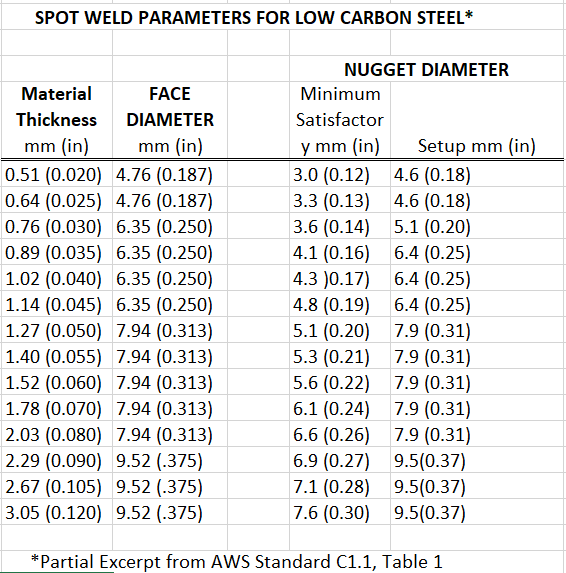
Many factories use charts and tables based on the formula to help workers choose the right tip. Here is an example chart for low-carbon steel:
| Sheet Thickness (mm) | Electrode Tip Diameter (mm) |
|---|---|
| 0.8 | 4.5 |
| 1.0 | 5.0 |
| 1.2 | 5.5 |
| 1.5 | 6.1 |
| 2.0 | 7.1 |
| 2.5 | 7.9 |
| 3.0 | 8.7 |
These charts make it easier to select the right size quickly.
In practice, experienced welders often use these charts as a starting point but will adjust the tip size after testing a few welds. They know that even small changes in material or coating can require a change in tip diameter.
This is why having a good understanding of the formula and the process is more valuable than just memorizing numbers.
Non-obvious Insights For Better Spot Welding
Beginners often focus only on the formula. But two key ideas often go unnoticed:
1. Tip Cooling Matters
The cooling system in the welding gun keeps the tip from overheating and changing shape. Poor cooling makes the tip diameter change faster, causing bad welds.
2. Electrode Force And Tip Diameter Work Together
The pressure you apply with the electrode affects the weld as much as the tip diameter does. If you use a larger tip but low force, the weld will be weak. Always check both.
Another Insight: Surface Condition
Even with the right tip diameter, if the metal surface is dirty, oily, or coated with rust, the weld may fail. Clean surfaces are essential for good spot welding.
Finally, Consistent Setup
If you change the welding machine, electrode holder, or even the work table, re-check your tip diameter and welding results. Small changes in setup can change how the tip interacts with the metal.

Credit: www.sciencedirect.com
How Tip Diameter Affects Weld Nugget Formation
The weld nugget is the small melted area that joins the sheets. The tip diameter controls the size and shape of the nugget. If the tip is too small, the nugget is tiny and may not hold. If the tip is too large, the nugget may be shallow and not strong.
A good rule is that the weld nugget diameter should be about 5 times the sheet thickness. The electrode tip should be a little larger than the nugget size.
For example, with a 1 mm sheet, the nugget diameter should be around 5 mm, and the tip diameter should be 5. 5–6 mm. Always check the nugget after welding—if the nugget is too small, try a slightly larger tip or increase the welding time.
A practical tip: After making a test weld, peel the sheets apart and check the size and shape of the nugget. If it matches the expected size, your settings and tip diameter are correct. If not, adjust and try again.
Safety Tips Related To Electrode Tip Diameter
Using the correct tip diameter is also a safety issue. If the tip is too small, sparks can fly, and hot metal may splash. Workers should always:
- Wear protective gloves and eyewear.
- Check the tip size before starting.
- Replace or reshape tips before they wear out.
Also, ensure that cooling water is flowing correctly to avoid tip overheating. In case of any unusual noise, vibration, or excessive heat at the electrode, stop and check the tip condition immediately.
Another safety point: Always allow the electrode and workpiece to cool before handling. Even a short welding cycle can make the tip and metal very hot.
Case Study: Automotive Spot Welding
Car factories use spot welding for body panels. They must weld sheets of different thicknesses and coatings. Workers use charts based on the AWS formula but adjust for coatings and steel type. They check tip diameter every shift and replace tips often.
This keeps welds strong and panels in the right position.
In one plant, using the wrong tip size led to 5% more rejects. After workers followed the correct formula, rejects dropped below 1%.
Another example: In a factory welding aluminum auto parts, switching from a 5 × √t to a 6 × √t formula improved weld quality and reduced tip sticking. This change also reduced downtime for tip maintenance and improved production speed.
Expert Recommendations
- For regular steel, use 5 × √t as your main formula.
- For high-strength steel, go up to 5.5 × √t.
- For aluminum, use 6 × √t.
- Always measure sheet thickness in millimeters.
- Keep spare electrode tips and maintenance tools ready.
In addition, always test a few welds before starting mass production. Adjust the tip diameter, current, and force as needed to get the right nugget size and strength.
Useful Resources And Further Reading
If you want to study more, the American Welding Society and ISO standards offer detailed guidance. You can find more technical information at the Wikipedia: Spot Welding page.
Frequently Asked Questions
What Is The Most Common Formula For Spot Welding Electrode Tip Diameter?
The most common formula is 5 × √t, where t is the sheet thickness in millimeters. This formula fits most low-carbon steel welding jobs.
How Do I Measure The Electrode Tip Diameter?
Use a caliper to measure the flat or dome area at the end of the electrode. Make sure the tip is clean before measuring.
Should I Use The Same Tip Diameter For Aluminum And Steel?
No. Aluminum usually needs a larger tip diameter because it conducts heat and electricity better. Use 6 × √t for aluminum.
How Often Should I Replace Or Reshape The Electrode Tip?
Check the tip after every shift or after about 1000 welds. Replace or reshape the tip if the diameter increases by more than 1 mm from the original size.
Can I Use The Formula For All Types Of Metals?
The formula is a guide for most metals, but you should adjust for different materials. For high-strength steel or coated metals, use a slightly larger tip. Always check the recommended values for your specific application.
Spot welding is a reliable process, but small details like the electrode tip diameter make a big difference. By understanding and applying the right formula, you can create strong, clean welds and keep your machines running smoothly. With the correct information, you avoid costly mistakes and get the best results from your spot welding process.