Disclosure: This post contains affiliate links and I will be compensated if you make a purchase after clicking through my links. Learn More
Many people want to try MIG welding but feel limited because they do not have a gas tank. The good news is, you can MIG weld without using shielding gas. This process is called flux-cored arc welding (FCAW), and it uses a special wire that protects the weld from the air. For beginners, this method can be easier, cheaper, and more flexible than traditional MIG welding with gas.
This article explains everything you need to know about MIG welding without gas. You will learn how the process works, what equipment you need, how to set up your welder, and how to get good results. You will also see safety tips, common mistakes, and ways to improve your skills.
By the end, you will feel ready to start your first welding project with confidence.
What Is Gasless Mig Welding?
Gasless MIG welding uses a wire that has flux in its core. This flux burns during welding and creates a shield that keeps air away from the weld. This is different from regular MIG welding, which uses an external gas like argon or CO2. The wire does all the work for you, so you do not need to buy or handle gas cylinders.
Many people use the term “MIG welding” for both gas and gasless welding. But technically, only the version with gas is true MIG (Metal Inert Gas) welding. The gasless type is called flux-cored arc welding (FCAW). Most small welders you find in shops can do both if you use the right wire.
How Does Flux-cored Wire Work?
Flux-cored wire has a hollow center filled with flux. When you weld, the wire melts and the flux burns, creating a cloud of gas and a layer of slag over the weld. This protects the hot metal from oxygen and moisture, which can cause weak welds and rust. The slag must be chipped off after the weld cools.
There are two main types of flux-cored wire:
- Self-shielded (FCAW-S): Does not need any gas. All the protection comes from the flux.
- Gas-shielded (FCAW-G): Needs extra gas, not common for home use.
When people talk about MIG welding without gas, they mean using self-shielded flux-cored wire.
Why Choose Mig Welding Without Gas?
Many beginners choose gasless MIG welding for these reasons:
- Lower cost – You do not need to buy or refill gas bottles.
- Portability – You can use the welder outside or in the field.
- Easier setup – Fewer parts and less to break or leak.
- Better for outdoor work – Wind does not blow the shield away like with gas.
But there are some trade-offs. The welds do not look as clean as with gas, and you need to clean off the slag. Thin metals can be harder to weld without burning holes.
Equipment Needed For Mig Welding Without Gas
To weld without gas, you need the right equipment. Here is what you must have:
- Flux-cored wire welder: Make sure your welder can use flux-cored wire. Most small MIG welders have a “flux core” setting or can run without gas.
- Self-shielded flux-cored wire: The most common size is 0.030” or 0.035” (0.8mm or 0.9mm). Check your welder’s manual for the right size.
- Wire feed welder: Can be 110V or 220V, but 110V is common for beginners.
- Ground clamp and work lead: These come with your welder.
- Welding helmet: Use an auto-darkening helmet for safety.
- Welding gloves and jacket: Protect your skin from sparks and heat.
- Chipping hammer and wire brush: To clean the slag after welding.
- Angle grinder: For preparing and cleaning metal.
Example Equipment List
- Welder: Lincoln Electric Handy MIG, Hobart Handler 140, Forney Easy Weld 140FC-i
- Wire: Lincoln NR-211-MP, Hobart Fabshield 21B, Forney E71T-GS
Always check your welder’s specs before you buy wire.
Setting Up Your Welder For Gasless Mig Welding
Getting the setup right is key for good welds. Follow these steps:
- Switch polarity: For flux-cored wire, the work clamp (ground) goes to positive (+), and the gun goes to negative (–). Most welders have a switch or you change the wires inside.
- Install the correct wire: Open the welder, remove any solid wire, and load the flux-cored wire. Make sure it feeds smoothly.
- Change contact tip: Use the tip that matches your wire size.
- Check drive rolls: Use knurled drive rolls (with teeth) for flux-cored wire. Smooth rolls can crush the wire.
- Set tension: Tighten the wire feed tension just enough so the wire does not slip.
- Turn off gas: If your welder has a gas valve, turn it off.
- Set voltage and wire speed: Start with the chart inside your welder or use these rough settings:
- 0.030” wire: 16–18 volts, 180–210 inches per minute (ipm) wire speed
- 0.035” wire: 17–19 volts, 200–230 ipm wire speed
Adjust as you practice.
- Check gun liner: Make sure it is clean and not worn. Replace if needed.
Preparing Metal For Welding
Good results start with clean metal. Follow these steps:
- Remove rust, paint, and oil: Use an angle grinder or wire brush until the metal is shiny.
- Cut edges straight: Crooked edges make welding harder.
- Fit pieces tightly: Small gaps create weak welds.
- Clamp pieces: Hold them steady so they do not move during welding.
- Clean again: Dust or dirt can cause bad welds.
Even though flux-cored wire is more forgiving than solid wire, dirty metal still causes problems like porosity (holes in the weld).
How To Mig Weld Without Gas: Step-by-step Process
Let’s go through the welding process in detail.
1. Set Up Your Workspace
- Work in a well-ventilated area.
- Remove flammable materials.
- Place a fire extinguisher nearby.
- Wear all your safety gear.
2. Position The Workpiece
- Clamp the metal to a solid, grounded workbench.
- Keep the pieces as flat as possible.
3. Adjust Welder Settings
- Set voltage and wire speed based on the thickness of your metal and your wire size.
- Start lower and increase as needed.
4. Hold The Gun Correctly
- Hold the gun at a 10–15 degree angle from vertical, pointing in the direction you want to move.
- Keep the nozzle about 1/2 inch (12mm) from the metal.
5. Strike The Arc
- Pull the trigger to start the wire feed.
- Hold the tip close to the joint.
- Move smoothly to avoid sticking.
6. Move Steadily
- Use a steady “drag” motion (pulling the gun toward you).
- Go slow enough for the metal to melt and fuse, but not so slow that you burn through.
- Watch the puddle, not just the arc.
7. Overlap Each Pass
- For wider welds, overlap each pass by half the width of the bead.
8. Stop And Clean
- Release the trigger to stop welding.
- Let the metal cool.
- Chip off the slag with a chipping hammer.
- Brush the weld clean.
9. Inspect Your Weld
- Look for even width, few holes, and no cracks.
- Practice on scrap metal until you are happy with the result.
Understanding Weld Settings And Their Impact
The settings on your welder matter a lot. Adjusting voltage and wire speed changes how deep the weld goes and how much wire you use.
| Setting | Effect if Too Low | Effect if Too High |
|---|---|---|
| Voltage | Poor fusion, weak weld | Burn-through, excess spatter |
| Wire Speed | Wire burns back, unstable arc | Wire piles up, poor penetration |
Start with the settings in your welder’s manual, then test and adjust. Write down what works for each metal thickness.

Credit: www.reddit.com
Choosing The Right Flux-cored Wire
Not all wires are equal. Here’s what to consider:
- Diameter: 0.030” (0.8mm) is good for thin metal; 0.035” (0.9mm) for thicker steel.
- Brand: Use trusted brands like Lincoln, Hobart, or Forney.
- Type: Make sure it is self-shielded (E71T-GS is common).
- Weld position: Some wires work in all positions, others only flat.
Check the wire’s box for details. Cheap wire can cause poor feed, more spatter, and weak welds.
Advantages And Limitations Of Gasless Mig Welding
Every method has pros and cons. Here is a comparison:
| Gasless MIG (FCAW-S) | Gas MIG (GMAW) |
|---|---|
| Works in wind Cheaper start-up Thicker metal | Cleaner welds No slag Best for thin metal |
| More spatter Slag to remove Rougher welds | Needs gas Not for windy areas Higher cost |
Non-obvious insight: Flux-cored wire can weld thicker steel than small gas MIG machines, often up to 1/2 inch in one pass. But for auto body or thin sheet, gas gives better results.
Common Mistakes Beginners Make (and How To Avoid Them)
Many new welders struggle with similar problems. Here’s what to watch for:
- Wrong polarity: Always check the manual. Using the wrong polarity gives weak, spattery welds.
- Dirty metal: Rust and paint block the arc and weaken the weld. Clean well before starting.
- Too much wire speed: The gun can “stutter” or the wire piles up. Turn it down if this happens.
- Too slow travel: You burn through or get big piles of weld. Move faster.
- Not removing slag: Slag traps rust and makes the next weld weak. Always clean between passes.
A helpful tip: Practice on scrap metal. Every welder and wire type acts a little differently.
Welding Techniques For Better Results
Technique matters as much as settings. Here are ways to improve:
Gun Angle And Movement
- Drag (pull) technique works best for flux-cored wire. Tilt the gun away from the weld and pull.
- Keep the angle steady—don’t swing side to side.
Stick-out Length
- Keep the wire stick-out (distance from tip to metal) around 1/2 inch (12mm). Longer stick-out leads to spatter and weak welds.
Control Speed
- Move at a steady pace. If the weld piles up or burns through, adjust your movement.
Multi-pass Welding
- For thick metal, make more than one pass. Clean the slag after each pass.
Visual Cues
- The weld pool should be smooth and even.
- Listen for a steady crackling sound, not popping.
Safety Tips For Gasless Mig Welding
Welding is safe if you follow these steps:
- Wear a welding helmet: UV rays can burn your eyes.
- Use gloves and a jacket: Sparks can burn skin.
- Work in fresh air: Flux fumes are not healthy. Use a fan or fume extractor.
- Protect your lungs: Wear a dust mask when chipping slag or grinding.
- Keep a fire extinguisher close: Sparks can start fires.
- Cover nearby items: Sparks travel far.
Non-obvious insight: Flux-cored welding makes more fumes than gas MIG. If you weld indoors often, buy a small fume extractor.
Cleaning And Finishing Your Welds
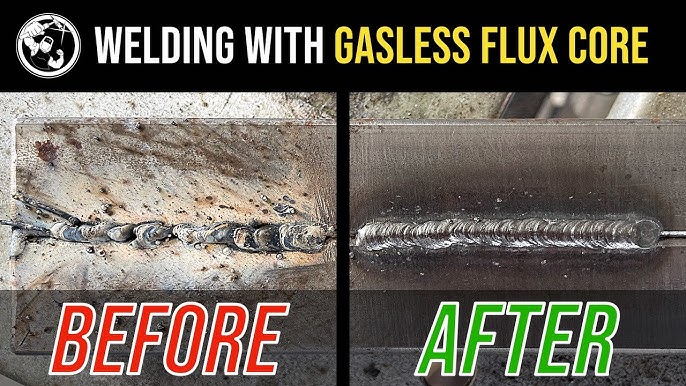
After you weld, the top will be covered in slag. You must remove this to see the weld and prepare for another pass.
- Use a chipping hammer to tap the slag off.
- Brush with a wire brush to clean the last bits.
- For a smooth finish, use an angle grinder.
If you leave slag, it can trap moisture and cause rust or weak spots.
Credit: www.youtube.com
Practical Project Ideas For Beginners
Start with easy projects to build confidence. Here are a few:
- Welding coupons: Practice beads on flat scrap steel.
- Garden stakes or hooks: Simple shapes and short welds.
- Tool racks or shelves: Join small angle iron or flat bar.
- Repair a wheelbarrow: Weld patches or braces.
- Make a small frame: Square tubing or angle iron.
These projects use basic skills and help you learn to control heat and bead shape.
How To Improve Your Skills
You get better at welding through practice and feedback. Here are ways to learn faster:
- Weld on scrap before each project.
- Compare your welds to photos in books or online.
- Ask a friend or post photos in forums for advice.
- Try different settings and wires to see what works best.
- Keep notes on what settings work for each job.
If you want to go deeper, read the American Welding Society guides or take a local class.
Maintenance Tips For Your Welder
Keep your welder in good shape for best results:
- Clean the gun nozzle: Remove spatter with pliers.
- Replace contact tips: Worn tips make the arc unstable.
- Check the ground clamp: Clean the contact area often.
- Keep wire dry: Store in a sealed bag if not used often.
- Inspect cables: Replace any with cracks or cuts.
A well-kept welder lasts longer and gives better welds.
When To Use Gasless Mig Welding (and When Not To)
Gasless MIG welding is best for:
- Outdoor work or windy conditions
- Farm equipment repair
- Heavy steel up to 1/2 inch thick
- Projects where looks are less important
It is not ideal for:
- Thin sheet metal (less than 1/16 inch)
- Auto body repairs where clean welds are needed
- Aluminum or stainless steel (usually needs gas)
If you need smooth, clean welds, consider switching to MIG with gas or TIG welding.
Troubleshooting Poor Welds
If your welds look rough or break easily, check these things:
| Problem | Likely Cause | Solution |
|---|---|---|
| Porosity (holes) | Dirty metal, damp wire | Clean metal, dry wire |
| Excess spatter | Wrong settings, poor wire | Adjust voltage/wire speed, try better wire |
| Wire feeds poorly | Worn liner or tip, wrong tension | Replace liner/tip, adjust tension |
| Weak welds | Wrong polarity, dirty metal | Check polarity, clean metal |
If you try these fixes and still have problems, ask for help from a more experienced welder or check your manual.
Important Tips For Success
- Always use the correct self-shielded wire for gasless welding.
- Clean your metal as well as you can.
- Start with simple joints and practice your technique.
- Take time to set your machine and write down what works.
- Clean off slag fully between welds.
- Check your polarity before every project.
If you want more details on welding processes, you can read about FCAW on the Wikipedia FCAW page.
Welding is a skill you can build with practice and patience. Even with a basic machine, you can do strong, useful welds without gas.
Frequently Asked Questions
What Is The Main Difference Between Gasless Mig And Regular Mig Welding?
Gasless MIG welding (FCAW-S) uses a flux-cored wire that creates its own shield from the air, so you do not need a gas tank. Regular MIG welding (GMAW) uses a solid wire and needs an external shielding gas, like argon or CO2. Gasless is better for outdoor work, but leaves more slag and spatter.
Can I Use Any Wire For Gasless Mig Welding?
No. You must use self-shielded flux-cored wire (like E71T-GS). Solid wire needs gas and will not protect the weld if used without it. Using the wrong wire gives weak, porous welds.
Is Gasless Mig Welding Safe To Use Indoors?
You can weld indoors, but gasless welding makes more smoke and fumes than gas MIG. Always keep your space well-ventilated. Use a fan or fume extractor and wear a mask if needed.
What Thickness Of Metal Can I Weld Without Gas?
Most small welders with flux-cored wire can weld steel from 1/16 inch (1. 6mm) up to about 1/2 inch (12mm) in multiple passes. For very thin metal, it is harder to avoid burning through. For thick steel, you may need to weld in layers.
Why Does My Weld Look Rough Or Have Holes?
Rough welds or holes (porosity) come from dirty metal, damp wire, or the wrong settings. Clean your work area, keep your wire dry, and adjust your welder for a smooth, steady arc. Check the polarity and use the correct wire.
Gasless MIG welding is a practical way to start welding with less cost and simpler setup. With good technique and the right tools, you can make strong welds for many home and farm projects.