Disclosure: This post contains affiliate links and I will be compensated if you make a purchase after clicking through my links. Learn More
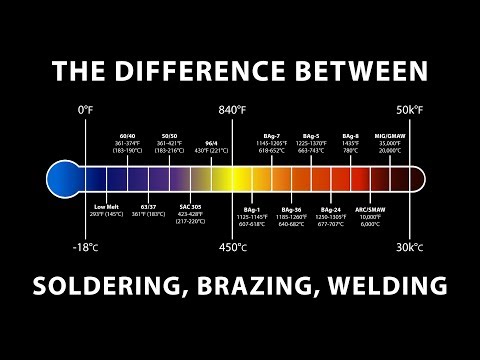
Welding vs brazing vs soldering comes down to heat and what melts. Welding melts the base metal for the strongest joint, brazing melts only a filler metal above 840°F (450°C), and soldering melts a filler below 840°F for light-duty and electrical joints.
So pick welding for structural steel and load-bearing frames. Pick brazing for HVAC lines, carbide tips and mixed metals. Pick soldering for electronics, small copper water lines and jewelry.
The 840°F line comes from the American Welding Society (AWS) definitions. Everything else, from joint strength to the tools you buy, follows from that one number and from whether the base metal melts.
Welding vs Brazing vs Soldering at a Glance
| Feature | Welding | Brazing | Soldering |
|---|---|---|---|
| Does the base metal melt? | Yes | No | No |
| Filler melting point | Near the base metal’s melting point | Above 840°F (450°C), below the base metal | Below 840°F (450°C) |
| Typical work temperature | Base metal melting point at the joint | About 1,150°F to 1,600°F (620°C to 870°C) | Below 840°F |
| Joint strength | Highest; can match or beat the base metal | High; about 5 times the shear strength of solder | Lowest; not for load-bearing joints |
| Dissimilar metals | Limited with most processes | Yes | Yes |
| Distortion | Highest | Low | Lowest |
| Common heat sources | Arc (MIG, TIG, stick, flux core), laser, resistance | Torch, furnace, induction, resistance | Soldering iron, torch, hot plate, reflow oven |
| Typical uses | Bridges, buildings, pressure vessels, pipelines, ships | HVAC and refrigeration, radiators, auto parts, carbide tools | Electronics, plumbing, stained glass, jewelry |
What Is Welding?
Welding joins metal by melting the base metals at the joint so they fuse into one piece. Most processes add a filler metal, and many use a shielding gas to protect the molten pool from air.
The common arc processes are GMAW (MIG), GTAW (TIG), SMAW (stick) and FCAW (flux core). ESAB notes that a good weld is as strong as or stronger than the base metal, which is why welding carries bridges, buildings and pressure vessels.
The cost of that strength is heat. Welding puts the most heat into the part, so it causes the most distortion and residual stress, and some jobs need stress relief after welding.
What Is Brazing?
Brazing joins metal with a filler metal that melts above 840°F (450°C) but below the melting point of the parts. The base metals stay solid, and the molten filler gets pulled into a tight joint by capillary action.
Lucas-Milhaupt, a brazing alloy maker, gives a joint gap of about 0.002 to 0.005 inch for best results. ESAB puts typical brazing temperatures at 1,150°F to 1,600°F (620°C to 870°C).
Braze filler metals come in families named by AWS, such as BAg (silver), BCuP (copper-phosphorus), BCu (copper), BNi (nickel) and BAlSi (aluminum-silicon). Heat comes from a torch, a furnace, an induction coil or resistance heating.
What Is Soldering?
Soldering joins metal with a filler, called solder, that melts below 840°F (450°C). Like brazing, the base metals do not melt, and flux cleans the surface so the solder can wet and bond to it.
Older solders were tin-lead. TWI lists lead-free options built on tin with silver, copper, antimony, bismuth or indium. For drinking water lines in the US, the Safe Drinking Water Act limits solder and flux to 0.2% lead.
Solder joints conduct electricity well, so soldering is the standard way to connect wires and parts on circuit boards. Plumbers also solder copper pipe for household water lines.
Credit: www.youtube.com
Welding vs Brazing vs Soldering: The Core Difference
Welding melts the base metal. Brazing and soldering melt only the filler, and the AWS 840°F (450°C) filler melting point is the line between them.
Key Differences
Temperature
Welding works at the melting point of the base metal, which for steel is far above any braze or solder. Brazing fillers melt above 840°F, and solders melt below it.
The lower the heat, the safer the process is for thin walls, nearby plastic parts and heat-sensitive electronics. EWI notes that many parts can be damaged by brazing heat and do better with solder.
Base Metal Melting
Only welding melts the parts themselves. Brazing and soldering leave the base metal solid and bond the filler to its surface, so the parts keep most of their original properties.
Joint Strength
Welding gives the strongest joints, followed by brazing, then soldering. EWI states that brazed joints usually have about 5 times the shear strength of soldered joints.
A well-designed brazed joint with the right gap can match the strength of the base metal, per Lucas-Milhaupt. Solder is usually weaker than the metals it joins, so a soldered joint tends to fail through the solder.
Heat Resistance in Service
Welds hold up best at high service temperatures. Lucas-Milhaupt notes that soldered joints and adhesives cannot handle temperatures above about 200°F (93°C) under load, which rules solder out near engines, exhaust and furnaces.
Dissimilar Metals
Brazing and soldering join mixed pairs such as copper to steel or brass to stainless steel. Most welding processes join only similar metals, so brazing is the usual pick for carbide tips on steel tool bodies.
Distortion and Heat Damage
Welding causes the most warping and residual stress. Brazing and soldering cause little distortion and usually need no heat treatment after joining, which helps on thin tubing and finished parts.
Appearance and Cleanup
Brazed and soldered joints form smooth, neat fillets. Weld beads are rougher and often need grinding on visible parts. Brazing and soldering both leave flux residue that you should clean off to stop corrosion.
Equipment and Skill
Soldering needs the least gear: a soldering iron for electronics or a torch for copper pipe. Brazing on a small job needs a torch hot enough for the filler, flux and clean, tight joints.
Welding needs a welding machine, a helmet, gloves and often a gas cylinder. ESAB notes that brazing is easier to learn than welding.
Where Each One Fits
- Welding: structural steel, trailers, frames, pressure vessels, pipelines, ship hulls and any joint that carries heavy load.
- Brazing: HVAC and refrigeration lines, radiators, automotive parts, carbide-tipped tools, bike frames and mixed-metal parts.
- Soldering: circuit boards and wire splices, household copper water lines, stained glass, jewelry and small sheet metal seams.
Copper pipe shows how the three overlap. ESAB notes that plumbers usually solder copper water lines, refrigeration techs braze copper refrigerant lines, and industrial copper systems may be welded.
For copper-to-copper refrigeration joints, BCuP alloys are self-fluxing, so no flux residue is left inside the closed system, per EWI and Lucas-Milhaupt.
Safety Notes for All Three
All three make fumes, and fluxes can contain toxic compounds. Work with good ventilation or fume extraction, and keep your face out of the plume.
Some older silver braze alloys contain cadmium. EWI lists BAg-1 at 24% cadmium, and cadmium fumes are highly toxic. Choose a cadmium-free alloy such as BAg-34 when you can, and check the safety data sheet before you heat any filler.
Torch brazing and soldering are open-flame work, so clear away anything that can burn and keep a fire extinguisher close. Arc welding adds UV light and electric shock risk, so wear a welding helmet, dry gloves and flame-resistant clothing.
Which One Should You Choose?
Choose welding if:
- The joint carries structural or heavy load.
- The part runs hot in service.
- You are joining similar metals, such as steel to steel, in thick sections.
Choose brazing if:
- You need a strong, leak-tight joint with little distortion.
- You are joining two different metals, such as copper to steel.
- You are working on HVAC or refrigeration copper lines.
Choose soldering if:
- The joint must conduct electricity, as on a circuit board.
- The parts can’t take much heat.
- You are joining household copper water pipe with lead-free solder.
Frequently Asked Questions
Is Brazing Stronger Than Welding?
No, welding is stronger in most cases. A weld fuses the base metals into one piece, so it can match or beat the base metal. A well-designed brazed joint can also reach base metal strength, but welds hold up better under heavy load and high service heat.
Is Brazing Stronger Than Soldering?
Yes. EWI states that brazed joints usually have about 5 times the shear strength of soldered joints. Braze fillers melt above 840°F and form a stronger bond. Solder is softer and weaker than most base metals, so a soldered joint tends to fail through the solder itself.
What Temperature Separates Brazing From Soldering?
The line is 840°F (450°C), set by the American Welding Society. A filler that melts above 840°F, but below the base metal, is a braze filler. A filler that melts below 840°F is a solder. Silver-based fillers melt well above that line, so they count as brazing alloys.
Can You Braze or Solder Steel?
Yes. Steel brazes well with silver, copper or nickel braze fillers and the right flux, and brazing can join steel to copper or brass. Steel can also be soldered with a suitable flux, but the joint is weak, so use it only for light-duty seams and never for load-bearing parts.
Is Silver Soldering the Same as Brazing?
Usually, yes. “Silver soldering” often means brazing with a silver alloy, because most silver fillers melt above 840°F, which makes them braze alloys under AWS rules. Some low-temperature tin-silver solders melt below 840°F, so check the filler’s melting range on its data sheet.
Final Words
Welding, brazing and soldering sit on one heat scale. Welding melts the parts for the strongest joint, brazing melts a filler above 840°F for strong, low-distortion joints, and soldering melts a filler below 840°F for electrical and light-duty work.
Start with the load, the service temperature and the metals involved. Those three answers point to the right process almost every time.