
Disclosure: This post contains affiliate links and I will be compensated if you make a purchase after clicking through my links. Learn More
In CV vs CC welding, pick constant voltage (CV) for wire-fed MIG and flux core, and pick constant current (CC) for stick and TIG. CV holds the voltage you set and lets current follow the wire, and CC holds the amperage you set and lets your hand control the arc.
The process decides the output, so most buyers never choose between them in a vacuum. The choice matters when you buy a used machine, try to stick weld on a MIG unit, or run a suitcase feeder off a stick welder.
CV vs CC Welding at a Glance
CV vs CC welding comes down to which value the machine holds steady. Every other difference follows from that.
| Feature | CV (constant voltage) | CC (constant current) |
|---|---|---|
| Value held steady | Voltage | Amperage |
| What you set | Voltage and wire feed speed | Amperage |
| Who controls arc length | The machine, through preset voltage | Your hand |
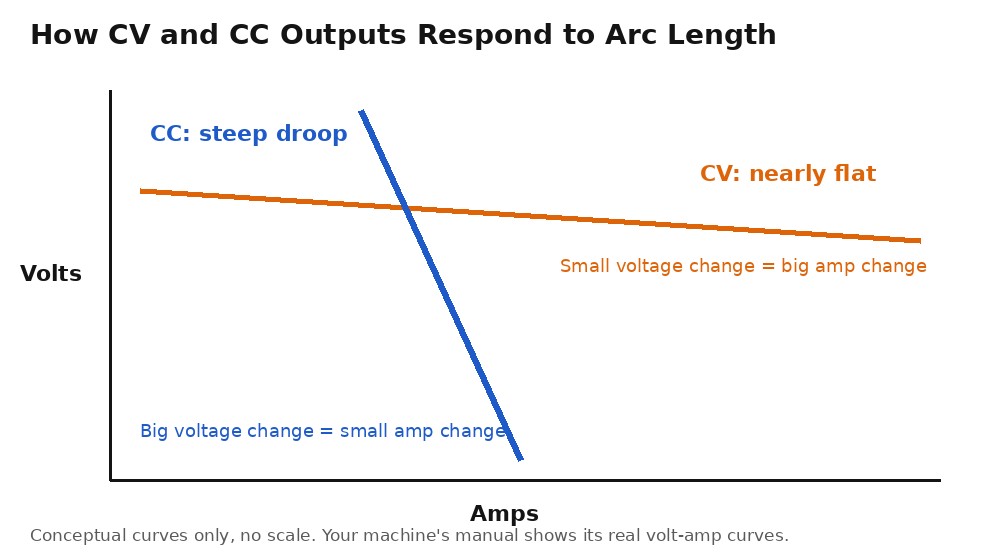
| Volt-amp curve | Nearly flat | Drooping (stick) or nearly vertical (TIG) |
| Main processes | GMAW (MIG), FCAW (flux core) | SMAW (stick), GTAW (TIG) |
| Typical machine | MIG welder, wire feeder | Stick welder, TIG welder |
What Is CV Welding?
CV welding uses a power source that holds a preset voltage. Paul Cameron explains in Practical Welding Today that arc length relates directly to voltage, so a fixed voltage holds a steady arc length as the wire feeds.
Current is not set on a CV machine. It follows wire feed speed, wire diameter, and stick-out. Faster wire or thicker wire raises current and penetration. Longer stick-out lowers current, and Cameron notes it can drop by 25 to 50 amps.
What Is CC Welding?
CC welding uses a power source that holds a preset amperage. Voltage is only measured, and it rises and falls with the arc length you hold by hand.
Miller Electric says a stick electrode runs at about 20 volts at a normal arc length. Pull the rod back and voltage climbs. Push it in and voltage drops. The machine keeps the current close to your setting either way.
Key Differences Between CV and CC
What You Set on the Machine
On CV, voltage and wire feed speed are the controlling settings, and current is the result. On CC, amperage is the controlling setting, and voltage is the result.
How Arc Length Changes the Output
Higher voltage gives a longer, wider arc. Lower voltage gives a shorter, narrower arc. On CV, the preset voltage keeps that length steady, so a semiautomatic wire process stays stable without perfect hand control.
On a CC stick machine, Miller notes that amperage moves opposite to voltage. A shorter arc raises amperage a little, and a longer arc lowers it. That small swing lets you push heat into a puddle by tightening the arc.
Volt-Amp Curve Shape
A CV curve is nearly flat: a small voltage change brings a big current change. Older stick machines earned the nickname “droopers” for their sloped curve. Miller says a TIG output is nearly vertical, so amperage stays constant when arc length changes.
Bead Shape and Penetration
Miller ties voltage to bead height and width and amperage to penetration. On CV you shape the bead with voltage and drive penetration with wire speed. On CC you set penetration with the amperage knob and shape the bead with arc length and travel.
Where Each One Fits
Each output matches how the filler metal gets fed. A wire process feeds filler at a fixed speed, so it needs a fixed voltage. A manual process depends on your hand, so it needs a fixed current.
Credit: www.youtube.com
- MIG (GMAW): CV. Short-circuit, spray, and most hobby MIG work.
- Flux core (FCAW-S and FCAW-G): CV for the best arc stability.
- Stick (SMAW): CC. A MIG-only CV machine is not intended or recommended for stick welding.
- TIG (GTAW): CC with a nearly vertical curve, which keeps heat steady on thin metal.
Running Wire on a CC Machine
A voltage-sensing suitcase feeder with a CC/CV switch can run wire off a CC stick machine. Fabricating & Metalworking reports that gas-shielded flux core and spray transfer, at about 24 volts or higher, handle CC fairly well.
Short-circuit MIG and self-shielded flux core, usually at 22 volts or lower, run much less stable on CC. Long arcs with self-shielded wire on CC can cause porosity and lower low-temperature impact toughness. Use CV whenever you have it, and always for code-quality work.
Multiprocess Machines
A multiprocess welder carries both outputs. Miller’s XMT 350 CC/CV, for example, covers stick, TIG, MIG, flux core, and air carbon arc gouging from one power source.
Newer inverters with pulse waveforms adjust voltage and current so fast that they don’t fit neatly into either group. Treat pulse modes as their own setting and follow the machine’s manual.
Which One Should You Choose?
Pick the output by the process you plan to run most.
Choose CV if:
- You weld mostly with MIG or flux core wire.
- You want the machine to hold arc length for you.
- You run production or code work with wire.
Choose CC if:
- You stick weld outdoors, on rusty steel, or on pipe.
- You TIG weld thin steel, stainless, or aluminum.
- You want a machine that a suitcase feeder can borrow for gas-shielded flux core in the field.
Need both? A multiprocess machine with CV and CC modes costs more but saves buying 2 power sources.
Frequently Asked Questions
Can You Stick Weld With a CV Welder?
Not well. A MIG-only machine with CV output is not intended or recommended for stick welding. Stick needs constant current, because your hand sets the arc length and the machine has to hold amperage steady. Use a CC machine or a multiprocess unit with a stick mode.
Is MIG Welding CV or CC?
MIG welding runs on constant voltage. You set the voltage and the wire feed speed, and the machine lets current rise or fall with wire speed and stick-out. That holds arc length steady as the wire feeds. Flux core welding uses CV for the same reason.
Is TIG Welding CV or CC?
TIG welding uses constant current. Miller notes that a TIG output has a nearly vertical volt-amp curve, so amperage stays the same even when your arc length changes. That steady current protects thin metal. A drooping stick output used for TIG can add current and burn through.
Can You Run Flux Core on a CC Welder?
You can with a voltage-sensing suitcase feeder, but results are limited. Gas-shielded flux core and spray transfer, around 24 volts or higher, handle CC fairly well. Self-shielded flux core and short-circuit MIG run poorly on CC. Use a CV power source whenever you have one, and always for code-quality work.
What Does a Multiprocess Welder Do for CV and CC?
A multiprocess welder has both CV and CC outputs in one box. You switch modes to run MIG and flux core on CV, then stick or TIG on CC. These machines cost more, but one power source covers the common arc processes.
Final Words
CV holds voltage for wire processes, and CC holds amperage for stick and TIG. Match the output to the process and most arc problems tied to the power source go away.
If you want to run everything from one box, look at a multiprocess machine. Check its manual for which modes are CV, which are CC, and how its pulse settings behave.