Disclosure: This post contains affiliate links and I will be compensated if you make a purchase after clicking through my links. Learn More
Why does your weld have tiny holes, also called porosity? Tiny holes form when trapped gas bubbles get stuck in the cooling weld metal. These holes weaken the weld, look bad, and can cause failures if not fixed. Porosity has clear causes and practical solutions.
What Is Porosity In Welding?
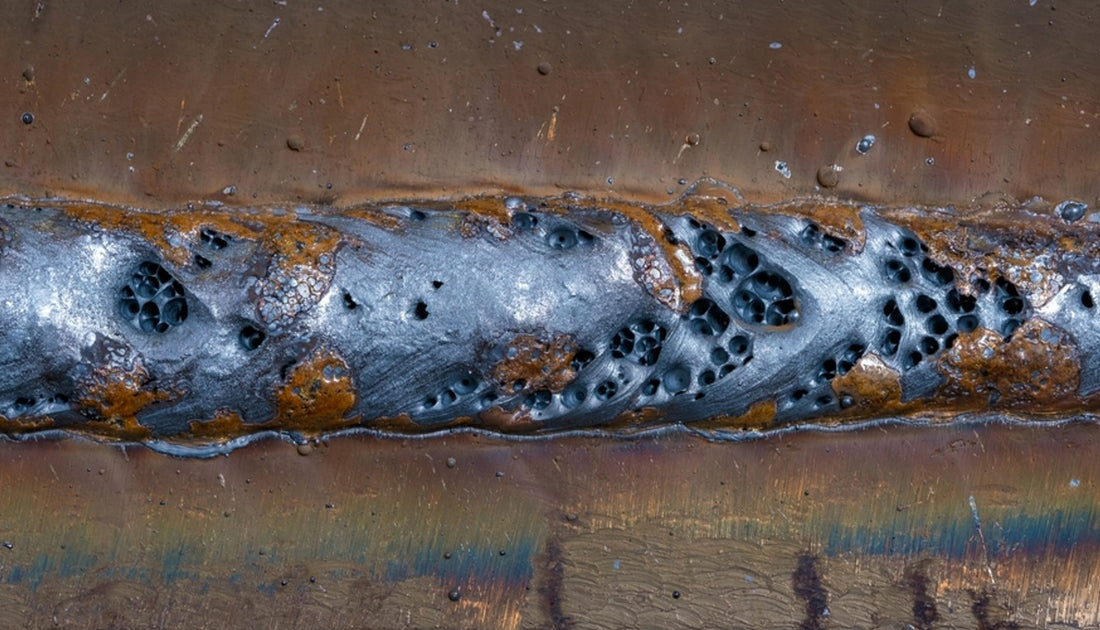
Porosity means small holes or cavities inside or on the surface of a weld. They can look like pinholes, bubbles, or even larger craters, depending on how much gas is trapped. These holes happen when gas cannot escape before the weld solidifies.
Porosity is a common welding defect across MIG, TIG, stick (SMAW), and flux-cored processes. It’s not just about looks—porosity reduces weld strength, can make the joint leak, and may cause the weld to fail under stress.
Welders often spot porosity as small dots or craters on the bead or by grinding the weld and seeing internal holes. Many new and even experienced welders face this issue, but with the right knowledge, it’s easy to control.
Why Porosity Is A Problem
Porosity is more than just an ugly mark. Here’s why you must take it seriously:
- Reduces weld strength: Gas pockets mean less metal holding the joint together.
- Creates leaks: Especially dangerous for tanks, pipes, or pressure vessels.
- Can hide other defects: Porosity may signal deeper welding problems.
- Fails inspections: Any code or industry standard will flag porosity as a defect.
Porosity isn’t always visible. Sometimes, it’s hidden inside the weld. X-rays or ultrasonic tests often find these hidden flaws in critical jobs.

Credit: www.thefabricator.com
What Causes Porosity In Welds?
Porosity forms when gas gets trapped in the molten metal, then freezes inside as the weld cools. Here are the main reasons gas gets trapped:
1. Contaminated Workpiece
Dirt, oil, grease, rust, moisture, paint, or coatings on the metal release gas during welding. This gas can’t escape and forms holes. Always clean your base metal down to shiny bare metal before welding.
2. Bad Filler Material
Wet, rusty, or oily electrodes or filler rods also give off gas. Moisture in stick electrodes or flux-cored wire is a major cause of porosity. Always store electrodes in a dry, clean place and never use damaged wire.
3. Incorrect Shielding Gas
Wrong gas type or flow rate leads to porosity. For example, using pure CO₂ instead of an argon mix for MIG on stainless steel increases porosity. Too little gas means air gets in; too much gas creates turbulence and sucks in air.
4. Poor Gas Coverage
If the shielding gas is blown away by wind or a draft, the weld pool is exposed to oxygen and nitrogen. These gases cause porosity. Always weld indoors or block the wind if outside.
5. Faulty Equipment
Leaks in hoses, loose gas fittings, or a broken regulator reduce gas coverage. A blocked or dirty MIG nozzle also ruins shielding. Regularly check hoses and fittings for leaks and keep your equipment clean.
6. Poor Welding Technique
Holding the MIG gun or TIG torch too far from the work lets air mix with the shielding gas. Moving too fast or using the wrong angle also affects gas coverage.
7. Incorrect Welding Parameters
Welding with too high or too low voltage/amperage can cause unstable arcs, spatter, and porosity. Each metal and welding process has an optimal setting.
8. Excessive Travel Speed
Moving the torch or gun too quickly doesn’t let gas protect the weld pool, allowing air to get in and causing pinholes.
9. Damp Or Dirty Flux
For stick and flux-cored welding, moisture in the flux coating or wire releases hydrogen gas, which creates hydrogen porosity. Always keep flux materials dry.
10. Wrong Electrode Angle
Incorrect torch or electrode angle reduces gas coverage and lets air get in, causing porosity, especially in corners or tight spots.
Types Of Porosity
Porosity isn’t all the same. Understanding different types helps you identify the root cause.
Surface Porosity
Small holes visible on the weld bead. Usually caused by poor cleaning or lack of shielding gas.
Subsurface Porosity
Holes inside the weld, not visible without grinding or x-ray. Often from moisture or deep contamination.
Linear Porosity
A row of holes, often along the edge of the weld. Signals a continuous gas problem, like a leaking gas nozzle.
Scattered Porosity
Random holes, not in a line. Usually from inconsistent gas coverage or scattered contamination.
Crater Porosity
Holes at the end of the weld bead. Often from stopping too quickly or not filling the crater.
Credit: simpleweld.com
How To Identify Porosity In Welds
Spotting porosity is mostly visual, but sometimes you need extra tools.
- Visual inspection: Look for tiny holes, bubbles, or craters on the surface.
- Grinding: Grind the surface to check for hidden porosity.
- X-ray or ultrasonic testing: Finds hidden porosity in critical welds.
- Dye penetrant: For surface porosity, color seeps into holes and shows up under light.
If you see holes, don’t ignore them. Even small porosity can signal a bigger problem.
How Porosity Affects Weld Quality
Porosity weakens the weld. Here’s what it does:
- Reduces load capacity: Weld can break under stress.
- Makes joints leaky: Pipes, tanks, and pressure vessels may fail.
- Causes corrosion: Moisture can collect in holes and rust from inside out.
- Fails code inspections: Most codes (like ASME, AWS) strictly limit porosity.
In critical jobs, even a small amount of porosity can mean a failed weld and lost time or money.
Detailed Causes Of Porosity And How To Fix Each One
Let’s break down the most common causes and how to stop them.
Base Metal Contamination
Reason: Oil, paint, rust, or water vapor give off gas.
Solution: Clean the weld area with a grinder, wire brush, or chemical cleaner. Dry the metal before welding. For painted or galvanized metal, grind down to bare steel.
Dirty Or Wet Filler Material
Reason: Filler rods or wire pick up moisture, oil, or rust.
Solution: Store rods and wire in a dry place. Use only clean, dry filler material. For stick welding, bake electrodes in an oven if they get damp.
Wrong Shielding Gas Or Flow Rate
Reason: The wrong gas mix or too much/too little flow.
Solution: Check your gas type (argon, CO₂, or mix) for the metal you’re welding. Set your flow rate to 20–30 cubic feet per hour (CFH) for MIG/TIG. Avoid high flows that cause turbulence.
Poor Gas Coverage
Reason: Wind, drafts, or blocked nozzle lets air in.
Solution: Weld indoors if possible. Use wind shields outdoors. Clean the MIG nozzle often. Hold the gun about ½ inch from the work.
Equipment Problems
Reason: Leaks or worn parts reduce gas protection.
Solution: Check hoses, fittings, and regulators for leaks. Replace damaged parts. Clean or replace the MIG or TIG nozzle if clogged.
Bad Welding Technique
Reason: Wrong torch angle, distance, or speed.
Solution: Keep a consistent arc length (⅜ to ½ inch for MIG). Hold the gun at 10–15° from vertical. Move at a steady, not too fast speed.
Incorrect Welding Parameters
Reason: Wrong voltage, amperage, or wire feed speed.
Solution: Set machine to recommended settings for your metal and process. Adjust as needed for weld bead appearance.
Moisture In Flux Or Electrode
Reason: Damp flux releases hydrogen gas.
Solution: Store flux and stick electrodes in a dry oven. Never weld with damp consumables.
Wrong Electrode Angle
Reason: Too steep or flat angle reduces gas coverage.
Solution: For MIG, use a 10–15° push angle. For stick, keep electrode at 15° from vertical.
Improper Termination
Reason: Stopping too quickly leaves a crater.
Solution: Fill the crater at the end of the weld by pausing or making a small circle before stopping.
Common Welding Processes And Porosity
Each process has unique porosity causes. Here’s how it happens for each:
Mig (gmaw)
- Typical porosity: Poor gas coverage, dirty base metal, too fast travel.
- Key fix: Use correct gas, check for leaks, keep nozzle clean.
Tig (gtaw)
- Typical porosity: Contaminated base/filler, wind, wrong gas.
- Key fix: Use pure argon, keep everything very clean, block drafts.
Stick (smaw)
- Typical porosity: Damp electrodes, dirty metal, too long arc.
- Key fix: Dry electrodes, clean base, correct arc length.
Flux-cored (fcaw)
- Typical porosity: Damp wire, wrong polarity, fast travel.
- Key fix: Dry wire, correct polarity, steady speed.
Comparing Porosity Causes By Welding Process
This comparison shows which causes matter most for each welding process:
| Cause | MIG | TIG | Stick | Flux-Cored |
|---|---|---|---|---|
| Contaminated Base Metal | High | High | Medium | High |
| Wet Filler Material | Medium | Medium | High | High |
| Poor Gas Coverage | High | High | Low | Medium |
| Wrong Parameters | Medium | Medium | High | High |
High means a major cause, Medium means possible, Low means rare.
Real-world Example: Porosity In Pipeline Welding
A pipeline welder notices pinholes after welding a section. Inspection finds surface and subsurface porosity. Investigation shows:
- Welded outdoors on a windy day.
- Used old, damp electrodes.
- Base metal had traces of oil.
After switching to dry rods, cleaning the metal, and blocking the wind, the porosity problem disappeared. This highlights how small changes prevent major weld defects.

Credit: www.youtube.com
Effects Of Porosity On Different Applications
Porosity affects jobs differently:
- Structural steel: Weakens joints, may cause failure under load.
- Pressure vessels: Causes leaks, dangerous for gas/liquid tanks.
- Food/Pharma equipment: Holes trap bacteria, violate sanitary codes.
- Automotive/transport: Reduces fatigue strength, risk of weld cracking.
- Artistic/ornamental: Hurts appearance, not always a strength issue.
In critical jobs, even small porosity is unacceptable.
Porosity Prevention: Step-by-step
Follow these steps to avoid porosity in your welds:
- Clean everything: Remove all oil, rust, paint, and moisture.
- Check filler material: Use only clean, dry rods and wire.
- Use correct shielding gas: Match gas type and flow to the metal and process.
- Block wind and drafts: Weld indoors if possible; use screens outdoors.
- Check equipment: Inspect hoses, regulators, and nozzles for leaks and blockages.
- Set parameters right: Use the recommended voltage, amperage, and travel speed.
- Use proper technique: Hold the torch/gun at the right angle and distance.
- Store consumables dry: Keep rods, wires, and flux away from moisture.
- Fill craters: Don’t stop too quickly—fill the end of the weld bead.
- Inspect your welds: Look for holes, grind if needed, and test critical welds.
Porosity Troubleshooting Table
Here’s a quick troubleshooting guide for welders:
| Porosity Symptom | Probable Cause | Solution |
|---|---|---|
| Pinhole dots on bead | Dirty base metal | Clean metal before welding |
| Random holes | Dirty filler, bad gas coverage | Check filler, adjust gas flow |
| Holes at weld end | Quick stop, no crater fill | Pause to fill crater |
| Row of holes | Leaking nozzle or wind | Fix leaks, block drafts |
| Holes after rain/humidity | Damp electrodes/flux | Dry consumables before use |
Two Insights Beginners Miss About Porosity
- Shielding gas flow matters more than you think. Too much gas is just as bad as too little. High flow creates turbulence, which pulls in air and causes porosity. Use a flow meter and stick to the recommended settings.
- Humidity is a hidden enemy. Even small amounts of moisture—from humid air, sweaty hands, or a damp shop—can cause porosity. Always store rods and flux in a warm, dry place, especially in rainy or humid climates.
Essential Tips For Preventing Porosity
- Preheat thick or rusty metal to drive off moisture before welding.
- Use anti-spatter spray on nozzles to keep them clean.
- Purge inside pipes or tubes with inert gas when welding stainless steel.
- Keep a log of settings and problems to track what works in your shop.
- Don’t trust your eyes alone: Sometimes, porosity is hidden. Test critical welds.
Industry Standards For Porosity
Industry codes like AWS D1.1 or ASME Section IX set limits for acceptable porosity in welds. For example, AWS D1.1 allows only isolated small pores, not in clusters or along the weld’s edge. Always check the code for your project.
If you’re unsure, get a copy of the code or see the latest rules at the American Welding Society or AWS D1.1.
When To Repair Or Remove A Porous Weld
- For critical structures, pressure vessels, or code work: Always repair porosity.
- For non-structural or ornamental work: Minor porosity may be acceptable.
- If in doubt: Grind out the porous area and re-weld.
- Never just weld over porosity: Gas trapped inside will cause more holes.
Welding Safety And Porosity
Porosity often means there’s contamination, moisture, or chemical fumes in your workspace. These can be health hazards. Always ventilate your area, wear gloves, and keep your shop clean. Don’t breathe fumes from painted or rusty metal.
Frequently Asked Questions
What Is Weld Porosity And Why Should I Care?
Weld porosity means there are tiny holes or bubbles in your weld. These holes make your welds weaker, can cause leaks, and may even make your project fail safety tests. Fixing porosity is important for strong, safe welds.
Can I Fix A Weld With Porosity, Or Do I Need To Start Over?
You can fix a porous weld by grinding out the bad area and re-welding it. Never just weld over the holes, because trapped gas will cause more problems. Always find and fix the cause before repairing the weld.
Does Porosity Only Happen With Mig Welding?
No, porosity happens with all welding processes—MIG, TIG, stick, and flux-cored. The causes and fixes may be a little different for each process, but any time gas gets trapped, you can get porosity.
How Do I Know If My Shielding Gas Is Causing Porosity?
If you see porosity and you know your metal and filler are clean, check your shielding gas. Look for leaks, blocked nozzles, or the wrong flow rate. Welding outdoors or in a draft can also blow away your gas and cause holes.
Is A Little Porosity Okay In Non-critical Welds?
For non-critical or decorative welds, a tiny bit of porosity may be fine. But for any weld carrying weight, pressure, or passing inspection, you should remove or repair all porosity to keep your work strong and safe.
—
Tiny holes in your weld—porosity—are a common but serious problem. They hurt strength, cause leaks, and can ruin your project. The main causes are contaminated metal, wet rods, bad gas coverage, and poor technique. The fixes are simple: keep everything clean, use the right gas, store materials dry, and check your technique. Spot porosity early, fix it the right way, and your welds will be stronger and more reliable every time.