Disclosure: This post contains affiliate links and I will be compensated if you make a purchase after clicking through my links. Learn More
Welding thin metal is one of the most challenging jobs for beginners and even experienced welders. Thin metal—like sheet metal, car body panels, and ductwork—melts quickly and easily, making it hard to get strong, clean welds without burning holes. Many people think you can only weld thin metal with a MIG welder and shielding gas. But flux core welding offers a practical, affordable way to join thin materials, even outside or in windy conditions where gas is a problem.
If you want to fix a car fender, build a small project, or repair garden tools, you may already have a flux core welder at home. The question is—how do you use it successfully on thin metal without destroying your work? This article explains everything you need to know, from picking the right wire and settings to controlling heat and avoiding warping. You will learn proven methods, tips, and real-world examples so you can weld thin metal with confidence.
Why Flux Core Is Good For Thin Metal
Flux core welding uses a wire filled with flux that creates its own protective gas as it melts. This means you do not need a separate gas bottle, which is great for outdoor work. Flux core welding (also called FCAW) is popular for beginners because the machines are often cheaper and more portable than gas MIG welders.
Many people think flux core is only for thick, rough steel. But with the right technique, you can use it on thin metal as well. The main challenge is that flux core produces more heat and spatter than MIG with shielding gas.
This can burn through thin material if you are not careful.
But flux core still has advantages:
- No shielding gas required: Works well outdoors and in windy areas.
- Good penetration: Strong welds, even on dirty or rusty metal.
- Easy to set up: Most machines are plug-and-play.
The key is learning how to control the heat and move the welder properly.
Understanding Thin Metal
Thin metal means material that is usually 1/16 inch (1.6 mm) or less. Common types include:
- Sheet metal: Used for cars, appliances, and ductwork (often 18–22 gauge).
- Light tubing: For furniture, racks, or small frames.
- Auto body panels: Often 20–22 gauge.
Welding thin metal is tricky because:
- It heats up very fast.
- It can burn through and create holes.
- It can warp or twist if overheated.
You must use the lowest possible heat that still gives a strong weld. Small mistakes show up easily.

Credit: www.youtube.com
Tools And Equipment You Need
To weld thin metal with flux core, you need a few basic tools. Using the right equipment makes the process smoother and results stronger.
Essential Tools
- Flux core welder: A small 110V/120V machine is usually enough. Look for models with adjustable voltage and wire speed.
- Flux core wire: Use .030″ (0.8 mm) wire for thin metal. .035″ (0.9 mm) can work but is riskier for burn-through.
- Proper tips and nozzles: Use contact tips that match your wire size.
- Angle grinder or wire brush: For cleaning metal before welding.
- Welding pliers: Helpful for changing wire and cleaning tips.
- Clamps and magnets: Hold pieces together tightly during welding.
Safety Gear
- Auto-darkening welding helmet
- Welding gloves
- Long sleeves and pants (to protect from sparks)
- Safety glasses (when cleaning or grinding)
Optional Items
- Copper backing bar: Absorbs heat and prevents burn-through.
- Sheet metal screws or clecos: Hold thin pieces together for small repairs.
- Welding blanket: Protects nearby surfaces from sparks.
Choosing The Right Flux Core Wire
Picking the right wire is the first step to welding thin metal successfully.
Wire Size
- .030″ (0.8 mm): Best for most thin metal jobs. Gives good control and lower heat input.
- .035″ (0.9 mm): Possible on slightly thicker sheet, but increases risk of burn-through on very thin metal.
Wire Type
There are two main types of flux core wire:
- E71T-GS: Self-shielded, works with most hobby welders. Ideal for thin steel.
- E71T-11: Similar, but sometimes used for thicker materials.
For thin metal, choose E71T-GS in .030″ size.
Brand And Quality
Not all wires are equal. Cheap wires can give poor results, with lots of spatter and weak welds. Stick to trusted brands like Lincoln Electric, Hobart, or Forney. Read reviews and avoid unknown brands.
Storage
Flux core wire absorbs moisture, which can cause porosity (tiny holes) in your welds. Keep the spool in a dry place and seal it in a bag if you do not use it often.
Machine Settings For Thin Metal
Setting your welder correctly is critical. Small changes make a big difference. Here is what you should adjust:
Voltage And Amperage
- Use the lowest voltage that still gives a stable arc.
- Many small welders have only a High/Low switch. Use Low for thin metal.
- If your machine has a dial, start near the lowest setting and increase slowly if needed.
Wire Speed
- Start at a low to medium wire speed.
- Too fast: The wire pushes into the puddle, causing spatter and irregular welds.
- Too slow: The wire burns back, the arc is unstable, and the weld is weak.
- Adjust until you hear a steady, sharp “sizzling” sound.
Polarity
Flux core wire needs DCEN (Direct Current Electrode Negative), also called “straight polarity”. Check your welder’s manual and connect the torch to the negative terminal.
Example Machine Settings
Here is a general guide for 18–22 gauge (1.2–0.8 mm) steel:
| Metal Thickness | Wire Size | Voltage | Wire Speed |
|---|---|---|---|
| 22 gauge (0.8 mm) | .030″ | Low | Medium |
| 20 gauge (1.0 mm) | .030″ | Low to Med | Medium |
| 18 gauge (1.2 mm) | .030″ | Medium | Medium to High |
Always test on a scrap piece first, as every welder is a little different.
Preparing Thin Metal For Welding
Good preparation is half the battle. Flux core wire can handle some rust and paint, but thin metal needs special care to avoid weak welds.
Clean The Metal
- Use a wire brush or grinder to remove rust, paint, oil, and dirt.
- Clean at least 1/2 inch around the weld area.
- Even new steel may have a coating called mill scale—remove it if possible.
Fit-up And Gaps
- Tight fit is important. Even a small gap makes burn-through more likely.
- Use clamps or magnets to hold pieces together firmly.
- For patch panels, try to make the pieces fit with almost zero gap.
Backing Bar
A copper backing bar or aluminum block placed under the seam can absorb heat and prevent burn-through. Copper does not stick to steel welds, so you can weld right against it.
Tack Welds
Make small tack welds (quick weld spots) every 1–2 inches to hold the metal in place. This stops warping and keeps the gap from opening during welding.
Techniques For Welding Thin Metal With Flux Core
You cannot use the same method as you would for thick steel. Thin metal needs a gentle approach.
Stitch Welding
This is the safest way to weld thin steel. Make a short weld (1/4″ or 6 mm), then move to another spot, let it cool, and repeat. This spreads out the heat.
Steps:
- Weld a short bead (1/4″).
- Skip ahead a few inches.
- Weld another short bead.
- Repeat until the seam is complete.
- Go back and fill in the gaps, letting each spot cool before welding again.
This method prevents burn-through and warping.
Spot Welding (plug Welds)
If you need to join panels, you can drill small holes (1/4″) in one piece, place it over the other, and weld through the holes. This makes a strong connection without long beads.
Push Or Pull?
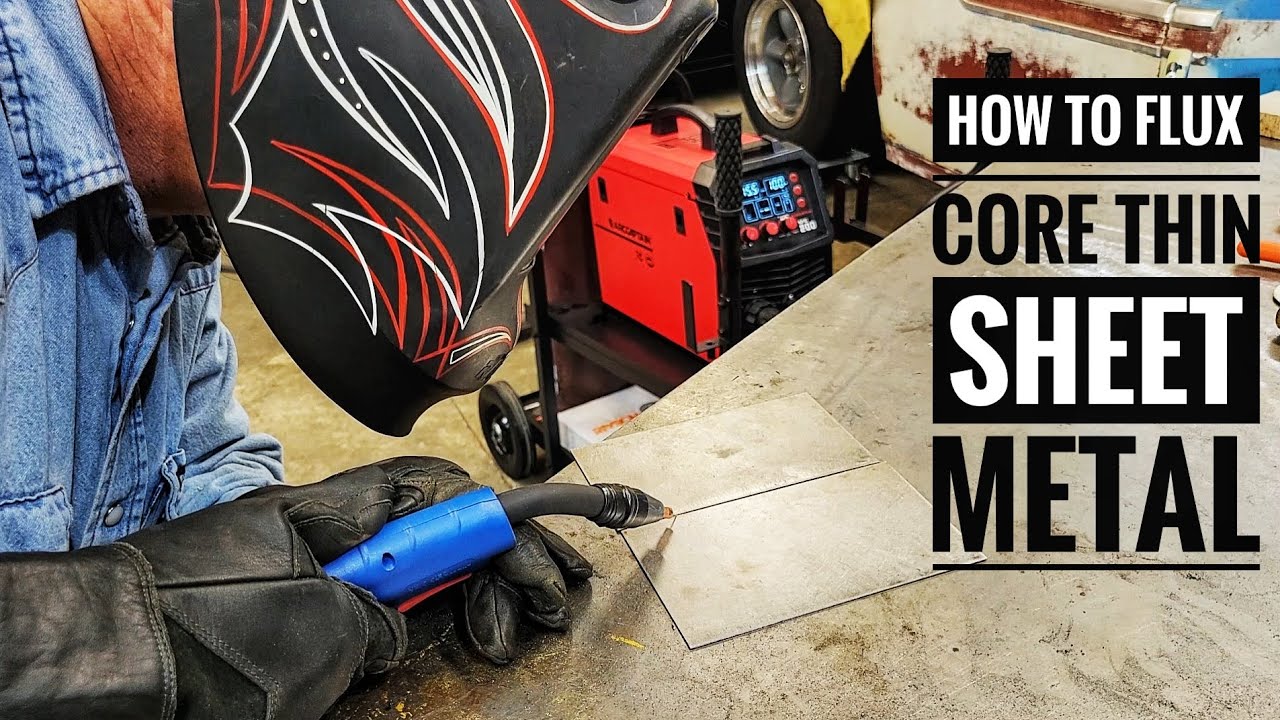
For flux core, always drag (pull) the gun. Angle the tip back at about 10–15 degrees, and pull away from the weld. This gives better penetration and less spatter.
Travel Speed
Move the gun quickly across thin metal. Do not linger in one place—this will melt through. Practice smooth, steady motion.
Gun Angle And Distance
- Keep the nozzle 1/4″ to 1/2″ from the work.
- Hold at a 10–15 degree angle.
- Too far: Weak welds and spatter.
- Too close: Wire may stick.
Example: Car Panel Repair
Suppose you want to weld a patch into a car fender:
- Clean the area well.
- Cut a patch to fit with almost no gap.
- Clamp in place with copper behind.
- Tack every 1–2 inches.
- Stitch weld, jumping around to avoid heat buildup.
- Grind smooth if needed.
Avoiding Burn-through And Warping
The biggest problems when welding thin metal are burn-through (holes) and warping (bending).
How To Prevent Burn-through
- Lower the heat: Use the lowest setting that gives a steady arc.
- Move fast: Do not stay in one spot.
- Use stitch welds: Do not run long beads.
- Let metal cool: Wait between welds.
- Use copper backing: Absorbs extra heat.
How To Prevent Warping
- Tack first: Tack welds keep the metal from moving.
- Weld in short bursts: Do not overheat the area.
- Jump around: Weld different sections rather than in a straight line.
- Clamp well: Use strong clamps or magnets.
- Use a wet rag: Cool the metal between welds.
Example Table: Actions To Prevent Problems
| Problem | Prevention |
|---|---|
| Burn-through | Lower heat, stitch weld, move fast, use backing bar |
| Warping | Tack weld, short welds, jump around, cool with rag |
| Excess spatter | Correct wire speed, clean metal, proper gun angle |
Cleaning And Finishing The Weld
Flux core welds leave a layer of slag on top. This must be removed for a clean finish.
Removing Slag
- Use a chipping hammer or old screwdriver to knock off the slag.
- Brush with a wire brush for a shiny finish.
Grinding
If you want a smooth surface (like on car panels), use an angle grinder with a flap disc. Go gently—do not grind away too much and thin the metal further.
Painting
Bare metal rusts quickly. Spray with primer or paint as soon as possible.
Common Mistakes When Welding Thin Metal With Flux Core
Many beginners make the same errors. Avoid these for better results:
- Using too much heat: Causes burn-through and warping.
- Wrong wire size: .035″ is too thick for very thin metal.
- Not cleaning the metal: Dirt and rust make weak, porous welds.
- Long welds: Overheats the material.
- Wrong gun angle: Causes spatter and weak beads.
- Poor fit-up: Gaps make it much harder.
- Not tacking first: Pieces move and warp.
Credit: www.arccaptain.com
Practical Tips From Experienced Welders
Here are some useful tips that many new welders miss:
- Practice on scrap: Always test your settings on extra metal first.
- Use both hands: Steady the gun with your off-hand for better control.
- Work in good light: Shadows make it hard to see the puddle.
- Watch the puddle, not the arc: Focus on where the metal is melting.
- Pause between welds: Give the work time to cool.
- Keep wire clean: Dirty wire causes feeding problems.
- Replace tips often: Worn tips lead to poor arc control.
Comparing Flux Core With Mig Welding For Thin Metal
Many people wonder if they should use flux core or switch to MIG (gas shielded) for thin metal. Here is a quick comparison:
| Feature | Flux Core | MIG (Gas) |
|---|---|---|
| Outdoor use | Excellent | Poor (wind blows gas away) |
| Thin metal welds | Possible, needs care | Easier, cleaner |
| Cost | Lower (no gas needed) | Higher (gas bottle needed) |
| Spatter | More | Less |
| Penetration | Good | Good |
| Portability | High | Low |
If you work outside or do not want to buy gas, flux core is a good choice. If you do a lot of thin metal work in a garage, consider investing in a MIG setup.
Safety Advice For Flux Core Welding
Welding always has risks, and flux core adds some special safety concerns:
- Sparks and spatter: These can burn skin and clothing. Always wear gloves and long sleeves.
- Fumes: Flux core makes more smoke than MIG. Weld in a well-ventilated area. Do not breathe the fumes.
- Eye protection: Use an auto-darkening helmet and safety glasses.
- Fire risk: Sparks travel far. Keep flammable materials away.
- Wire tension: If the wire jams, turn off the machine before fixing it.
Example Projects That Use Thin Metal Welding
Many small jobs need you to weld thin metal. Here are a few examples:
- Car body repair: Fixing rust holes or patching panels.
- Ductwork: Joining or repairing thin HVAC sheet metal.
- Tool repair: Fixing shovels, rakes, or brackets.
- Small frames: Furniture, carts, or bike racks.
- Metal art: Sculptures or decorative pieces.
For all these jobs, follow the same basic rules: clean the metal, use .030″ wire, low heat, and short welds.
Extra Insights Most Beginners Miss
Many guides skip these advanced tips, but they can make a big difference:
- Let the panel air-cool: Do not use compressed air—it can create hard spots or cracks in the weld.
- Pre-bend panels: Thin metal often warps when welded. Pre-bend the panel slightly in the opposite direction. When you finish welding, it will flatten out.
- Test for penetration: On a test scrap, weld a bead, then break the metal. Check if the weld holds or tears off. Good penetration means the weld is strong.
When To Avoid Flux Core For Thin Metal
While you can weld thin metal with flux core, it is not always the best choice.
- For stainless steel: Flux core wire is usually for mild steel only.
- For aluminum: Flux core wire for aluminum is rare and difficult to use on thin material.
- For show surfaces: If you need a perfect, almost invisible weld (like on custom cars), MIG with shielding gas gives a cleaner result.
If your project demands a very smooth finish or you need to weld aluminum, look for other welding methods.

Credit: www.mig-welding.co.uk
Useful Resources
If you want to see how experienced people handle thin metal with flux core, check out tutorials and forums. For technical details and more advanced guidance, visit the WeldingWeb Forum.
Frequently Asked Questions
What Is The Thinnest Metal I Can Weld With Flux Core?
With good skill and. 030″ wire, you can weld as thin as 22 gauge (0. 8 mm) steel. Below this thickness, burn-through becomes very hard to avoid. Always test on scrap first.
Why Does My Flux Core Weld Have Lots Of Spatter?
Common causes are too much wire speed, dirty metal, or a wrong gun angle. Try lowering wire speed, cleaning the area, and dragging the gun at a 10–15 degree angle.
Can I Weld Stainless Steel Or Aluminum Thin Metal With Flux Core?
Flux core wire for stainless is rare and not recommended for thin sheets. Aluminum flux core wire is almost impossible to use on thin metal. Stick to mild steel for best results.
Should I Use Gas With My Flux Core Wire For Thin Metal?
No. Self-shielded flux core wire does not need gas. Using gas with flux core can cause problems and is not needed for thin steel.
How Do I Fix A Hole Made By Burn-through?
Let the area cool. Place a copper backing bar behind the hole. Start with tack welds at the edges, letting the metal cool between welds. Fill in the hole slowly, moving the gun quickly and using short bursts.
Welding thin metal with flux core is challenging, but not impossible. With the right setup, good technique, and patience, you can make strong, clean welds that last. Always practice on scrap, pay attention to heat, and do not rush the job.
With experience, your results will improve, and you will be able to tackle more complex projects with confidence.