Disclosure: This post contains affiliate links and I will be compensated if you make a purchase after clicking through my links. Learn More
A fillet weld joins two surfaces at a right angle or a similar angle. It is common in construction, automotive, shipbuilding, and many other fields. People use fillet welds because they are strong, efficient, and easy to make. But, to get a safe and reliable weld, you must give clear instructions about its size and shape.
This is where the dimensions for a fillet weld come in.
If you read a welding drawing or prepare one, you will see symbols, numbers, and notes that explain the weld. These details are not just for looks. They give the welder the exact information needed. Mistakes in these dimensions can lead to weak joints, failed structures, or wasted materials.
So, knowing how the dimensions for a fillet weld are given is important for both safety and cost.
This article explains how the dimensions for a fillet weld are specified. You will learn about the standard methods, key terms, and common practices. Whether you are new to welding or want to improve your understanding, this guide will help you read, write, and check fillet weld dimensions like an expert.
What Is A Fillet Weld?
A fillet weld is a triangular weld that connects two metal pieces at an angle, most often 90 degrees. Fillet welds are used in T-joints, lap joints, and corner joints. They are popular because they do not require much joint preparation. They are also faster and cheaper to produce compared to groove welds.
The shape of a fillet weld is not a perfect triangle, but it is close. The size and shape affect the strength and performance. So, the dimensions must be clear and correct.
Why Fillet Weld Dimensions Matter
Clear and correct dimensions are essential for three main reasons:
- Safety: If a weld is too small, it may fail under load. If it is too large, it can cause distortion or waste material.
- Cost: Too much weld metal increases costs. Too little makes the structure weak.
- Quality control: Inspectors use the dimensions to check the welds. If the weld does not match the drawing, it will fail inspection.
Small mistakes in dimensions can cause big problems. For example, a bridge weld that is 2 mm smaller than required may not hold the weight it should.
Key Terms Used In Fillet Weld Dimensions
Before you read a drawing or give instructions, you need to know these terms:
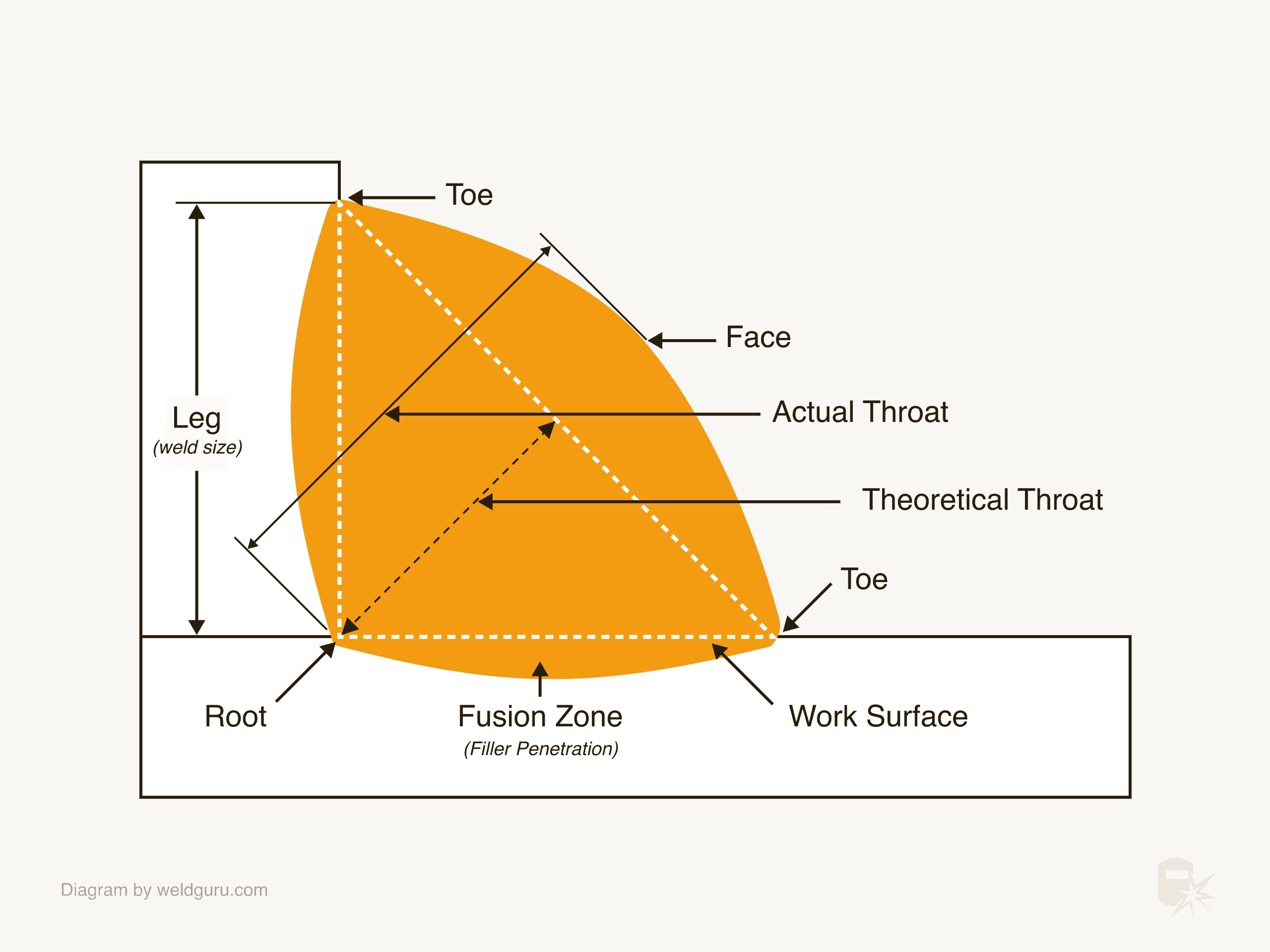
- Leg length: The length of the two sides of the weld triangle that touch the base metals.
- Throat: The shortest distance from the root (where the two metals meet) to the face (outer surface) of the weld.
- Weld size: Usually means the leg length or the throat, depending on the standard.
- Effective throat: The part of the throat that actually carries the load.
- Convexity/Concavity: The shape of the weld face. Convex means it bulges out, concave means it curves in.
Some standards use different words, but these are the most common.
How Are Fillet Weld Dimensions Given?
Fillet weld dimensions are given in standard ways so that anyone can understand the size, length, and other details. The most used standards are from the American Welding Society (AWS) and the International Organization for Standardization (ISO).
Standard Methods
Drawings use symbols, numbers, and notes to show weld dimensions. The main methods are:
- Symbolic method: Uses weld symbols on the drawing.
- Numeric method: Uses numbers to show size, length, and spacing.
- Supplementary notes: Give extra details if needed.
Let’s look at each method.
Symbolic Representation
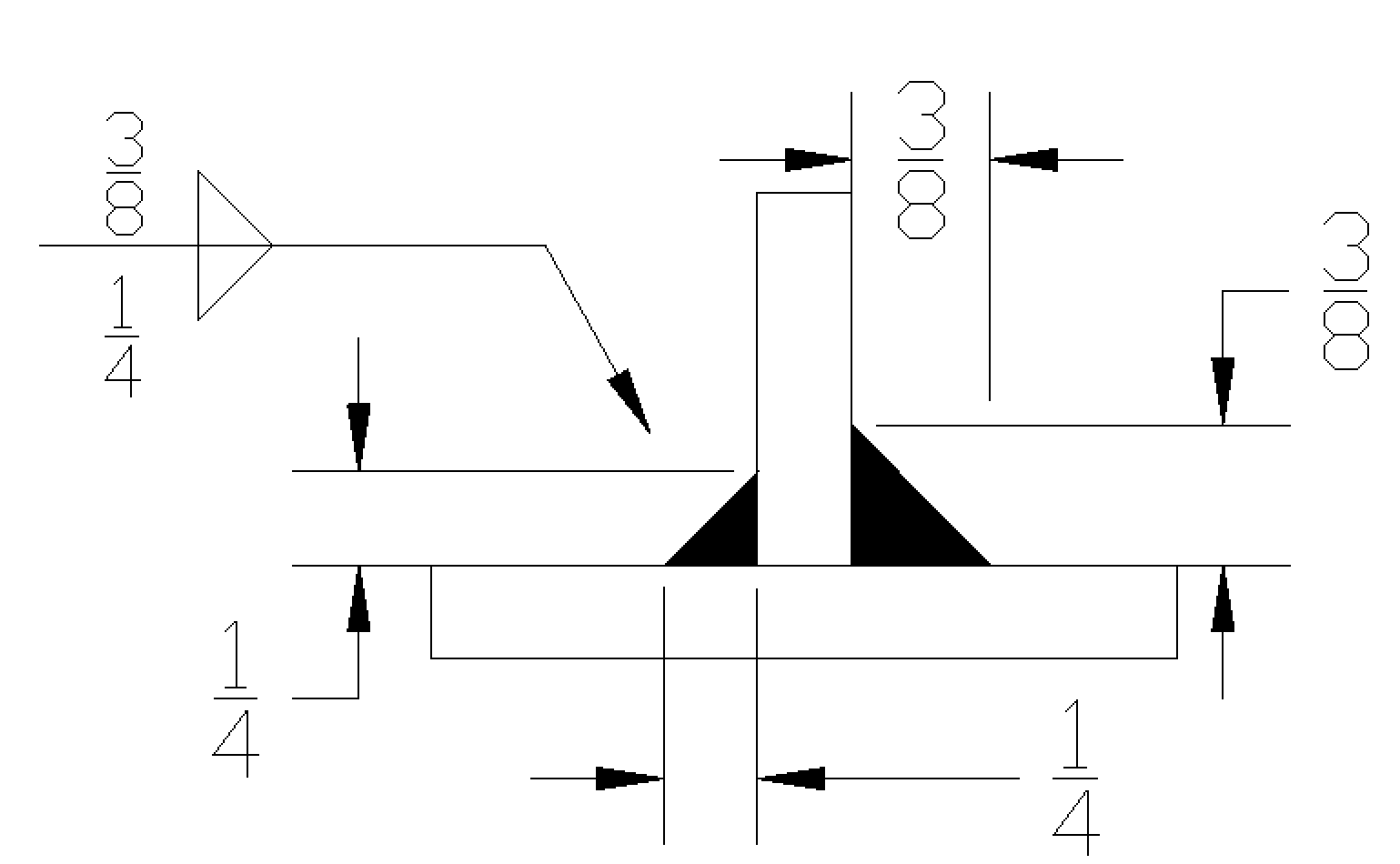
A weld symbol is a small picture that shows the type of weld and its size. It has a reference line, an arrow, and the symbol for the weld.
The fillet weld symbol looks like a small right triangle. You will see it on the reference line, either above or below. Where the symbol is placed tells you which side of the joint to weld.
Example:
If you see this on a drawing:
Arrow ---- Reference Line
|
| ⏋ 6
The triangle means “fillet weld. ” The “6” means the weld leg length is 6 mm.
Numeric Representation
Numbers are used with symbols to give the exact size.
- Leg length: Written to the left of the symbol. For example, “6” means both legs are 6 mm.
- Weld length: Written to the right of the symbol. For example, “100” means the weld is 100 mm long.
- Pitch (center-to-center spacing): Given after the weld length, separated by a dash. For example, “100-200” means a 100 mm weld every 200 mm.
Example:
6 ⏋ 100-200
This means: 6 mm leg, 100 mm weld, spaced every 200 mm.
Supplementary Notes
Sometimes the designer adds notes for more detail, such as:
- “All around” (a circle at the junction): Weld goes all the way around the joint.
- “Field weld” (a flag): Weld on site, not in the shop.
- “Staggered welds”: Welds are not in a straight line but offset.
Understanding The Fillet Weld Symbol
The fillet weld symbol is a core part of welding drawings. Here’s how to read it:
- Reference line: The horizontal line where the symbol sits.
- Arrow: Points to the joint to be welded.
- Symbol: The triangle shows a fillet weld.
- Size (leg length): Left of the symbol.
- Weld length: Right of the symbol.
- Other symbols: “All around,” “field weld,” etc.
Placement Of The Symbol
- Below the line: Weld on the arrow side.
- Above the line: Weld on the other side.
- Both sides: Symbols on both sides mean weld both.
This system avoids confusion and helps welders know exactly what to do.
Common Fillet Weld Dimensions
The size of a fillet weld depends on the thickness of the materials and the forces they must carry. Here are some typical sizes:
- Light structures (thin metal): 3 mm to 6 mm leg length
- Medium structures: 6 mm to 10 mm
- Heavy structures (bridges, cranes): 10 mm to 16 mm or more
If you need to weld 8 mm thick plates, a common fillet weld size is 6 mm.
Fillet Weld Dimensioning Standards: Aws Vs Iso
Different countries use different standards. The two main ones are AWS (used in the US) and ISO (used in Europe and many other places).
Aws (american Welding Society)
- Weld size: Given as leg length (S).
- Symbol: Triangle.
- Throat: Sometimes specified for special cases.
Iso (international Organization For Standardization)
- Weld size: Can be leg length (a) or throat thickness (z).
- Symbol: Triangle, but the size is written differently.
- Placement: The symbol and numbers are placed above or below the reference line, depending on the side.
Example Comparison
| Feature | AWS | ISO |
|---|---|---|
| Leg Length | Left of symbol (e.g., 6) | After “a” (e.g., a6) |
| Throat | Sometimes (special cases) | After “z” (e.g., z4.2) |
| Placement | Above/below line for side | Above/below line for side |
This table shows that while both standards use similar symbols, they write the size in different ways.
Leg Length Vs Throat Thickness: Which To Use?
The leg length and throat thickness are two ways to describe the size of a fillet weld. Most drawings use leg length, but some use throat thickness, especially for critical joints.
- Leg length is easy to measure and check.
- Throat thickness is more accurate for load calculations because it shows the “shortest path” across the weld.
For example, a 6 mm leg length fillet weld has a throat thickness of about 4. 2 mm (6 × 0. 707).
Some codes require throat thickness for dynamic loads or fatigue-prone joints.
How To Specify Unequal Leg Fillet Welds
Sometimes, the two legs of the fillet weld are not equal. This can happen when you weld plates of different thicknesses.
To show this, write both sizes with an “x” between them:
- AWS: “6×8” means one leg is 6 mm, the other is 8 mm.
- ISO: “a6x8” or “a8x6”.
Unequal leg fillet welds are not as common, but they are important for certain designs.
How To Show Intermittent Fillet Welds
Not all welds run the whole length of a joint. Sometimes, small welds are spaced along the joint. This is called an intermittent fillet weld.
To show this, write:
- Weld length: The length of each weld.
- Pitch: The distance from the start of one weld to the start of the next.
For example: “6 ⏋ 50-150” means a 50 mm weld every 150 mm, with 6 mm legs.
Intermittent welds save material and reduce distortion, but they must be clear on the drawing.
How To Specify Continuous Fillet Welds
If the weld goes all the way along the joint, you do not need to write the length. The symbol alone means a continuous weld.
For extra clarity, you can use the “all around” symbol (a small circle at the elbow of the reference line).
How To Indicate The Location Of The Fillet Weld
A drawing can show fillet welds on one side, both sides, or all around. The placement of the symbol tells the welder where to put the weld.
- Symbol below the line: Arrow side
- Symbol above the line: Other side
- Symbols both sides: Both sides
This system avoids mistakes.
Convex, Concave, And Flat Fillet Welds
The face of a fillet weld can have different shapes:
- Convex: The weld face bulges out. Stronger but uses more metal.
- Concave: The weld face curves in. Less metal, sometimes better for fatigue.
- Flat: The weld face is level with the base metals.
To show this, add a small curve to the symbol or write a note. For example, “convex” or “concave. ”
How To Measure A Fillet Weld
Inspectors use special gauges to check the size of the fillet weld. They measure the leg length, throat, and sometimes the shape (convex or concave).
A common tool is the fillet weld gauge, which has cutouts for different sizes. The inspector places the gauge on the weld to see if it matches the drawing.
Example Welding Drawings And What They Mean
Here are three examples to show how fillet weld dimensions appear on drawings.
Example 1: Simple Fillet Weld
6 ⏋
This means a 6 mm leg fillet weld, continuous, on the arrow side.
Example 2: Intermittent Weld, Both Sides
6 ⏋ 50-150
⏋
This means 6 mm leg, 50 mm long welds, every 150 mm, on both sides.
Example 3: All Around Weld
6 ⏋ (with a circle at the elbow)
This means 6 mm fillet weld, continuous, all around the joint.
Common Mistakes When Giving Fillet Weld Dimensions
People often make the following mistakes:
- Missing sizes: Not writing the leg length or throat.
- Wrong placement: Putting the symbol on the wrong side of the line.
- No units: Not saying if the size is in mm or inches.
- Confusing length and pitch: Mixing up the weld length and spacing.
- Ignoring standards: Mixing AWS and ISO methods.
Avoid these mistakes to ensure safe and clear instructions.
Credit: openoregon.pressbooks.pub
How To Decide The Correct Fillet Weld Size
The correct size depends on:
- Material thickness: The weld should be strong enough for the thinnest plate.
- Load: Heavier loads need bigger welds.
- Code requirements: Follow the rules of your industry or country.
- Distortion: Larger welds can bend the metal.
Often, engineers use formulas or tables from standards to pick the right size.
Sample Table: Recommended Fillet Weld Sizes
For quick reference, here is a table for common plate thicknesses and recommended weld sizes.
| Plate Thickness (mm) | Recommended Fillet Weld Leg Size (mm) |
|---|---|
| Up to 3 | 3 |
| 3 – 5 | 4 |
| 5 – 8 | 6 |
| 8 – 12 | 8 |
| 12 – 20 | 10 |
These are just guidelines. Always check your project specifications.
Advanced: Special Fillet Welds And Their Dimensioning
Some projects need special fillet welds, such as:
- Staggered intermittent welds: Welds are offset on both sides.
- Slot welds with fillet reinforcement: Used for special connections.
- Combination welds: Fillet and groove welds together.
These need extra notes or symbols on the drawing.
How To Read A Full Welding Symbol
A full welding symbol can have many parts:
- Reference line
- Arrow
- Fillet weld symbol
- Size (leg or throat)
- Length
- Pitch
- Finish symbol (if needed)
- Notes (“all around,” “field weld,” etc.)
Here is an example of a full symbol:
6 ⏋ 50-150
⏋
(circle at elbow)
This means: 6 mm leg, 50 mm welds every 150 mm, both sides, all around.
How Software And Cad Tools Help
Modern CAD software lets you add weld symbols and dimensions quickly. It checks the standards and helps avoid mistakes. But you still need to understand the basics to use the tools correctly.
How To Communicate Fillet Weld Dimensions On Site
On the shop floor or construction site, people use:
- Drawings with symbols and notes
- Weld maps (showing where each weld goes)
- Weld procedure specifications (WPS)
Clear communication avoids errors and wasted time.
Real-world Example: Bridge Welding
A bridge designer specifies:
- Plates: 20 mm thick
- Load: Heavy vehicles
The drawing shows:
10 ⏋ (circle at elbow)
This tells the welder to use a 10 mm leg fillet weld, all around the joint. Inspectors check every weld for correct size and coverage.
Fillet Weld Size Vs. Strength: A Data Table
How does weld size affect strength? Here is a simplified table for mild steel (for illustration):
| Leg Length (mm) | Throat (mm) | Approximate Strength (kN/m) |
|---|---|---|
| 4 | 2.8 | 14 |
| 6 | 4.2 | 21 |
| 8 | 5.7 | 28 |
| 10 | 7.1 | 35 |
This shows that a larger weld can carry more load, but costs more.
Credit: weldguru.com
Inspection And Quality Control
Inspectors check:
- Size: Using gauges.
- Length and spacing: With a tape measure.
- Shape: Visual check for concave, convex, or flat.
- Location: Matches the drawing.
If the weld does not match the drawing, it may need repair.
Non-obvious Insights
- The drawing always “wins.” If there is a conflict between written notes and symbols, follow the drawing.
- Bigger is not always better. Oversized welds can cause distortion or cracks. Always use the size the engineer gives.
- Throat is key for strength. Even if the legs look big, a small throat means a weak weld.
- Intermittent welds can save money but are not allowed for every application. Check the code first.

Credit: www.millerwelds.com
Practical Tips For Giving Fillet Weld Dimensions
- Always use the same units (mm or inches) throughout the drawing.
- Double-check the side (arrow or other) before placing the symbol.
- If in doubt, add a note for clarity.
- For complex joints, include a sketch or section view.
Where To Learn More
To go deeper, see the AWS A2.4 standard for welding symbols, or the ISO 2553 standard. These documents give full details on all symbols and rules. The Wikipedia page on welding symbols is also a good place to start.
Frequently Asked Questions
What Is The Most Common Way To Give Fillet Weld Dimensions?
The most common way is to use the weld symbol (a triangle) with the leg length to the left and the weld length to the right of the symbol. This follows the AWS standard.
How Do You Specify A Fillet Weld On Both Sides Of A Joint?
You put the fillet weld symbol on both sides of the reference line. This tells the welder to weld on both sides of the joint.
What Does “all Around” Mean In Fillet Weld Dimensioning?
“All around” means the weld goes completely around the joint. It is shown by a small circle at the elbow where the arrow and reference line meet.
When Should You Use Throat Thickness Instead Of Leg Length?
Use throat thickness for critical joints, especially those that will carry dynamic or fatigue loads. Throat thickness gives a more accurate idea of the weld’s strength.
Can You Use Intermittent Fillet Welds Everywhere?
No. Intermittent fillet welds are not allowed in all cases. For example, joints that need to be airtight or watertight must have continuous welds.
A clear understanding of how fillet weld dimensions are given helps you make safe, strong, and cost-effective joints. With practice and careful attention to standards, you can read and specify fillet welds with confidence.