Disclosure: This post contains affiliate links and I will be compensated if you make a purchase after clicking through my links. Learn More
What is silver brazing? Silver brazing is a brazing process that joins metals with a silver-bearing filler alloy that melts above 840°F (450°C) but below the melting point of the base metals. The base metal never melts. Heat and flux let the liquid filler flow into a tight joint by capillary action.
You may also hear it called silver soldering or hard soldering. Most silver brazing rods carry roughly 5% to 50% silver, with copper and zinc making up most of the rest. Some grades add tin, nickel or cadmium.
Shops use it to join copper to steel, braze carbide tips and repair HVAC lines. It runs cooler than welding and needs only a torch, the right rod and flux.
What Is Silver Brazing and How Does It Work?
Silver brazing works by heating the joint, not the rod, until the base metal is hot enough to melt the filler on contact. The molten alloy then wicks through the gap and bonds to both surfaces as it cools.
The American Welding Society draws the line between brazing and soldering at 840°F (450°C). Fillers that melt above it are brazing alloys. Fillers that melt below it are solders. Silver brazing alloys melt in a range of about 1,145°F to 1,650°F (618°C to 899°C), according to Weld Guru.
Three things make the process work:
- Tight clearance: a gap of 0.002 to 0.005 inch (0.051 to 0.127 mm) gives the strongest capillary pull.
- Clean metal: oil, paint and oxide block wetting, so sand or wire brush the joint first.
- Active flux: flux keeps oxygen off the hot metal and lets the filler wet the surface.
For a wider look at how this compares with fusion welding and soft solder, our page on welding vs brazing vs soldering covers the full picture.
Silver Brazing Alloys and Their Temperatures
Silver brazing alloys are classed under AWS A5.8 with a “BAg” prefix. Each alloy has a solidus (where it starts to melt) and a liquidus (where it is fully liquid). A narrow gap between the two means the rod flows fast and cleanly.
| Alloy (maker) | Class or type | Silver content | Melt or brazing range |
|---|---|---|---|
| Silver Alloy 50 (Prince & Izant) | AWS BAg-1a, contains cadmium | 50% | Solidus 1,160°F (627°C), liquidus 1,175°F (635°C), braze at 1,225°F to 1,275°F |
| Silver-flo 55 (Johnson Matthey) | Low temp, step brazing | See data sheet | 630°C to 660°C (1,166°F to 1,220°F) |
| Silver-flo 33 (Johnson Matthey) | Mid temp, step brazing | See data sheet | 700°C to 740°C (1,292°F to 1,364°F) |
| Silver-flo 18 (Johnson Matthey) | High temp, step brazing | See data sheet | 784°C to 816°C (1,443°F to 1,501°F) |
| Safety-Silv 45 and 56 | For iron and steel, with white flux | Sold as 45% and 56% | See maker data sheet |
| Stay-Silv 15 and Dynaflow | Phosphorus-bearing, copper only | Sold as 15% (Stay-Silv 15) | See maker data sheet |
Silver Alloy 50 has a melting range of only 15°F, which is why Prince & Izant calls it a free-flowing eutectic-type filler. It joins nearly all nickel, iron and copper based alloys.
Cadmium vs Cadmium-Free Alloys
Older silver brazing alloys such as BAg-1a hold 18% cadmium, which lowers the flow temperature. The catch is the fume. Prince & Izant warns that poisonous fumes may form when the alloy is heated and recommends cadmium-free alloys.
For home and HVAC work, buy a rod labeled cadmium-free. Check the label or safety data sheet before you light the torch.
Phosphorus-Bearing Rods vs High-Silver Rods
Low-silver rods like Stay-Silv 15 contain phosphorus and are self-fluxing on copper. Stoody warns that phosphorus alloys on iron or steel can leave a brittle joint. HVAC School gives the same warning for 15% rod on steel.
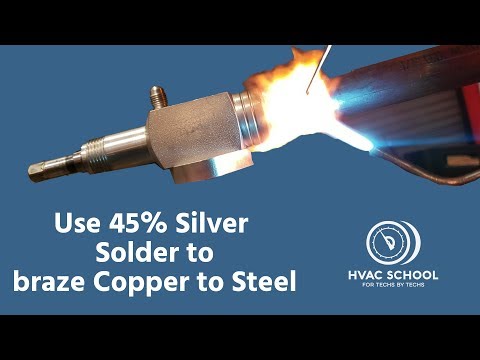
For copper to steel, use a 45% or 56% silver rod with white flux. For copper to copper, a phosphorus rod with no flux usually does the job.
Credit: www.youtube.com
What Metals Can You Silver Braze?
Silver brazing joins almost all ferrous and non-ferrous metals. Weld Guru lists the main exceptions as aluminum, magnesium and other metals with too low a melting point.
| Base metal | Works with silver brazing? | Notes |
|---|---|---|
| Copper to copper | Yes | Phosphorus rod, no flux needed |
| Copper to steel | Yes | 45% or 56% silver rod plus flux |
| Brass and bronze | Yes | Use white flux |
| Stainless steel | Yes, with care | Johnson Matthey recommends Argo-braze 56 or 63 to limit interface corrosion |
| Tungsten carbide tips | Yes | Silver-flo 55 fills 0.05 mm (0.002 in) gaps on tips up to 9 mm long |
| Gray cast iron | With prep | Remove surface graphite first |
| Aluminum, magnesium, titanium | No | Silver fluxes do not work on these metals |
Stainless steel deserves a second look. Johnson Matthey notes that common silver alloys like Silver-flo and Easy-flo are the least resistant to interfacial corrosion on stainless. For wet or marine stainless parts, it recommends Argo-braze 56 or 63.

Credit: www.youtube.com
Choosing the Right Flux
Flux must melt and turn active before the filler melts, and it must stay active until the joint is done. Johnson Matthey gives a simple rule: the flux should work from at least 50°C (90°F) below the solidus to at least 50°C (90°F) above the liquidus of the rod.
For Silver Alloy 50, that means a flux active from about 1,070°F to 1,265°F at minimum. High-temperature rods like Silver-flo 18 need a high-temperature flux.
Flux also works as a heat gauge. Stoody advises heating until the flux passes its bubbling stage and turns clear. That is the moment to touch the rod to the joint.
How to Silver Braze: Basic Steps
The six steps Johnson Matthey lists for any brazed joint are joint design, filler choice, cleaning, fluxing, heating and flux removal. Here is how that looks on a copper to steel joint.
- Fit the joint. Aim for 0.002 to 0.005 inch clearance. On tube up to 1 inch (25 mm), overlap one tube diameter.
- Clean both parts. Use emery cloth or a stainless wire brush until the metal is bright.
- Flux the male part. Brush a thin coat on the male end only, so excess flux stays out of the line.
- Heat with a neutral flame. Heat the copper first, as HVAC School shows, then the whole joint, until the flux turns clear.
- Feed the rod. Touch the rod to the joint, not the flame. Capillary action pulls it into the gap.
- Clean the flux off. Soak in hot water above 104°F (40°C) for about 30 minutes, or wire brush it.
On refrigerant lines, HVAC techs also flow nitrogen through the tube to limit oxide scale inside, and wrap valves in a wet rag to protect the seats.
Silver Brazing Safety
Silver brazing involves an open flame, hot metal, fluoride flux and metal fumes. Treat every joint as a fire and fume risk.
- Ventilation: braze only with fume extraction, exhaust fans or a supplied-air respirator, per ANSI Z49.1. Stand back from the work, not over it.
- Cadmium: cadmium oxide fumes are highly toxic. Use cadmium-free rod unless a spec demands otherwise.
- Flux: silver brazing flux contains fluorides. Wear gloves and wash your hands before eating.
- Pickle: sodium bisulfate pickle is corrosive. Use copper tongs and eye protection.
- Fire: clear wood, insulation and fuel from the area and keep an extinguisher close.
Pros and Cons of Silver Brazing
| Pros | Cons |
|---|---|
| Joins dissimilar metals such as copper to steel | Silver content raises rod cost |
| Base metal does not melt | Needs tight fit-up of 0.002 to 0.005 inch |
| Leak-proof joints on pipe and tube | Flux residue must be cleaned off |
| Low flow temperatures near 1,200°F | Some alloys contain cadmium |
| Works with a simple torch setup | Does not work on aluminum or magnesium |
Frequently Asked Questions
Is silver brazing the same as silver soldering?
Yes, in most shops the two names mean the same process. Silver soldering is an older name for silver brazing, and some people call it hard soldering. The filler melts above 840°F (450°C), so by the AWS temperature line it counts as brazing.
Can you silver braze with a propane torch?
Yes, for small copper and brass parts a propane or MAPP torch can reach low-temperature silver alloys that flow near 1,200°F. Larger steel parts and thick fittings soak up heat fast. For those joints, HVAC School’s demo uses an oxy-acetylene torch with a neutral flame.
How strong is a silver brazed joint?
A silver brazed joint gets most of its strength from joint design. Keep the gap at 0.002 to 0.005 inch and use a lap joint. Johnson Matthey advises an overlap of 3 to 4 times the thickness of the thinnest part, or one diameter on small tube.
Can you silver braze aluminum?
No, standard silver brazing alloys and silver fluxes do not work on aluminum. Johnson Matthey states silver fluxes are not effective on aluminum, magnesium or titanium. To braze aluminum, you need a filler rod and flux made for aluminum and its tough oxide layer.
Do you need flux for silver brazing?
Yes, silver brazing needs flux on steel, stainless steel, brass and bronze. Phosphorus-bearing rods such as Stay-Silv 15 are self-fluxing only on copper to copper. Pick a flux that stays active from about 90°F below the rod’s solidus to 90°F above its liquidus.
Final Words
Silver brazing gives you a strong, leak-proof joint between metals that would be hard to weld together. It runs at lower heat than welding and needs only a torch, flux and the right rod.
Match the alloy to the job. Use a phosphorus rod for copper to copper and a 45% or 56% silver rod for copper to steel. Pick cadmium-free rod and keep the fumes away from your face.
Start with a clean, tight joint and let the flux tell you when the metal is hot enough. That habit fixes most bad brazed joints before they happen.