Disclosure: This post contains affiliate links and I will be compensated if you make a purchase after clicking through my links. Learn More
You can MIG weld mild steel with 100 argon in the sense that the wire will arc and lay a bead, but you shouldn’t use it for any weld that has to hold. Pure argon gives steel a sluggish puddle, a tall crowned bead and poor wetting at the toes, so the weld sits on top of the joint instead of fusing into it.
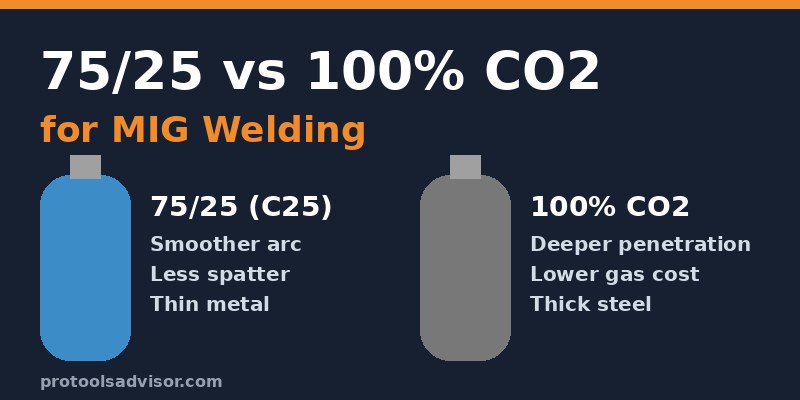
For mild steel, Miller names 75% argon / 25% CO2 (C25) as the common choice for DIY short-circuit MIG work, with 100% CO2 as the cheaper option and 90/10 for spray transfer. Pure argon is the right gas for MIG on aluminum and for silicon bronze MIG brazing, which is why so many home shops end up with an argon bottle on the cart.
If you are new to MIG welding, the short version is simple: steel needs a little “active” gas in the mix, and argon alone has none.
Can You MIG Weld Mild Steel With 100 Argon?
Yes, the machine will run, but the result is a weak, ugly weld on mild steel. Argon has no oxygen or CO2 to lower the surface tension of molten steel. So the puddle stays thick, rolls up into a high bead, and doesn’t flow out into the base metal. Keep pure argon for aluminum, silicon bronze and TIG, and use C25 or straight CO2 for steel.
| What you see with 100% argon on steel | Why it happens |
|---|---|
| Tall, rope-like bead with a steep crown | High surface tension in the steel puddle |
| Poor tie-in at the edges (cold toes) | Puddle won’t wet out into the base metal |
| Arc that wanders on wider joints | No active gas to anchor the arc to the puddle |
| Narrow fusion on short-circuit settings | Less heat spread into the plate |
| Very little spatter | Argon gives a smooth arc, which hides the problem |
The low spatter is the trap. A pure argon bead on steel can look clean on top and still have poor fusion underneath.

Credit: contenthub.itwwelding.com
Why Steel Needs CO2 Or Oxygen In The Mix
Steel welds best with a small amount of active gas (CO2 or oxygen) in the shield. In the arc, CO2 breaks down and adds a little oxygen to the puddle surface. That oxygen lowers surface tension, so the molten steel flows out and wets the joint edges.
That is why the common steel MIG gases all contain CO2 or oxygen:
| Gas | Common name | Best use on mild steel |
|---|---|---|
| 75% argon / 25% CO2 | C25 | Short-circuit MIG on sheet and plate, low spatter |
| 100% CO2 | C100 | Short-circuit MIG at lower cost, deeper penetration, more spatter |
| 90% argon / 10% CO2 | C10 | Spray transfer on thicker plate |
| 98% argon / 2% oxygen or CO2 | 98/2 | Spray and pulsed spray, also common on stainless |
| 100% argon | Pure argon | Not for steel MIG. Use it for aluminum, silicon bronze and TIG |
Higher CO2 content gives more penetration and more spatter. Higher argon content gives a smoother arc and a flatter bead, up to the point where the CO2 or oxygen drops too low.
When Pure Argon Is The Right Gas
Pure argon still earns its spot in a home shop. These are the jobs where you want it:
- MIG on aluminum: Miller calls 100% argon the most common gas for MIG welding aluminum. You’ll also need a spool gun or a push-pull setup for soft aluminum wire.
- Silicon bronze MIG brazing on steel: Miller lists 100% argon for short-circuit transfer with ERCuSi-A silicon bronze wire. Auto body welders use it on thin panels and galvanized parts because the base metal doesn’t fully melt.
- TIG on steel: TIG welding steel uses pure argon because the tungsten electrode needs an inert shield. This is a different process from MIG, so it doesn’t change the answer for MIG.
So the argon bottle isn’t wasted. It just belongs on a different job.
What To Do If Argon Is All You Have
The safe move is to stop and swap the cylinder. Many welding gas suppliers will exchange an argon bottle for C25 of the same size. If the project can’t wait, these are your options, from best to worst:
- Switch to self-shielded flux core wire (such as E71T-11 or E71T-GS) and run it without gas on DCEN. It welds steel without a bottle.
- Borrow or rent a C25 or CO2 cylinder for the day.
- Use the argon only for tack welds or non-load-bearing practice beads, then go back and weld the joint with the right gas.
Don’t use a pure argon MIG weld on trailer hitches, frames, stands, brackets or anything that holds weight or people.
Setting Up With The Right Gas Instead
Once you have C25 or CO2 on the machine, start with the settings below and adjust from your welder’s door chart.
- Flow rate: Miller lists 25 to 35 cfh for short-circuit MIG.
- Contact-tip-to-work distance: 1/4 to 5/8 inch per Miller. Too much stickout cools the arc and thins the gas shield.
- Polarity: DCEP for solid wire with gas.
- Regulator: Argon and C25 cylinders use a CGA 580 fitting, and pure CO2 cylinders use CGA 320. So a CO2 bottle needs a CO2 regulator or the right adapter, and a heater helps on long runs because CO2 can freeze a regulator.
For a full step-by-step, follow our guide on how to set up a MIG welder with gas.
Safety note: Argon, CO2 and their mixes displace oxygen. In a small, closed room, a leaking cylinder can drop oxygen levels without any smell or warning. Weld with ventilation, chain cylinders upright, and close the cylinder valve when you finish.
Frequently Asked Questions
What Happens If You MIG Weld Steel With Pure Argon?
The wire arcs and lays a bead, but the puddle is sluggish and the bead sits tall with poor tie-in at the edges. Argon has no active gas to lower surface tension, so the steel won’t wet out. The weld can look clean and still be weak underneath.
Is 100% Argon Or 75/25 Better For Mild Steel?
75% argon / 25% CO2 is far better for mild steel. Miller names C25 as the common choice for DIY short-circuit MIG on steel because it runs with minimal spatter. Keep 100% argon for aluminum, silicon bronze MIG brazing and TIG welding.
Can I Use An Argon Tank For MIG And TIG?
You can use one pure argon tank for TIG on steel and MIG on aluminum. For MIG on mild steel, you need a second bottle of C25 or CO2. Many home welders keep one argon bottle and one C25 bottle on the cart for that reason.
Can You MIG Weld Mild Steel With Argon And Flux Core Wire?
Not with self-shielded flux core wire, which is made to run without gas. Gas-shielded flux core (dual shield) wire is a different product and usually runs on 100% CO2 or 75/25. Check the wire’s AWS classification and the maker’s gas list before you add shielding gas.
Does Pure Argon Cause Porosity In Steel Welds?
Porosity is not the main problem. Argon still keeps air away from the puddle, so the bead is usually free of holes. The issue is poor fusion and a high, narrow bead. That makes pure argon welds on steel look acceptable from the top but weak at the edges.
Final Words
You can MIG weld mild steel with 100 argon only in the loosest sense. The arc runs and the bead looks smooth, but the steel puddle never wets out, so the joint is weak at the edges.
Put C25 or straight CO2 on the machine for steel, and save the argon bottle for aluminum, silicon bronze and TIG. If argon is all you have today, use flux core wire or wait for the right gas before you weld anything that has to hold.