Disclosure: This post contains affiliate links and I will be compensated if you make a purchase after clicking through my links. Learn More
75/25 vs 100 CO2 for MIG welding comes down to one trade: 75/25 (C25) gives a smoother arc, less spatter and flatter beads, and 100% CO2 gives deeper penetration at the lowest gas cost. For most home and hobby work on mild steel, C25 is the better pick. Straight CO2 wins on thicker steel when you care more about fusion and running cost than about spatter cleanup.
Both gases work with standard ER70S-6 solid wire on DCEP, and both are common in home shops. If you are new to MIG welding, start with C25 because it is more forgiving on thin metal and easier to read in the puddle.
| Feature | 75/25 (C25) | 100% CO2 |
|---|---|---|
| Mix | 75% argon, 25% carbon dioxide | 100% carbon dioxide |
| Penetration | Moderate, wider profile | Deeper |
| Spatter | Low | Higher |
| Bead look | Flatter, cleaner toes | Rougher, more crowned |
| Arc feel | Smooth and quiet | Harsher, more crackle |
| Voltage at the same wire speed | Baseline | Usually 1 to 2 volts more |
| Transfer modes | Short circuit (not true spray) | Short circuit only |
| Best metal thickness | Sheet metal to medium plate | Medium to thick steel |
| Cylinder valve | CGA 580 | CGA 320 |
| Gas cost | Higher | Lowest of the common MIG gases |
75/25 vs 100% CO2 for MIG Welding: Which Is Better?
75/25 is better for most MIG welding on mild steel, especially anything under 1/8 inch, visible welds and beginner work. 100% CO2 is better for thicker steel, farm and frame repair, and shops that burn through a lot of gas, because it penetrates deeper and costs less to fill.
Neither gas is wrong for steel. Bernard, a MIG gun maker, describes the split this way: CO2 gives deep penetration and is the least expensive shielding gas, and argon mixes give a more stable arc and less post-weld cleanup. Pick the one that fits the jobs you weld most.
What Is 75/25 (C25) Shielding Gas?
75/25 is a blend of 75% argon and 25% CO2, sold under the name C25 by most welding gas suppliers. Argon is inert, so it keeps the arc smooth and steady. The 25% CO2 adds enough active gas to wet the steel puddle out and give the weld real fusion at the toes.
That balance is why C25 is the default gas on most home welder door charts for steel. Pure argon has no active gas at all, which is why 100% argon on mild steel gives a tall, poorly fused bead.
What Is 100% CO2 Shielding Gas?
100% CO2 is straight carbon dioxide with no argon added. In the arc, CO2 breaks apart and releases extra heat into the puddle, which melts more base metal and drives the weld deeper. That same reaction makes the arc less stable, so the wire throws more spatter.
CO2 sits in the cylinder as a liquid with gas on top. That is why a CO2 bottle uses a different valve, behaves differently on the gauge and holds a lot of gas for its size.
Key Differences Between 75/25 and 100% CO2
Penetration
100% CO2 penetrates deeper. CO2 adds heat to the weld pool as it breaks down, so you get more melting of the plate at the same settings. Jody Collier of Welding Tips and Tricks reports that a dialed-in CO2 arc usually penetrates better than 75/25 at the same wire speed.
C25 still gives full fusion on most home-shop steel when your voltage and wire speed are set right. The difference shows most on 3/16 inch and thicker plate.
Spatter and Cleanup
75/25 wins on spatter. Bernard notes that CO2 creates more spatter than argon mixes, and that extra spatter means more time with a grinder or chipping hammer. More spatter also builds up in the nozzle faster, so plan on anti-spatter gel and more frequent nozzle cleaning with straight CO2.
You can cut CO2 spatter a lot by running in the sweet spot of voltage and wire speed. If your welder has an inductance knob, turning it up softens the CO2 arc.
Bead Appearance
C25 lays a flatter, cleaner bead. The argon in the mix lowers surface tension and spreads the puddle, so the toes tie in smoothly. CO2 beads tend to sit a little higher with a rougher surface.
For show welds, furniture and anything that gets painted with no grinding, C25 saves cleanup time.
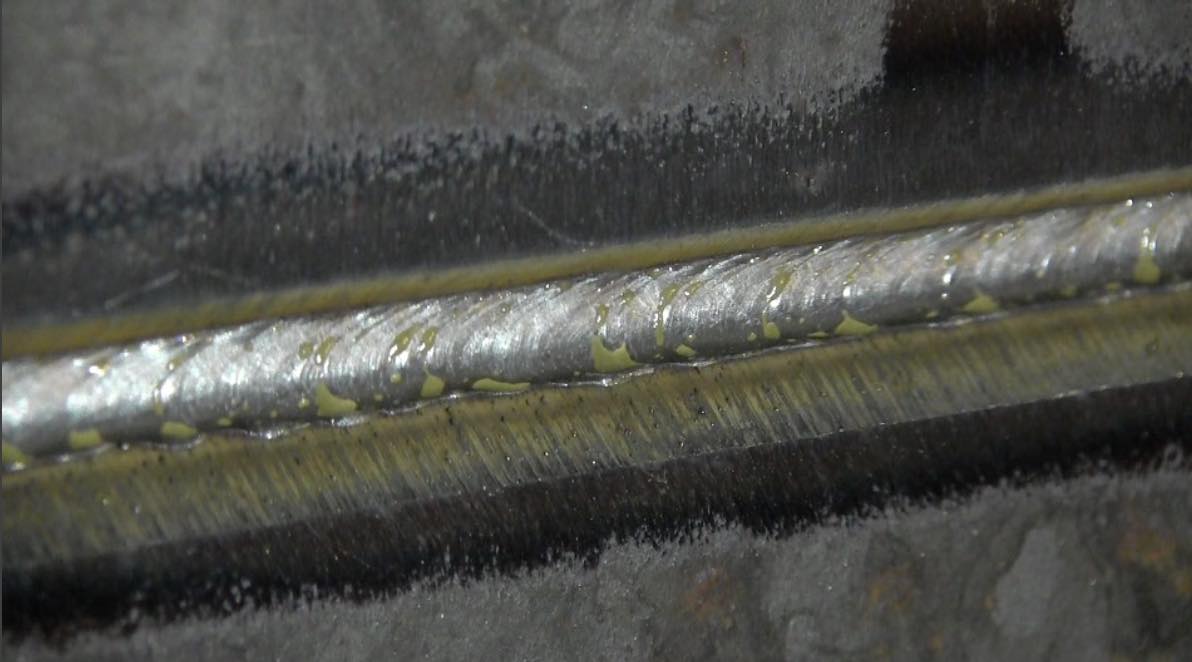
Credit: www.weldingtipsandtricks.com
This root pass was run with 75/25 at 18 volts and 230 inches per minute with .030 inch ER70S-6 wire on 3/8 inch plate. The brown spots are silicon deposits from the wire, which is normal on both gases.
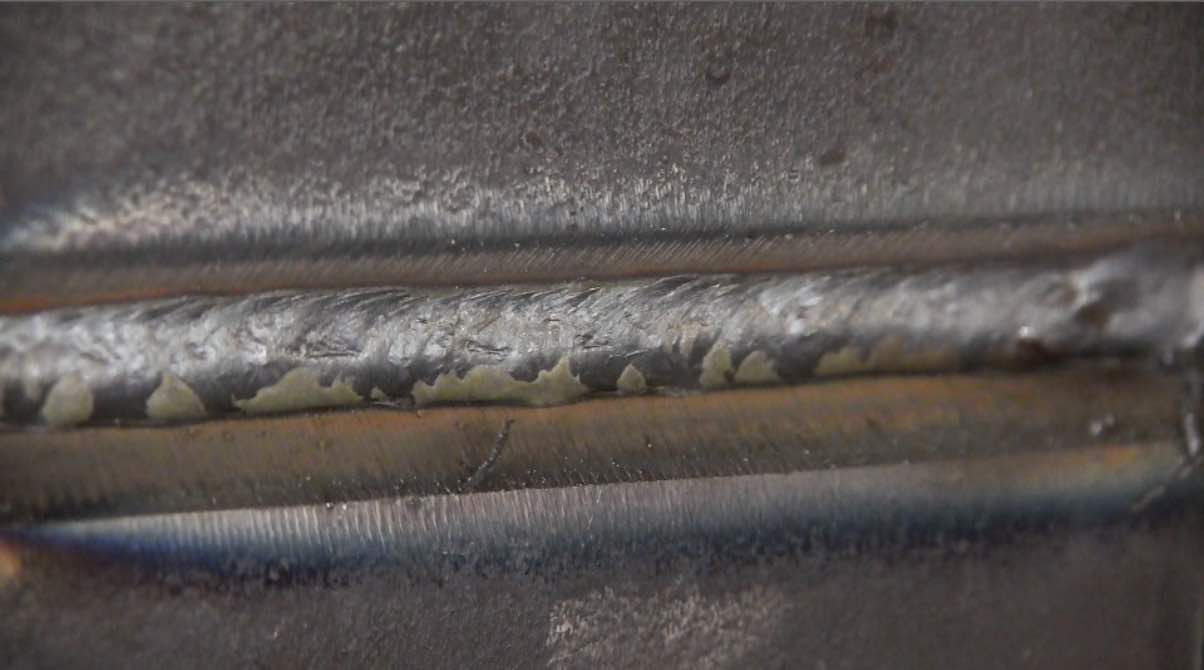
Credit: www.weldingtipsandtricks.com
The same joint run with straight CO2 at the same settings. Compare the bead width and the tie-in at the edges with the C25 root pass.
Arc Feel and Machine Settings
CO2 needs a little more voltage. Jody Collier’s rule of thumb is to add 1 to 2 volts with CO2 for the same wire speed you would use with 75/25. Some welder door charts list separate rows for C25 and CO2 for this reason.
The CO2 arc also sounds harsher, with more crackle and pop. That is normal. A steady frying sound with C25 and a slightly rougher crackle with CO2 both mean you are close.
Thin Metal and Burn-Through
75/25 is the safer gas for sheet metal. CO2’s extra heat makes burn-through more likely on 22 to 16 gauge panels. If you mostly MIG weld thin metal like auto body patches, exhaust tubing or light brackets, C25 gives you more room for error.
Transfer Modes
Both gases are short-circuit gases. Bernard states that pure CO2 works only in short-circuit transfer. C25 has too much CO2 for true spray transfer as well, so spray on thick plate calls for an argon-rich blend such as 90/10.
Cylinder, Regulator and Fittings
The two gases use different valve fittings. C25 and argon cylinders use a CGA 580 valve, and CO2 cylinders use a CGA 320 valve. So a regulator that came with your welder for C25 won’t thread onto a CO2 bottle without a CO2 regulator or a listed adapter with the correct washer.
CO2 also reads differently on the gauge. Because it is a liquid in the bottle, the pressure stays near the liquid’s vapor pressure (roughly 830 psi at 70°F) until the liquid runs out, then drops fast. To know how much CO2 is left, weigh the cylinder and subtract the tare weight stamped on the neck. A C25 cylinder gauge drops steadily as you use gas, so the gauge tells you the level.
At high flow rates or on long welds, CO2 can chill the regulator enough to frost or freeze it. A heated CO2 regulator fixes that on production work. Most hobby welding at normal flow rates doesn’t need one.
Gas Cost and Cylinder Capacity
100% CO2 costs less to fill. Bernard calls CO2 the least expensive shielding gas, and C25 costs more because of the argon. Fill prices vary a lot by supplier and region, so ask your local gas shop for both quotes on the same cylinder size.
CO2 is also sold by weight. One pound of liquid CO2 turns into about 8.7 cubic feet of gas (44 g/mol, about 10.3 moles per pound, at 70°F and sea level pressure). So a 20 lb CO2 cylinder holds about 175 cubic feet of gas, which is about 7 hours of arc-on time at 25 CFH.
Your flow rate setting changes that runtime a lot. Use our MIG gas flow rate chart to set the right CFH for your nozzle size and shop conditions.
Where Each Gas Fits
These are the jobs where each gas earns its spot on the cart:
| Job | Better gas | Why |
|---|---|---|
| Auto body panels and patch work | 75/25 | Less heat, less burn-through, less spatter on visible panels |
| Exhaust tubing and thin brackets | 75/25 | Easier puddle control on thin wall |
| Furniture, gates and art pieces | 75/25 | Flatter beads, less grinding before paint |
| Trailer frames and hitches (1/4 inch and up) | 100% CO2 | Deeper penetration on thick steel |
| Farm and equipment repair | 100% CO2 | Lower gas cost and good fusion on dirty, thick parts |
| High-volume shop work on plate | 100% CO2 | Lowest gas cost per weld |
| Gas-shielded flux core (dual shield) wire | Check the wire label | Most are rated for 100% CO2 or 75/25 |
Which One Should You Choose?
Choose 75/25 (C25) if:
- You weld mostly 1/8 inch and thinner steel
- You are learning and want a smoother, easier arc
- Your welds show and you want less grinding
- Your welder’s door chart only lists C25 settings
Choose 100% CO2 if:
- You weld mostly 3/16 inch and thicker steel
- You want the lowest gas cost per fill
- You don’t mind cleaning spatter and nozzles
- You run dual shield flux core wire rated for CO2
If you split your time, start with C25. It handles both thin and medium steel well. When you set up a MIG welder with gas, match the regulator to the cylinder valve and set the machine from the chart row for that gas.
Safety note: CO2 and argon mixes displace oxygen. In a small closed room, a leak can lower oxygen levels with no smell or warning. Weld with ventilation, chain cylinders upright, and close the cylinder valve when you finish. CO2 throws more spatter, so keep sleeves buttoned and move rags and cardboard out of the area.
Frequently Asked Questions
Can You Use 100% CO2 for MIG Welding?
Yes, 100% CO2 is a standard MIG gas for mild and carbon steel. It works in short-circuit transfer, penetrates deeper than 75/25 and costs less to fill. Expect more spatter and a rougher bead, and plan to run 1 to 2 volts more than your C25 settings.
Is 75/25 or CO2 Better for Thin Metal?
75/25 is better for thin metal. CO2 adds heat to the puddle, so it burns through 22 to 16 gauge sheet more easily. C25 runs cooler and smoother, which gives you more control on auto body panels, exhaust tubing and light brackets. Use small wire such as .023 inch too.
Do You Need a Different Regulator for CO2?
Yes, in most cases. CO2 cylinders use a CGA 320 valve, and C25 or argon cylinders use a CGA 580 valve. So you need a CO2 regulator or a listed adapter with the right washer. A heated regulator helps on long, high-flow welds where CO2 can freeze it.
Does CO2 Need More Voltage Than 75/25?
Yes, CO2 usually needs about 1 to 2 more volts at the same wire speed. CO2 makes a harsher arc, and the extra voltage helps it wet out the puddle. Check your welder’s door chart for a CO2 row, then fine-tune by sound and bead shape on scrap.
Can You Use 75/25 for Spray Transfer?
No, 75/25 has too much CO2 for true spray transfer. Spray transfer on thick steel calls for an argon-rich blend, such as 90% argon and 10% CO2. With C25, you will stay in short-circuit or globular transfer even at high voltage and wire speed settings.
Final Words
75/25 vs 100 CO2 for MIG welding is a choice between a smoother, cleaner weld and a deeper, cheaper one. C25 is the better all-round gas for home shops, beginners and anything thin or visible.
Switch to straight CO2 when most of your work is thick steel and gas cost matters more than spatter. Whichever bottle you pick, match the regulator to the valve, add a volt or 2 for CO2, and test on scrap before the real joint.