Disclosure: This post contains affiliate links and I will be compensated if you make a purchase after clicking through my links. Learn More
Welding aluminum takes more skill than welding steel. The metal heats up fast, cools down quickly, and melts at a lower temperature. Many welders want to use aluminum because it makes things lighter and stronger, like car parts, boat frames, and trailers. But to get clean welds on aluminum, you need the right tools and methods. One popular way is to use a spool gun with a MIG welder. This tool feeds the soft aluminum wire directly to the weld, stopping jams and giving you more control.
Many beginners struggle with aluminum because the wire is soft and can tangle easily. A spool gun solves this by holding a small spool of wire close to the torch. This reduces how far the wire must travel and keeps it from bending or birdnesting.
If you want to weld aluminum for repairs, DIY projects, or work, learning to use a spool gun the right way will save you time and stress.
This article explains everything you need to know about MIG welding aluminum with a spool gun. You will learn how to choose the right equipment, set up your welder, pick the best wire and gas, and use good technique for strong welds. You will also see common mistakes and how to fix them. If you want to make your aluminum welding easier and get better results, this guide is for you.
Why Use A Spool Gun For Aluminum Mig Welding?
Aluminum wire is much softer than steel wire. It bends and tangles if you use a standard MIG welding torch with a long cable. The drive rolls in a regular MIG welder push the wire through a long hose, but this often causes jams with aluminum.
A spool gun solves this by putting the wire spool right on the gun. The wire only travels a short distance to the tip.
Spool guns help you:
- Avoid wire jams and birdnesting
- Feed wire smoothly for better welds
- Change spools quickly for different jobs
- Work on-site or on large parts with less trouble
If you plan to weld aluminum often, a spool gun is almost always the best option. It works well for both thin and thick aluminum pieces.
Essential Equipment For Mig Welding Aluminum With A Spool Gun
You need the right tools to get good results. Here is what you must have before you start:
Mig Welder That Accepts A Spool Gun
Not all MIG welders can use a spool gun. Check your welder’s manual or look for a spool gun port on the machine. Many newer welders have a quick-connect for this tool. Make sure your welder has enough power (at least 180 amps) for the thickness of aluminum you want to weld.
Spool Gun
A spool gun holds a small spool of wire (usually 1 pound). Some guns let you use larger spools, but 1-pound is most common. Choose a gun that matches your welder’s brand and model. Some popular options are the Miller Spoolmate, Lincoln Magnum, and Hobart SpoolRunner.
Aluminum Mig Wire
Use ER4043 or ER5356 wire. ER4043 is easier to feed and gives a smoother weld, while ER5356 is stronger and better for some alloys. Most jobs use 0.030″ or 0.035″ wire. Pick the size based on your welder’s settings and the thickness of the metal.
Shielding Gas
Pure argon works best for most aluminum MIG welding. A 100% argon tank gives a clean arc and smooth welds. Some jobs use argon/helium mixes, but pure argon is simpler and widely used.
Protective Gear
Wear a good welding helmet, gloves, long sleeves, and pants. Aluminum gives off bright light and UV rays, so protect your skin and eyes. Use a helmet with an auto-darkening feature if possible.
Cleaning Tools
Aluminum must be very clean before welding. You need:
- A stainless steel wire brush (never use a brush that touched steel)
- Acetone or alcohol for wiping grease and oil
- Clean rags
Table: Common Equipment Comparison
Here is a quick comparison of key equipment options:
| Equipment | Best For | Main Benefit | Common Brands |
|---|---|---|---|
| Spool Gun | Aluminum wire feeding | Prevents jams | Miller, Lincoln, Hobart |
| ER4043 Wire | General welding | Smooth, easy feed | Harris, Lincoln |
| ER5356 Wire | Stronger welds | Higher strength | Hobart, Weldcote |
| Argon Gas | All aluminum MIG | Clean welds | Airgas, Praxair |

Credit: weldmongerstore.com
Preparing Aluminum For Mig Welding
Aluminum collects dirt, grease, and an oxide layer that blocks good welds. Cleaning is even more important for aluminum than for steel.
Steps To Prepare The Metal
1. Remove Oil And Grease
Wipe the surface with acetone or alcohol. Do this before brushing or grinding to avoid spreading oil into the pores of the metal.
2. Scrub Off Oxide Layer
Use a dedicated stainless steel wire brush. Brush the area right before welding. Do not use a steel brush, as this can contaminate the aluminum.
3. Cut Edges Smooth
If you cut aluminum with a saw, file or grind any rough edges. Smooth joints help the weld pool flow better.
4. Check Fit-up
Make sure the parts fit tightly. Gaps make it hard to control the weld pool. Clamp the pieces if needed.
Non-obvious Insights
- Always clean both sides of thin aluminum, not just the top.
- If you touch the cleaned surface with bare hands, oil from your skin can cause weld problems. Wear clean gloves after cleaning.
Setting Up Your Mig Welder And Spool Gun
Correct setup is key for good welds. Aluminum is less forgiving than steel, so take your time with these steps.
Install The Spool Gun
- Attach the gun to the welder’s port (follow the manual).
- Load the aluminum wire spool into the gun. Make sure the wire feeds smoothly.
- Adjust the tension on the drive rolls. Too tight will crush the wire; too loose will slip.
Connect The Shielding Gas
- Attach the argon tank to the welder’s gas inlet.
- Set the flow to 20–30 cubic feet per hour (CFH). Too much flow can cause turbulence, too little will not protect the weld.
Choose The Right Polarity
Most MIG welding uses DC Electrode Positive (DCEP). Check your welder and set it to DCEP for aluminum.
Set Voltage And Wire Speed
These settings depend on your wire size and material thickness. Start with the welder’s chart or manual, then adjust as needed.
A typical starting point:
- 0.030″ wire: 17–19 volts, 350–450 inches per minute (IPM) wire speed
- 0.035″ wire: 18–21 volts, 375–500 IPM wire speed
Fine-tune these based on how the weld looks and sounds.
Table: Wire Size And Settings Reference
This table shows common starting settings for aluminum wire:
| Wire Size | Material Thickness | Voltage | Wire Speed | Gas Flow (CFH) |
|---|---|---|---|---|
| 0.030″ | 1/8″ (3 mm) | 17–19 | 350–450 | 20–30 |
| 0.035″ | 3/16″ (4.8 mm) | 19–22 | 375–500 | 20–30 |
| 0.045″ | 1/4″ (6.4 mm) | 22–25 | 450–600 | 25–35 |
Note: Always test on scrap pieces before welding your final project.
Choosing The Right Filler Wire
Your weld quality depends on using the best filler wire for your job.
Er4043 Vs. Er5356
- ER4043: This is the most common wire for MIG welding aluminum. It flows well, gives a soft arc, and works with most aluminum grades. It is good for parts that need to look nice and do not need high strength.
- ER5356: This wire is stronger and better for marine work, bike frames, and parts that face stress. It can be harder to feed, but a spool gun solves many of these issues.
Wire Diameter
- 0.030″ wire: Best for thin material (under 1/8″)
- 0.035″ wire: Good for most jobs (1/8″ to 3/16″)
- 0.045″ wire: Use for thick parts (over 1/4″)
Spool Size
Most spool guns use 1-pound spools. Some guns can use 2-pound or 4-inch spools for longer jobs.
Non-obvious Insight
- Store aluminum wire in a dry area. Even a little moisture can cause white powder (oxidation), which blocks the arc and weakens the weld.
Shielding Gas Selection And Setup
The right gas protects your weld pool from air, which can cause holes and weak spots.
Pure Argon
For almost all aluminum MIG welding, use 100% argon. This gas gives a steady arc and keeps the weld clean.
Gas Flow Rate
Set your regulator to 20–30 CFH. A higher flow does not always mean better protection. Too much flow blows the gas away. Shield the area from wind if welding outside.
Using Gas Correctly
- Do not start welding until gas flows for a few seconds to clear the hose.
- Stop welding if you hear hissing or see bubbles in the weld; check for leaks.
Non-obvious Insight
- Do not use CO2 or Argon/CO2 mixes with aluminum. These are for steel and will ruin your weld.
For more information about shielding gases, see the Wikipedia page on Gas Metal Arc Welding.
Welding Techniques: Mig Aluminum With A Spool Gun
Good technique is the difference between strong, neat welds and messy, weak ones.
Holding The Spool Gun
Hold the gun at a 10–15 degree push angle. Point the tip forward, moving in the direction you want the weld to go. Do not drag the gun back. Pushing gives better gas coverage and a cleaner weld.
Travel Speed
Move the gun at a steady, medium speed. Go too slow, and you will burn through the metal. Too fast, and the weld will be thin and weak. Watch the pool and keep it about 1. 5 times the width of the wire.
Stickout
Keep the wire stickout short, around 3/8″ from the tip to the work. A long stickout means less gas and a poor arc.
Starting The Arc
- Pull the trigger to start the gas and wire.
- Pause for a half-second so the gas covers the weld area.
- Begin moving smoothly as soon as the arc forms.
Weld Pattern
For most joints, a straight line works best. On thicker parts, you can use a gentle weave, but keep the motion small.
Table: Gun Angles For Common Welds
| Joint Type | Gun Angle | Technique |
|---|---|---|
| Butt Joint | 10–15° push | Straight line |
| T-Joint | 10–15° push, tip in center | Small weave if thick |
| Lap Joint | 10–15° push, tip on top edge | Straight or small weave |
Controlling Heat
Aluminum spreads heat quickly. Short welds (called stitch welding) stop the metal from warping. If welding a long joint, weld an inch, then let it cool before starting again.
Finishing The Weld
Release the trigger and let the gas flow for one second to protect the cooling weld. This helps prevent holes and keeps the weld clean.
Common Mistakes And How To Fix Them
Even skilled welders make errors with aluminum. Here are the most common mistakes and what to do.
1. Burn-through
Why it happens: Too much heat, moving too slow, or welding thin material.
Solution:
- Lower voltage or wire speed
- Use shorter welds
- Place a copper backing bar under thin parts to absorb heat
2. Poor Wire Feeding
Why it happens: Wire tension is wrong, liner is dirty, or using the wrong tip size.
Solution:
- Adjust the drive roll tension on the spool gun
- Clean or replace the liner
- Use the right contact tip for your wire size
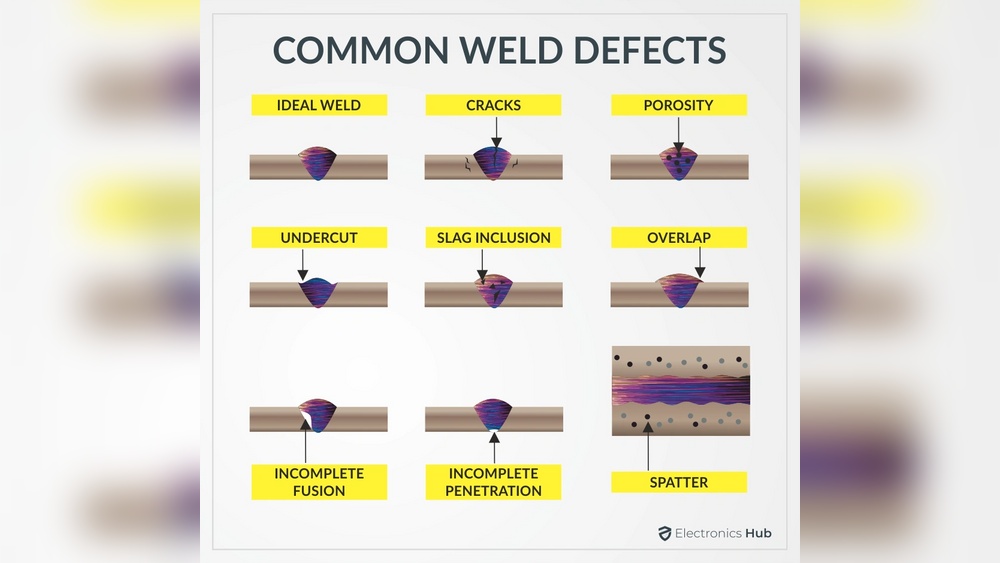
3. Porosity (holes In Weld)
Why it happens: Dirty metal, too little gas, or wind blowing away gas.
Solution:
- Clean the workpiece again
- Check for leaks in the gas hose
- Shield the weld from wind
4. Weak Welds
Why it happens: Wrong wire type, wrong polarity, or not enough penetration.
Solution:
- Use ER4043 or ER5356
- Set to DCEP polarity
- Increase voltage slightly if welds are sitting on top
5. Cracking
Why it happens: Poor joint fit, dirty metal, or using the wrong filler wire.
Solution:
- Clean parts well
- Use the correct wire for the alloy
- Clamp parts tightly
Non-obvious Insights
- Change contact tips often. Aluminum wire wears tips quickly.
- If you see black soot around the weld, check for gas leaks or slow down your travel speed.
Safety Tips For Mig Welding Aluminum
Welding is safe if you follow good habits. Aluminum welding has a few special risks.
- Always wear gloves and a long-sleeve shirt. Aluminum reflects heat and light more than steel.
- Use a helmet with a shade 10–13 lens to protect your eyes from the bright arc.
- Keep your work area dry. Water and electricity are a bad mix.
- Do not weld near flammable materials. Shielding gas does not burn, but sparks can start fires.
- Ventilate your work area. Fumes from aluminum welding can be harmful if you breathe them for long periods.
Practical Tips For Better Aluminum Mig Welds
- Use short bursts for thin metal. Welding in short sections helps control heat and avoids burn-through.
- Practice on scrap before starting your real project. Aluminum welds look different than steel.
- Let the gun and wire cool between welds. Spool guns can get hot fast, which can damage the wire or gun.
- Store wire in a sealed bag or box to keep out moisture.
- Replace liners and tips often. Aluminum wire wears them out faster than steel.

Credit: www.youtube.com
Advanced Advice: Working With Different Aluminum Alloys
Not all aluminum is the same. Some alloys weld easily, while others crack or give weak welds.
Common Aluminum Alloys
- 6061: Easy to weld, used for frames and structures
- 5052: Good for tanks, marine parts, hard to crack
- 2024: Not recommended for MIG welding; cracks easily
- 7075: Also hard to weld, best avoided unless you know the alloy
Matching Filler Wire
- Use ER4043 for 6061 and most common grades.
- Use ER5356 for 5052 and marine work.
If you are not sure which alloy you have, try a small weld on scrap and check for cracks or poor flow.
Troubleshooting Guide
Sometimes things still go wrong. Here are quick fixes for common problems:
- Weld pool is hard to see: Check your helmet lens. A lighter shade may help.
- Wire burns back to tip: Reduce wire speed or increase voltage.
- No arc forms: Check ground clamp and connections. Make sure the gun is plugged in tight.
- Spatter everywhere: Clean the metal better, check gas flow, and slow your travel speed.

Credit: bakersgas.com
Maintaining Your Spool Gun And Welder
A little care keeps your tools working longer.
- Blow out dust from the gun and welder with compressed air every few jobs.
- Replace worn contact tips and liners.
- Keep the drive rolls clean and check them for wear.
- Oil moving parts lightly, but keep oil away from the wire path.
If your gun jams often, check the wire path for kinks or sharp bends.
When To Use Pulse Mig (if Your Welder Has It)
Some MIG welders have a pulse mode. This feature gives short bursts of high and low current, making it easier to weld thin aluminum or get a better-looking bead.
Pulse MIG helps:
- Weld thin parts without burn-through
- Reduce spatter
- Get smoother, flatter welds
If your welder has this setting, read the manual and try it on scrap. Not all jobs need pulse, but it can help with tricky pieces.
Real-world Examples
Many boat builders use spool guns to fix hulls and decks. Car shops repair aluminum body panels with MIG and spool guns because TIG welding is slower and harder to learn. Trailer makers weld long, thin aluminum sheets and need the fast wire feed and good control that a spool gun gives.
For example, a small shop making aluminum toolboxes uses a Miller Spoolmate 100 with ER4043 wire and pure argon. They weld 1/8″ sheets with a 10–15 degree push angle, moving quickly to avoid warping. Clean parts, good fit-up, and the right settings mean fewer problems and strong welds.
Frequently Asked Questions
Why Is Aluminum Harder To Weld Than Steel?
Aluminum melts at a lower temperature and conducts heat faster than steel. It also forms an oxide layer that blocks the weld. These factors make it easy to burn through or get poor welds if you do not use the right tools and methods.
Can I Use A Regular Mig Welder Without A Spool Gun For Aluminum?
You can try, but it is much harder. The soft wire often jams or birds nests in standard MIG cables. A spool gun feeds the wire directly and avoids these problems, making welding easier and more reliable.
What Gas Should I Use For Mig Welding Aluminum?
Use 100% argon for almost all aluminum MIG welding. Do not use CO2 or argon/CO2 mixes, as these are for steel and can ruin your weld.
How Do I Stop Wire From Jamming In The Spool Gun?
Check the tension on the drive rolls. Too tight crushes the wire, too loose slips. Make sure the liner is clean and use the right size contact tip for your wire.
What Thickness Of Aluminum Can I Weld With A Spool Gun?
Most spool guns can handle aluminum from 18 gauge (1.2 mm) up to 1/2 inch (12 mm) if your welder has enough power. For very thick parts, you may need to preheat the metal.
Welding aluminum with a spool gun is easier than many think once you know the basics and avoid common mistakes. With practice, you can get strong, neat welds for many projects, from cars to boats. Take your time, use the right setup, and your results will show real improvement.