Disclosure: This post contains affiliate links and I will be compensated if you make a purchase after clicking through my links. Learn More
FCAW welding, or Flux-Cored Arc Welding, is a popular method in construction, shipbuilding, and repair work. Many welders use FCAW because it can join thick metals quickly, works well outdoors, and often costs less than other welding types. Still, FCAW is not always easy. Many beginners, and even experienced welders, make errors that can lead to poor weld quality, wasted materials, and sometimes dangerous results.
This article explains the most common FCAW welding mistakes and defects. You will learn how these problems happen, what they look like, and how to fix them. With clear examples and practical advice, this guide helps both new and experienced welders improve their FCAW results.
Understanding Fcaw Welding
FCAW stands for Flux-Cored Arc Welding. This process uses a special wire with flux inside. When the wire melts, the flux creates gas and slag to protect the weld from air. FCAW has two main types: self-shielded and gas-shielded. Self-shielded FCAW works without extra gas, which is good for outdoor jobs. Gas-shielded FCAW uses extra shielding gas for cleaner welds indoors.
Many people like FCAW because it works fast and can handle dirty or rusty metals better than some other welding methods. But FCAW also brings its own set of challenges. Even a small mistake can cause a defect that weakens the weld.
Common Fcaw Welding Mistakes
Many FCAW problems start with simple human errors or wrong settings. Understanding these mistakes helps you avoid them and produce stronger welds.
1. Wrong Polarity
FCAW needs a specific electrical polarity. Most flux-cored wires need DC Electrode Negative (DCEN) or DC Electrode Positive (DCEP), depending on the type. If you use the wrong polarity, the arc becomes unstable. The weld may have poor penetration or too much spatter. Always check the wire manufacturer’s label and your machine’s settings before starting.
2. Incorrect Wire Feed Speed
Wire feed speed controls how much wire enters the weld. If the speed is too high, the gun can push the weld pool ahead, causing spatter or burn-through. If it is too low, the arc may keep breaking, creating weak welds. Adjust the speed until you hear a steady, soft crackling sound. Most machines have recommended speeds based on wire size and metal thickness.
3. Using The Wrong Voltage
Voltage affects the arc’s heat. Too much voltage causes a flat, wide bead with little penetration. Too little voltage makes a tall, narrow bead and can trap slag inside the weld. Always match voltage to your wire size and base metal.
Practice on scrap metal and adjust until the bead looks smooth and even.
4. Poor Gun Angle And Travel Speed
The way you hold the welding gun matters. Most FCAW welds use a drag technique—you pull the gun toward you at a small angle (10-15° from vertical). If you push the gun or use the wrong angle, slag can get trapped, and the bead becomes uneven. Moving too fast creates a thin bead, while moving too slow causes a wide, high bead with more heat input.
5. Not Cleaning The Base Metal
Even though FCAW can handle some dirt or rust, too much contamination causes problems. Oil, paint, or thick rust can make the weld porous or weak. Always brush or grind the weld area before starting.
6. Using The Wrong Wire Type
There are many FCAW wire types. Some need shielding gas, while others do not. Using the wrong wire can cause porosity, slag, and poor welds. Check your machine, job type, and environment before choosing wire.
7. Ignoring Machine Maintenance
A dirty liner, worn tip, or loose connections can cause wire feeding problems, erratic arcs, or even safety risks. Clean and check your welding machine and gun parts regularly.
8. Not Controlling Moisture
Moisture on the wire, base metal, or flux can create hydrogen-induced cracking and porosity. Store wires in a dry place and keep your work area clean.
9. Incorrect Stick-out Length
Stick-out means how much wire sticks out from the tip to the workpiece. Too long stick-out cools the arc and increases spatter. Too short stick-out overheats the tip and can cause burn-back. For most FCAW wires, a stick-out of ¾ inch (19 mm) is best.
10. Ignoring Safety Practices
FCAW produces strong fumes and intense UV light. Welding without proper gear (helmet, gloves, jacket) increases the risk of burns and health problems. Always use proper ventilation and safety equipment.
Most Common Fcaw Welding Defects
Many mistakes lead to specific weld defects. Spotting these defects early helps you fix your process and avoid failures.
1. Porosity
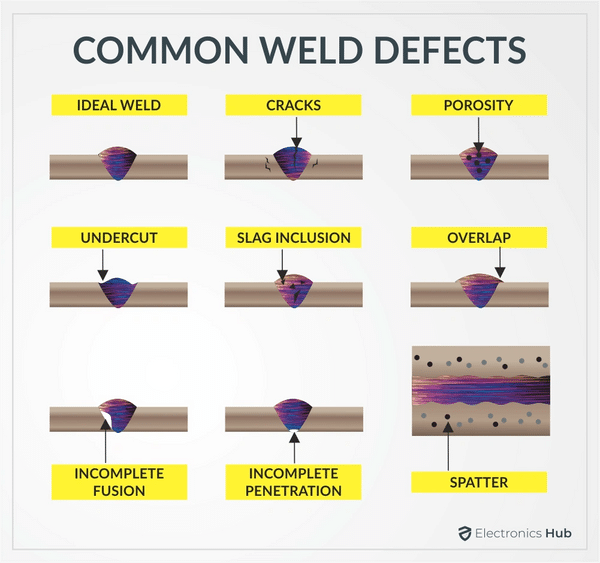
Porosity means small holes (pores) in the weld bead. Air, moisture, or contaminants cause these holes. Porosity weakens the weld and can cause leaks in pipes or tanks.
How to avoid: Clean the base metal, use dry wire, and check shielding gas flow (if used). Keep the gun angle right and avoid windy conditions.
2. Slag Inclusion
Slag inclusion means pieces of flux (slag) get trapped inside the weld. This happens if you use the wrong gun angle, move too fast, or weld over slag from a previous pass. Slag inside the weld makes it weak and can cause cracks.
How to avoid: Use the drag technique, clean slag between passes, and keep travel speed steady.
3. Incomplete Fusion
Incomplete fusion means the weld metal does not fully join with the base metal. This defect creates a weak joint that can break under stress. It often happens when the voltage is too low, travel speed is too high, or the base metal is dirty.
How to avoid: Use the correct voltage and travel speed. Clean the metal before welding and watch the bead to ensure full melting.
4. Incomplete Penetration
This defect means the weld does not go deep enough into the joint. The weld may look fine on the surface but be weak inside. It usually happens with thick metals, low heat, or poor technique.
How to avoid: Increase voltage, slow down travel speed, or use multiple passes for thick joints.
5. Excessive Spatter
Spatter means small bits of metal fly out during welding. While some spatter is normal, too much makes the weld look rough and wastes material. High voltage, wrong polarity, or dirty wire can cause spatter.
How to avoid: Check settings, keep wire clean, and use the right polarity.
6. Cracking
Cracks can appear in the weld or nearby metal. They are serious because they can grow under stress. Cracks often form from rapid cooling, moisture, or hydrogen in the weld.
How to avoid: Preheat thick or hard metals, use dry wire, and avoid high heat input.
7. Undercut
Undercut is a groove melted into the base metal near the weld toe but not filled with metal. It weakens the joint and can lead to cracks. Moving too fast, too high voltage, or wrong gun angle causes undercut.
How to avoid: Reduce travel speed, lower voltage, and adjust the gun angle.
8. Overlap
Overlap means the weld metal flows over the base metal without bonding. The bead sits on top instead of fusing. This often happens with low heat, poor technique, or moving too slow.
How to avoid: Increase voltage, adjust travel speed, and use proper gun angle.
9. Worm Tracking
Worm tracking shows as small, track-like marks on the weld bead. It is caused by gas bubbles moving through the weld pool and leaving lines. Often, it happens with some self-shielded wires.
How to avoid: Use the recommended wire, keep parameters stable, and avoid too long stick-out.
10. Burn-through
Burn-through means the weld completely melts through the base metal, making a hole. This usually happens on thin metals or with too much heat.
How to avoid: Lower voltage, use a faster travel speed, and practice on scrap first.
11. Distortion
Welding heat can bend or twist the metal. This is called distortion. Large, uneven welds or too much heat input cause distortion.
How to avoid: Use short welds (stitch welding), clamp parts, and balance heat input.
12. Poor Bead Appearance
A rough, uneven bead does not always mean a weak weld, but it often signals a problem. Wrong settings, poor technique, or dirty metal can all affect bead quality.
How to avoid: Practice holding a steady gun angle, set correct parameters, and clean the workpiece.
Practical Examples Of Fcaw Mistakes And Defects
Example 1: Porosity In Outdoor Welding
A welder works outdoors using self-shielded FCAW wire. The wind blows away the protective gas from the flux. The weld bead has many small holes. This is porosity from poor shielding. The welder should use windshields or weld on a calm day.
Example 2: Slag Inclusion From Fast Travel
An operator welds a thick joint and moves the gun too quickly. The flux does not have time to rise to the surface and gets trapped. After grinding, the weld reveals black lines inside. This is slag inclusion. Slowing down and cleaning between passes fixes this.
Example 3: Cracking From Wet Wire
A welder stores flux-cored wire in a damp shop. Moisture gets inside the wire. The next weld cracks soon after cooling. This is hydrogen-induced cracking. Storing wire in a dry place prevents this problem.
Key Data And Comparisons For Fcaw Defects
Welders often want to know how FCAW compares to other welding types for common defects. The following table compares FCAW with MIG and Stick welding for typical defect rates.
| Defect Type | FCAW (Flux-Cored) | MIG (GMAW) | Stick (SMAW) |
|---|---|---|---|
| Porosity | Medium | Low | Medium |
| Slag Inclusion | High | Low | High |
| Cracking | Medium | Low | High |
| Spatter | Medium | High | Medium |
| Undercut | Medium | Medium | High |
This comparison shows FCAW has more slag inclusion risk than MIG, but less than Stick welding. Cracking is often higher in Stick welding due to hydrogen.
Key Settings For Fcaw Quality
The right settings make a big difference in FCAW. Here is a table with recommended settings for common wire sizes.
| Wire Size (inch/mm) | Voltage (V) | Wire Feed Speed (ipm) | Stick-Out (inch) | Shielding Gas |
|---|---|---|---|---|
| 0.035″ (0.9mm) | 16-20 | 250-350 | 3/4″ | Optional |
| 0.045″ (1.2mm) | 20-26 | 300-400 | 3/4″ | CO2/Argon |
| 0.052″ (1.4mm) | 24-30 | 350-500 | 3/4″ | CO2/Argon |
Note: Always check the wire manufacturer’s chart for your exact wire and metal.
Practical Tips To Avoid Fcaw Mistakes
Many beginners miss small details that improve weld quality. Follow these tips for better results:
- Set up your work area to avoid wind or drafts. Even self-shielded FCAW can fail if wind is strong.
- Store wires properly in sealed containers or dry rooms. Moisture can ruin the wire and cause cracks.
- Use the right extension cord for your welder. Long, thin cords cause voltage drop and weak welds.
- Replace worn contact tips and liners. A blocked liner or tip causes erratic wire feeding.
- Inspect welds visually and by feel. If the bead feels rough or has holes, check your process before continuing.
- Test on scrap metal first. Small changes in settings can make a big difference in the finished weld.
- Keep a welding log. Write down what works for different jobs, wires, and metals.
Advanced Insight: Fcaw Wire Types And Their Role In Defects
Many welders think all flux-cored wires are similar, but wire type affects defects. Some wires are designed for all positions, while others work best flat or horizontal. Using a wire for the wrong position increases defects like slag inclusion and poor fusion.
Also, some wires have higher hydrogen content. These wires work well for mild steel but may cause cracking in hard or thick steels. Always match wire to your base metal and welding position.
Credit: yeswelder.com
Advanced Insight: The Hidden Danger Of Micro-cracks
Some FCAW defects are easy to see, like porosity or spatter. Others, like micro-cracks, are almost invisible. These tiny cracks often form under the weld surface, especially if there is too much heat or moisture. Over time, micro-cracks can grow and cause sudden failure.
Testing with ultrasonic or X-ray inspection can find these cracks, but most shops rely on good practices to avoid them. Keeping moisture away and controlling heat input are the best defenses.
Common Myths About Fcaw Welding Defects
Some welders believe FCAW does not need much cleaning because the flux protects the weld. This is not true. While FCAW handles some rust, oil and thick paint still cause defects.
Another myth is that more heat always gives a stronger weld. In fact, too much heat can cause burn-through, undercut, or cracking.

Credit: metalfusionpro.com
How To Inspect Fcaw Welds
A strong inspection process finds defects before they cause problems. Here are common inspection steps:
- Visual Inspection: Look for holes, cracks, or uneven beads.
- Slag Removal: Clean the weld and look for trapped slag.
- Destructive Testing: For critical jobs, break a sample to check inside.
- Non-Destructive Testing: Use X-ray, ultrasonic, or dye-penetrant tests for hidden cracks.
A good inspector uses a strong light, magnifier, and sometimes a weld gauge to check bead size and undercut.
How To Repair Common Fcaw Defects
If you find defects, do not ignore them. Small problems grow over time. Here’s how to repair common FCAW defects:
- Porosity: Grind out the affected area and re-weld with clean wire and base metal.
- Slag Inclusion: Remove slag by grinding or chipping, then re-weld.
- Cracks: Cut out the crack, preheat if needed, and weld again using dry wire.
- Burn-Through: Patch the hole with a small metal piece and weld over it at lower heat.
- Undercut: Fill the groove with a new weld pass at lower voltage and slower speed.
The Role Of Welding Codes And Standards
Welding codes, like AWS D1.1 for structural steel, set limits for defects and guide repairs. Following codes ensures safety and quality. Many shops use certified inspectors to check welds against these standards.
For more information, you can read the Welding Wikipedia page.
Frequently Asked Questions
What Causes Porosity In Fcaw Welding?
Porosity usually comes from moisture, dirty metal, or wrong settings. Using clean, dry wire and metal, and checking gas flow (if used), prevents most porosity.
How Do I Fix Slag Inclusion In A Finished Weld?
Grind or chip out the area with slag, clean the groove, and weld again. Always remove slag between passes to stop this problem.
Why Does My Fcaw Weld Crack After Cooling?
Cracks often come from moisture in the wire or base metal, high heat input, or welding thick/hard steel without preheating. Store wire dry and preheat thick steel to avoid cracks.
What Is The Best Stick-out Length For Fcaw?
For most flux-cored wires, keep a stick-out of about ¾ inch (19 mm). Too long or short causes problems like spatter or burn-back.
How Can I Avoid Undercut In Fcaw Welds?
Slow down your travel speed, lower voltage, and adjust your gun angle to fill the groove at the weld toe.
Credit: wholesale.yeswelder.com
Final Thoughts
FCAW welding offers speed, power, and flexibility, but it also brings risks if you make common mistakes. Problems like porosity, slag inclusion, cracking, and undercut can weaken a weld or cause failure. Most defects come from wrong settings, poor technique, or ignoring basic care of materials and equipment.
The best welders check their process, clean their metal, and adjust their settings for each job. They learn from mistakes and keep up with new wire types and standards. By understanding FCAW mistakes and defects, you can weld with more confidence and produce stronger, safer results every time.