Disclosure: This post contains affiliate links and I will be compensated if you make a purchase after clicking through my links. Learn More
TIG welding is a precise process that gives high-quality welds on many metals. But the quality of your weld does not depend only on your skill and machine. The type of tungsten electrode you choose can make or break your results. Many beginners struggle to select the right tungsten for TIG welding. The market offers several types, each with different colors, properties, and uses. If you pick the wrong one, you may face unstable arcs, dirty welds, or even damage to your workpiece.
This guide will help you choose the right tungsten for TIG welding. You will learn about the main types, what makes each one special, and how to match them with your welding needs. We will cover everything—tungsten composition, color codes, sizes, and even mistakes that new welders often make.
By the end, you will feel confident to select the best tungsten for your projects.
What Is Tungsten In Tig Welding?
Tungsten electrodes are metal rods that conduct current in TIG welding. They are made mostly of tungsten because this metal has a very high melting point (over 3400°C). Unlike filler rods, the tungsten does not melt and mix with the weld. Instead, it creates a stable arc between the torch and the workpiece. This arc melts the base metal, while you add filler metal if needed.
Tungsten electrodes come in different alloys. Each type works better with certain metals and welding settings. Choosing the right tungsten helps you get a stable arc, low contamination, and a clean weld.
Why Choosing The Right Tungsten Matters
You may wonder why it is so important to pick the correct tungsten. The answer is simple: it affects your weld quality and your safety. If you use the wrong electrode, you might face:
- Arc instability: The arc may jump or flicker.
- Electrode contamination: The tungsten can break down and pollute the weld.
- Short electrode life: You need to replace the tungsten more often.
- Poor weld quality: Cracks, porosity, or weak joints can result.
Each tungsten type handles heat, current, and metal types differently. Understanding these differences is the key to good TIG welding.
Main Types Of Tungsten Electrodes
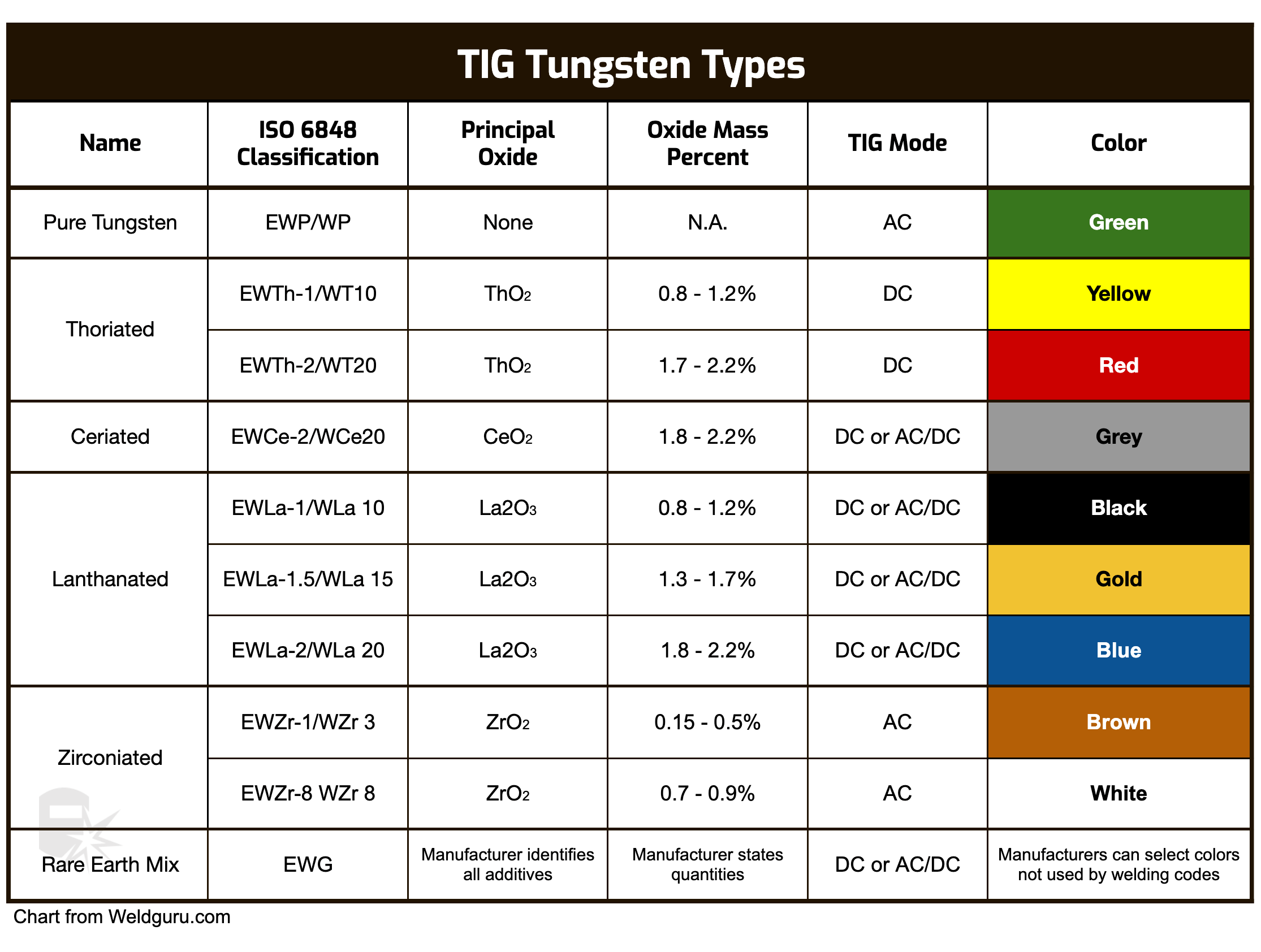
The American Welding Society (AWS) classifies tungsten electrodes by their chemical makeup. Each type has a color code, which you can see as a painted tip. These are the main tungsten types you will find:
| Type | Color Code | Main Alloying Element | Best Use |
|---|---|---|---|
| Pure Tungsten | Green | 99.5%+ Tungsten | AC welding of aluminum and magnesium |
| 2% Thoriated | Red | 2% Thorium Oxide | DC welding of steel, stainless steel |
| 2% Ceriated | Gray | 2% Cerium Oxide | Low-current DC or AC applications |
| 1.5% Lanthanated | Gold | 1.5% Lanthanum Oxide | AC/DC welding, all-purpose |
| 2% Lanthanated | Blue | 2% Lanthanum Oxide | AC/DC, best for inverter machines |
| Zirconiated | White | 0.8% Zirconium Oxide | AC welding of aluminum |
| Rare Earth | Various (usually purple) | Mix of rare oxides | Multi-purpose, modern use |
Let’s look closer at each type, so you know when to use them.
1. Pure Tungsten (green)
Pure tungsten contains at least 99.5% tungsten. It is soft and forms a clean, round ball on the tip when you use it with AC. This makes it good for aluminum and magnesium welding, especially with older transformer machines.
- Melting point: High, but not the best for high current
- Arc: Stable with AC, not as good with DC
- Life: Shorter than alloyed types
Pure tungsten is not good for DC welding because the arc can wander. Also, it wears out faster. Some welders still use it for AC welding of aluminum, but newer types often give better results.
2. Thoriated Tungsten (red, 2% Thorium)
2% thoriated tungsten is popular for DC welding. It contains 2% thorium oxide. This type gives excellent arc starting and stability. It also holds up to higher current and lasts longer than pure tungsten.
- Best for: DC welding of carbon steel, stainless steel, and titanium
- Current: Handles high amps
- Drawback: Thorium is slightly radioactive, so grinding produces dust that can be harmful. Use safety gear and grind in a safe area.
Thoriated tungsten is not ideal for AC welding of aluminum. Many welders like it for its reliability and clean arc in DC.
3. Ceriated Tungsten (gray, 2% Cerium)
Ceriated tungsten has 2% cerium oxide. It works well at low current. The arc is easy to start and very stable, even at low settings. This type is good for thin materials and jobs where you do not need much heat.
- Common use: Low-current DC welding (like thin sheet metal)
- AC: Can be used, but not as good as lanthanated or pure tungsten
- Advantage: Less wear on the electrode; lasts longer at low currents
One thing many beginners miss is that ceriated tungsten can overheat at high currents. This makes it less suitable for thick metal or heavy jobs.
4. Lanthanated Tungsten (gold And Blue)
Lanthanated tungsten comes in two main versions: 1.5% (gold) and 2% (blue). Both types offer strong all-purpose performance. They have a lower start voltage and keep a sharp tip well. Lanthanated tungsten is popular with modern inverter TIG machines.
- 1.5% lanthanated (gold): Good balance between AC and DC. Works well for most jobs.
- 2% lanthanated (blue): Even better for inverters; higher current capacity.
You can use lanthanated tungsten for steel, stainless, aluminum, copper, and more. It replaces thoriated tungsten in many shops, especially where safety is important.
5. Zirconiated Tungsten (white)
Zirconiated tungsten contains about 0.8% zirconium oxide. It is best for AC welding of aluminum. It resists splitting and forms a smooth, rounded tip.
- Advantage: Resists contamination and splitting
- Limitation: Not good for DC welding
Zirconiated tungsten offers great arc stability and is less likely to spit tungsten into your weld. This makes it a strong choice for clean aluminum welds.
6. Rare Earth Tungsten (purple Or Other Colors)
Rare earth tungsten is a newer category. It contains a mix of rare oxides, such as lanthanum, cerium, or yttrium. These types are called “universal” because they work well for both AC and DC welding. Many manufacturers claim they last longer and give a more stable arc.
- Use: Multi-purpose
- Benefit: Lower electrode wear, strong performance on many metals
Rare earth types are becoming more popular as they do not have the health risks of thorium. They are a good choice if you want one electrode for many jobs.
How Tungsten Composition Affects Welding
The chemical elements added to tungsten change how the electrode performs. For example:
- Thorium improves electron emission, making arc starts easier.
- Cerium helps with low-current stability.
- Lanthanum gives a stable arc over a wide range of currents.
- Zirconium increases resistance to contamination.
If you work with just one metal and current type, you can pick a tungsten optimized for that task. But if you switch between AC and DC, or weld many metals, a universal type like lanthanated or rare earth is better.

Credit: www.youtube.com
Tungsten Electrode Sizes And Their Impact
Tungsten electrodes come in different diameters, usually from 0. 5 mm up to 6. 4 mm (1/64” to 1/4”). The most common sizes are 1. 6 mm, 2. 4 mm, and 3. 2 mm (1/16”, 3/32”, and 1/8”).
Here’s how size matters:
| Diameter | Recommended Current Range (Amps) | Common Use |
|---|---|---|
| 1.0 mm (0.040″) | 5 – 30 | Thin sheet, precision work |
| 1.6 mm (1/16″) | 20 – 90 | General use, light fabrication |
| 2.4 mm (3/32″) | 60 – 150 | Medium thickness steel, aluminum |
| 3.2 mm (1/8″) | 120 – 250 | Heavy plate, high current |
- Too small: Electrode will overheat, melt, or distort.
- Too large: Harder to start arc, less precise control.
Match your tungsten size to your job. For most hobby and light industrial work, 1. 6 mm or 2. 4 mm is enough.
Ac Vs. Dc Welding: How It Changes Your Choice
The type of current you use in TIG welding changes which tungsten works best.
- AC (alternating current): Used for aluminum and magnesium. Needs a tungsten that forms a rounded tip and resists contamination.
- DC (direct current): Used for steel, stainless, copper, and titanium. Needs a tungsten that keeps a sharp point and gives a focused arc.
Pure, zirconiated, and lanthanated types are good for AC. For DC, use thoriated, ceriated, or lanthanated.
Matching Tungsten To Metal Type
The metal you weld also affects your choice. Here are common matches:
- Aluminum (AC): Pure, zirconiated, or lanthanated
- Steel/Stainless (DC): Thoriated, ceriated, or lanthanated
- Titanium/Nickel: Lanthanated or ceriated
- Copper: Lanthanated or thoriated
If you weld both aluminum and steel, lanthanated is a safe all-round choice.
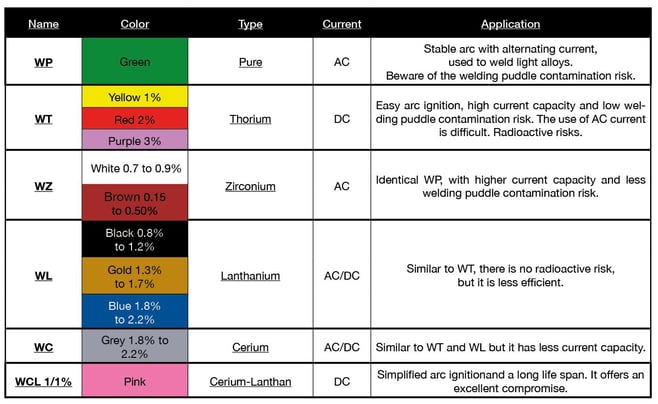
Color Codes And What They Mean
You do not have to remember all the chemistry. Manufacturers paint the end of each electrode with a color. Here is a quick reference:
- Green: Pure tungsten
- Red: 2% thoriated
- Gray: 2% ceriated
- Gold: 1.5% lanthanated
- Blue: 2% lanthanated
- White: Zirconiated
- Purple: Rare earth/multi-mix
Never use an unmarked tungsten unless you are sure of its type. Mixing up electrodes can cause poor results or even safety risks.
Credit: www.axxair.com
How To Prepare And Grind Tungsten Electrodes
Many welders overlook how tungsten preparation changes welding results. The way you grind and shape the tip affects arc shape and stability.
- For DC welding: Grind a sharp point. Make the grind marks along the length, not around the rod. This gives a focused, stable arc.
- For AC welding: Ball the tip. Use a flat or slightly rounded end, which spreads the arc and helps clean the weld pool.
Non-obvious tip: Use a dedicated grinding wheel for tungsten. If you use a wheel shared with other metals, you risk contamination.
Another insight: The angle of the point changes how the arc behaves. A narrow angle (20-30°) gives a small, focused arc for thin metal. A larger angle (up to 60°) spreads the arc for thicker work.
Common Mistakes When Choosing Tungsten
Many new TIG welders make these errors:
- Using the wrong type for the metal or current: For example, using pure tungsten for DC steel welding leads to unstable arcs.
- Ignoring electrode size: Too thin or too thick a tungsten causes problems.
- Mixing up color codes: Always check the color, especially if you use different types.
- Not grinding properly: A blunt or dirty tip will give poor arc starts and dirty welds.
- Reusing old tungsten: Electrodes with contamination or cracks should be replaced, not reused.
How To Test And Compare Tungsten Types
If you are unsure which tungsten is best for your setup, test a few types. Set your machine to your usual settings and weld a short bead with each electrode. Look for:
- Arc stability: Does the arc stay steady or jump around?
- Electrode wear: Does the tip keep its shape?
- Weld appearance: Is the bead smooth and clean?
Write down your results. Over time, you will see which types work best for your favorite metals and projects.
Health And Safety Tips
Some tungsten types, like thoriated, are slightly radioactive. The risk is low if you handle them properly, but the dust from grinding can be harmful if you breathe it in.
- Always grind tungsten in a well-ventilated area.
- Wear a mask and safety glasses.
- Consider switching to lanthanated or rare earth tungsten, which have no health risks.
Credit: weldguru.com
Cost And Availability
Tungsten electrodes are not very expensive, but prices vary by type. Pure tungsten is usually the cheapest. Lanthanated and rare earth types cost more but last longer and perform better for many jobs.
- For hobby use: Buy a small pack of lanthanated or ceriated.
- For production: Buy in bulk, and keep a few types on hand.
Check the color and type before you buy—don’t just pick the cheapest option.
Modern Trends In Tungsten Selection
In recent years, many welders have moved away from thoriated tungsten. Health and safety rules push shops to use lanthanated or rare earth types. These newer options give equal or better performance without the risks.
Many inverter TIG machines work best with lanthanated or rare earth tungsten. If you use a modern machine, start with one of these types.
Summary Table: Choosing The Right Tungsten
Here’s a quick summary to help you pick the right tungsten:
| Metal | Current | Best Tungsten Types | Color Codes |
|---|---|---|---|
| Aluminum | AC | Pure, Zirconiated, Lanthanated | Green, White, Gold/Blue |
| Steel | DC | Thoriated, Lanthanated, Ceriated | Red, Gold/Blue, Gray |
| Stainless Steel | DC | Thoriated, Lanthanated, Ceriated | Red, Gold/Blue, Gray |
| Titanium | DC | Lanthanated, Ceriated | Gold/Blue, Gray |
| Multi-purpose | AC/DC | Lanthanated, Rare Earth | Gold/Blue, Purple |
Non-obvious Insights For Better Results
- Keep extra tungsten rods in different sizes and types. Sometimes you need to switch mid-job if you change metals or thickness.
- Store electrodes in a dry place. Moisture can cause contamination, especially with pure tungsten.
Where To Learn More
If you want deeper information, the Wikipedia page on tungsten electrodes has detailed technical data.
Frequently Asked Questions
What Is The Most Universal Tungsten For Tig Welding?
Lanthanated tungsten (especially 2%, blue) is the best all-purpose choice. It works well for both AC and DC, on most metals, and with modern inverter machines.
Can I Use Thoriated Tungsten For Aluminum Welding?
You can use thoriated tungsten for aluminum, but it is not the best choice. Pure, zirconiated, or lanthanated types give better results, especially with AC.
How Can I Tell If My Tungsten Is Contaminated?
If your tungsten tip turns black, forms a ball, or you see arc instability, it is likely contaminated. Replace or regrind it before you continue welding.
Is Ceriated Tungsten Better Than Thoriated?
Ceriated tungsten is safer (no radioactivity) and works well at low currents. Thoriated is better for high-current DC welding. For general use, lanthanated often beats both.
What Is The Correct Way To Grind A Tungsten Electrode?
For DC welding, grind to a sharp point along the length of the rod. For AC welding, ball the tip. Always use a dedicated grinding wheel to avoid contamination.
—
Choosing the right tungsten for TIG welding is a simple step that leads to better welds, less frustration, and safer work. Match your electrode to your metal, current, and machine. Test different types if you are unsure, and always follow safe grinding practices.
With the right tungsten, you will see smoother arcs and cleaner results on every project.