Disclosure: This post contains affiliate links and I will be compensated if you make a purchase after clicking through my links. Learn More
Welding in confined spaces safety starts with one rule: test the air, ventilate the space and keep a trained attendant outside before anyone strikes an arc. A tank, boiler or crawl space can trap fumes, lose oxygen or fill with flammable gas in minutes.
OSHA treats welding inside these spaces as a high-risk job. The rules sit in 29 CFR 1910.146 (permit spaces), 29 CFR 1910.252 (welding, cutting and brazing), 29 CFR 1926.353 for construction and 29 CFR 1915 for shipyards.
We pulled the key requirements straight from those standards and turned them into a plain checklist you can use on the job.
What Counts as a Confined Space for Welding?
OSHA defines a confined space in 29 CFR 1910.146(b) as a space that meets all 3 of these tests:
- It’s large enough and so configured that a worker can bodily enter and do assigned work.
- It has limited or restricted means for entry or exit.
- It isn’t designed for continuous employee occupancy.
The welding standard, 29 CFR 1910.252(b)(4)(i), gives common examples: a tank, boiler, pressure vessel or small compartment of a ship. Pipes, vaults, silos, pits and the inside of large weldments often fit the same 3 tests.
Permit-Required Confined Spaces
A confined space becomes a permit-required confined space when it has 1 or more of these hazards, per 1910.146(b):
- It contains or could contain a hazardous atmosphere.
- It holds a material that could engulf a worker, like grain or sand.
- Its shape could trap or asphyxiate a worker, such as walls that slope inward to a small opening.
- It has any other recognized serious safety or health hazard.
Welding adds heat, fumes, sparks and gas to a closed space. So most welding jobs inside a confined space need a permit and a hot work permit, which OSHA defines as the employer’s written authorization for welding, cutting, burning, heating or other work that can ignite something.
Why Is Welding in a Confined Space So Dangerous?
The same features that make a space confined also stop bad air from leaving. Here are the main hazards a welder faces inside one.
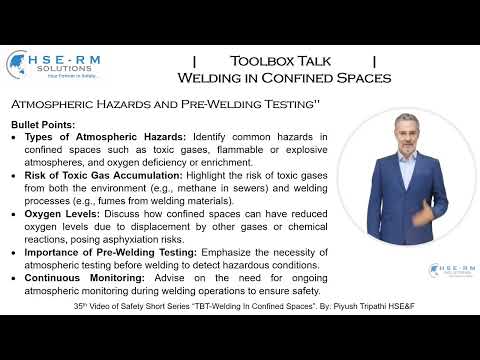
Oxygen Deficiency
OSHA calls air with less than 19.5% oxygen by volume oxygen deficient. OSHA’s shipyard ventilation guide (OSHA 3639) warns that oxygen can be displaced after hot work, and that rusting steel inside a closed space can use up oxygen too.
Low oxygen gives little warning. A worker can collapse before noticing anything is wrong.
Oxygen Enrichment and Fire
Air with more than 23.5% oxygen is oxygen enriched under 1910.146. Clothing, gloves and grease burn much faster in that air. A leaking oxy-fuel hose or torch left inside the space is a common way this happens.
Flammable Gas and Explosion
OSHA counts flammable gas, vapor or mist above 10% of its lower flammable limit (LFL) as a hazardous atmosphere. One spark or a hot bead of spatter can ignite residue from fuel, paint, solvent or a leaking fuel-gas line.
Toxic Fumes and Gases
Welding fumes and gases build up fast when there’s no airflow. Coatings and base metals with zinc, lead, cadmium, chromium or beryllium add their own toxic fumes, which 29 CFR 1926.353(c) covers for construction work.
Electric Shock and Heat
Tight spaces push your body against metal that’s part of the welding circuit. Sweat and damp surfaces make that worse. Heat stress also builds quickly inside a closed steel space.
Credit: www.youtube.com
OSHA Rules for Welding in Confined Spaces
The rule set that applies depends on your industry. 1910.146 itself says it doesn’t cover construction (part 1926) or shipyard work (part 1915), which have their own rules.
| Industry | Main OSHA Standards | Key Welding Rules |
|---|---|---|
| General industry | 1910.146, 1910.252(b)(4) and (c)(4) | Permit program, ventilation, cylinders and machines outside, attendant outside |
| Construction | 1926.353(b) and 1926 Subpart AA | Ventilation, airline respirators when needed, attendant with a rescue plan |
| Shipyards | 1915.51 and 1915 Subpart B | Mechanical exhaust ventilation, oxygen kept at 19.5% to 22.0% |
Across all 3, the core duties match: ventilate the space, keep a worker outside and never use oxygen for ventilation.
Welding in Confined Spaces Safety Checklist
Use this checklist before and during every confined space welding job. Each item ties back to an OSHA paragraph.
Step 1: Get the Permits in Place
Confirm whether the space is a permit space and get the entry permit and hot work permit signed. Name the entrant, the attendant and the rescue plan on the permit.
Step 2: Test the Air in the Right Order
Use a calibrated direct-reading gas monitor. 1910.146(c)(5)(ii)(C) lists the order: oxygen first, then flammable gases and vapors, then toxic air contaminants. Keep the monitor running for the whole job.
Step 3: Ventilate the Space
Ventilation is a prerequisite for welding in confined spaces under 1910.252(b)(4)(ii). The air you pull out must be replaced with clean, breathable air, per 1910.252(c)(4)(i). Shipyard rule 1915.51 calls for mechanical exhaust ventilation.
Step 4: Keep Cylinders and Machines Outside
1910.252(b)(4)(iii) says gas cylinders and welding machines stay outside the confined space. Run only leads, hoses and the torch or gun inside.
Step 5: Station an Attendant Outside
An attendant with a preplanned rescue procedure must watch the welder at all times, per 1910.252(b)(4)(iv) and 1926.353(b)(3). When entry is through a manhole or other small opening, OSHA also requires a way to pull the welder out fast in an emergency.
Step 6: Wear the Right Respirator
When ventilation can’t keep the air safe, 1910.252(c)(4)(ii) calls for NIOSH-approved airline respirators or hose masks. Spaces with air that’s immediately dangerous to life or health need self-contained breathing apparatus, per 1910.252(c)(4)(iii).
Step 7: Shut Down Right During Breaks
When arc welding stops for any length of time, remove the electrodes from the holders and disconnect the machine from its power source, per 1910.252(b)(4)(v).
For gas welding or cutting, close the torch valves and shut off the gas at a point outside the space. Remove the torch and hose from the space where you can, per 1910.252(b)(4)(vi).
Step 8: Mark Hot Metal
After welding, mark hot metal or warn other workers some other way, per 1910.252(b)(4)(vii). A coworker crawling in later can’t see that a plate is still hot.

Credit: www.youtube.com
Common Mistakes to Avoid
- Using oxygen to “freshen” the air. OSHA bans it in 1910.252(c)(4)(v) and 1926.353(a)(6). It turns the space into a fire hazard.
- Testing once and never again. Welding changes the air as you work, so keep a monitor running.
- Leaving the torch inside over lunch. A slow leak from a closed but faulty valve can fill the space.
- Sending a second worker in to rescue. The attendant stays outside and runs the rescue plan.
- Bringing cylinders inside “just for a minute.” Cylinders and machines stay outside every time.
Safety note: Never bypass a gas monitor alarm, a permit step or the attendant rule to finish a job faster. If the air reading is outside safe limits, leave the space and fix the ventilation first.
Frequently Asked Questions
What is considered a confined space in welding?
A confined space is any space large enough to enter and work in, with limited ways in or out, and not built for people to stay in. OSHA lists tanks, boilers, pressure vessels and small ship compartments as common welding examples under 29 CFR 1910.252(b)(4).
What oxygen level is safe for welding in a confined space?
OSHA treats air below 19.5% oxygen as oxygen deficient and above 23.5% as oxygen enriched in 29 CFR 1910.146. Shipyard rules keep oxygen between 19.5% and 22.0%. Test with a calibrated monitor before entry and keep checking as you weld.
Can you bring gas cylinders into a confined space?
No. OSHA 29 CFR 1910.252(b)(4)(iii) says gas cylinders and welding machines must stay outside the confined space. Only the hoses, leads and torch or gun go inside, and the gas must be shut off at a point outside the space during breaks.
Do you need an attendant when welding in a confined space?
Yes. OSHA requires an attendant stationed outside with a preplanned rescue procedure to watch the welder at all times. The attendant keeps contact with the welder, calls for help when needed and does not enter the space to attempt a rescue alone.
Why can’t you use oxygen to ventilate a confined space?
Extra oxygen makes clothing, gloves, grease and other materials ignite more easily and burn much faster. OSHA bans using oxygen for ventilation in 29 CFR 1910.252(c)(4)(v) and 1926.353(a)(6). Use clean, breathable replacement air from a blower or exhaust system instead.
Final Words
Welding in a confined space is safe only when the air, the people and the gear are all controlled before the first arc. Test the air in order, ventilate it and keep cylinders and machines outside.
Keep an attendant outside with a real rescue plan, and shut everything down right during breaks. If something looks off on the monitor, get out first and ask questions later.