Disclosure: This post contains affiliate links and I will be compensated if you make a purchase after clicking through my links. Learn More
How To Convert 3 Phase Welder To Single Phase
If you want to convert a 3 phase welder to single phase, you need to understand wiring, power requirements, and safety. Most 3 phase welders cannot run directly on single phase, but with the right steps and equipment, you can make this conversion safely.
Converting a 3 phase welder to single phase is a project that many shop owners and DIY welders think about. Maybe you bought a used industrial welder at a great price, but your home or small shop only has single phase power.
Or perhaps you moved to a new location and the electrical service is different. This guide shows you exactly how to approach this conversion, the risks, what methods work, and which mistakes to avoid. You’ll get clear answers based on real industry practice, not guesswork.
Why Convert A 3 Phase Welder To Single Phase?
Many welders designed for factories use three phase electricity. In the USA, most homes and small shops have single phase 240V power, not three phase. Three phase welders are often cheaper on the used market because fewer buyers can use them. If you can convert one, you might get a high-quality welder for much less money.
But it’s not just about saving money. Sometimes the only welder available is three phase. Or maybe your favorite brand only makes large units in three phase. If you can convert it, you have more choices.
Key reasons people do this conversion:
- Lower cost for industrial welders
- More options in the used equipment market
- Limited access to three phase power in most locations
Before you start, understand this is an advanced electrical project. Do not attempt if you are not comfortable with high-voltage work. Always follow local codes and consult a licensed electrician.
How 3 Phase And Single Phase Power Differ
To convert a welder, you need to know the basics of how these power systems work.
Three phase power delivers electricity through three wires, each carrying a current that peaks at a different time. This gives a smooth, constant flow of energy, which is perfect for big motors and industrial machines.
Single phase power uses just one alternating current. It’s standard for homes and small shops in the USA. Single phase is less efficient for big machines, but it’s what most people have.
Here’s a comparison to help you see the difference:
| Feature | Three Phase | Single Phase |
|---|---|---|
| Number of wires | 3 (plus ground/neutral) | 2 (plus ground/neutral) |
| Voltage (USA) | 208V, 240V, 480V | 120V or 240V |
| Power delivery | Smoother, more constant | Pulsing, less efficient at high loads |
| Common use | Industry, factories | Homes, small shops |
Can Every 3 Phase Welder Be Converted?
Not all welders can be converted. Some are designed only for three phase and cannot run on single phase at all. Others can be re-wired or adapted, but will run at reduced power.
Check these things first:
- Manufacturer’s label: Look for a wiring diagram or voltage options. Some welders are “dual voltage” or “multi-phase.”
- Inside the welder: Some units have jumpers or switches for phase selection.
- Manual: Download the manual from the manufacturer’s website. It often shows if conversion is possible.
If none of these are present, you may need a professional to inspect the internal wiring.
Three Main Methods To Convert 3 Phase Welder To Single Phase
There are three common ways to convert a 3 phase welder to single phase. Each has pros and cons. Your choice depends on your skill, budget, and the welder itself.
1. Internal Rewiring (if Supported By The Welder)
Some welders are designed to run on both single phase and three phase power. They can be rewired internally to accept single phase. This is the best and most efficient way if your welder supports it.
Steps For Internal Rewiring:
- Check the manual and labels for wiring instructions and supported voltages.
- Open the case and locate the input terminal block. This is where the power wires connect.
- Look for jumpers or selector switches. Some welders have clear instructions for setting to single phase.
- Move the jumpers or wires as directed by the manual for single phase operation.
- Connect your single phase power to the correct terminals (usually L1 and L2, with L3 left unconnected).
- Double-check all connections for tightness and correctness.
- Replace the cover and test the welder with a low setting first.
Important: Only use this method if your welder manual or wiring diagram shows single phase support. Do not guess. Wrong wiring can destroy the machine or cause injury.
Example
Many Miller and Lincoln Electric welders from the 1980s and 1990s support both single and three phase input. Their manuals provide diagrams for moving jumpers to set single phase. You can find manuals on their official websites.
Pros And Cons
| Pros | Cons |
|---|---|
| Efficient and reliable | Only possible if welder supports it |
| No extra equipment needed | Requires wiring knowledge |
| Full or near-full output | May need new plug |
Non-obvious Insight
Many welders that support this conversion still need a higher amperage breaker on single phase. For example, a welder using 20A on three phase may need 30A or more on single phase to get the same output. Always check the manual for the correct breaker size.
2. Using A Phase Converter
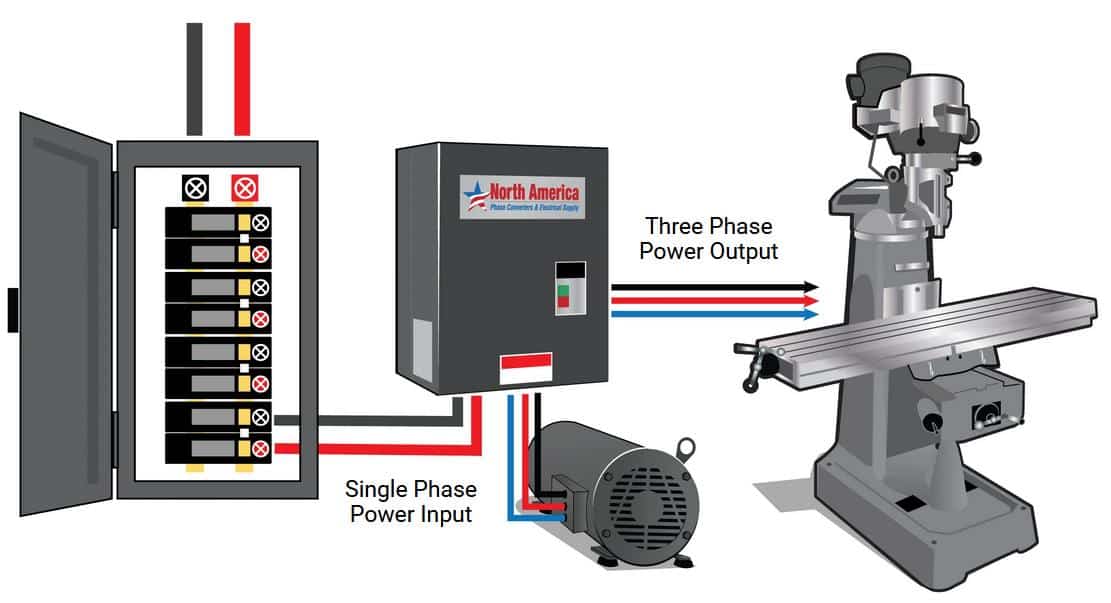
If internal rewiring isn’t possible, a phase converter lets you run a three phase welder on single phase power. There are two main types: rotary phase converters and static phase converters.
Rotary Phase Converter
A rotary phase converter uses a motor and capacitors to create a third phase from your single phase power. It can run three phase welders and other machines.
How it works:
- Plug the converter into your single phase outlet.
- Connect your welder to the converter.
- The converter “spins up” and produces three phase output.
Rotary converters are the most reliable for welders because they supply balanced power at all loads.
Static Phase Converter
A static phase converter uses capacitors to “kick start” a three phase machine, then drops out. It’s cheaper but not ideal for welders. Most static converters only allow the welder to run at 2/3 rated power, and arc stability may be poor.
Steps To Use A Phase Converter
- Choose the right size converter for your welder’s input amps.
- Install the converter near your power panel, following the manufacturer’s instructions.
- Wire the converter input to your single phase power (240V).
- Wire the converter output to your welder’s input.
- Test the converter with the welder on a low setting.
- Monitor for overheating or odd noises.
Example
If your welder is rated for 15kVA, choose a rotary phase converter with at least 20kVA capacity. Popular brands include American Rotary and Phase-A-Matic.
Pros And Cons
| Pros | Cons |
|---|---|
| Works with most three phase welders | Expensive ($500-$2000+) |
| No need to modify the welder | Needs space and wiring |
| Can run multiple machines | Some power loss |
Non-obvious Insight
For welders with electronic controls, rotary converters are much better than static types. Static converters can damage sensitive electronics or give poor arc quality. Always oversize your phase converter by at least 20% for welding.
3. Using A Variable Frequency Drive (vfd)
A Variable Frequency Drive converts single phase input to three phase output, and also allows you to control the output frequency and voltage. VFDs are mainly used for motors, but in some cases, they can power welders.
How Vfds Work
A VFD takes single phase AC power, converts it to DC, then back to three phase AC at the required voltage and frequency. It’s all done with solid-state electronics.
VFDs are great for powering three phase motors from single phase, but not all welders work with them. Only welders with simple transformer inputs (not inverter welders) are candidates.
Steps To Use A Vfd
- Check your welder’s input type. Only use VFDs for transformer-type welders.
- Buy a VFD rated for your welder’s voltage and amps. Always get one rated for single phase input.
- Wire the VFD input to your single phase power.
- Wire the VFD output to your welder’s input terminals.
- Set the output frequency to 60 Hz (standard USA frequency).
- Start the welder at low power and check for proper operation.
Example
A 10kW transformer welder can run on a 15kW single phase VFD, set to 60Hz and correct output voltage. Brands like Hitachi and TECO-Westinghouse make these units.
Pros And Cons
| Pros | Cons |
|---|---|
| Compact and quiet | Not for inverter welders |
| Efficient for transformer welders | May need special setup |
| Some allow soft start | Expensive for high current |
Non-obvious Insight
Most VFDs are designed for motors, not welders. If your welder draws high inrush current when starting, choose a VFD with overcurrent protection and high peak amperage rating. Never use a VFD with a welder that has built-in electronics or inverter technology.
Credit: www.northamericaphaseconverters.com
Safety Precautions For Conversion
Working with high voltage is dangerous. Don’t skip safety steps.
- Turn off power at the breaker before opening any equipment.
- Use insulated tools and wear protective gear.
- Double-check all wiring against diagrams.
- If unsure, hire a licensed electrician.
- Follow National Electrical Code (NEC) rules for wire size and breaker ratings.
- Label your converted welder to avoid future confusion.
Non-obvious tip: Many people skip checking the grounding system. Improper grounding can cause shocks or even fire. Always update your ground connection to match the new wiring.
Power And Output Considerations
When you convert a 3 phase welder to single phase, the input amps will increase to get the same welding power. This can overload circuits if not planned.
Example:
A 3 phase welder that uses 15A per phase at 240V might need 25-30A on single phase. Check your panel and breaker size. Use #8 or #6 copper wire for heavy loads.
Also, some converted welders may not reach their full output. You might notice lower maximum amperage or duty cycle. This is normal if you’re using a converter or VFD.
Step-by-step Guide: Converting A Common 3 Phase Welder
Let’s look at a typical example using the three main methods:
Internal Rewiring Example: Miller Dialarc 250
- Find the wiring diagram inside the cover or manual.
- Locate the input terminal block.
- Move jumpers as shown for single phase (usually “L1” and “L2” for hot wires, “L3” left empty).
- Connect 240V single phase to L1 and L2.
- Install a 50A breaker (per manual).
- Test at low amperage and increase.
Rotary Phase Converter Example
- Buy a rotary converter sized for your welder (e.g., 10kW welder, 15kW converter).
- Install converter near power panel.
- Connect single phase 240V to converter input.
- Connect converter output to welder’s three phase input.
- Switch on converter first, then welder.
Vfd Example
- Get a VFD rated for single phase input and correct amps/voltage.
- Wire single phase 240V to VFD input.
- Wire VFD output to two hot terminals of the welder.
- Set VFD to 60 Hz.
- Test for proper arc.
Common Mistakes And How To Avoid Them
- Guessing at wiring without a manual. Always get the correct diagram.
- Using undersized wires or breakers. This causes overheating and fire risk.
- Choosing a phase converter or VFD that’s too small. Always oversize by 20-30% for welders.
- Ignoring duty cycle. Converted welders may overheat if used at high settings for long periods.
- Skipping ground checks. Improper grounding is a major hazard.
Non-obvious warning: Some welders have internal fans or controls that use only three phase. These may not work at all on single phase, even if the main transformer does. Check all internal loads before converting.
Cost Comparison: Conversion Vs Buying New
Is conversion worth it? Here’s a quick cost breakdown:
| Option | Typical Cost (USD) | Notes |
|---|---|---|
| Used 3 phase welder + conversion | $400–$2,000 | Depends on welder, converter/VFD cost |
| New single phase welder | $1,000–$4,500 | Warranty, easier setup |
| Hire electrician for conversion | $200–$1,000 | Safety and code compliance |
In many cases, converting a used 3 phase unit is cheaper, especially for heavy-duty machines. But for small shops or hobbyists, buying a new single phase welder may be simpler.
Expert Tips For A Reliable Conversion
- Always oversize your converter or VFD to handle welding surges.
- Use industrial-grade connectors for all wiring.
- Mark your converted welder clearly with “Single Phase Only” stickers.
- Test the welder at low settings before full power.
- Keep a fire extinguisher nearby during first testing.
Professional insight: If you plan to run multiple three phase machines, invest in a larger rotary converter. It’s more cost-effective than separate converters for each device.

Credit: www.mig-welding.co.uk
Where To Find Help And More Information
If you’re unsure, contact your welder’s manufacturer or a licensed electrician. Many brands have forums and support lines for this exact question.
For more on three phase power and conversion, the Wikipedia page on Three-Phase Electric Power is a solid resource.
Frequently Asked Questions
Can All Three Phase Welders Run On Single Phase?
No, only some can be converted. Check your welder’s manual or wiring diagram. Some welders are “multi-phase” and allow single phase input, but others require special converters or cannot be used at all.
How Much Power Do I Lose When Converting To Single Phase?
You may lose some maximum output, especially with static phase converters or VFDs. Expect about 20–30% less power in most cases. Rotary phase converters give the best performance with less loss.
Is Using A Phase Converter Safe For My Welder?
Yes, if sized correctly and wired properly. Always use a converter rated above your welder’s max input. Poorly sized converters can damage the welder or cause bad weld quality.
What Size Breaker Do I Need For My Converted Welder?
Breaker size depends on your welder’s input amps on single phase. Check the welder’s manual or use the formula: input kVA × 1000 ÷ voltage = amps. Then use the next higher standard breaker size.
Can I Use A Vfd To Run Any Three Phase Welder?
No, VFDs only work with transformer-based welders, not inverters or welders with sensitive electronics. Always check your welder’s input type and VFD specs before trying this method.
Converting a 3 phase welder to single phase is possible with the right approach, good planning, and respect for safety. Always check your specific machine, use the right equipment, and don’t take shortcuts. With careful work, you can save money and get top performance from your welder—even on single phase power.

Credit: www.hobby-machinist.com