Disclosure: This post contains affiliate links and I will be compensated if you make a purchase after clicking through my links. Learn More
Learning how to choose brazing flux comes down to three things: the filler metal’s working temperature, the base metals and how long the joint stays hot. For most silver brazing on copper, brass and steel, a white AWS FB3-A paste does the job.
Stainless steel, carbide and long heating cycles call for a boron-modified black FB3-C flux. Aluminum and high-temperature bronze work need their own flux classes.
The wrong flux burns out before the filler flows, or never gets active at all. That mismatch can ruin a joint that is otherwise clean and well fitted.
What Brazing Flux Does
Harris says flux absorbs the oxides that form during heating and helps the filler metal flow. It shields the joint from air until the alloy wets the surface.
Flux is not a cleaner. Harris lists that as the top misconception: you must clean the parts before you apply flux, because flux only handles oxides made during heating.
Harris describes the usual flux mix as fluorides and fluoroborates. Some fluxes also contain boric acid, and Harris sells an ECO SMART line with a boric acid free formula.
How to Choose Brazing Flux in 5 Steps

Credit: www.youtube.com
The answer starts with the filler. Pick the brazing alloy first, then choose a flux that is active across that alloy’s working range and suits your base metals.
Step 1: Match the Flux to the Filler Temperature
Harris says the flux must be active at the same temperature as your brazing alloy. Harris Safety-Silv 56 (BAg-7) is fully liquid at 1,205°F, which sits well inside a white flux rated from 1,050°F to 1,600°F.
High-temperature fillers need a flux rated much higher. Castolin XuperBraze 14D, an FB3-D flux for cast iron with high-silicon rods, lists a range of 1,400°F to 2,200°F.
Step 2: Match the Base Metals
Copper, brass and mild steel accept a standard white flux. Stainless steel, nickel alloys and tungsten carbide form tougher oxides, and Harris recommends its boron-modified Stay-Silv Black for them.
Aluminum is a separate case. Superior Flux says open-air aluminum brazing needs an aluminum brazing flux, which falls under AWS class FB1-A.
Step 3: Factor in Heating Time and Method
Long heating cycles wear out flux. Lucas-Milhaupt recommends black flux for large parts with long heat times, for high-liquidus fillers and for fast induction heating.
Harris also pairs induction brazing with Stay-Silv Black. A small torch joint that comes up to heat fast rarely needs it.
Step 4: Pick the Flux Form
- Paste: the most common form. Brush it on both joint surfaces. Harris Stay-Silv White and Black come as pastes.
- Powder: dip a hot rod into it (“hot rodding”) or mix it with water or alcohol into a paste. Harris Stay-Silv Powder is class FB3-F.
- Flux-coated or flux-cored rod: the flux rides on the filler, which suits field work and occasional jobs.
- Auto-dispensing flux: a smoother paste, such as Harris Dynaflow, made for automated feeding.
Step 5: Check the AWS A5.31 Class
AWS A5.31 is the specification for brazing and braze welding fluxes. The class on the label tells you the flux type, so you can compare brands. Harris states that all its fluxes meet AWS A5.31 for their class.
Brazing Flux Types at a Glance
| AWS A5.31 class | Typical use | Example product and listed range |
|---|---|---|
| FB3-A (white paste) | Silver brazing on copper, brass, steel | Harris Stay-Silv White, 1,050°F to 1,600°F |
| FB3-C (black, boron-modified) | Stainless, nickel alloys, carbide, long or induction heats | Harris Stay-Silv Black, about 1,050°F to 1,700°F |
| FB3-F (powder) | Same chemistry as white paste, for hot rodding | Harris Stay-Silv Powder, 1,200°F to 1,600°F |
| FB3-D (high temperature) | Cast iron with high-silicon rods, high-temperature fillers | Castolin XuperBraze 14D, 1,400°F to 2,200°F |
| FB1-A (aluminum) | Aluminum-silicon (BAlSi) fillers | Castolin XuperBraze 190 FP, 915°F to 1,350°F |
| FB3-J (bronze) | Low fuming bronze (LFB) rods | Superior Flux Anti-Borax No. 2 |
Ranges are the makers’ listed active ranges for each product. Check the data sheet for the exact flux you buy.
White Flux vs Black Flux
Credit: www.youtube.com
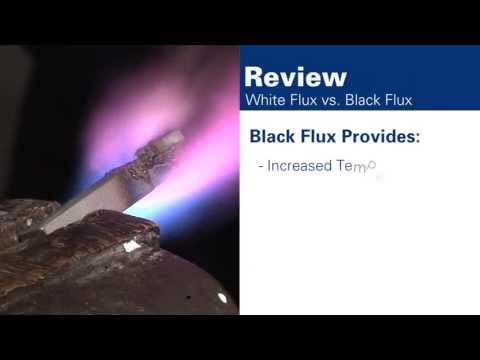
Lucas-Milhaupt explains that adding metallic boron turns white flux black. The boron gives the flux more protection over long heats and helps it break down tenacious oxides.
Harris lists Stay-Silv White for about 90% of silver brazing jobs, with an active range of 1,050°F to 1,600°F. Stay-Silv Black stretches the top end to about 1,700°F and lasts longer at heat.
Makers don’t fully agree on stainless. Harris lists white flux as usable on stainless steel, but Superior Flux says its white flux is not for stainless. Both point to black flux for stainless work, so black is the safer pick there.
Flux Choice by Base Metal and Filler
| Joint | Filler | Flux |
|---|---|---|
| Copper to copper | Phos-copper (BCuP) | None needed (Harris) |
| Copper to brass | Phos-copper-silver (BCuP) | White Stay-Silv (Harris) |
| Steel or brass | Silver (BAg) | White FB3-A |
| Stainless steel | Silver (BAg) | Black FB3-C |
| Tungsten carbide | Silver (BAg) | Black FB3-C |
| Aluminum | Aluminum-silicon (BAlSi) | Aluminum flux, FB1-A |
| Cast iron | High-silicon rod | High-temperature FB3-D |
| Steel or cast iron | Low fuming bronze (LFB) rod | Bronze flux, FB3-J |
Harris notes that copper to copper brazing does not require a flux. That applies to phos-copper (BCuP) fillers on copper. Harris pairs BCuP alloys with Stay-Silv flux once brass enters the joint.
Common Mistakes to Avoid
- Using flux as a cleaner. Remove oil, grease and oxide first. Flux only handles oxides formed during heating.
- Using one flux for every job. Harris says this is a common misconception. Match the flux to the alloy temperature and base metal.
- Thinning flux with water. Harris warns that dilution causes burning or charring and can stop the alloy from flowing.
- Overheating the joint. Overheated flux can char, and Harris says charred flux may need a wire brush or grinding to remove.
- Leaving residue on the part. Most flux residue comes off with a rag or brush and water when it hasn’t been overheated.
Safety Tips for Brazing Flux
Fluoride-based fluxes give off fumes when heated. Work with good ventilation or fume extraction, keep your face out of the plume and read the flux safety data sheet before you start.
Wear gloves when you handle flux paste and wash your hands after. If boric acid is a concern in your shop, look at a boric acid free option such as Harris ECO SMART.
Frequently Asked Questions
What Is the Most Common Brazing Flux?
A white AWS FB3-A paste is the most common brazing flux. Harris says its Stay-Silv White covers about 90% of silver brazing jobs, with an active range of 1,050°F to 1,600°F. It works on copper, brass, steel and nickel alloys with silver brazing alloys.
Do You Need Flux to Braze Copper?
For copper to copper, Harris says you don’t need flux, which applies when you use a phos-copper (BCuP) filler on bare copper. You do need flux when you braze copper to brass or steel, or when you use a silver (BAg) filler.
What Is Black Brazing Flux Used For?
Black flux is a boron-modified FB3-C flux for stainless steel, nickel alloys and tungsten carbide. It also suits large parts with long heating times, high-liquidus fillers and induction brazing. Harris lists its Stay-Silv Black paste as active from about 1,050°F to 1,700°F.
Can You Use Soldering Flux for Brazing?
No. Soldering flux is made for soldering temperatures, and Superior Flux puts brazing at about 800°F to 2,000°F. Harris says a brazing flux must be active at the same temperature as your brazing alloy, so pick an AWS A5.31 brazing flux rated for that range.
How Do You Know When Brazing Flux Is Ready?
Watch the flux closely as you heat the joint. Harris says flux begins to turn clear when the joint is up to brazing temperature. At that point, touch the rod to the joint and let the base metal melt the filler.
Final Words
The quickest way to choose brazing flux is to start with the filler alloy and its temperature. Then check the base metals and how long the joint will stay hot.
White FB3-A paste covers most silver brazing on copper, brass and steel. Switch to black FB3-C for stainless, carbide, big parts or induction heating.
Use the flux at full strength, clean the parts before you apply it and wash off the residue after. The AWS A5.31 class on the label lets you compare brands quickly.