Disclosure: This post contains affiliate links and I will be compensated if you make a purchase after clicking through my links. Learn More
What is high frequency start TIG welding? It is a non-contact arc start where the TIG welder sends a short burst of very high voltage at radio frequency across the gap, so the arc lights without the tungsten ever touching the work.
High frequency, or HF start, is the most common way to start a TIG arc, according to TWI. It keeps the tungsten clean, stops tungsten inclusions at the start of the weld, and lets you begin a bead with the torch held at working height.
The trade-off is electrical noise. HF can disturb radios, computers and machine controls, so it needs a good ground and some care around electronics.
What Is High Frequency Start TIG Welding
HF start adds a short, very high voltage pulse on top of the welder’s open circuit voltage. That pulse breaks down the gas gap between the tungsten and the work, so welding current can flow.
Once the arc burns, the working voltage drops to a normal range. EWM lists TIG arc voltage as usually 10 to 40 V.
How HF Start Works
The welder’s HF circuit makes high voltage sparks of several thousand volts that last a few microseconds, TWI explains. Those sparks ionize the shielding gas, and ionized argon conducts current.
Argon makes ignition easier because it ionizes more easily, EWM notes. That’s one reason pure argon is the default TIG gas for most jobs.
| HF spec | Value | Source |
|---|---|---|
| Peak voltage limit (manual torches) | 15 kV maximum | EWM |
| Pulse length | About 1 microsecond | EWM |
| Pulse rate | Around 100 pulses per second | EWM |
| Signal frequency | Typically around 5 MHz | The Fabricator |
| Arc voltage after start | Usually 10 to 40 V | EWM |
Older machines use a spark gap, a set of points that works much like a spark plug gap. Miller notes that grinding dust, dirt or humidity can change that gap and hurt arc starts.

Credit: www.youtube.com
HF on AC TIG
On AC TIG, many transformer welders leave HF on continuously to keep the arc stable when the current reverses. The Fabricator notes that most GTAW machines show AC arc instability without it, but some newer AC inverters don’t need it.
HF on DC TIG
On DC TIG, the welder uses HF only to light the arc and then shuts it off.
HF Start vs Lift Arc vs Scratch Start
TIG welders start the arc in 3 main ways. Each one handles the tungsten and the base metal differently.
| Start method | How it starts | Tungsten contact | Inclusion risk |
|---|---|---|---|
| High frequency (HF) | High voltage spark jumps the gap | None | Lowest |
| Lift arc | Touch, then lift at very low current | Brief, low current | Low |
| Scratch start | Strike the tungsten like a match | Yes, at weld current | Highest |
TWI notes that scratch start risks the electrode sticking and leaving a tungsten inclusion. Lift arc forms the short circuit at a very low current, which cuts that risk.
Miller says non-contact HF starts are needed in aerospace and other critical work to remove a source of inclusions in the weld bead.
Advantages of HF Start
- No tungsten contact: the tip stays sharp and clean, so you grind less.
- No start inclusions: tungsten never touches the puddle at arc start.
- Clean start position: you hold the torch at working height and press the pedal or switch.
- AC arc stability: continuous HF keeps the AC arc lit on transformer machines.
- Better foot pedal control: you can start, stop and restart without lifting or tapping the torch.
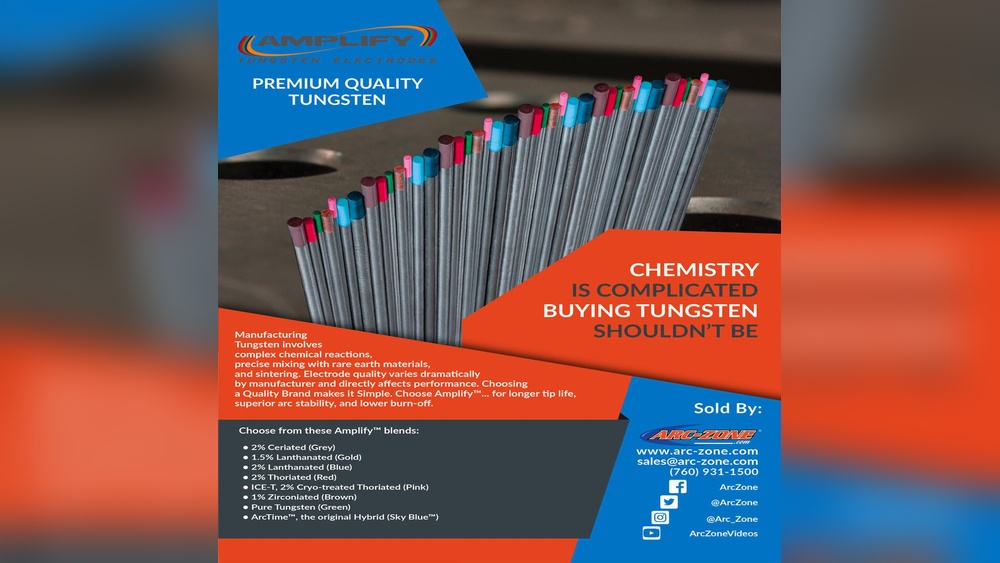
For critical low amp work, Miller pairs good arc starts with a sharply pointed tungsten. Miller says 2% lanthanated (EWLa-2) tungsten gives up to 200 arc starts against 70 for 2% thoriated.
Disadvantages of HF Start
- Radio frequency interference: HF travels through cables and radiates back into shop power lines, The Fabricator reports.
- Electronics damage: it can damage nearby electrical equipment. The Fabricator advises unplugging a car’s engine computer before AC TIG work on a vehicle.
- Robots and controls: robotic GTAW is rarely used because HF could damage the robot controller.
- Stray start marks: when the arc fails to light, Miller says HF can dance around the part and mark it.
- Spark gap upkeep: dust and humidity change the gap on older machines.
TWI adds that HF makes abnormally high electromagnetic emission, so you need to keep it away from control systems and instruments.
How to Reduce HF Interference
- Clamp the work to a solid ground. The Fabricator advises giving HF an easy, reliable path to ground by connecting the part to a good building ground.
- Keep the spark gap set and clean on older transformer machines, per your welder manual.
- Unplug or move sensitive electronics, such as vehicle computers, before you weld near them.
- Consider a newer AC inverter TIG welder that does not need continuous HF on AC.
Safety note: HF is a very high voltage pulse. EWM shows it can break down through a leather glove, and it says to switch the power source off before you change the tungsten or the gas nozzle. If you wear a pacemaker or other implanted device, ask your doctor and read the welder manual before you use HF.

Credit: www.youtube.com
When You Need HF Start
Pick a TIG welder with HF start when you weld aluminum on AC, do critical work where tungsten inclusions are not allowed, or start and stop often with a foot pedal.
Lift arc works well for DC TIG on steel and stainless in a shop full of electronics. It avoids HF noise and still keeps start inclusions low.
Scratch start suits basic DC rigs, such as a TIG torch on a stick welder, where cost matters more than start quality.
Frequently Asked Questions
Is High Frequency Start Necessary for TIG Welding?
No, you can TIG weld DC steel and stainless with lift arc or scratch start. HF matters most for AC aluminum on transformer machines, where it keeps the arc stable, and for critical welds where any tungsten touch could leave an inclusion in the bead.
Can HF Start Damage Electronics?
Yes. The Fabricator reports that HF travels through cables, radiates into shop power lines and can damage nearby electrical equipment. Ground the part well, keep sensitive devices away, and unplug a vehicle’s engine computer before you TIG weld on a car with continuous AC high frequency.
Does HF Start Work on DC TIG?
Yes. On DC TIG, the machine uses a short burst of high frequency to light the arc, then turns it off once current flows. On AC TIG, older transformer machines often keep HF on continuously to stabilize the arc when the current reverses direction.
Why Won’t My HF Start Light the Arc?
Common causes include a dirty or worn spark gap, a poor work clamp ground, a contaminated or blunt tungsten, and too much gas flow at low amps. Miller suggests sharp tungsten points and cutting flow from 15 to 12 cfh at 10 amps or less.
Is HF Start Better Than Lift Arc?
For aluminum on AC and critical welds, HF start is usually the better pick because the tungsten never touches the work. For DC steel work around computers or CNC controls, lift arc is often the safer choice because it creates far less radio frequency noise.
Final Words
High frequency start lights the TIG arc with a short, high voltage spark, so the tungsten never touches the work. You get clean starts, sharp tungsten and no start inclusions.
The cost is electrical noise that can upset nearby electronics. Ground the work to a good building ground, keep the spark gap clean, and choose lift arc when interference is the bigger problem.