Disclosure: This post contains affiliate links and I will be compensated if you make a purchase after clicking through my links. Learn More
Do you need a dedicated circuit for a welder? In most cases, yes. Hobart’s manuals for the Handler 140 and the Stickmate 160i call for an individual branch circuit, and Hobart writes its wiring tables for a dedicated circuit sized to the welder’s rated output and duty cycle.
A welder pulls a big share of a household circuit at full output. The Handler 140 draws 20 amps at rated output on 115 V, which is the whole rating of a 20 amp circuit. Add a shop light, a radio or a grinder to the same circuit and the breaker trips.
The rules for welder supply circuits sit in NEC Article 630. Your local code and the welder’s nameplate set the final numbers, so have a licensed electrician do the install.
Do You Need a Dedicated Circuit for a Welder?
Yes, for nearly every home and shop setup. Welder manuals ask for an individual circuit, and sharing one with other loads leads to nuisance trips, voltage sag and a weak arc.
The Handler 140 manual (OM-258 267D) states it plainly: “A 115 volts AC, 20 ampere individual circuit protected by time-delay fuses or circuit breaker is required.” The Stickmate 160i manual (OM-278400) asks for a 15 or 20 amp individual branch circuit on 120 V input.
What Welder Manuals Say About the Supply Circuit
Here’s what two Hobart owner’s manuals list for input power. These values come from each manual’s specifications and Electrical Service Guide.
| Welder (Manual) | Input | Rated Input Current | Circuit Called For | Max Time-Delay Fuse | Min Copper Wire |
|---|---|---|---|---|---|
| Hobart Handler 140 (OM-258 267D) | 115 V, 1-phase | 20 A at rated output | 20 A individual circuit | Not listed | Not listed |
| Hobart Stickmate 160i (OM-278400) | 120 V, 1-phase | 20.7 A | 15 or 20 A individual branch circuit | Not listed | Not listed |
| Hobart Stickmate 160i (OM-278400) | 240 V, 1-phase | 27.8 A (I1max) | Dedicated circuit | 30 A | 14 AWG, up to 66 ft |
| Hobart Stickmate 210i (OM-278400) | 240 V, 1-phase | 43.4 A (I1max) | Dedicated circuit | 60 A | 10 AWG, up to 82 ft |
Hobart adds a clear note under its service guide: “These recommendations are for a dedicated circuit sized for the rated output and duty cycle of the welding power source.” It also warns that skipping the guide could create an electric shock or fire hazard.
Your welder’s numbers will differ. Read the rating label and the input power section of your own manual before you pick a breaker or wire.
Why a Shared Circuit Causes Problems
A 120 V welder near full output can use the entire capacity of a 15 or 20 amp circuit by itself. Any other load on that circuit pushes the total past the breaker rating.
- Nuisance trips: the breaker opens mid-weld when the combined load gets too high.
- Voltage drop: other loads and long runs lower the voltage at the welder, so the arc gets weaker and harder to hold.
- Heat in the wiring: Hobart’s safety section says “Do not overload building wiring” and to make sure the supply is properly sized, rated and protected.
Never fix trips with a bigger breaker on the same wire. Hobart’s manuals say to use only correct fuses or circuit breakers and not to oversize or bypass them.
Credit: www.youtube.com
What NEC Article 630 Says About Welder Circuits
NEC Article 630 covers arc welding, resistance welding, plasma cutting and similar equipment connected to an electric supply. Hobart’s manual points readers to NEC 210.21, 630.11 and 630.12 for the supply circuit.
- 630.11, conductors: you size the supply wire by multiplying the rated primary current on the nameplate by a duty cycle multiplier from Table 630.11(A).
- 630.12, overcurrent protection: the breaker or fuse can be sized up to 200% of the rated primary current of the welder.
- 630.6, listing: all welding equipment must be listed.
Writing in Electrical Contractor magazine, electrical trainer Mark C. Ode gives two examples of the 200% rule: a 30 amp welder receptacle protected at 60 amps, and a 50 amp receptacle protected at 100 amps.
For the wire side of a 240 V setup, compare any 50 amp welder circuit wire table with the numbers in your manual.
GFCI Rules for Welder Receptacles
Ode notes that NEC 210.8(B)(10) requires GFCI protection for the covered receptacle ratings in commercial garages, accessory buildings, service bays and similar areas. He adds that none of the exceptions in 210.8(B) apply to welder outlets in those areas.
NEC 630.8 is a separate rule. It requires GFCI protection for 125 V, 15 and 20 amp receptacles used for hand tools or portable lighting in welding work areas. Ask your electrician which code edition your area enforces.
120V vs 240V Welders: Circuit Needs
Small 120 V welders like the Handler 140 plug into a standard-voltage receptacle, but that receptacle still needs its own 15 or 20 amp circuit. Check the breaker for a 120V welder against your manual before you plug in.
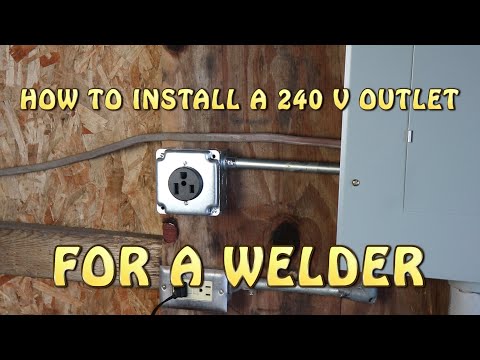
240 V welders need a 240 V circuit with the fuse or breaker size from the manual’s service guide. If you’re adding one, learn what it takes to wire a 220 outlet for a welder, and confirm the breaker size for a welder from the nameplate.

Credit: www.youtube.com
Can You Use an Extension Cord Instead?
An extension cord doesn’t replace a dedicated circuit. It only moves the plug, and the cord adds voltage drop.
If you must use one, follow your manual. The Handler 140 manual lists 10 AWG for up to 100 ft and 12 AWG for up to 50 ft, based on a maximum 3% voltage drop, and says to use the shortest cord possible. The same voltage drop logic sets welder extension cord size for any machine.
Safety Notes
- Hobart says input power installs must meet all national and local codes, and only qualified persons should make them.
- Turn off and lock out power at the panel before anyone works on a welder circuit.
- Never bypass a breaker or fuse to stop trips. Find the cause instead.
- Don’t use the plug rating to size branch circuit protection. Hobart’s Stickmate manual warns against this.
Frequently Asked Questions
Can I Plug a 120V Welder Into Any Outlet?
Only if that outlet sits on a circuit the welder can have to itself. The Handler 140 needs a 20 amp individual circuit, and the Stickmate 160i needs a 15 or 20 amp individual branch circuit. A kitchen or bedroom outlet shared with other loads will trip under welding load.
Does the NEC Require a Dedicated Circuit for a Welder?
NEC Article 630 sets how welder supply conductors and breakers are sized from the nameplate and duty cycle. Welder makers like Hobart write their service guides for a dedicated circuit and call for an individual circuit on 120 V models. Your local inspector has the final word on the code edition.
What Size Breaker Does a Welder Need?
Use the size in your welder’s manual. Hobart lists a 30 amp time-delay fuse for the Stickmate 160i on 240 V and a 60 amp time-delay fuse for the Stickmate 210i. NEC 630.12 allows overcurrent protection up to 200% of the welder’s rated primary current.
Can a Welder Share a Circuit With an Air Compressor?
It’s a bad idea. A welder at full output can use most or all of a circuit’s rating, and a compressor motor pulls a high starting current. Running both on one circuit invites trips and voltage drop. Give each machine its own circuit sized from its nameplate.
Why Does My Welder Keep Tripping the Breaker?
The most common cause is a shared or undersized circuit. Other loads on the same circuit add up with the welder’s draw and push past the breaker rating. Move the welder to its own circuit, check the breaker against the manual, and skip long, thin extension cords.
Final Words
A welder works best on a circuit it doesn’t share. Hobart’s manuals call for an individual circuit, and NEC Article 630 sizes the wire and breaker around the welder’s nameplate and duty cycle.
Start with the input power section of your manual, then have a licensed electrician run a circuit that matches it. You’ll get fewer trips and a steadier arc.