Disclosure: This post contains affiliate links and I will be compensated if you make a purchase after clicking through my links. Learn More
Welding goggles vs welding helmet comes down to the process: goggles fit gas welding, torch brazing and oxygen cutting, and a welding helmet is the right pick for every arc process. OSHA requires a helmet or hand shield for all arc welding and arc cutting, except submerged arc welding.
Goggles cover your eyes and nothing else. A helmet covers your eyes, face and the front of your neck, and it holds a much darker filter.
We’ll compare both by shade range, coverage, comfort and the OSHA rules, then match each one to the jobs where it belongs.
| Feature | Welding Goggles | Welding Helmet |
|---|---|---|
| Main use | Gas welding, torch brazing, oxygen cutting, grinding | Stick, MIG, flux core, TIG, plasma, air carbon arc |
| Typical OSHA minimum shade for the job | Shade 3 to 6 | Shade 7 to 11 |
| Covers | Eyes only | Eyes, face, front of neck |
| OSHA status for arc work | Not a substitute for a helmet | Required (except submerged arc) |
| Weight and bulk | Light, fits in a pocket | Heavier, sits on a headgear |
| Field of view | Small, two round or one wide lens | Larger viewing window |
| Auto-darkening option | Rare | Common |
Credit: upload.wikimedia.org
What Are Welding Goggles?
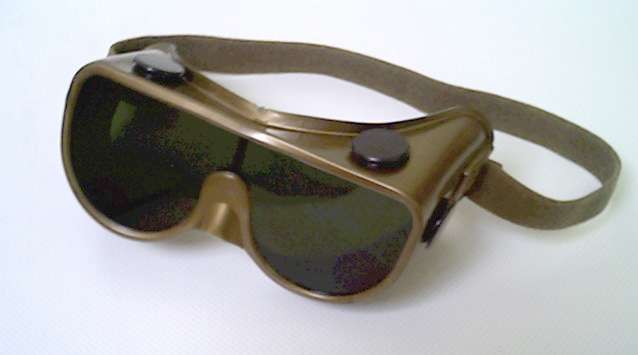
Welding goggles are sealed eye protectors with tinted filter lenses, built for oxyfuel work. They strap around your head and sit close to your face, so sparks and flying chips can’t get in from the sides.
Goggle lenses come in fixed shades. The Lincoln Electric K3118-1 cutting and grinding goggles, for example, use a shade 5 lens. Some models have a flip-up front, so you can switch from the tinted lens to a clear lens for chipping and inspection.
What Is a Welding Helmet?
A welding helmet is a full face shell with a filter lens in front of your eyes. It mounts on adjustable headgear and flips down over your face when you strike an arc.
Helmets come in two lens types: a passive lens with one fixed dark shade, and an auto-darkening filter that switches from a light state to a dark shade when the arc starts. The auto-darkening vs passive welding helmet choice comes down to budget, speed of work and how often you flip the shell.
Welding Goggles vs Welding Helmet: Key Differences
The main differences are shade range, coverage, impact protection and comfort. Shade matters most, because it decides which jobs each one can handle.
Shade Range
Shade is the biggest difference. OSHA’s table in 29 CFR 1910.133(a)(5) sets the minimum shade for each job, and a higher number means a darker lens.
Gas welding needs a minimum of shade 4 to 6 by plate thickness, and oxygen cutting needs shade 3 to 5. Arc processes start at shade 7 and run up to shade 11 for heavy stick welding and arc cutting. A shade 5 goggle falls well short of every arc minimum in that table.
| Job (OSHA 1910.133) | Minimum shade | Fits goggles? |
|---|---|---|
| Torch soldering | 2 | Yes |
| Torch brazing | 3 | Yes |
| Oxygen cutting, under 1 in plate | 3 | Yes |
| Gas welding, under 1/8 in plate | 4 | Yes |
| Gas welding, 1/8 to 1/2 in plate | 5 | Yes |
| Gas welding, over 1/2 in plate | 6 | Yes, with a shade 6 lens |
| Stick welding, under 60 A | 7 | No, use a helmet |
| MIG and flux core, 60 to 500 A | 10 | No, use a helmet |
| TIG welding, 150 to 500 A | 10 | No, use a helmet |
| Plasma arc cutting, 400 to 800 A | 10 | No, use a helmet |
OSHA also gives a rule for picking a shade: start with a shade that is too dark to see the weld zone, then go lighter until you see the puddle clearly. Never go below the minimum. A full welding shade number chart lists every process and amperage in one place.
Coverage
Goggles protect your eyes only. Your cheeks, forehead and neck stay open to sparks, heat and radiant energy.
A helmet shields your whole face and the front of your neck. That matters with an electric arc, which gives off intense ultraviolet and infrared light that can burn bare skin.
Impact and Spatter Protection
Goggles seal against your face, so they block flying chips well. A helmet blocks spatter and heat from the front but can let small chips in from below.
OSHA’s welding eye protection fact sheet says that when objects can fly toward your face, you need side protection. If you wear a filter-lens helmet, wear safety glasses with side shields or goggles under it.
Comfort and Field of View
Goggles are light and easy to carry on a cutting rig or in a toolbox. The trade-off is a narrow view through small lenses.
A helmet weighs more and rests on a headgear, but its viewing window is larger. Auto-darkening helmets let you keep the shell down between welds, which saves neck strain from constant flipping.
Shade Stacking
You can combine a filter lens under a helmet with the helmet lens. OSHA’s fact sheet notes that the combined shade of the eyewear and the helmet lens should equal the shade the table calls for. A shade 5 goggle under a shade 5 helmet lens adds up to shade 10.
Can You Use Welding Goggles for Arc Welding?
No. OSHA rule 29 CFR 1910.252(b)(2)(i)(A) requires a helmet or hand shield for all arc welding and arc cutting, except submerged arc. A shade 5 goggle lens is also too light for arc work, which needs at least shade 7.
Arc light can cause arc eye and skin burns. Wear a helmet with the correct shade for your amperage, plus safety glasses or goggles under it for chip protection.

Credit: upload.wikimedia.org
Where Each One Fits
Goggles fit oxyacetylene welding of sheet metal, torch brazing, soldering, light oxygen cutting and grinding. OSHA allows goggles or other suitable eye protection for all gas welding and oxygen cutting. It also allows spectacles with suitable filter lenses for light gas welding, torch brazing and inspection.
Helmets fit stick, MIG, flux core, TIG, plasma arc welding and air carbon arc gouging. They also fit heavy oxyfuel cutting when you want face coverage from heat and slag.
Many shops keep both: a helmet for the arc welder and a pair of flip-front goggles on the cutting torch cart.
Standards to Check Before You Buy
OSHA rule 29 CFR 1910.133(b) requires eye and face protectors to meet ANSI Z87.1. Check for the Z87 mark on the goggles or helmet shell and the shade number on the filter lens.
For oxyfuel work with a strong yellow flare, OSHA’s shade table notes that a filter lens that absorbs the yellow or sodium line light helps.
An auto-darkening welding helmet must block ultraviolet and infrared light in both its light and dark states. Buy from a brand that lists ANSI Z87.1 compliance on the label.
Which One Should You Choose?
Choose Welding Goggles If:
- You do oxyacetylene welding, brazing or soldering
- You cut plate under 1 in with an oxyfuel torch
- You need light eye protection on a cutting cart or for grinding
- You want to wear a filter under a helmet for shade stacking
Choose a Welding Helmet If:
- You stick, MIG, flux core or TIG weld
- You run a plasma cutter or air carbon arc gouging
- You want face and neck coverage from arc light and spatter
- You want an auto-darkening lens for hands-free work
If you do both gas and arc work, buy both. A helmet is the only one of the two that meets OSHA rules for arc welding.
Frequently Asked Questions
Are Welding Goggles as Safe as a Welding Helmet?
For gas welding, brazing and oxygen cutting, yes, if the lens meets the OSHA minimum shade for the job. For arc welding, no. OSHA requires a helmet or hand shield for arc work, and a shade 5 goggle lens falls below the shade 7 arc minimum.
What Shade Are Welding Goggles?
Goggle lenses come in fixed shades, such as shade 5 on the Lincoln Electric K3118-1. OSHA minimums for gas welding run from shade 4 for plate under 1/8 in to shade 6 for plate over 1/2 in. Oxygen cutting needs shade 3 to 5, by plate thickness.
Can You Use Welding Goggles for MIG Welding?
No. MIG welding needs a minimum of shade 7 under 60 amps and shade 10 from 60 to 500 amps under OSHA 1910.133. Gas welding goggles are too light, and OSHA requires a helmet or hand shield for every arc process.
Do You Need Safety Glasses Under a Welding Helmet?
Yes, when chips or slag can fly. OSHA’s welding eye protection fact sheet says a worker using a filter-lens helmet also needs safety glasses with side shields or goggles. Chipping slag and grinding are two common reasons to wear them.
Can You Use Welding Goggles for Plasma Cutting?
Usually not. OSHA lists a minimum of shade 8 for light plasma arc cutting under 300 amps and up to shade 10 for heavy cutting. Standard shade 5 goggles fall short. OSHA allows lighter filters only when the workpiece hides the arc.
Final Words
Welding goggles and welding helmets each do one job well. Goggles cover your eyes for oxyfuel welding, brazing and light cutting. A helmet covers your face and holds the darker lens every arc process needs.
Match the lens to the OSHA minimum shade for your job, look for the ANSI Z87.1 mark, and wear safety glasses under your helmet when slag or chips fly.