Disclosure: This post contains affiliate links and I will be compensated if you make a purchase after clicking through my links. Learn More
Auto-darkening welding helmets work by pairing arc sensors with a liquid crystal lens that turns dark the instant you strike an arc. Miller’s spec sheet for the Digital Infinity, for example, lists a switch from light to dark in 1/20,000 of a second, and a separate UV/IR filter protects your eyes the whole time, even before the lens darkens.
So the dark shade is for comfort and clear vision. The always-on UV/IR filter is what blocks the radiation that causes arc eye. That split is the key to knowing which part has failed when a helmet starts acting up.
The filter is a stack of thin layers, and only the liquid crystal part needs a battery. Once you know what each layer does, the sensitivity, delay and grind controls make sense.
How Do Auto-Darkening Welding Helmets Work?
An auto-darkening welding helmet works in 3 steps: sensors on the front of the lens see the arc, a small circuit sends voltage to a liquid crystal cell, and that cell blocks most visible light within a fraction of a millisecond. When the arc stops, the circuit waits for the delay you set and lets the lens go light again.
The lens itself is called an auto-darkening filter (ADF). It sits in a cartridge in the front of the shell, behind a clear outer cover lens and in front of a clear inner cover lens. The covers take the spatter and scratches, so the ADF stays clean.
| Step | What happens | Typical time |
|---|---|---|
| 1. Arc starts | Arc light (and, on some helmets, the arc’s electromagnetic field) reaches the sensors | 0 ms |
| 2. Detection | The control circuit decides the light is an arc, using your sensitivity setting | Part of the rated switching time |
| 3. Switching | Voltage goes to the liquid crystal cell and the lens reaches your dark shade | 0.05 to 0.1 ms on name-brand helmets |
| 4. Welding | The lens holds your set shade (for example, shade 10 for 120 amp stick) | As long as the arc runs |
| 5. Arc stops | The circuit waits for your delay setting, then the lens goes back to the light shade | Set by you |
The Parts Inside An Auto-Darkening Filter
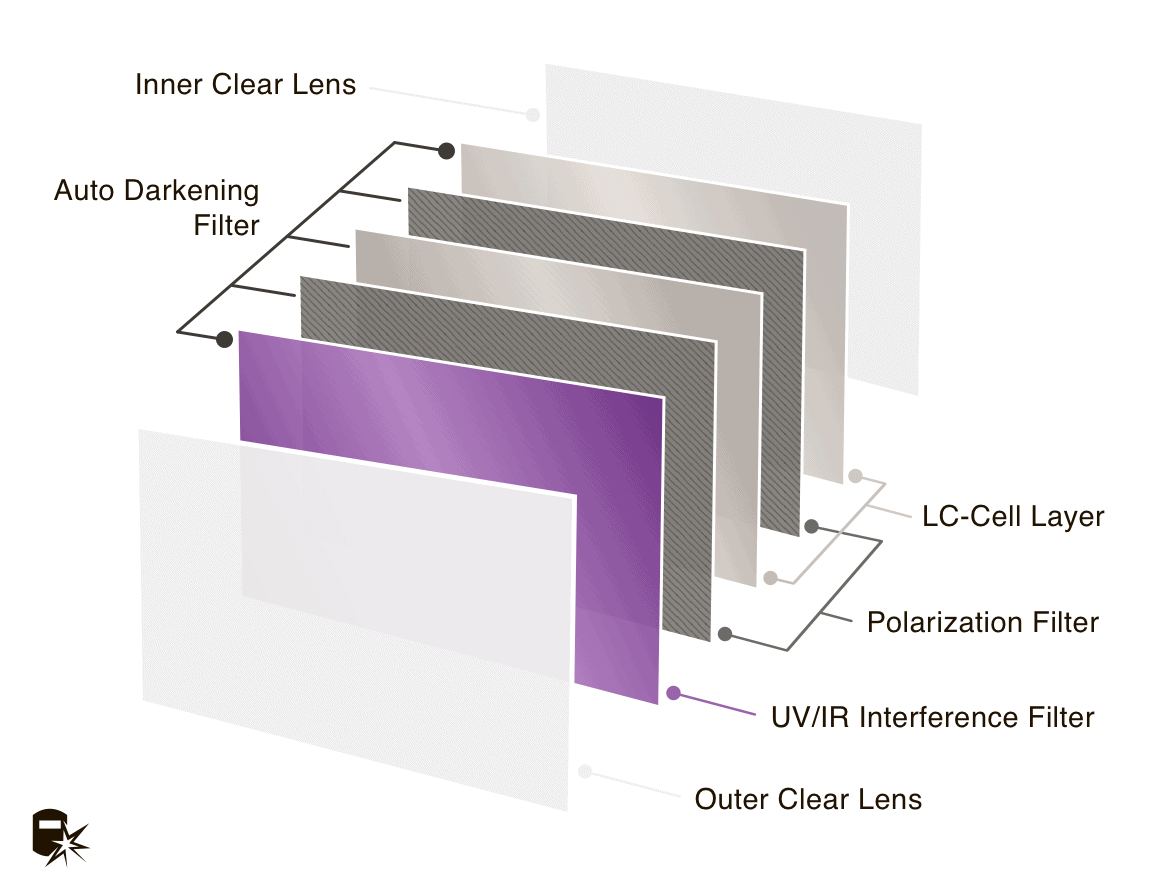
An ADF is a sandwich of thin layers. Each layer has one job, and only one of them needs a battery.
UV/IR Interference Filter
This is a coated layer that reflects and absorbs ultraviolet (UV) and infrared (IR) light. It is passive, so it works with the battery dead, the helmet switched off or the lens in its light state. 3M states its Speedglas 9100 filters give permanent UV/IR protection equal to shade 13, in the light or dark state.
Polarizing Filters
2 polarizing filters sit on either side of the liquid crystal cell. Each one passes light vibrating in only one direction. They are set at 90 degrees to each other, so light can only get through if something in between twists it.
Liquid Crystal Cell
The liquid crystal cell is the part that does the twisting. With no voltage, the crystals rotate the light 90 degrees, so it passes through the second polarizer and you see a light shade (usually shade 3 to 4). With voltage, the crystals straighten out, the light stops twisting, and the second polarizer blocks it. More voltage means a darker shade. Some high-end lenses stack 2 or more cells for a darker range and a more even tint.
Arc Sensors
Arc sensors are small photodiodes on the front of the cartridge. 3M uses 3 sensors that react independently on the Speedglas 9100. Miller uses 4 sensors on the Digital Infinity. More sensors means a blocked sensor (your arm, the work piece, a pipe) is less likely to leave the lens light.
Power Supply And Control Circuit
A small circuit reads the sensors and drives the cell. Most helmets run on a coin cell battery, often with a solar cell that tops it up. The Speedglas 9100 takes 2 CR2032 batteries, and the Miller Digital Infinity takes a CR2450.
Credit: weldguru.com
Switching Speed: What The Numbers Mean
Switching speed is how long the lens takes to go from light to dark after it sees the arc. Brands write it as a fraction of a second, so it helps to convert it to milliseconds.
| Rated speed | In milliseconds | Example |
|---|---|---|
| 1/10,000 sec | 0.1 ms | 3M Speedglas 9100 (0.1 ms at 73°F) |
| 1/20,000 sec | 0.05 ms | Miller Digital Infinity (spec sheet AY/42.0) |
| 1/25,000 sec | 0.04 ms | Miller Digital Infinity ClearLight 4x |
All of these are faster than you can notice. The bigger risk is a lens that never darkens because a sensor is blocked or the battery is weak. Liquid crystals also respond more slowly in the cold, and 3M rates its speed at 73°F (23°C). On a freezing morning, keep the helmet indoors until you start.
Shade, Sensitivity, Delay And Grind Mode
Most helmets give you 4 controls. Each one changes how the circuit behaves, and none of them touch the UV/IR filter.
Shade
Shade sets how dark the lens gets when it switches. A common range is shade 9 to 13. The Speedglas 9100 covers shades 5, 8 and 9 to 13, and the Miller Digital Infinity covers 5 to 8 for cutting and 8 to 13 for welding. Pick the shade from the amperage and process, then fine-tune for comfort.
Sensitivity
Sensitivity sets how much light it takes to trigger the lens. Turn it up for low-amp TIG, where the arc is small and steady. Turn it down if the lens flickers from shop lights, sunlight or a welder in the next bay. When you set up a TIG welder for thin stock, check this setting first, since a 20 to 40 amp arc is easy to miss.
Delay
Delay sets how long the lens stays dark after the arc stops. A longer delay protects your eyes from the glowing puddle on high-amp welds. A shorter delay suits tack welding, where you want to see the next spot fast.
Grind Mode
Grind mode locks the lens in its light state so it ignores sparks from a grinder. 3M locks the Speedglas 9100 at shade 3 in grind mode. Switch it back before you weld. Striking an arc in grind mode is the fastest way to get flashed.
Why The Lens Is Safe Even When It Fails
A dead battery or a failed circuit leaves most ADFs in the light state, not the dark state. The UV/IR filter still blocks the invisible radiation, so the risk is a bright visible flash, not a UV burn of the kind that causes arc eye. That flash still hurts and can leave spots in your vision, so stop and fix the helmet before the next weld.
Repeated flashes from a lens that switches late are a sign to replace the battery or the cartridge. If your eyes feel gritty hours later, read our guide on how to prevent arc eye and see a doctor if the pain lasts.
Safety note: Never weld with a cracked cover lens or a cartridge that has a damaged edge. Light can leak around the filter, and the UV/IR coating only protects the area it covers.
Common Problems And The Part Behind Each One
Most helmet complaints trace back to one layer of the filter. This table maps each symptom to the part that causes it.
| Symptom | Likely cause | Fix |
|---|---|---|
| Lens flickers light and dark mid-weld | Sensor blocked or sensitivity too low | Clear the sensor view, raise sensitivity |
| Lens stays light when you strike an arc | Weak battery, grind mode on, or dirty sensors | Check the mode, replace the battery, clean the cover lens |
| Lens goes dark before you weld | Sensitivity too high, sunlight or a nearby arc | Lower sensitivity, use a helmet with an arc-sensing mode |
| Dark state looks blotchy or uneven | Aging liquid crystal cell or a cold lens | Warm the helmet up, replace the cartridge if it stays uneven |
| Bright flash at every arc start | Slow switching from a weak battery or a damaged circuit | Replace the battery, then the cartridge |
Sunlight And Outdoor Welding
Sunlight carries enough light to trigger some sensors, so a lens can darken before you weld or flicker as clouds pass. Miller’s X-Mode handles this by sensing the arc’s electromagnetic field instead of light. Miller says it keeps sunlight from darkening the lens and stops low-amp arcs from opening the lens when the sensors are blocked.
How Optical Clarity Ratings Work
The EN 379 standard grades every auto-darkening filter with 4 numbers, such as 1/1/1/2. A 1 is the best grade and a 3 is the worst.
- Optical class: how much the lens distorts the view
- Diffusion of light: how much haze or scatter you see through it
- Variation in luminous transmittance: how even the shade is across the lens
- Angle dependence: how much the shade changes when you look through the edge
The 3M Speedglas 9100 is rated 1/1/1/2. Lincoln Electric lists the Viking 3350 at 1/1/1/1 with a 12.5 sq. in. viewing area. In the US, also look for the ANSI Z87.1 mark on the helmet. Miller lists the Digital Infinity as meeting ANSI Z87.1+ and CSA standards.
Auto-Darkening Vs Passive Lenses
A passive helmet has one fixed shade, usually shade 10, and no electronics. You nod it down before every arc. An auto-darkening helmet lets you see the joint in a light shade, then switches on its own, so you keep your hand and torch in place. Both block UV and IR. The ADF costs more and needs a battery, but it cuts misplaced starts and neck strain from nodding.
A helmet is only one part of your safety gear, so pair it with leather gloves, a flame-resistant jacket and good ventilation.
Frequently Asked Questions
Do Auto-darkening Helmets Protect Your Eyes When They Are Off?
Yes, against UV and IR. The UV/IR filter is a passive coating, so it works with the battery dead or the helmet switched off. You lose the dark shade, so the visible glare can still flash you. Never weld with a lens that will not darken.
How Fast Does An Auto-darkening Helmet Darken?
Name-brand lenses switch in about 0.04 to 0.1 milliseconds. Miller lists 1/20,000 to 1/25,000 of a second for Digital Infinity versions, and 3M rates the Speedglas 9100 at 0.1 ms at 73°F. Cold weather slows the liquid crystals, so warm the helmet before you weld outside in winter.
Do Auto-darkening Welding Helmets Need Batteries?
Yes. The liquid crystal cell and sensors need a small amount of electricity. Most helmets use a coin cell such as a CR2032 or CR2450, often with a solar cell that tops it up. 3M rates Speedglas 9100 battery life at 1,800 to 2,800 hours by model.
Why Does My Auto-darkening Helmet Flicker?
Flicker usually means a sensor lost sight of the arc or the sensitivity is set too low. Your arm, the work piece or a dirty cover lens can block a sensor. Raise sensitivity a step, clean the cover lens, and check the battery if flicker continues after that.
Can Sunlight Set Off An Auto-darkening Helmet?
Yes. Bright sunlight can trigger light-based sensors, so the lens darkens before you weld or flickers outdoors. Lower the sensitivity first. Helmets with arc-sensing modes, such as Miller X-Mode, read the arc’s electromagnetic field instead of light, which stops sunlight from triggering the lens.
Final Words
An auto-darkening welding helmet is 2 systems in one lens. The UV/IR filter protects your eyes all the time with no power. The sensors, circuit and liquid crystal cell handle the dark shade, and that is the part that can fail, flicker or slow down.
When a helmet acts up, work through the layers: check the mode, the battery, the sensors and the sensitivity, in that order. Most problems clear up at one of those 4 steps. If the dark state stays blotchy or slow after a fresh battery, replace the cartridge.