Disclosure: This post contains affiliate links and I will be compensated if you make a purchase after clicking through my links. Learn More
How many watts does a MIG welder use? Most home MIG welders draw between 1,200 and 7,500 watts, depending on their power rating, amperage, and voltage. Smaller 120V machines use less; heavy-duty 240V models use much more. Always check your welder’s specs for exact figures.
Understanding Mig Welder Power Consumption
MIG welding is popular for its speed and ease, but many users wonder how much power a MIG welder actually uses. This isn’t a simple one-number answer. The watts used depend on the model, input voltage, amperage, duty cycle, and what you’re welding. Knowing how many watts your MIG welder uses helps you pick the right generator, avoid tripped breakers, and calculate energy costs.
Many people focus only on the welder’s amperage or voltage. But watts equal volts multiplied by amps. For example, a 120V MIG welder running at 20 amps uses 2,400 watts (120 x 20). That’s just the start. Some welders use more power when starting an arc or running at high duty cycles. Let’s break down every factor that affects MIG welder wattage.
Main Factors That Affect Mig Welder Watt Usage
Several variables impact how many watts your MIG welder uses. Understanding them gives you control over your power needs and budget.
1. Input Voltage (120v Vs 240v)
Most home and light industrial MIG welders run on either 120 volts (standard household outlet) or 240 volts (heavy-duty outlet). Higher voltage lets you weld thicker metal, but it also means higher watt usage. Typical home welders use 120V. Shop or professional welders often require 240V.
- 120V MIG welders: Usually draw between 1,200 and 2,400 watts at full output.
- 240V MIG welders: Can pull 3,600 to 7,500 watts or more.
2. Amperage Range
Amperage controls how much welding power you get. A higher amp welder can weld thicker steel, but it uses more watts. Most hobby MIG welders run at 20–140 amps. Shop or pro units go up to 250–300 amps, with much higher wattage.
3. Duty Cycle
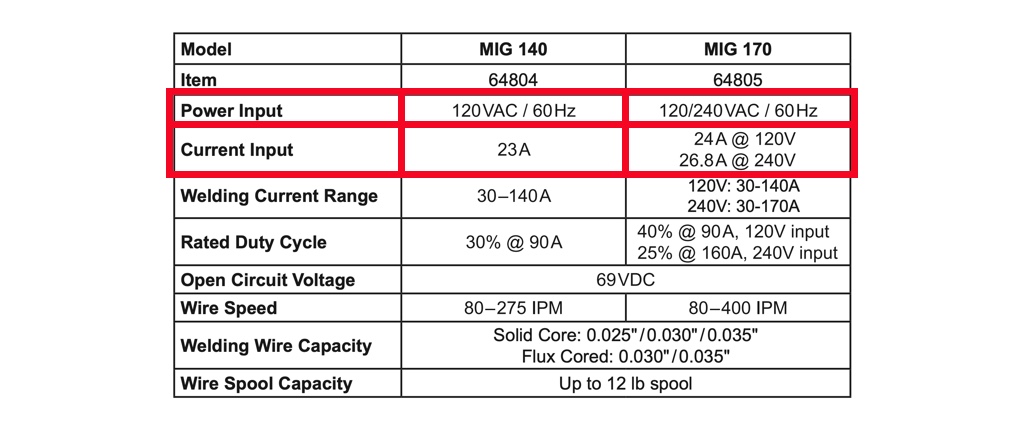
Duty cycle means how long a welder can run without overheating. For example, a 30% duty cycle at 90A means you can weld for 3 minutes, then wait 7 minutes. If you exceed this, the machine can overheat and shut off. Higher duty cycles often mean higher watt usage.
4. Efficiency
No welder is 100% efficient. Some energy is lost as heat. Most modern inverter welders are more efficient (80–85%) than older transformer welders (60–65%). Efficiency affects your true power draw.
5. Welding Settings And Real-world Use
Actual watt usage changes as you adjust voltage and wire feed speed. Thicker metal and higher settings use more power. Light work uses less.
Typical Power Draw Of Common Mig Welders
To make things concrete, here’s a comparison of some popular MIG welder models and their watt usage. These are average numbers; always check your specific machine’s manual.
| MIG Welder Model | Input Voltage | Max Amps | Estimated Max Watts |
|---|---|---|---|
| Lincoln Electric Handy MIG | 120V | 70A | 1,320W |
| Hobart Handler 140 | 120V | 90A | 1,800W |
| Forney Easy Weld 261 | 120V | 140A | 2,400W |
| Miller Millermatic 211 | 120/240V | 150A | 3,600W (at 240V) |
| Lincoln Power MIG 256 | 240V | 250A | 6,000W |
Calculating Mig Welder Wattage: The Simple Formula
You can figure out your MIG welder’s watt usage with a basic formula:
Watts = Volts x Amps
- Example: If your welder runs on 120 volts and draws 20 amps:
120v X 20a = 2,400 Watts
But that’s not the whole story. The number on the data plate is usually the maximum draw at full output. Most users weld below maximum, so your real usage may be lower.
Adding Duty Cycle And Efficiency
To get a more accurate real-world number, factor in duty cycle and efficiency.
- If you weld 3 minutes out of 10 (30% duty cycle), you use less energy than running full-time.
- Inverter welders use power more efficiently, so you might use fewer watts than an old transformer unit.
Power Consumption At Different Settings
Your welder’s power draw varies as you change settings. Here’s a realistic look at how watts change with different settings on a typical 120V MIG welder:
| Setting | Voltage | Amps | Watts Used |
|---|---|---|---|
| Low | 16V | 30A | 480W |
| Medium | 18V | 60A | 1,080W |
| High | 20V | 100A | 2,000W |
| Max | 22V | 120A | 2,640W |
How To Check Your Mig Welder’s Power Draw
For your own welder, check these sources:
- Data plate or manual: The label on the side of your welder lists amps, volts, and sometimes watts.
- Manufacturer’s website: Many list detailed specs online.
- Use a watt meter: Plug your welder into a heavy-duty watt meter for real-world readings.
- Ask a dealer or expert: They can often explain real-life usage for your model.
Generator Sizing For Mig Welders
If you want to run your MIG welder with a generator, you need to match the wattage. Under-sizing causes voltage drops, bad welds, or even damage. Over-sizing costs more but gives you headroom for tough jobs.
Basic Generator Sizing Tips
- Add up your welder’s maximum watt draw.
- Add 20–30% for startup surge (when you strike the arc).
- Make sure the generator can deliver continuous power at that level.
For example, a 120V MIG welder drawing 20A (2,400W) needs a generator with at least 3,000 running watts to handle surges. For 240V welders drawing 30A (7,200W), a generator with at least 8,500 running watts is safer.
Sizing Chart For Common Welders
| Welder Amps | Voltage | Min. Generator Watts |
|---|---|---|
| 90A | 120V | 2,500W |
| 140A | 120V | 3,500W |
| 180A | 240V | 5,500W |
| 250A | 240V | 8,500W |
Pro tip: Always check your generator’s *continuous* watt rating, not just the “peak” or “surge” number.
Real-world Examples: Home, Farm, And Shop Use
Home Garage Mig Welding
If you weld thin sheet metal or car panels, a 120V, 90-140A MIG welder is enough. These use 1,400 to 2,400 watts at full power. You can run them from a standard 15A or 20A household outlet. For basic jobs, your power bill will barely budge.
Farm And Field Repairs
Farmers often use portable MIG welders for gates, trailers, or equipment. A 240V, 180-250A unit can use 5,000 to 7,500 watts. That means you need a dedicated heavy-duty outlet or a 6,000-8,000 watt generator. Don’t try to run these from standard home wiring.
Professional Shops
Shops use the biggest MIG welders—sometimes 300A or more, pulling 8,000+ watts. These need special wiring, breakers, and power panels. Running multiple welders at once multiplies your total wattage.
How Power Usage Affects Your Electric Bill
Welding doesn’t usually cost much in electricity for home users, unless you weld many hours a day. Here’s how you can estimate your cost:
- Find your welder’s average wattage when working (not just max).
- Multiply by the number of hours you weld per month.
- Divide by 1,000 to get kilowatt-hours (kWh).
- Multiply by your electricity rate (usually $0.10–$0.20 per kWh in the USA).
Example:
You weld 2 hours a week with a 2,000W welder.
2,000w X 8 Hours/month = 16,000 Watt-hours = 16 Kwh
16 Kwh X $0.15 = $2.40/month
So, even if you weld every weekend, most home users spend less than $5/month on MIG welding power.
Efficiency: Inverter Vs Transformer Mig Welders
Inverter welders are more efficient and use less power than old transformer models.
- Inverter MIG welders: 80–85% efficient
- Transformer MIG welders: 60–65% efficient
This means you get more welding power for each watt you pay for. If you want to run from a generator or have limited household power, an inverter model is a smart choice.
Common Mistakes People Make About Mig Welder Power
Many first-time buyers or DIY welders get tripped up by these mistakes:
- Ignoring startup surge: Welders need more watts to start the arc than to keep it going.
- Confusing input and output amps: The amps you weld with aren’t the same as the amps drawn from the wall.
- Underestimating breaker size: A 20A breaker is only enough for small welders. Big units need 30A or 50A wiring.
- Thinking all 120V welders are “low power”: Some 120V units draw more than a basic outlet can handle.
- Not checking duty cycle: If you weld for long stretches, you need a machine (and power source) that can keep up.
How To Reduce Mig Welder Power Usage
If you want to lower your power bill or work from a small generator, these expert tips help:
- Use an inverter MIG welder for higher efficiency.
- Weld at the lowest setting that does the job.
- Take breaks to match your welder’s duty cycle.
- Use correct wire size and shielding gas for your material.
- Keep your welder’s cables and connections clean and tight.

Credit: www.reddit.com
Watts, Amps, And Volts: What They Mean For Welders
- Volts: The pressure pushing electricity through the welder. Higher volts = thicker metal.
- Amps: The flow of electricity. Higher amps = hotter weld, thicker wire.
- Watts: Total power used (volts x amps).
Don’t confuse welding amps (what you set on the machine) with input amps (what comes from the wall). A welder with a 140A output usually draws much less from the wall socket, thanks to transformers or inverters.
Choosing The Right Power Source For Your Mig Welder
Make sure your wiring, outlets, and breakers match your welder’s needs:
- For 120V welders up to 20A input, use a 20A circuit.
- For 240V welders, install a 30A or 50A circuit as required.
- Never use extension cords unless they’re heavy-gauge and short.
If you’re not sure, ask a licensed electrician. Overloading circuits causes tripped breakers, poor welds, or fire hazards.

Credit: www.arccaptain.com
Mig Welder Power And Safety
High wattage means high current, which can be dangerous if you’re not careful. Follow these safety tips:
- Always use a properly grounded outlet.
- Never run a welder from a light-duty extension cord.
- Don’t weld in wet or damp conditions.
- Check your cords, plugs, and outlets for heat or damage.
What About 3-phase Power?
Most home users never see 3-phase power. Large industrial MIG welders can use 3-phase, which spreads the load and uses power more efficiently. If you’re running a big shop, talk to an electrician about 3-phase wiring.
Comparing Mig Welder Power Use To Other Tools
For perspective, here’s how a typical MIG welder’s wattage compares to common home and shop tools:
- Hair dryer: 1,200–1,800 watts
- Toaster oven: 1,500 watts
- Table saw: 1,800–2,400 watts
- Small MIG welder: 1,200–2,400 watts
- Large MIG welder: 5,000–7,500+ watts
This means a basic MIG welder uses about the same power as a toaster or saw. Bigger welders use as much as an air conditioner or water heater.
How Power Factor Impacts Real Watt Usage
Many welders have a power factor less than 1.0. This means they draw extra current to do the same work. Inverter welders have a better power factor (closer to 1.0), so they waste less energy. If you run your welder from a generator or shop panel, a higher power factor helps you get more real power for your money.
The Environmental Impact Of Mig Welder Power Use
Welding uses electricity, but for most home users, the impact is small. If you weld every day, using an inverter welder and sticking to lower settings can cut your carbon footprint. For big shops, consider energy-efficient models and recycle scrap metal to balance power usage.
Professional Advice: What Experts Say About Mig Welder Wattage
Experienced welders recommend always checking your welder’s label and manual. Don’t guess—know your amp and watt requirements before you buy or plug in. A pro tip: Use a dedicated circuit for your welder to avoid nuisance trips and keep your welds strong.
For more technical details, the MIG welding Wikipedia page offers a deep look at how MIG welding works.
Credit: weldguru.com
Frequently Asked Questions
How Many Watts Does A 120v Mig Welder Use?
A typical 120V MIG welder uses between 1,200 and 2,400 watts at full output. Actual wattage depends on the amp setting and the machine’s efficiency. Always check your welder’s label or manual for exact numbers.
Can I Run A Mig Welder On A Regular Household Outlet?
Yes, you can run most 120V MIG welders on a standard 15A or 20A outlet. Check your welder’s input amps; if it’s over 15A, use a 20A outlet. Avoid extension cords, or use only heavy-duty, short ones.
What Size Generator Do I Need For A Mig Welder?
For a 120V welder (up to 140A), a generator with 3,000 to 4,000 running watts works well. For 240V welders (180A or above), use a generator with at least 6,000 to 8,500 running watts. Always add extra wattage for startup surge.
Is An Inverter Mig Welder More Efficient?
Yes, inverter MIG welders are 80–85% efficient, while transformer models are 60–65% efficient. This means inverters use less power for the same output, letting you weld longer from the same outlet or generator.
Does Higher Wattage Mean Better Weld Quality?
Not always. Higher wattage lets you weld thicker metal or run hotter, but weld quality depends on technique, wire type, and settings. Using the right wattage for your material gives the best results—not simply using the most power.
—
A MIG welder’s wattage shapes everything from performance to cost. By knowing your welder’s power needs and matching them to your wiring or generator, you get safe, reliable welds without surprises. Whether you’re a weekend DIYer or a pro fabricator, understanding watts puts you in control of your welding projects.