Disclosure: This post contains affiliate links and I will be compensated if you make a purchase after clicking through my links. Learn More
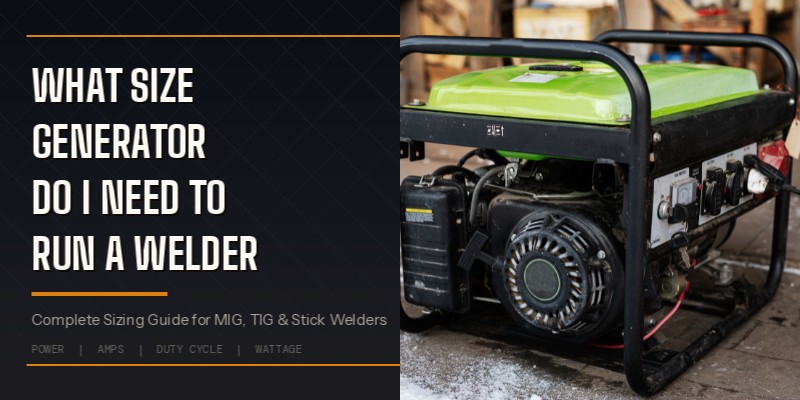
To run a welder, you need a generator that matches your welder’s input power. Most portable welders need a generator with at least 5,000 watts, but bigger industrial welders can require 10,000 watts or more. Always check your welder’s specifications before making your choice, as power needs can vary a lot between different models and welding processes.
Why Generator Size Matters For Welding
Choosing the right generator size isn’t just about making your welder turn on. It’s about consistent performance, safety, and protecting your equipment. If your generator is too small, you risk tripping breakers, damaging your welder, or ruining a job with poor welds. On the other hand, an oversized generator costs more to buy, fuel, and move. The right size keeps your costs reasonable and your welds strong.
A generator that matches your welder’s needs helps you avoid downtime and frustration. For example, if you’re working on a job site and your generator keeps stalling or shutting off, you lose valuable time. Inconsistent power can also lead to “dirty” welds—ones with spatter, lack of fusion, or poor bead appearance.
That can mean extra grinding and rework later.
A correctly sized generator also makes your workspace safer. Overloaded generators can overheat and become a fire risk. Too much or too little voltage can also shorten the life of your welder or even void the warranty. The bottom line: choosing the right size is about doing quality work, staying safe, and protecting your investment.
Understanding Welder Power Requirements
Not all welders are built the same. Some use less power; others demand a lot. Knowing your welder’s needs is the first step. This includes looking at both the type of welding you’re doing and the specific model you own.
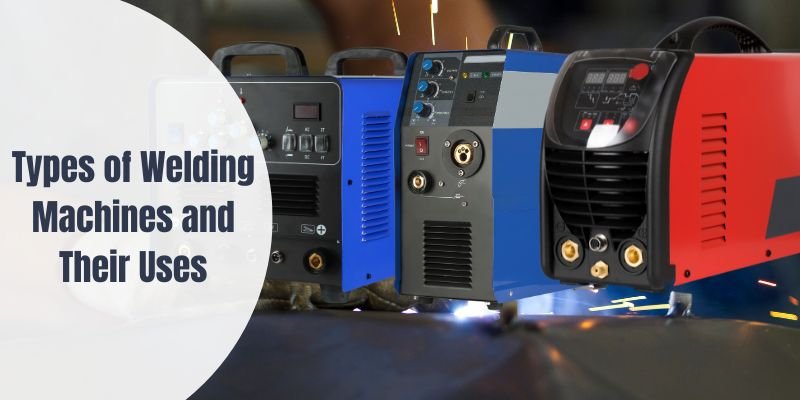
Types Of Welders And Their Power Demands
- Stick (SMAW) Welders: Most common for field work, usually need 5,000–7,000 watts for light jobs, up to 11,000+ watts for industrial use. For instance, a small farm welder may run on 6,000 watts, but a big repair welder for thick steel could need double that.
- MIG (GMAW) Welders: Range widely. Small hobby MIGs can run on 120V and need 3,000–5,000 watts. Industrial MIGs with higher amps require 7,000–12,000 watts. MIG welders often use extra power for wire feeders and cooling fans, so check the full specs.
- TIG (GTAW) Welders: Precision machines, often 3,000–8,000 watts, but high-end models need more. TIG units for aluminum or stainless can sometimes have higher surge draws, especially at full output.
- Multi-process Welders: Can switch between types, so check the highest requirement. For example, a welder that does both stick and TIG may need more power than a single-process model.
Ac Vs. Dc Welders
Some welders need AC power, others need DC. Many modern generators can handle both, but always check compatibility. DC welders are often more efficient and stable, but require generators with clean, steady output.
Some welders can run in either mode, but certain jobs (like welding aluminum) may require AC. If your generator can’t provide stable AC, you may see erratic arcs or machine errors. DC welders, which are more common for steel, run best on generators with low total harmonic distortion (THD).
Inverter generators usually provide this cleaner power, but always check the welder and generator specs to be sure.
Input Voltage: 120v Vs. 240v
- 120V Welders: Lower wattage, suitable for small jobs or thin metal. Need less than 6,000 running watts. Most household outlets can power these, but they’re limited to lighter work.
- 240V Welders: For thicker metals, higher amperage. Generators should supply at least 7,000–12,000 watts. These welders are common in shops and on construction sites. They need special outlets and heavier wiring.
If you have a dual-voltage welder, always calculate your needs based on the higher voltage setting, since that’s when the welder draws the most current.
How To Calculate The Right Generator Size
Here’s a straightforward way to figure out what you need. Taking a few minutes to calculate now can save you from buying the wrong generator.
Step 1: Find Your Welder’s Input Power
Check the welder’s label or manual for:
- Input voltage (V)
- Input current (A)
- Phase (single or three-phase)
Most portable welders use single-phase. If your welder is three-phase, you’ll need a much larger generator, usually found only in industrial settings. Look for the highest amperage rating if your welder lists several input values.
Step 2: Calculate Required Watts
Use this formula:
Watts = Volts x Amps
If your welder needs 240V and 30A:
240 X 30 = 7,200 Watts
Remember, the input amps listed are usually at the rated output, not the maximum. If you plan to use the welder at maximum settings, use the highest amperage value.
Step 3: Add A Margin
Generators should be at least 20–30% larger than your welder’s demand. This covers startup surges and keeps voltage stable.
If your welder draws 7,200 watts, aim for a generator that supplies at least 9,000 watts running power. This extra margin also covers power drops due to temperature or altitude, and gives you room to run small tools or lights if needed.
Step 4: Consider Duty Cycle
The duty cycle tells you how long you can weld in a 10-minute window before the welder needs to cool. If you weld at high output for long periods, your generator needs to handle continuous loads, not just short bursts.
A welder with a 60% duty cycle at full output means you can weld for 6 out of every 10 minutes. If you consistently push your welder close to its limit, make sure your generator is sized for that continuous load, not just the average.
This is one detail many beginners miss when they weld for long stretches. You also use this generator wattage calculator to know the actual generator size.
Step 5: Check Power Factor
Most welders have a power factor of 0.8–0.9. Multiply your wattage by this factor for accuracy. For example:
7,200 watts x 0. 9 = 6,480 watts real power needed.
But always size up, not down. The power factor adjusts for the fact that welders don’t use all the incoming power efficiently. Some newer inverter welders have better power factors, but always check your manual.
Generator Sizing Examples For Popular Welders
Here’s a look at popular welders and the generator sizes they need.
| Welder Model | Input Voltage | Input Amps | Watts Needed | Recommended Generator |
|---|---|---|---|---|
| Lincoln 225 Stick | 240V | 50A | 12,000 | 15,000W |
| Miller 211 MIG | 120V/240V | 24A/20A | 2,880/4,800 | 6,500W |
| Hobart Handler 140 MIG | 120V | 20A | 2,400 | 3,500W |
| Everlast PowerTIG 210 | 240V | 28A | 6,720 | 8,500W |
| ESAB Rebel EMP 215ic | 120V/230V | 25A/18A | 3,000/4,140 | 5,500W |
It’s important to note that recommended generator size is always higher than the direct wattage needs. This buffer keeps your generator from running at max capacity all the time, which can shorten its life.
Factors That Affect Generator Size For Welders
1. Surge (starting) Wattage
Welders can draw more power when starting an arc than during steady use. Always check the surge wattage for your welder.
For example, some stick welders can spike 30–50% above their rated amps when you first strike an arc. If your generator isn’t sized to handle this, you’ll notice breakers tripping or the welder struggling to start. Some generator manuals list both “starting” and “running” watts—always use the higher value for sizing.
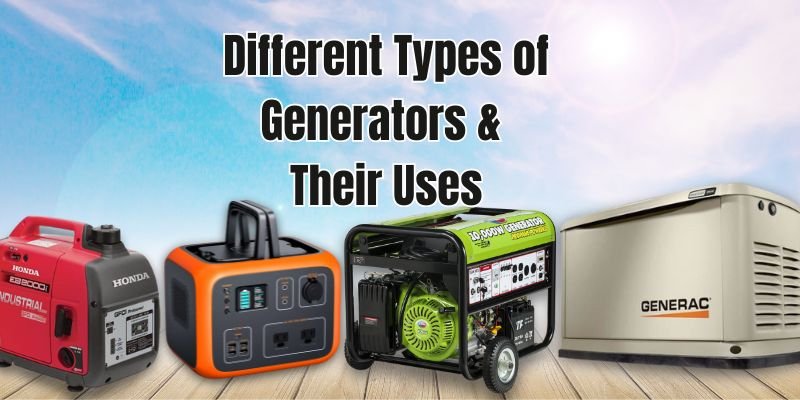
2. Generator Type: Conventional Vs. Inverter
Inverter generators provide cleaner, more stable power. They’re ideal for sensitive welders, especially those with electronics. They’re often more fuel-efficient and quieter but can cost more per watt.
Conventional generators work well for basic stick or industrial welders but may not deliver clean enough power for advanced MIG or TIG units. If you use an inverter welder on a conventional generator, check that the generator’s THD is below 5%. High THD can cause erratic arcs or even damage your welder’s circuit boards.
3. Environmental Conditions
High altitude, extreme heat, and humidity can reduce generator power output. If you work in tough conditions, size up your generator.
For example, at 7,000 feet elevation, a generator might lose 20% or more of its output. If you’re welding in the desert or a humid climate, heat and moisture can also affect both the generator and welder, making it harder to maintain power levels.
Always plan for the worst-case scenario, not just ideal shop conditions.
4. Fuel Type
Gasoline, diesel, propane, or dual-fuel? Diesel generators often handle heavy loads better and last longer, but gasoline models are lighter and cheaper for small jobs.
Propane can be a good choice for indoor or remote work since it stores well and burns clean. Diesel is preferred for long, heavy-duty jobs because of its efficiency and reliability, but these generators are heavier and cost more upfront.
If you work in areas where one fuel type is scarce, choose a model that fits your environment.
5. Portability And Weight
A larger generator is heavier. If you move from job to job, balance power needs with portability.
For example, a 3,500-watt inverter generator can often be carried by one person, while a 15,000-watt model may need wheels or a trailer. Think about your typical job site. If you weld in the same place every day, weight may not matter.
But for mobile welders, a heavy generator can slow you down and require extra equipment to transport.
Common Generator Sizes For Welding
To make it easy, here’s a quick reference for typical welding applications:
| Welder Type | Amps | Voltage | Minimum Generator Size |
|---|---|---|---|
| 120V MIG (up to 140A) | 20-25A | 120V | 3,500-4,000W |
| 240V MIG (up to 210A) | 25-30A | 240V | 7,000-9,000W |
| Stick Welder (225A) | 40-50A | 240V | 10,000-12,000W |
| TIG Welder (200A) | 20-28A | 240V | 7,000-8,500W |
| Multi-process (200A) | 25-30A | 240V | 8,000-10,000W |
These numbers are based on typical use, but always confirm with your specific welder’s manual.
How To Read Your Welder’s Data Plate
Every welder has a data plate or label. This is your best source for power info. Look for:
- Input voltage
- Input amps
- Duty cycle
- Phase
- Frequency (Hz)
If your plate lists “input kVA,” multiply by 1,000 to get watts. If it lists “input kW,” you already have the wattage.
Sometimes the plate lists different amperages for different voltages. Always use the numbers that match your planned setup. If you’re unsure, most manufacturers have manuals online or customer support that can help.
Mistakes People Make When Sizing Generators For Welders
1. Ignoring Surge Wattage
Starting a weld needs more power. If you size for running watts only, your generator may trip or fail. Many beginners are surprised when their generator can run the welder for a few minutes, then suddenly stalls or shuts down during a tough job.
2. Not Checking Power Quality
Some welders need “clean power” with less than 5% total harmonic distortion (THD). Cheap generators can damage electronics inside modern welders. THD is especially important for inverter and multi-process welders with digital controls.
3. Underestimating Duty Cycle
If you weld at high amps for long periods, your generator must handle that continuous load, not just occasional use. This is a common mistake on busy job sites.
4. Overloading the Generator
Running other tools (grinders, lights) at the same time? Add their wattage to your total needs. Even a small grinder can add 1,000 watts or more.
5. Forgetting Altitude and Temperature
High altitudes or hot weather can cut generator power by 10–15%. Failing to account for this can mean your generator works fine in winter but not in summer or at a mountain site.
6. Ignoring Cord and Plug Ratings
Your cords and plugs must be rated for the amperage and voltage, or you risk fire or failure. Using undersized cords is a hidden danger—voltage drop can hurt both the generator and the welder.
Generator Features That Matter For Welders
Not all generators are ready for welding right out of the box. Look for these features:
- 120/240V Outlets: Match your welder plug. Some welders need twist-lock plugs, so check before buying.
- GFCI Protection: Meets OSHA job site rules. GFCI (Ground Fault Circuit Interrupter) is required on many job sites for safety.
- Automatic Voltage Regulation (AVR): Keeps voltage steady for stable arcs. Without AVR, you can get surging or fluctuating welds.
- Low Total Harmonic Distortion: Important for inverter welders. This helps protect sensitive electronics.
- Heavy-duty Frame: Handles vibrations from welding. A sturdy frame also protects your generator during transport.
- Fuel Gauge and Large Tank: Less downtime for refueling. A big fuel tank is especially important for all-day jobs.
- Hour Meter: Track maintenance easily. This helps you keep up with oil changes and other service.
Sizing For Multiple Welders Or Tools
If you plan to run more than one welder, or use grinders, lights, or air compressors at the same time, add up all the running and surge wattages. Always pick a generator that can handle the combined load with a 20–30% safety margin.
For example, if you’re running a 6,000-watt welder and a 1,000-watt grinder, plus a 500-watt work light, you need at least 8,700 watts (with a 20% margin). Don’t forget to check the total amperage of all cords and outlets—never overload a single circuit.
Standalone Engine-driven Welders Vs. Separate Generator
Some jobs need an engine-driven welder—a unit that combines a generator and a welder in one. These are common for pipeline or field work. They’re heavier and cost more, but you get both functions in one machine.
If you already have a portable welder, buying a separate generator is usually cheaper and more flexible, especially for shop or light field work. Engine-driven welders are built for heavy-duty, outdoor, and remote work, but they’re overkill for most home or small business jobs.
Real-world Examples
Example 1: Hobbyist With A 120v Mig Welder
You own a Lincoln Handy MIG (20A, 120V). You want to weld in your garage or backyard.
- 120V x 20A = 2,400 watts
- Surge: Add 25% = 3,000 watts
- Generator size: 3,500–4,000 watts is safe
This size also lets you run a small light or fan at the same time. Many users find a 4,000-watt inverter generator perfect for hobby work.
Example 2: Construction Site With A 225a Stick Welder
You use a Lincoln AC-225 (50A, 240V) for field repairs.
- 240V x 50A = 12,000 watts
- Surge: Add 20% = 14,400 watts
- Generator size: 15,000 watts is best
This setup gives you peace of mind that your generator won’t bog down, even on tough jobs. You can also run a grinder or work light without worry.
Example 3: Mobile Welding Business With A Multi-process Welder
You run an ESAB Rebel EMP 215ic (230V, 18A) for various jobs.
- 230V x 18A = 4,140 watts
- Surge: Add 30% = 5,382 watts
- Generator size: 6,500 watts covers all needs, even with some accessories.
This generator size is easy to move and covers nearly all light commercial jobs.
How To Pick The Right Generator Brand And Model
Stick with brands known for durability and service. Look for:
- Honda
- Yamaha
- Generac
- Miller (engine-driven)
- Lincoln Electric (engine-driven)
- Westinghouse
- Champion
Choose based on your wattage needs, budget, and service availability in your area. Talk to other welders in your field—they often know which brands hold up best. If you’re buying used, check for easy access to parts and service.
Tips To Get The Most From Your Generator And Welder
- Use heavy-duty extension cords rated for welding. Thicker cords (lower gauge numbers) mean less voltage drop.
- Keep your generator’s air filter and oil clean. Dirty filters or oil can reduce power and cause breakdowns.
- Run your generator on a flat, stable surface to prevent vibration and fuel problems.
- Let the generator warm up for a few minutes before welding, especially in cold weather.
- Don’t overload—watch the wattage, especially if you add tools or lights.
- Store fuel safely, and use stabilizer to prevent gumming or varnish in the tank.
- For inverter welders, always use a generator with low THD to protect electronic boards.
Welding At High Altitude Or In Extreme Weather
Generators lose power at high altitudes (above 5,000 ft) and in hot weather. For every 1,000 feet above sea level, reduce the generator’s output by 3–4%. For every 10°F above 85°F, reduce output by 1–2%. Size up your generator if you work in these conditions.
For example, a 10,000-watt generator at 7,000 feet may only deliver about 8,000 watts. If you plan to weld in mountain regions or deserts, always build in a safety margin. Some manufacturers offer special high-altitude kits—ask your dealer if you work at elevation.
The Cost Of The Wrong Generator
Buying a generator that’s too small leads to:
- Overheating and tripping
- Poor weld quality (porosity, spatter, weak welds)
- Damaged electronics (expensive repairs)
- Lost time and money (project delays, extra trips)
Buying a generator that’s too big means you spend more up front, burn more fuel, and haul more weight than needed. Balance your needs for power, portability, and budget. A well-chosen generator pays for itself by working reliably for years.
How To Test Your Setup Before The First Job
Before starting real work, hook up your welder to your new generator. Run it at maximum amps for a few minutes. Watch for:
- Generator bogging down or stalling
- Breakers tripping
- Weld quality issues (sputtering, inconsistent arc)
If you notice problems, your generator may be too small, or your connections may be wrong. Double-check all plugs, cords, and settings before starting your project.
Generator Maintenance For Welding Jobs
Well-maintained generators last longer and give you stable power.
- Change oil every 50–100 hours.
- Clean or replace the air filter regularly.
- Drain fuel if storing long-term.
- Check and tighten all connections.
- Inspect spark plugs and replace if needed.
- Keep the cooling area clear.
Proper care keeps your welder running smoothly and avoids costly downtime. Many generator failures are due to skipped oil changes or dirty air filters—a small step that saves big money later.
Safety Tips For Generator-powered Welding
- Always run generators outdoors—never indoors or in garages. Carbon monoxide poisoning is a real risk.
- Use GFCI outlets for job site safety.
- Ground your generator if required by local code or manufacturer.
- Wear PPE (helmet, gloves, boots) at all times.
- Never touch a running generator with wet hands.
- Store fuel in approved containers away from sparks, hot surfaces, and welding arcs.
Generator Vs. Engine-driven Welder: Pros And Cons
| Feature | Generator + Welder | Engine-Driven Welder |
|---|---|---|
| Flexibility | High, can run other tools | Purpose-built for welding |
| Cost | Lower for small jobs | Higher, but includes welder |
| Portability | Lighter for small units | Heavier, trailer often needed |
| Power Output | Varies by model | Usually high |
| Maintenance | Separate for each unit | Combined in one |
Final Checklist Before You Buy
- Check your welder’s input voltage and amperage.
- Calculate starting and running watts.
- Add up extra tools you’ll use at the same time.
- Pick a generator with 20–30% extra capacity.
- Make sure outlets and plugs match your welder.
- Choose a trusted brand with good support.
- Plan for maintenance and storage.
Frequently Asked Questions
What Happens If My Generator Is Too Small For My Welder?
If your generator is too small, it can overheat, trip breakers, or fail to start the welder. You might also get poor weld quality or damage your equipment. Always use a generator that meets or exceeds your welder’s power requirements.
Can I Use An Inverter Generator With A Welder?
Yes, many inverter generators work well with welders, especially smaller MIG or TIG units. Inverter generators deliver stable, clean power with low harmonic distortion. Always check your welder’s input needs and make sure the generator can handle the load.
How Do I Calculate The Wattage Needed For My Welder?
Multiply your welder’s input voltage by its input amps to get the required wattage. For example, if your welder is 240V and 30A, you need at least 7,200 watts. Add a 20–30% safety margin for startup surges and stable operation.
Can I Run Other Tools At The Same Time As My Welder On A Generator?
Yes, but you must add the wattage of all tools you plan to use. Make sure your generator can handle the combined load with extra capacity for surges. Overloading can damage both the generator and your tools, so calculate carefully.
What Maintenance Does A Generator Need For Welding Jobs?
Change the oil every 50–100 hours of use, clean or replace the air filter, drain fuel before long storage, check connections, and inspect spark plugs. Keep the cooling area clear and follow the manufacturer’s schedule for best performance and long life.
With the right information, you can confidently select a generator that powers your welder safely, reliably, and efficiently—no guesswork, just great results every time.