Disclosure: This post contains affiliate links and I will be compensated if you make a purchase after clicking through my links. Learn More
How strong is JB Weld? The Original J-B Weld epoxy is rated at a tensile strength of 6,220 PSI by its maker, which makes it the strongest product in the regular J-B Weld cold weld line.
That number comes from J-B Weld’s own product data. The faster versions are weaker on paper: KwikWeld is rated at 4,360 PSI, and the SteelStik and HighHeat putties are rated at 4,000 PSI.
A PSI rating tells you how hard the cured epoxy resists being pulled apart. It does not tell you how much weight your repair will hold. Surface prep, joint shape, cure time and heat decide that.
JB Weld Strength by Product
These figures are copied from the J-B Weld product pages for each formula. Set time is when you can handle the part. Cure time is when the epoxy reaches full strength.
| Product | Tensile strength | Set time | Full cure | Max temperature |
|---|---|---|---|---|
| J-B Weld Original (8265S, 8281) | 6,220 PSI | 4 to 6 hours | 15 to 24 hours | 550°F (fully cured) |
| J-B Weld KwikWeld (8276) | 4,360 PSI | 6 minutes | 4 to 6 hours | 250°F |
| J-B Weld SteelStik putty (8267) | 4,000 PSI | 5 minutes | 1 hour | 350°F |
| J-B Weld HighHeat putty (8297) | 4,000 PSI | 1 hour | 8 hours | 450°F continuous, 500°F intermittent |
The Original and KwikWeld both mix at a 1:1 ratio and cure to a dark gray color. J-B Weld lists both as sandable, drillable, paintable, water resistant and oil resistant.
Speed costs strength. KwikWeld sets in minutes, but it gives up about 1,860 PSI and 300°F of heat resistance compared with the Original formula.
What 6,220 PSI Tensile Strength Really Means
Tensile strength is the pulling force a material can take per square inch of cross section before it breaks. So 6,220 PSI describes the cured epoxy itself.
Your repair can fail in 2 other places first. The epoxy can peel off a dirty or smooth surface, or the base material next to the joint can crack.
For scale, ASTM A36 structural steel has a minimum tensile strength of 58,000 PSI. Even the strongest J-B Weld formula is about one ninth of that, so it can’t replace the steel it bonds.
How Strong Is JB Weld Compared to a Real Weld?
JB Weld is much weaker than a real weld. A weld melts and fuses the base metals into one piece. Epoxy only grips the surface, so it can’t carry the loads a welded joint carries.
The YouTube channel Project Farm tested this by gluing a broken Briggs and Stratton connecting rod back together with epoxy. Hackaday reported that the rod came apart within seconds once the engine ran.
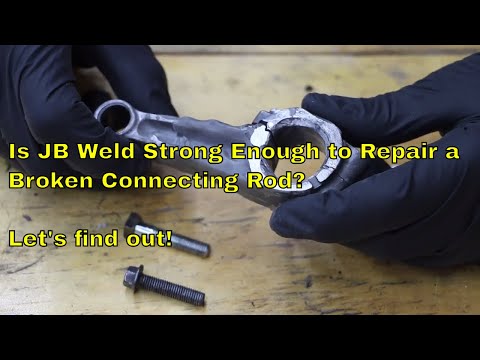
Credit: www.youtube.com
That test is extreme, but it shows the point. A rotating or impact load finds the weakest spot fast, and a bonded joint is that spot.
What Affects JB Weld Strength in a Real Repair
Surface Prep
Epoxy holds best on clean, rough, dry metal. Remove oil, paint and rust, then scuff the area with coarse sandpaper or a file so the epoxy has something to grip.
Mix Ratio
The Original and KwikWeld formulas need equal parts of resin and hardener. Mix until the color is even. A batch with too much of one part may stay soft and never reach the rated strength.
Cure Time and Temperature
Wait for the full cure before you load the part. J-B Weld says to allow at least 15 hours before you put an Original repair back in use. KwikWeld sets slower below 40°F.
Cold shops slow every formula. When you use JB Weld in cold weather, warm the part and the room first, then give the repair extra cure time.
Joint Design
A wide overlap spreads the load over more square inches. Epoxy handles shear, where 2 surfaces slide past each other, far better than peel, where one edge lifts and unzips the bond.
Heat
Each formula has a temperature ceiling. Go past it and the epoxy softens and loses grip. Exhaust parts and engine blocks near the heat source need the Original or HighHeat, never KwikWeld.
Where JB Weld Holds Up and Where It Fails
JB Weld works well on repairs where the epoxy fills, seals or holds a part in place without carrying a heavy or shock load.
- Cracks in non-structural cast iron or aluminum housings
- Stripped threads you rebuild, then drill and tap after the full cure
- Small leaks in water-resistant or oil-resistant parts
- Bonding metal to wood, ceramic, concrete, fiberglass or PVC, which J-B Weld lists as compatible surfaces
- Filling gaps and pits before paint
It fails on parts that see high stress, vibration or impact.
- Connecting rods, crankshafts and other rotating engine parts
- Trailer hitches, axles, suspension and steering parts
- Lifting gear, ladders, brackets that hold people or heavy loads
- Joints that run hotter than the product’s rated temperature
Safety note: never use JB Weld as the only repair on a part where failure could hurt someone. Weld it, replace it or take it to a pro.
Which JB Weld Is the Strongest?
J-B Weld Original is the strongest of the 4 formulas in the table at 6,220 PSI. It also has the highest heat rating, at 550°F once fully cured.
Pick KwikWeld only when you need the part back in minutes and the load is light. Pick SteelStik or HighHeat when you need a putty you can press into a hole or crack. JB Weld HighHeat drying time is longer than SteelStik: it sets in 1 hour and cures in 8 hours.
Frequently Asked Questions
Is JB Weld as Strong as Welding?
No. JB Weld Original is rated at 6,220 PSI, and a weld fuses the base metal itself, which can be many times stronger. Epoxy grips only the surface, so use it for sealing, filling and light-duty bonds, and weld any part that carries a structural or shock load.
How Much Weight Can JB Weld Hold?
J-B Weld publishes tensile strength in PSI, not a weight limit for a repair. The real load a joint holds depends on bonded area, surface prep, joint shape and cure time. A clean, wide overlap holds far more than a thin edge-to-edge butt joint.
Can You Drill and Tap JB Weld?
Yes. J-B Weld says the Original and KwikWeld formulas can be shaped, tapped, filed, sanded and drilled after curing. Wait for the full cure first, which is 15 to 24 hours for the Original and 4 to 6 hours for KwikWeld, then drill slowly.
Is JB Weld Waterproof?
J-B Weld lists the Original and KwikWeld formulas as water resistant and oil resistant. The product pages do not use the word waterproof. For parts that sit underwater or hold drinking water, check the product label or pick a formula made for that job.
How Long Does JB Weld Take to Reach Full Strength?
J-B Weld Original sets in 4 to 6 hours and fully cures in 15 to 24 hours. KwikWeld sets in 6 minutes and cures in 4 to 6 hours. Cold temperatures slow the cure, so give the repair extra time in a cold shop.
Final Words
JB Weld is strong for an epoxy. The Original formula is rated at 6,220 PSI and handles 550°F, which covers many cracked housings, stripped threads and small leaks.
It is still a glue. Treat the PSI number as the best case, prep the surface well, give it the full cure, and keep it away from parts that carry heavy, rotating or safety-critical loads.