
Disclosure: This post contains affiliate links and I will be compensated if you make a purchase after clicking through my links. Learn More
A sheet metal gauge chart converts a gauge number into real thickness, and the answer depends on the metal. For example, 16 gauge mild steel is 0.0598 in (1.518 mm), but 16 gauge aluminum is only 0.05082 in (1.291 mm).
Gauge numbers run backward: the higher the number, the thinner the sheet. So 10 gauge steel is about 0.13 in thick, and 24 gauge is about 0.02 in.
Our chart uses supplier data from Metal Supermarkets, cross-checked against SendCutSend. Both list the same inch values for every gauge they share.
Sheet Metal Gauge Chart (Inches and mm)
Find your gauge in the left column, then read across to your metal. Thickness is shown in inches first, with millimeters in parentheses.
| Gauge | Mild steel in (mm) | Galvanized steel in (mm) | Stainless steel in (mm) | Aluminum in (mm) |
|---|---|---|---|---|
| 7 | .1793 (4.554) | – | – | .1443 (3.665) |
| 8 | .1644 (4.175) | .1681 (4.269) | .17187 (4.365) | .1285 (3.264) |
| 9 | .1495 (3.797) | .1532 (3.891) | .15625 (3.968) | .1144 (2.906) |
| 10 | .1345 (3.416) | .1382 (3.510) | .14062 (3.571) | .1019 (2.588) |
| 11 | .1196 (3.038) | .1233 (3.132) | .125 (3.175) | .09074 (2.305) |
| 12 | .1046 (2.656) | .1084 (2.753) | .10937 (2.778) | .08081 (2.053) |
| 14 | .0747 (1.897) | .0785 (1.994) | .07812 (1.984) | .06408 (1.628) |
| 16 | .0598 (1.518) | .0635 (1.613) | .0625 (1.587) | .05082 (1.291) |
| 18 | .0478 (1.214) | .0516 (1.310) | .050 (1.270) | .04030 (1.024) |
| 20 | .0359 (0.911) | .0396 (1.005) | .0375 (0.953) | .03196 (0.812) |
| 22 | .0299 (0.759) | .0336 (0.853) | .03125 (0.794) | .02535 (0.644) |
| 24 | .0239 (0.607) | .0276 (0.701) | .025 (0.635) | .02010 (0.511) |
| 26 | .0179 (0.454) | .0217 (0.551) | .01875 (0.476) | .01594 (0.405) |
| 28 | .0149 (0.378) | .0187 (0.474) | .01562 (0.396) | .01264 (0.321) |
| 30 | – | .0157 (0.398) | .0125 (0.318) | .01003 (0.255) |
Source: Metal Supermarkets gauge charts for mild steel, galvanized, stainless and aluminum. A dash means the gauge is not listed for that metal. Metal Supermarkets notes that actual thickness varies with mill tolerances.
How to Read This Chart
Gauge is an old naming system, not a unit of length. Metal Supermarkets puts it plainly: gauges are neither standard nor metric.
- Higher number, thinner sheet. 28 gauge steel is 0.0149 in, about one tenth the thickness of 7 gauge steel (0.1793 in).
- Same gauge, different thickness. 18 gauge steel is 0.0478 in, but 18 gauge aluminum is 0.0403 in. SendCutSend notes that different materials use different gauge charts.
- Galvanized runs thicker. Galvanized sheet in each gauge measures a little more than bare mild steel. At 16 gauge, it is 0.0635 in vs 0.0598 in.
- Thickness varies a bit. Mill tolerance means a real sheet can measure slightly over or under the chart value.
- Measure when it matters. For a weld procedure or a tight fit, check the sheet with calipers or a gauge wheel instead of trusting the label.
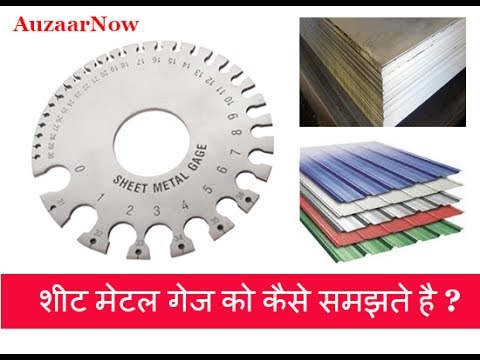
Credit: www.youtube.com
Gauge Thickness by Metal Type
Mild Steel
The mild steel chart runs from 7 gauge (0.1793 in) down to 28 gauge (0.0149 in), with 10 gauge at 0.1345 in and 16 gauge at 0.0598 in.
Galvanized Steel
Galvanized sheet uses its own chart. Each gauge sits about 0.003 to 0.004 in above the matching mild steel gauge, so do not swap the two charts.
Grind the zinc back from the weld zone before you weld, and use ventilation or a respirator. Zinc fumes from galvanized steel are a real health risk.
Stainless Steel
Stainless gauges are close to mild steel but not the same. 16 gauge stainless is 0.0625 in (1/16 in), and 11 gauge stainless is exactly 0.125 in (1/8 in).
Aluminum
Aluminum uses a thinner chart. 10 gauge aluminum is 0.1019 in, about 0.03 in thinner than 10 gauge steel.
Ordering by decimal thickness, such as 0.063 or 0.125 in, avoids a gauge mix-up between the steel and aluminum charts.
Welding by Gauge: Starting Amps and Wire Size
Miller gives a simple rule for MIG welding steel with solid wire: each 0.001 in of thickness needs about 1 amp. We used that rule and the mild steel chart to build a starting point.
| Steel gauge | Thickness (in) | Starting amps (1 amp per 0.001 in) | Suggested solid wire |
|---|---|---|---|
| 10 | .1345 | about 134 | .030 or .035 in |
| 11 | .1196 | about 120 | .030 or .035 in |
| 12 | .1046 | about 105 | .030 or .035 in |
| 14 | .0747 | about 75 | .030 or .035 in |
| 16 | .0598 | about 60 | .030 or .035 in |
| 18 | .0478 | about 48 | .030 in or .023/.024 in |
| 20 | .0359 | about 36 | .023 or .024 in |
| 22 | .0299 | about 30 | .023 or .024 in |
Wire sizes follow Miller guidance: .023 or .024 in wire for most light gauge sheet, .030 in at 18 gauge and thicker, and .035 in in the 50 to 180 amp range. Start with the chart in your machine’s door, then run a test bead on scrap of the same gauge.
Tips for Welding Thin Gauge Sheet
- Use short-circuit MIG or TIG. Miller names short arc MIG, TIG and pulsed TIG as the processes with the most heat control on thin sheet.
- Skip flux-cored wire on thin sheet. Miller warns that flux-cored wire puts more heat into the base metal.
- Use 75/25 gas on steel. A 75% argon, 25% CO2 mix carries less heat than straight CO2 and gives less spatter.
- Stitch weld. Short welds spread out along the seam keep heat even and cut warping.
- Get tight fit-up. On 20 to 24 gauge, a 1/16 in gap can turn into a hole, so clamp parts tight before you tack.
- Add a backing bar. A copper or aluminum bar behind the joint pulls heat away and helps stop burn-through.

Credit: www.youtube.com
Safety Note
Thin sheet edges are sharp enough to cut through skin, so wear cut-resistant gloves when you handle and shear it. When you weld, wear a helmet, FR clothing and leather gloves, and never weld galvanized or coated sheet without fume control.
Frequently Asked Questions
What Is the Thickness of 16 Gauge Sheet Metal?
16 gauge mild steel is 0.0598 in (1.518 mm) thick. 16 gauge stainless is 0.0625 in, galvanized is 0.0635 in, and aluminum is 0.05082 in. Always check which metal the gauge refers to, because the same number means a different thickness for each material.
Is 10 Gauge Thicker Than 16 Gauge?
Yes. Gauge numbers run backward, so a lower number means thicker sheet. 10 gauge mild steel is 0.1345 in thick, more than twice the thickness of 16 gauge mild steel at 0.0598 in. The same pattern holds for aluminum, stainless and galvanized sheet.
What Gauge Is 1/8 Inch Steel?
11 gauge is the closest match. 11 gauge mild steel is 0.1196 in, a little under 1/8 in (0.125 in), and 11 gauge stainless is exactly 0.125 in. If you need a true 1/8 in, order by decimal thickness to avoid confusion.
Why Is Aluminum Gauge Thinner Than Steel Gauge?
Aluminum and steel use different gauge charts, and SendCutSend notes the gauge thickness depends on the material. At 18 gauge, steel is 0.0478 in and aluminum is 0.0403 in. Order aluminum by decimal thickness when possible to avoid costly mistakes.
What Gauge Sheet Metal Can a 120V MIG Welder Handle?
A 120V MIG welder handles most thin gauge sheet well. Using the Miller rule of about 1 amp per 0.001 in, 18 gauge steel needs about 48 amps and 14 gauge about 75 amps. Check your welder’s door chart for its rated thickness range.
Final Words
A sheet metal gauge chart saves you from guessing. Remember that gauge numbers run backward and that steel, galvanized, stainless and aluminum each use their own chart.
For welding, turn the gauge into a decimal thickness first. Then use the 1 amp per 0.001 in rule as a starting point, pick a small wire, and test on scrap before you weld the real part.