Disclosure: This post contains affiliate links and I will be compensated if you make a purchase after clicking through my links. Learn More
There are 5 types of welding joints: the butt joint, tee joint, corner joint, lap joint and edge joint. The American Welding Society (AWS) treats these 5 as the basic joint designs, and almost every weld you make in a shop fits one of them.
A joint describes how the 2 pieces of metal meet. The weld type, such as a fillet weld or a groove weld, describes the bead you lay in that joint. Keep the two apart and the prep choices get much simpler.
We cover what each joint looks like, which welds it takes, how much load it handles and the setup tips that keep it from cracking, warping or burning through.
What Are the 5 Types of Welding Joints?
The 5 types of welding joints are butt, tee, corner, lap and edge. Butt and tee joints carry most structural work, lap and corner joints cover sheet metal and frames, and edge joints are for light, low-stress parts.
| Joint | How the parts meet | Common welds | Load handling | Typical uses |
|---|---|---|---|---|
| Butt | Side by side in the same plane | Square, V, bevel, J and U groove welds | High with full penetration | Pipe, plate, structural beams |
| Tee | One edge on the face of the other at 90 degrees | Fillet welds, bevel or J groove welds | High, best when welded on both sides | Brackets, stiffeners, base plates |
| Corner | Edges meet at 90 degrees to form an L | Fillet, groove and flange welds | Medium to high, depends on prep | Boxes, square frames, enclosures |
| Lap | Pieces overlap in parallel planes | Fillet, plug, slot and spot welds | Good, not flush | Sheet metal, auto body, patches |
| Edge | Edges side by side, nearly parallel | Edge, flange and groove welds | Low, not for heavy stress | Thin sheet, flanged parts, covers |
This joint and weld matrix follows the joint lists in AWS symbol training material and the AISC welding primer. Your Welding Procedure Specification (WPS) or drawing always wins over a general chart.
Joint Types vs Weld Types: Why the Difference Matters
A fillet weld is a triangle-shaped bead that fills the inside corner of a tee, lap or corner joint. It needs no edge prep, which makes it the fastest weld to set up.
A groove weld fills a gap or a machined groove between the parts. Complete joint penetration (CJP) groove welds develop the full strength of the joint, and partial joint penetration (PJP) groove welds develop part of it.
The AISC bolting and welding primer gives a common rule of thumb: fillet welds for material under 3/4 inch thick and PJP groove welds above that. The primer also notes that PJP groove welds use weld metal more efficiently than large fillets.
For sizing fillets, AWS D1.1 (Structural Welding Code, Steel) lists minimum fillet weld sizes by base metal thickness. A fillet weld size rule of thumb is handy for shop work, but code jobs use the D1.1 table.
Butt Joint
Credit: contenthub.itwwelding.com
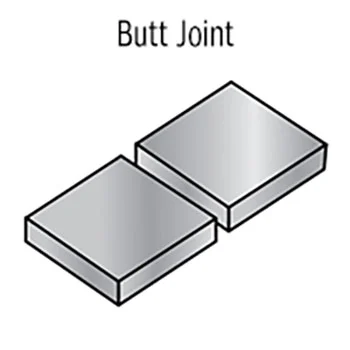
A butt joint puts 2 pieces side by side in the same plane and welds the seam between them. ESAB calls it the most common joint in pipelines and structures.
Butt Joint Edge Prep
- Square groove: no bevel. Miller recommends it for material under 1/8 inch, where you can still get full penetration.
- Single V or single bevel: for thicker plate. A bevel gives a stronger weld but takes more filler and more time.
- Double V, J or U groove: for heavy sections. Miller notes J and U grooves need less filler than a V on thick material.
- Root opening and backing: optional, per Miller, and set by the WPS on code work.
Butt Joint Problems to Watch
ESAB lists porosity, burn-through, incomplete penetration and cracking as the usual butt joint defects. Good fit-up fixes most of them, so tack the pieces with an even gap before you run the root.
CJP groove welds in butt joints are the normal choice for parts in tension, per the AISC primer.
Tee Joint
Credit: contenthub.itwwelding.com
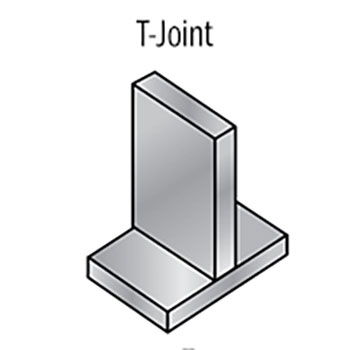
A tee joint forms when one piece meets the flat face of another at 90 degrees, making a T. A tube welded upright on a base plate is also a tee joint.
- Work angle: Miller recommends 45 degrees on a 90 degree tee so the heat reaches both pieces.
- Weld both sides when the load can come from either direction. A one-sided fillet can fail if the unwelded side takes an impact.
- Uneven thickness: aim more of the arc at the thicker piece so the thin one does not burn away.
- Positions: tees weld in flat, horizontal, vertical and overhead positions.
Tee joints usually take fillet welds, or a bevel or J groove when you need deeper fusion. ESAB warns that a tightly restrained tee can suffer lamellar tearing in thick plate.
Undercut along the top toe is a common tee joint flaw, so watch that edge of the bead as you travel.
Corner Joint
Credit: contenthub.itwwelding.com
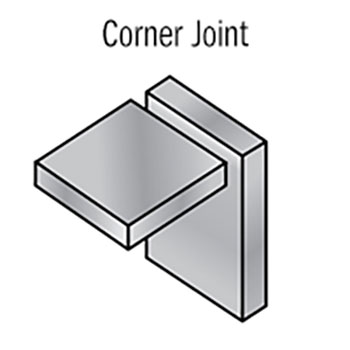
A corner joint is 2 pieces meeting at 90 degrees to form an L. It is the joint behind most boxes, square frames and sheet metal enclosures.
Open Corner vs Closed Corner
- Open corner: the edges meet at their corners and leave a V-shaped groove. It takes more filler, and thin stock needs faster travel to avoid burn-through.
- Closed corner: one edge sits flush against the face of the other. You can grind the weld face smooth for a clean outside edge.
Heat pulls a corner joint out of square as the bead cools. Clamp the parts in a fixture or jig, tack opposite corners first and check the angle with a square between tacks.
Corner joints can take fillet, groove or flange welds. The AISC primer lists lamellar tearing as a concern on heavy structural corners.
Lap Joint
A lap joint overlaps 2 pieces in parallel planes and welds the edge of one onto the face of the other. The thicker the metal, the more overlap you need.
- No gaps: clamp the sheets flat. A gap between the layers causes burn-through and cold lap.
- Thin sheet: lower the amperage and raise travel speed to limit distortion.
- Weld both edges of the overlap when you need more stiffness.
- Weld types: fillet welds on the edge, plus plug, slot and spot welds through the top sheet.
Lap joints handle load well, but they sit proud and are easy to see. The AISC primer notes plug and slot welds are rare in structures and restricted where loads repeat or shift.
Lap joints are common on auto body panels and patch plates, and they are a good first joint to practice with MIG welding on thin steel.
Edge Joint
An edge joint places 2 pieces side by side with their edges nearly parallel, then welds along those edges. It is common on thin sheet, flanged parts and covers.
Edge prep can be square, V, J or U groove, and flanged edges are popular on light gauge sheet. Miller notes that a V or U groove helps penetration on thicker material.
Do not use an edge joint where the part takes heavy stress or impact. Miller and ESAB both say edge joints suit parts that are not under load.
Basic Weld Joint Terms
These terms show up on drawings and weld symbols for every joint type.
- Root: the part of the joint where the 2 members are closest.
- Root opening: the gap between the members at the root.
- Root face: the flat land at the bottom of a groove, also called the land.
- Bevel angle: the angle cut on one member’s edge.
- Groove angle: the total included angle of the groove. With both edges beveled, it equals 2 bevel angles.
How to Choose the Right Welding Joint
- Pieces in the same plane: use a butt joint. Bevel it once the metal passes about 1/8 inch.
- One piece standing on another: use a tee joint and weld both sides if the load can come from either way.
- Building a box or frame: use a corner joint and fixture it to hold square.
- Joining sheet metal or a patch: use a lap joint with tight clamping.
- Light covers or flanged thin sheet: an edge joint works, but keep it away from heavy loads.
- Code work: follow the WPS and AWS D1.1 (or the code your job calls for) for joint design and weld size.
Joint choice also ties into process. A strongest welding process comparison means little if the joint design and penetration are wrong.
Welding Joint Safety Notes
Every joint type puts you near arc rays, hot spatter and fumes. Wear a helmet with the right shade, flame-resistant clothing and gloves, and weld with good ventilation. Grinding bevels throws sparks, so clear flammables from the area first.
Frequently Asked Questions
What Are the 5 Basic Types of Welding Joints?
The 5 basic types of welding joints are the butt joint, tee joint, corner joint, lap joint and edge joint. The American Welding Society uses these 5 designs. Each one describes how the pieces meet, and you then pick a fillet, groove or other weld to join them.
Which Welding Joint Is the Strongest?
A butt joint with a complete joint penetration groove weld is usually the strongest, because the weld fuses the full thickness of the metal. A tee joint welded on both sides is also very strong. Edge joints are the weakest and should not carry heavy loads or impact.
What Is the Difference Between a Joint and a Weld?
A joint is how the 2 pieces of metal are arranged, such as butt, tee or lap. A weld is the bead you put in that joint, such as a fillet weld or groove weld. One joint type can often take several weld types, depending on thickness and load.
What Is the Easiest Welding Joint for Beginners?
Most beginners find the lap joint and the flat tee joint easiest, because the fillet weld has a clear corner to follow and needs no edge prep. Butt joints on thin metal are harder, since you must get full penetration without burning through. Start in the flat position.
Do You Need to Bevel a Butt Joint?
You usually need to bevel a butt joint once the metal is thicker than about 1/8 inch, according to Miller. Below that, a square groove can still reach full penetration. Thicker plate needs a V, bevel, J or U groove so the weld can fuse the whole joint.
Final Words
The 5 types of welding joints cover nearly every job: butt joints for plate and pipe, tee joints for brackets and stiffeners, corner joints for frames, lap joints for sheet metal and edge joints for light parts.
Pick the joint by how the parts meet and how they will be loaded, then choose the weld and edge prep to match the thickness. Clean fit-up and a square setup solve more joint problems than any machine setting.