Disclosure: This post contains affiliate links and I will be compensated if you make a purchase after clicking through my links. Learn More
The size of a fillet weld is not just a technical detail; it is a key factor for safety and durability in welded structures. Many people think choosing a weld size is simple, but rules exist for a reason. If the weld is too large, it can cause distortion or even weaken the structure. If the weld is too small, it may fail under load. This article explains how to choose the maximum fillet weld size for plate thickness. You will learn the rules, see practical examples, and understand where mistakes often happen.
Engineers and welders use standards to set the right fillet weld size. These standards come from organizations like the American Welding Society (AWS) and the American Institute of Steel Construction (AISC). The goal is always to keep structures safe and reliable.
Understanding the limits for weld size helps prevent over-welding, saves money, and avoids common failures.
This guide uses simple language, real examples, and clear steps. You will find tables, answers to common questions, and expert tips that go beyond basic rules. By the end, you will know how to pick the correct fillet weld size for any plate thickness and why it matters.
What Is Fillet Weld Size?
A fillet weld joins two surfaces at a right angle or close to a right angle. You often see fillet welds in T-joints, lap joints, and corner joints. The fillet weld size is the length of the legs of the triangle formed by the weld cross-section. It is usually measured in millimeters or inches.
The weld size controls the strength of the joint. A bigger size increases the area that resists force, but this does not always mean a stronger or better weld. Too much weld can cause problems, just as too little can. That is why standards set maximum fillet weld size for different plate thicknesses.
Why Maximum Fillet Weld Size Matters
You might think a bigger weld always means better strength. In reality, maximum fillet weld size exists for several reasons:
- Distortion: Large welds make more heat, which can twist or bend plates.
- Cracking: Over-welding can lead to cracks as the metal cools.
- Waste: Extra weld metal costs more and takes longer without adding value.
- Base Metal Weakening: If the weld fuses too deeply into the plate, it can damage the parent metal.
Maximum size rules protect the structure from these problems. They also keep work efficient and cost-effective.

Credit: www.eng-tips.com
Basic Rules For Maximum Fillet Weld Size
Standards like AWS D1.1 provide clear limits. The main rule is:
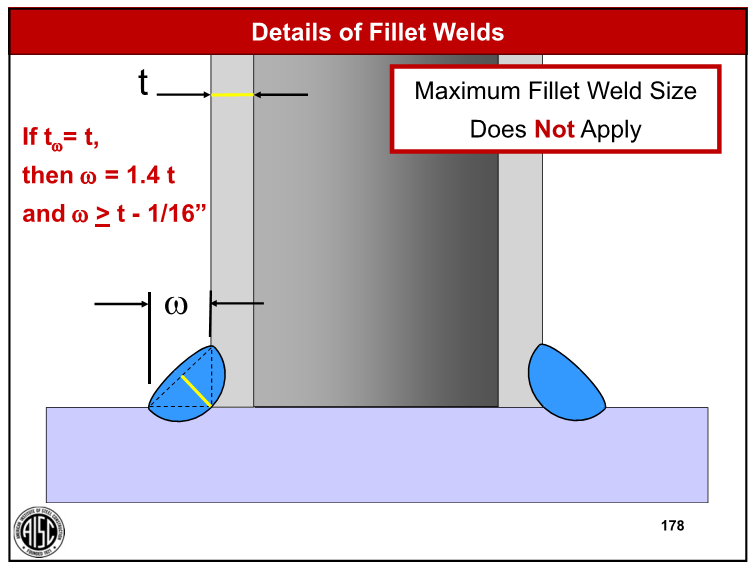
- The maximum fillet weld size should not exceed the thickness of the thinner plate at the joint.
But there are important details and exceptions, especially near edges or for very thick plates.
Here is a typical rule from AWS D1.1:
- For plates under 6 mm (1/4 inch) thick, the maximum fillet weld size is the same as the plate thickness.
- For plates 6 mm (1/4 inch) thick or more, the maximum weld size can be up to the thickness of the thinner part, but not more.
Near Edges
Welds near the plate edge need a smaller size. If you place a large weld close to the edge, you risk burning through or causing cracks.
The common rule is:
- The maximum size of the fillet weld at the edge must be at least 1.5 mm (1/16 inch) less than the edge thickness.
Simple Example
If you weld a 10 mm plate to a 6 mm plate, the maximum fillet weld size is 6 mm. If this weld is at the edge of the 6 mm plate, the maximum drops to 4. 5 mm (6 mm minus 1.
5 mm).
Standard Guidelines: Aws And Aisc
Most projects use the AWS D1.1 or the AISC Manual for weld sizes. These documents set clear limits and help avoid mistakes. Here are the main points:
- AWS D1.1: Limits fillet weld size to the thinner part’s thickness, with reduced size near free edges.
- AISC Manual: Uses the same rules as AWS for steel structures.
Some industries or countries use their own standards, but the logic stays the same.
Maximum Fillet Weld Size Table
The following table shows common maximum sizes for different plate thicknesses, based on AWS D1. 1. These are for standard carbon steel fillet welds.
| Thinner Plate Thickness (mm) | Maximum Fillet Weld Size (mm) | Maximum at Edge (mm) |
|---|---|---|
| 3 | 3 | 1.5 |
| 6 | 6 | 4.5 |
| 10 | 10 | 8.5 |
| 16 | 16 | 14.5 |
| 20 | 20 | 18.5 |
This table is a quick reference. Always check project specs or local codes for exact numbers.
How To Measure Fillet Weld Size
You measure fillet weld size by the leg length—the distance from the root of the weld to the toe on each side. Weld gauges are tools that help check the size quickly. To avoid errors, always clean the weld before measuring.
Some inspectors use the throat size (the shortest distance from the root to the face). But for maximum size, leg length is the standard.
Key Factors That Affect Maximum Size
Several things can change the best maximum fillet weld size:
- Type of Joint: T-joint, lap joint, or corner joint may have different rules.
- Plate Edge Condition: Square, rounded, or beveled edges affect weld size.
- Welding Position: Overhead welds are harder, so smaller sizes may be used.
- Material Type: Soft metals can burn through if the weld is too large.
- Heat Input: High heat can cause distortion in thin plates.
Knowing these factors helps you avoid common mistakes and choose the safest size.
Practical Steps To Select Maximum Fillet Weld Size
Choosing the right size is a process, not just a calculation. Here are the steps:
- Identify Plate Thicknesses: Measure both plates at the joint. Use the thinner one for the rule.
- Check Edge Location: See if the weld is near a free edge.
- Review Standards: Use AWS, AISC, or project codes.
- Consider Fit-Up: If gaps exist, adjust weld size or technique.
- Think About Welding Position: Overhead or vertical welds may need smaller size for control.
- Inspect Material: For soft or high-carbon steel, use the lower end of the size range.
- Document the Size: Mark or note the chosen maximum size for the welder.
Real-world Example
Suppose you need to weld a 12 mm plate to an 8 mm plate in a T-joint, not at an edge. The maximum fillet weld size is 8 mm. If the weld runs to the edge of the 8 mm plate, the maximum drops to 6.
5 mm (8 mm minus 1. 5 mm).
If you try to weld a larger bead, you risk burning through or causing cracks. Staying within limits keeps the structure safe and passes inspections.
Common Mistakes And How To Avoid Them
Even experienced welders make mistakes with fillet weld size. Here are the most frequent errors:
- Over-welding: Some think bigger is always better. This wastes time and material and can weaken the joint.
- Ignoring Edge Rules: Welding full-size beads at edges causes cracks or burn-through.
- Measuring Wrong: Using throat size instead of leg length gives the wrong result.
- Not Checking Standards: Each project may have unique rules; skipping this step leads to failures.
- Skipping Fit-Up Check: Gaps or misalignment can make a proper weld impossible at the planned size.
To avoid these mistakes, always follow the steps and check your work.
Advanced Considerations For Special Cases
Some situations need extra care:
Thin Plates
For plates thinner than 3 mm (1/8 inch), use the smallest possible fillet weld. Large welds on thin plates cause burn-through and distortion.
Dissimilar Materials
If you weld two different metals (like stainless to carbon steel), use the lower maximum size and special filler metals. Always consult the material supplier or engineer.
Heavy Plates
For very thick plates (over 25 mm or 1 inch), fillet welds alone may not be enough. In these cases, engineers often use groove welds instead, or a combination.
Fatigue Loads
If the joint will see repeated loading (like in bridges or cranes), keep welds smooth and avoid oversized beads. Large, uneven welds can start cracks under vibration.

Credit: www.youtube.com
Comparing Minimum And Maximum Fillet Weld Sizes
People often focus only on the maximum. But the minimum fillet weld size is also important to avoid weak welds.
Here is a comparison:
| Plate Thickness (mm) | Minimum Size (mm) | Maximum Size (mm) |
|---|---|---|
| 3 | 2.0 | 3.0 |
| 6 | 4.0 | 6.0 |
| 10 | 5.0 | 10.0 |
| 16 | 8.0 | 16.0 |
| 20 | 10.0 | 20.0 |
Always check both minimum and maximum size for safety.
Codes And Specifications In Practice
Most projects must follow specific welding codes. The most common are:
- AWS D1.1 (for steel)
- AISC Manual (for building construction)
- EN ISO 2553 (for Europe)
These codes list tables and special cases. Always use the latest version for your region. Some projects add extra safety margins, so never guess.
If you want to see the official details, you can check AWS D1.1 Structural Welding Code.
Fillet Weld Size And Structural Performance
The right fillet weld size does more than pass inspection. It keeps buildings, bridges, and machines safe under real loads.
Oversized welds may cause:
- Plate distortion
- Higher stress in the heat-affected zone
- Unnecessary material use
Undersized welds can:
- Crack under load
- Fail early
Engineers calculate the required weld size for each joint based on the loads. But the maximum size acts as a ceiling, even if calculations suggest a bigger weld.
How To Communicate Weld Size On Drawings
Clear communication avoids mistakes. Weld sizes appear on engineering drawings using symbols. The fillet weld symbol is a triangle placed on a reference line. The size (in mm or inches) is shown to the left of the symbol. If the weld must not reach the edge, the drawing will show the correct end distance.
Example:
A 6 mm fillet weld on both sides of a T-joint is shown as:
6 | | 6
(triangle Symbol On Both Sides Of The Reference Line)
If the weld must stop 10 mm from the edge, the drawing should show this clearly.
Credit: www.sefindia.org
Inspection And Quality Control
Inspectors use gauges and visual checks to confirm weld size. Quality control is important for safety and for passing code checks.
Steps include:
- Cleaning the weld before inspection
- Checking the leg length with a weld gauge
- Looking for cracks or undercut at the edge
- Comparing the actual size to the design
If the weld is too large, inspectors may call for grinding it down. If it is too small, the weld must be added again.
Welding Processes And Their Effect On Maximum Size
Different welding methods can affect the quality and control of fillet weld size:
- Shielded Metal Arc Welding (SMAW): Good for small to medium welds, but hard to control on thin plates.
- Gas Metal Arc Welding (GMAW/MIG): Makes smooth, controlled fillet welds, even on thin plates.
- Flux-Cored Arc Welding (FCAW): Fast for large welds, but can produce excessive spatter.
- Submerged Arc Welding (SAW): Used for very large, long welds in heavy structures.
Some processes are better for precise, small welds; others are best for production work with heavy plates.
Cost And Time Impacts
Using the right maximum fillet weld size saves time and money:
- Smaller welds require less filler, less power, and less labor.
- Over-welding wastes material and increases costs.
- Larger welds take longer to cool, slowing production.
Choosing the correct size keeps projects on budget and schedule.
Fillet Weld Size On Different Joint Types
T-joint
Maximum size is based on the thinner plate, unless at the edge.
Lap Joint
Same rule as T-joint, but care is needed to avoid over-welding on the thinner plate.
Corner Joint
Edge rules apply. The weld size may be less than the plate thickness if close to the edge.
Here is a simple comparison:
| Joint Type | Maximum Fillet Weld Size Rule | Edge Consideration |
|---|---|---|
| T-Joint | Thinner plate thickness | Reduce near edge |
| Lap Joint | Thinner plate thickness | Reduce near edge |
| Corner Joint | Thinner plate thickness | Reduce near edge |
Non-obvious Insights For Better Welds
Many people miss these points:
- Heat Control Is Key: Even if the weld size is correct, too much heat causes distortion. Use the lowest amperage that gives good fusion.
- Weld Sequence Matters: If you weld one side first, the plate may bend. Alternate sides or use small welds to control distortion.
- Fit-Up Quality Affects Weld Size: Gaps between plates mean the weld must be larger to fill the gap. Try to keep fit-up tight.
Summary Checklist
To select maximum fillet weld size for plate thickness:
- Measure both plate thicknesses
- Use the thinner plate for the limit
- Reduce size near free edges (by 1.5 mm or 1/16 inch)
- Check project standards and codes
- Consider welding position and material
- Avoid over-welding and under-welding
Frequently Asked Questions
What Is The Maximum Fillet Weld Size For A 10 Mm Plate?
The maximum fillet weld size for a 10 mm plate is 10 mm if both plates are 10 mm or more. If the other plate is thinner, use the thinner one. If the weld is at the edge, reduce by 1.5 mm, so the maximum is 8.5 mm.
Why Should Fillet Weld Size Not Be Larger Than Plate Thickness?
If the fillet weld size is larger than the plate thickness, the weld may overheat and weaken the base metal. This can cause cracks, distortion, or failure at the joint.
How Close To The Edge Can You Weld A Fillet Weld?
You should reduce the fillet weld size at the edge. The maximum size at the edge is 1.5 mm less than the edge thickness. This prevents burn-through and cracking.
What Happens If You Over-weld A Fillet Joint?
Over-welding wastes material and time. It can cause distortion, extra stress, and even cracks in the plate. It is not stronger and may fail inspection.
Do Fillet Weld Sizes Change For Stainless Steel Or Aluminum?
Yes. Stainless steel and aluminum have different thermal properties. Use the same basic rules for maximum size, but always check the material supplier or code for special limits due to lower melting points or higher expansion.
Welds are the backbone of metal structures, but only when done right. Following the rules for maximum fillet weld size keeps your work safe, efficient, and long-lasting. Always check standards, measure carefully, and avoid the urge to “make it big.
” Quality comes from doing things the right way, not just the strong way.