Disclosure: This post contains affiliate links and I will be compensated if you make a purchase after clicking through my links. Learn More
TIG welding aluminum is a skill many welders want to master. Aluminum is light, strong, and used in everything from cars to airplanes. But welding aluminum is not easy. It melts quickly, reacts with air, and shows every mistake. TIG welding, or Tungsten Inert Gas welding, gives the best control for joining aluminum.
If you want clean, strong welds on aluminum, TIG is usually the best choice. Still, getting great results requires more than just the right machine. You need to understand the right setup, technique, and practice.
This guide explains TIG welding aluminum techniques, equipment, and important tips. You will learn what makes aluminum different, how to set up your welder, and how to fix common problems. With clear steps and practical advice, you can improve your aluminum TIG welding skills and avoid costly mistakes.
Why Aluminum Needs Special Welding Techniques
Aluminum is different from steel or other metals. It conducts heat very well and melts at a lower temperature. It also forms a thin oxide layer when exposed to air, which melts at a much higher temperature than the metal below.
This oxide can cause weak welds if not removed. Also, aluminum does not change color before melting, so it is easy to burn through.
Welders must use the right process to handle these challenges. TIG welding works well because it uses a non-consumable tungsten electrode and a shielding gas, usually argon, to protect the weld area from contamination.
Essential Tig Welding Equipment For Aluminum
To weld aluminum successfully, you need more than just a basic TIG welder. Here’s what you must have:
- AC TIG Welder: Use a machine with AC (alternating current) mode. AC breaks up the oxide layer on the aluminum and allows clean welds. DC (direct current) is not suitable for most aluminum welding.
- High-Frequency Start: This feature helps strike an arc without touching the metal. It prevents contamination and makes starting the weld easier.
- Pure Argon Gas: Argon shields the weld from air. For most aluminum TIG welding, 100% argon works best. For thick aluminum, sometimes a small amount of helium is mixed for deeper penetration.
- Tungsten Electrodes: Use a 2% lanthanated (blue) or pure tungsten (green) electrode for AC welding. Sharpen the tungsten to a rounded point, not a sharp one, to avoid arc wandering.
- Filler Rods: The most common types for aluminum are 4043 and 5356. Choose the right filler rod for your base material.
- Protective Gear: Wear a welding helmet with an auto-darkening lens, gloves, and a long-sleeve shirt. Aluminum reflects UV light and can burn skin.
- Gas Flow Regulator: Set argon gas flow between 15–20 cubic feet per hour (CFH). Too little gas causes contamination; too much can create turbulence.
- Clean Workspace: Keep your work area free from oil, grease, and dust. Aluminum is very sensitive to contamination.
Preparing Aluminum For Tig Welding
Welding starts before you strike an arc. Proper preparation is vital for strong, clean welds. Here’s how to prepare aluminum:
- Degrease the Metal: Wipe the aluminum with acetone or a dedicated degreaser to remove oil and dirt. Do not use water-based cleaners, as they can leave residues.
- Remove Oxide Layer: Use a stainless steel wire brush (only for aluminum) to scrub the weld area. Brush in one direction. Never use a steel brush or sandpaper that touched steel, as it may cause contamination.
- Cut Edges Cleanly: Use a saw, shear, or plasma cutter for straight, clean edges. Remove burrs with a file.
- Fit-Up and Clamping: Make sure the pieces fit tightly. Gaps make welding harder, especially on thin aluminum.
- Preheat for Thick Sections: For thick pieces (over 6mm), preheat the aluminum to 150°C–200°C (300°F–400°F). This reduces cracking and makes the arc start easier.
- Secure Workpiece: Clamp your work to a solid table. Aluminum expands a lot when heated, so keep it from moving.
Key Tig Welding Settings For Aluminum
Getting the settings right is essential for good welds. Here’s what to adjust:
- AC Balance: This controls how much time the AC cycle spends cleaning versus penetrating. Start with 70% EN (electrode negative) for penetration and 30% EP (electrode positive) for cleaning. Some machines use a percentage dial.
- Amperage: Use about 1 amp per 0.001 inch (0.025 mm) of thickness. For 1/8 inch (3mm), set around 125 amps.
- Frequency: Most aluminum TIG welding uses 60–120 Hz. Higher frequencies focus the arc and give a narrower weld bead.
- Post-Flow Gas: Set a few seconds of argon flow after welding. This protects the cooling tungsten from contamination.
- Pulse Settings: If your welder has pulse, use it for thin aluminum. This helps control heat and prevents burn-through.
Here’s a quick comparison of settings for thin and thick aluminum:
| Setting | Thin Aluminum (1-3mm) | Thick Aluminum (>6mm) |
|---|---|---|
| Amperage | 50–90A | 150–250A |
| AC Frequency | 90–120 Hz | 60–80 Hz |
| Travel Speed | Faster | Slower |
| Preheat | No | Yes (150–200°C) |
Tig Welding Aluminum: Step-by-step Process
Welding aluminum with TIG is a hands-on skill. Here’s how to do it, step by step:
- Set Up Your Machine: Select AC mode. Adjust amperage, balance, and frequency. Attach the argon gas line and check for leaks.
- Prepare the Workpiece: Clean and fit the aluminum as explained earlier.
- Insert and Prepare Tungsten: Use a 2% lanthanated or pure tungsten electrode. Grind it to a rounded point. Install it in the torch with about 1/4 inch (6mm) sticking out.
- Start the Arc: Hold the torch at a 70–80 degree angle. Use the foot pedal or torch switch to start the arc, keeping the tungsten 1/8 inch (3mm) above the metal.
- Form the Weld Pool: Wait until a shiny puddle appears. This is the molten aluminum.
- Add Filler Rod: Dip the filler rod into the leading edge of the puddle. Do not touch the tungsten with the rod. Feed smoothly as you move the torch forward.
- Control the Heat: Use the foot pedal to adjust heat. Too much heat causes the puddle to collapse; too little makes a cold, weak weld.
- Finish the Weld: At the end, ramp down the amperage with the pedal. Hold the torch over the weld as it cools to protect it with argon.
- Clean Up: Check the weld for cracks or holes. Clean with a wire brush if needed.
Hand And Torch Techniques For Tig Aluminum
Welding aluminum with TIG requires steady hands and good technique. Here are important tips:
- Torch Angle: Keep the torch at 70–80 degrees to the workpiece. This gives the best shielding.
- Travel Speed: Move steadily. Too slow and you overheat the metal; too fast and the weld bead is narrow and weak.
- Tungsten Distance: Keep the tungsten close to the puddle (about 1/8 inch) but never touch the metal.
- Filler Rod Feed: Add the rod at the front of the puddle. Feed small amounts at a time. Remove the rod before stopping the arc to prevent a “crater crack.”
- Foot Pedal Control: Use the pedal to add or reduce heat, especially at the start and end of welds.
- Practice “Walking the Cup”: Rest the edge of the ceramic cup on the workpiece and move smoothly, using your hand as a guide. This gives better control.
- Avoid Overheating: Pause if the base metal gets too hot. Overheating causes warping and weak welds.
Credit: minhasmobilewelding.ca
Choosing The Right Filler Metal
The filler rod you use matters. The two most common types are:
- 4043: This rod has silicon, which helps the weld flow smoothly. It is easier to use, cracks less, and is good for most general aluminum alloys (like 6061). The weld is slightly softer.
- 5356: This rod contains magnesium. It makes a stronger weld but is less forgiving. Use it for alloys that need higher strength or when welding marine-grade aluminum (like 5083).
Check your base metal type before choosing a filler rod. Using the wrong rod can lead to weak welds or cracks. If you are not sure, 4043 is the safer choice for most jobs.
Troubleshooting Common Aluminum Tig Welding Problems
No matter how careful you are, problems happen. Here are solutions for the most common issues:
Porosity (tiny Holes In Weld)
Porosity looks like bubbles in the weld. Causes include dirty metal, bad gas coverage, or moisture.
- Solution: Clean the metal well. Use fresh argon. Check for leaks in hoses. Make sure the filler rod is dry.
Cracks In Weld
Cracks often appear at the end of the weld (crater cracks) or in the bead.
- Solution: Do not stop the arc suddenly. Taper down the amperage at the end. Preheat thick sections. Use the correct filler rod.
Black Soot Around Weld
Soot means poor shielding or oil contamination.
- Solution: Clean the workpiece and filler rod. Increase gas flow if needed. Check for drafts in the welding area.
Poor Penetration
If the weld sits on the surface and does not fuse deeply, it is weak.
- Solution: Increase amperage. Slow down travel speed. Make sure the AC balance gives enough penetration.
Electrode Contamination
If the tungsten turns black or balls up, it has touched the weld or filler.
- Solution: Keep the tungsten above the puddle. Regrind or replace the tungsten as needed.
Comparing Tig Welding Aluminum To Other Methods
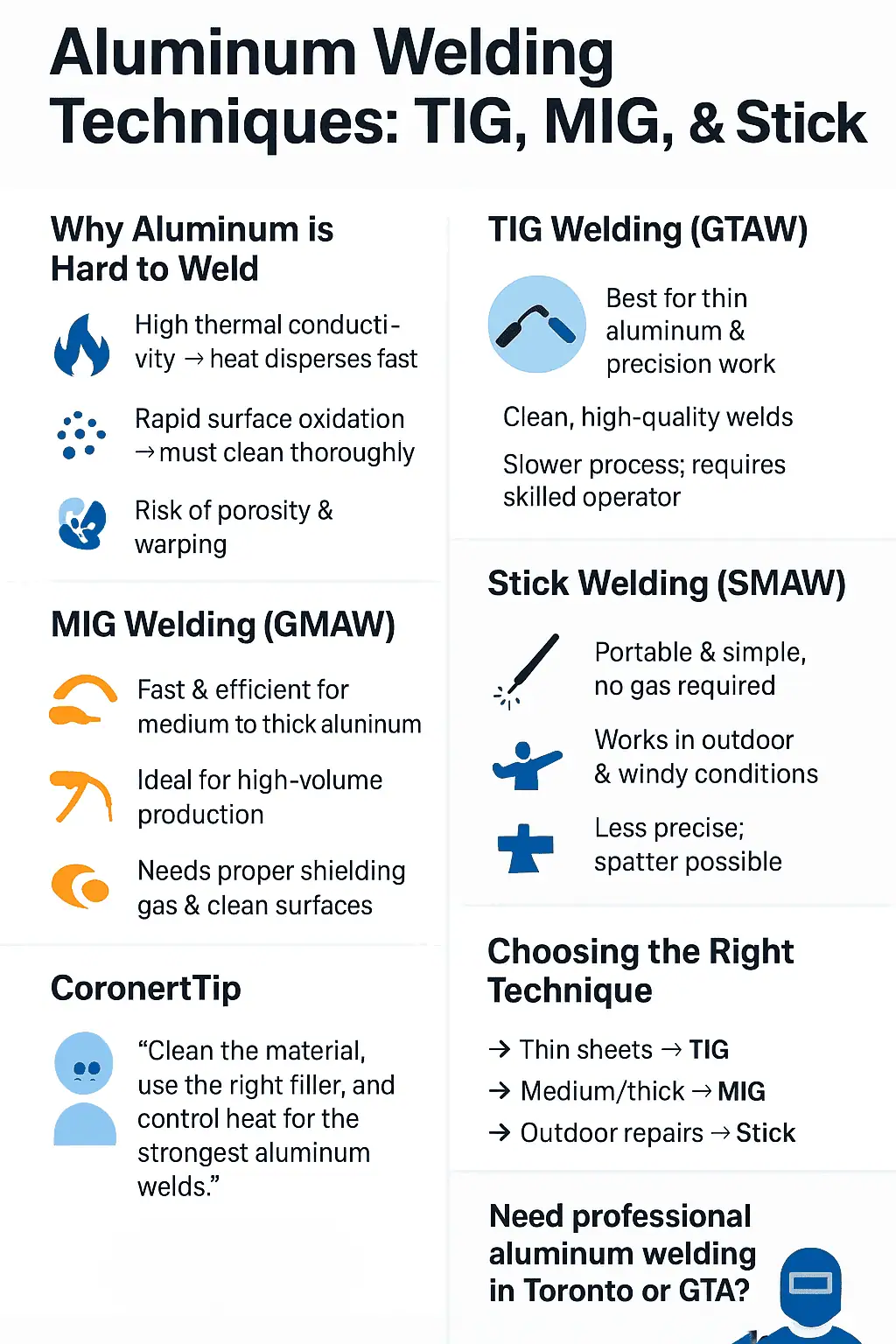
People sometimes ask why not use MIG welding or stick welding for aluminum. Here’s a quick comparison:
| Method | Aluminum Suitability | Control | Finish Quality |
|---|---|---|---|
| TIG Welding | Best for thin to thick | High | Excellent |
| MIG Welding | Good for thick | Medium | Fair |
| Stick Welding | Difficult, poor results | Low | Poor |
TIG welding gives the cleanest, strongest welds on aluminum, especially for thin parts and visible joints.
Advanced Tig Welding Aluminum Techniques
As you improve, you can use advanced techniques to get better results.
Using A Backing Plate
A backing plate is a thick piece of copper or aluminum placed under the weld area. It absorbs heat and prevents burn-through, especially on thin sheet metal. It also gives a smoother weld underside.
Weld Sequencing
For large or complex parts, weld in short sections and let the metal cool between passes. This reduces distortion and cracking.
Tack Welding
Before running long welds, place small tacks to hold the parts in place. Tacks prevent movement and keep the fit tight.
Using Pulse Tig
Pulse TIG alternates between high and low current. This helps control heat and makes it easier to weld thin aluminum without burning through.
Double-sided Welding
For thick aluminum, weld one side, then flip and weld the other. This ensures full penetration and a strong joint.
Cleaning The Tungsten Tip
If the tungsten becomes contaminated, stop and regrind it. A dirty tungsten causes an unstable arc and poor weld quality.
Mistakes Beginners Make When Tig Welding Aluminum
Many welders make the same mistakes at first. Knowing these can save you time and frustration.
- Poor Preparation: Not cleaning the metal or using the wrong brush causes contamination and weak welds.
- Incorrect Torch Angle: Holding the torch too flat or too upright can lead to poor shielding and uneven welds.
- Touching Tungsten to Workpiece: This contaminates the tungsten and the weld. Keep a steady hand and correct distance.
- Wrong Filler Rod: Using steel rods or the wrong aluminum alloy leads to cracks.
- Improper Heat Control: Too much or too little heat causes burn-through, warping, or weak joints.
- Ignoring Preheat Needs: Skipping preheat for thick material increases the risk of cracks.
- Poor Gas Coverage: Low gas flow, leaks, or drafts cause porosity.
- Fast Travel Speed: Moving too quickly results in narrow, weak welds.
- Not Practicing Enough: Aluminum TIG welding requires practice. Start with scrap pieces before moving to real projects.
Real-world Applications Of Tig Welding Aluminum
Aluminum TIG welding is used in many industries because of its strength and finish. Some common uses:
- Automotive: Welding panels, frames, and intake manifolds.
- Aerospace: Aircraft skins and structural parts.
- Bicycles: Lightweight frames.
- Food and Beverage: Clean welds for tanks and piping.
- Marine: Boats and docks that need corrosion resistance.
- Fabrication Shops: Prototyping and custom parts.
In each case, TIG welding gives precise, clean welds that last.

Credit: www.thefabricator.com
Safety Tips For Tig Welding Aluminum
Welding always involves risks. Aluminum TIG welding has its own safety points:
- UV Protection: Aluminum reflects UV rays. Always wear gloves, a proper welding helmet, and cover exposed skin.
- Ventilation: Welding produces fumes. Use fans or work in a well-ventilated area.
- Eye Safety: Even a quick glance at the arc can cause “arc eye.” Never weld without proper eye protection.
- Fire Safety: Keep flammable items away. Aluminum sparks are hot.
- Electrical Safety: Inspect cables and connections. Do not weld in wet conditions.
- Gas Cylinder Handling: Store argon tanks upright. Secure them to prevent falling.
How To Practice Tig Welding Aluminum
Improving your skills requires practice. Here are steps to get better:
- Start with Flat Joints: Practice on scrap aluminum in a flat position. Focus on forming a smooth puddle and feeding the rod.
- Try Different Thicknesses: Move to thicker and thinner pieces to learn heat control.
- Practice Different Joints: Butt joints, lap joints, and corner joints all behave differently.
- Check Your Welds: Look for even beads, no cracks, and no porosity.
- Keep a Log: Write down your machine settings, filler rod, and results. This helps repeat good results.
- Ask for Feedback: Show your welds to experienced welders or post photos in forums for advice.
Maintaining Your Tig Welder For Aluminum
A well-maintained machine gives better welds. Key maintenance steps:
- Clean the Torch: After each use, check the torch cup and tungsten for contamination.
- Inspect Cables: Look for cracks or wear in hoses and cables.
- Check Gas Flow: Test the regulator and lines for leaks.
- Replace Consumables: Change collets, cups, and tungsten as they wear out.
- Store Filler Rods Properly: Keep rods dry and clean. Moisture can cause porosity.
Environmental And Health Considerations
Aluminum welding is safer than welding coated steel, but it still produces fumes. Long-term exposure can cause health problems. Always weld in a ventilated area and use an exhaust hood if possible. Dispose of used cleaning rags and solvents according to local rules.

Credit: www.youtube.com
Where To Learn More
You can find more technical details and charts at the Wikipedia TIG welding page. Many community colleges and trade schools offer classes for hands-on practice.
Frequently Asked Questions
What Is The Best Tungsten Type For Tig Welding Aluminum?
Use pure tungsten (green) or 2% lanthanated (blue) electrodes for AC TIG welding. They give a stable arc and resist contamination. Pure tungsten is traditional, but lanthanated lasts longer.
Why Does Aluminum Need Ac For Tig Welding?
AC current removes the tough oxide layer on aluminum each cycle, allowing clean, strong welds. DC does not break up the oxide and leads to poor results.
How Do I Prevent Porosity In Aluminum Tig Welds?
Clean the metal and filler rod with acetone and a dedicated stainless steel brush. Use 100% argon shielding gas and keep your welding area free from drafts.
Can I Tig Weld Aluminum With A Dc-only Welder?
No. You need a TIG welder with AC capability for aluminum. DC is only for some rare alloys and produces poor welds on most aluminum.
What Is The Best Filler Rod For Welding 6061 Aluminum?
4043 is the most common and easiest to use for 6061 aluminum. It gives smooth, crack-free welds. For higher strength, use 5356.
Mastering TIG welding aluminum is a journey. With the right setup, practice, and attention to detail, you can produce strong, beautiful welds. This skill opens the door to many creative and practical projects, from cars to art. With patience and care, you can join the many welders who make aluminum TIG welding look easy.