Disclosure: This post contains affiliate links and I will be compensated if you make a purchase after clicking through my links. Learn More
Vertical down stick welding is a skill that many welders need for fast and efficient work on thin steel. Choosing the right rod makes a big difference in weld quality, speed, and ease. For beginners and experienced welders alike, the rod choice is not obvious.
The wrong rod can cause poor penetration, burn-through, too much spatter, or weak joints. This guide explains which rods work best for vertical down stick welding, why they work, and how to get the best results.
You will learn about common rods like 6010, 6011, and 6013. You will also see how rod diameter, coating, and current settings affect your welds. The article covers practical tips, mistakes to avoid, and how to match the rod to your project.
By the end, you will have a clear answer to which rod is best for vertical down stick welding, plus a deeper understanding of how to choose and use rods for this challenging position.
What Is Vertical Down Stick Welding?
Vertical down stick welding is a process where the welder moves the rod downward along a vertical joint. This position is often called “vertical down” or “downhill. ” The movement is from top to bottom, which is faster than vertical up welding.
Many welders use this method for thin metal because it produces less heat and reduces the chance of burning through the material.
This position is common in pipe welding, structural work, and repairs. It is important in industries where speed and efficiency matter. But it also has challenges. Gravity pulls the molten metal down, so control is harder. The right rod helps control the weld pool and avoids problems.
Why Not Use Any Rod?
Not all stick welding rods give good results for vertical down. Some rods are too slow-freezing, so the molten metal sags or falls. Others create too much heat, which makes holes in thin steel. The best rod needs the right balance: fast enough to keep up with gravity, but not so fast that the weld is weak or porous.
Common Stick Welding Rods For Vertical Down
Choosing the rod is the most important step for vertical down stick welding. Each rod has a number that tells you about its use, strength, and coating. Here are the most used rods:
6010 Rod
The 6010 rod is a favorite for many professional welders. It has a high cellulose sodium coating. This rod is known for deep penetration and a fast-freeze puddle, which means the molten metal hardens quickly.
- Main use: Pipe welding, root passes, repair work
- Advantage: Good for dirty or rusty steel
- Current: DC only
Welders pick 6010 for vertical down because it makes a strong, narrow bead. The fast freeze helps control the weld pool, even when working quickly. One challenge is that 6010 is not easy for beginners. It needs a steady hand and good rod angle.
6011 Rod
The 6011 rod is similar to 6010, but it works on both AC and DC machines. It has a high cellulose potassium coating.
- Main use: Farm equipment, repair, thin steel
- Advantage: Good for old or painted steel, works with AC
- Current: AC or DC
6011 also has a fast-freeze puddle, so it works well in vertical down. Many hobby welders use 6011 because their machines do not have DC capability. The bead is similar to 6010, but sometimes a bit rougher.
6013 Rod
The 6013 rod is a good choice for thin sheet metal and small projects. It has a rutile coating, which makes it easy to use and creates a smooth bead.
- Main use: Sheet metal, auto body, light fabrication
- Advantage: Easy to start and run, good appearance
- Current: AC or DC
6013 is less deep-penetrating than 6010 or 6011. This makes it safer for thin steel, but less strong for thick joints. The slag removes easily, and the arc is stable. Beginners often start with 6013 because it is forgiving.
7018 Rod
The 7018 rod is famous for strong, high-quality welds. It has a low-hydrogen coating, which gives strong, ductile welds with little cracking.
- Main use: Structural steel, pressure vessels
- Advantage: High strength, smooth bead
- Current: AC or DC
7018 is usually not the first choice for vertical down. The puddle is slower to freeze, so it can sag in this position. Most welders use 7018 for vertical up, where the bead builds on itself. Still, some skilled welders use 7018 vertical down on thicker steel, but it takes more practice and control.
7014 Rod
The 7014 rod is a rutile iron powder rod. It is easy to use and gives a smooth bead.
- Main use: General fabrication, farm equipment
- Advantage: High deposition rate, easy slag removal
- Current: AC or DC
7014 is not common for vertical down, but it can work on flat or horizontal positions. The iron powder makes the bead wider and gives more metal.
How Rod Numbers Matter
Each rod number tells you about its properties. For example, 6010 means:
- “60” = 60,000 psi tensile strength
- “1” = weld in any position
- “0” = type of coating and current
The last two numbers are the most important for vertical down. Numbers ending in 10 or 11 mean fast-freeze rods, which help in vertical down. Numbers ending in 13 or 14 are easier to use, but not as deep penetrating.
Rod Comparison For Vertical Down
To help you see the differences, here is a simple comparison:
| Rod | Current | Penetration | Ease of Use | Best for |
|---|---|---|---|---|
| 6010 | DC | Deep | Hard | Pipe, repair |
| 6011 | AC/DC | Deep | Medium | Farm, repair |
| 6013 | AC/DC | Medium | Easy | Sheet metal |
| 7018 | AC/DC | Medium-Deep | Medium | Structural |
| 7014 | AC/DC | Medium | Easy | General |
The Best Rod For Vertical Down Stick Welding
For most jobs, 6010 and 6011 rods are the top picks for vertical down. They handle thin steel well, freeze quickly, and give good penetration. If you use a DC machine, 6010 is the best. If you need AC, use 6011.
Why 6010 And 6011 Stand Out
Both rods give a fast, narrow bead that is less likely to sag or drip. Their fast-freeze action means you can move quickly and still get a strong joint. They also clean the steel as you weld, so rust and paint are less of a problem.
These rods are used in pipelines, farm repairs, and structural work where vertical down is needed.
When To Choose 6013
If your metal is very thin or you want a nice-looking bead, 6013 is a good option. It is less likely to burn through, and the slag is easy to remove. Many hobby welders use 6013 for car repairs, sheet metal, and small projects.
When To Try 7018
Advanced welders may use 7018 vertical down on thick steel, but it is not the best choice for most. The bead can sag if you move too slowly. If you need strong welds and have good control, you can practice with 7018, but expect a steeper learning curve.
Rod Diameter: Does Size Matter?
Rod diameter is as important as rod type. For vertical down, smaller diameters are better for thin steel and small joints. Larger rods add more metal, which is good for thick steel.
- 3/32” (2.4mm): Best for thin metal (under 1/8″), less chance of burn-through
- 1/8” (3.2mm): Common for general work, good balance of speed and control
- 5/32” (4.0mm) or larger: For thick steel, heavy welds
If you use a rod that is too big, you can melt holes in thin steel. If it is too small, you may not get enough metal in the joint. Always match the rod size to your metal thickness and the job needs.
Rod Diameter And Amperage
Each rod size needs the right current (amperage) to work well. Too much current will cause spatter and holes. Too little will make the rod stick and give a poor weld. Here is a simple guide:
| Rod Size | Amperage Range (A) | Best For |
|---|---|---|
| 3/32” | 40-90 | Sheet metal |
| 1/8” | 75-140 | General steel |
| 5/32” | 110-180 | Thick steel |
Rod Coating And Its Role
The rod coating, or flux, is a key factor in vertical down stick welding. It affects the arc, slag, and weld quality. There are three main types:
- Cellulose coating (6010, 6011): Fast-freeze, deep penetration, best for vertical down.
- Rutile coating (6013, 7014): Easy to use, smooth bead, medium penetration.
- Low-hydrogen coating (7018): Strong, ductile welds, slow-freeze, not ideal for vertical down.
A fast-freeze coating is best for vertical down. It lets you move quickly without the metal sagging.
Rod Storage And Handling
Poor rod storage can ruin your welds. Moisture in the coating causes porosity and weak joints. Keep rods in a dry, sealed container. For low-hydrogen rods like 7018, use a rod oven if possible.
Never use wet or rusty rods. If you are unsure, buy small packs and use them quickly.
Credit: www.wcwelding.com
Welding Technique For Vertical Down
Even the best rod will not save you if your technique is weak. Here are steps for success:
- Set the right amperage: Start at the low end of the range for your rod size.
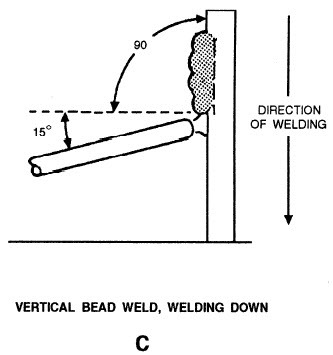
- Use a slight drag angle: Point the rod tip down, about 15-20° ahead of vertical.
- Keep a short arc: Stay close, but do not let the rod stick.
- Move fast: Vertical down needs speed. Move smoothly and steadily down the joint.
- Watch the puddle: Keep the puddle small and in front of the slag.
- Do not weave: Use a straight-down or slight zig-zag motion. Wide weaves cause sagging.
Example: Welding Thin Sheet Metal
Suppose you are welding two pieces of 16-gauge steel. Use a 6011 rod, 3/32” diameter, and set your welder to about 60 amps. Hold the rod at a 15° angle, start at the top, and move down quickly. Do not pause, or you will burn through.
Keep your arc short and watch the puddle for a smooth bead.
Common Mistakes In Vertical Down Stick Welding
Even experienced welders make errors in vertical down. Here are some to avoid:
- Moving too slowly: Causes large, saggy beads and burn-through.
- Using the wrong rod: Some rods are too slow-freezing or too hot for thin steel.
- Too much weaving: Makes the bead wide and weak.
- Wrong amperage: High amps cause spatter, low amps make the rod stick.
- Dirty steel: Rust, oil, or paint under the weld cause porosity.
Matching Rod To Project Type
Different jobs need different rods and settings. Here are some examples:
Thin Sheet Metal
Use 6011 or 6013, small diameter, low amps. Move fast to avoid burn-through.
Farm Equipment Repair
6011 is a good choice, as it works on dirty steel and AC machines. Use 1/8” rod for most repairs.
Pipe Welding
Professional pipe welders often use 6010 for the root pass. It gives deep penetration and a strong joint.
Structural Steel
7018 is common for vertical up, but skilled welders may use 6010 or 6011 vertical down for the root and fill passes.
Rod Quality: Does Brand Matter?
Rod quality can change the welding experience. Cheap rods sometimes have inconsistent coatings or poor arc stability. Trusted brands like Lincoln Electric, Hobart, and ESAB usually give better results. If your welds have problems and your settings are correct, try a different brand.

Credit: www.reddit.com
Safety Tips For Vertical Down Stick Welding
Vertical down welding can throw sparks and hot slag. Always wear:
- Welding helmet: Shade 10 or higher for stick welding.
- Gloves: Protect hands from heat and sparks.
- Long sleeves and pants: Flame-resistant material.
- Proper boots: No open shoes or sneakers.
Work in a well-ventilated area. Stick welding makes fumes, so use a fume extractor or work outside if possible.
Practice And Skill Development
Vertical down welding is fast but unforgiving. Practice is key. Start on scrap pieces. Work on steady rod movement and arc length. Try different rods and settings until you find what works best.
If you want to learn more, many welding schools and online resources offer detailed guides and videos. The Wikipedia page on SMAW is a good place to start.
Vertical Down Vs. Vertical Up
Some welders ask if vertical up is better than vertical down. Both have a place:
- Vertical down: Faster, better for thin steel, less heat input.
- Vertical up: Stronger, better for thick steel, more control of bead shape.
For structural work and heavy joints, vertical up is often required by code. For sheet metal and fast work, vertical down is preferred.
Choosing The Right Machine Settings
Rod choice is only half the battle. Set your welding machine for best results:
- Use DC+ for 6010, DC or AC for 6011 and 6013.
- Start at the low end of the amp range for your rod size.
- Adjust as needed for bead appearance and penetration.
If your bead is too high, turn up the amps. If you get spatter or burn-through, turn them down.

Credit: www.wcwelding.com
Advanced Tips For Better Results
- Clean the joint: Even though 6010 and 6011 can handle rust, a clean surface gives a better weld.
- Stagger your passes: If welding a long joint, let the piece cool between passes to avoid warping.
- Test your welds: Bend or hammer test scrap joints to check strength before starting on your real project.
Non-obvious Insights
- Rod angle control: Many beginners hold the rod too steep or too flat. Keeping a consistent 15-20° angle helps control the puddle and avoids defects.
- Amperage fine-tuning: Small changes in amperage (5-10 amps) can have a big effect, especially on thin steel. Do not be afraid to adjust as you weld.
Rod Storage For Best Results
Humidity ruins rods, especially 7018. Use sealed containers or rod ovens for long-term storage. Even 6010 and 6011 can get damp, which affects arc stability.
If your rod makes a “popcorn” sound or the coating flakes off, it is likely damp. Discard and use fresh rods.
Troubleshooting Guide
If your weld does not look right, check these causes:
- Porous bead: Rod is damp, steel is dirty, or amps are too low.
- Bead sags: Moving too slowly, amps too high, or wrong rod.
- Rod sticks: Amps too low, arc too short, or dirty surface.
- Spatter: Amps too high, rod angle wrong.
Making small changes often solves the problem. Try different rods, angles, or settings.
Cost And Availability
6010, 6011, and 6013 rods are cheap and easy to find at hardware stores and welding suppliers. 7018 is a bit more expensive and may need special storage. Most welding supply shops stock these rods in various diameters.
Environmental Factors
Welding outdoors or in humid conditions can change rod performance. Damp rods create poor arcs and porosity. Wind can blow away the arc shield, causing defects. Try to weld indoors or shield your work from the wind.
Summary Table: Which Rod To Use When
Here is a quick reference for common jobs:
| Project Type | Best Rod | Rod Size | Amperage |
|---|---|---|---|
| Thin sheet metal | 6011, 6013 | 3/32” | 50-80 |
| Farm equipment | 6011 | 1/8” | 90-120 |
| Pipe root pass | 6010 | 1/8” | 80-110 |
| Structural steel | 7018 (vertical up) | 1/8” | 110-130 |
| General repair | 6011 | 1/8” | 90-130 |
Final Advice
For vertical down stick welding, 6010 and 6011 are the best rods for most jobs, especially on thin or dirty steel. Use the smallest rod that fits your joint. Set your machine at the low end of the amp range and keep your movement steady and fast. Practice on scrap to build skill and confidence.
6013 works well for smooth beads on thin metal. Try 7018 only if you have experience and need extra strength. Always use good safety gear, store rods dry, and adjust your technique for the best results.
Stick welding in vertical down is a skill you can master with the right rod and practice. Keep learning, and you will get faster, better, and more confident with every weld.
Frequently Asked Questions
What Is The Difference Between 6010 And 6011 Rods For Vertical Down Welding?
6010 works only on DC and gives a deep, narrow bead with a fast-freeze puddle. 6011 works on both AC and DC and is more forgiving with old or painted steel. Both are good for vertical down, but 6011 is often used on smaller, AC-only welders.
Can I Use 7018 Rods For Vertical Down Stick Welding?
You can use 7018 vertical down, but it is harder to control. The puddle freezes slowly and can sag. Most welders use 7018 for vertical up or flat welds. Only try 7018 vertical down if you have good skill and thick steel.
What Amperage Should I Use For Vertical Down Stick Welding?
Start at the low end of the recommended range for your rod size. For example, 3/32” rods use 40-90 amps, and 1/8” rods use 75-140 amps. Adjust as needed for good bead shape and penetration.
Why Does My Bead Sag Or Drip When Welding Vertical Down?
Your movement may be too slow, your rod angle too flat, or your amperage too high. Use a fast-freeze rod (6010 or 6011), keep a short arc, and move quickly down the joint.
How Do I Prevent Burn-through On Thin Steel In Vertical Down?
Use a small diameter rod (3/32”), set low amperage, and move quickly. 6011 and 6013 are good choices for thin steel. Do not pause or weave the bead, and keep your arc short.
With these tips, you can pick the best rod for vertical down stick welding and get strong, neat welds every time.