Disclosure: This post contains affiliate links and I will be compensated if you make a purchase after clicking through my links. Learn More
Metal Inert Gas (MIG) welding is one of the most common welding methods in factories, workshops, and repair shops. It shapes cars, builds bridges, and repairs home equipment. Many people know the term MIG welding, but few understand how it works or why it became so popular.
If you want to learn about MIG welding, this guide explains everything in clear language.
What Is Mig Welding?
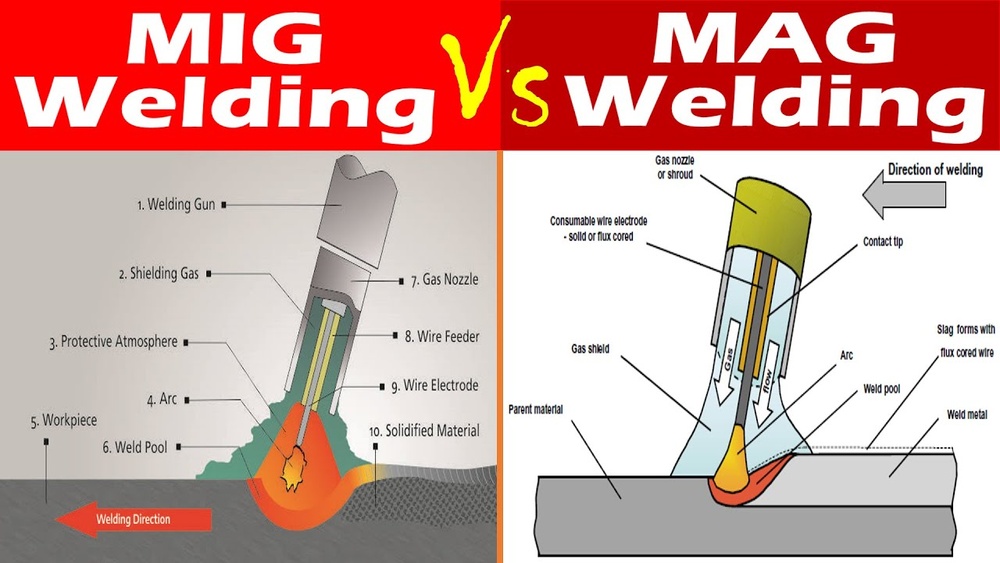
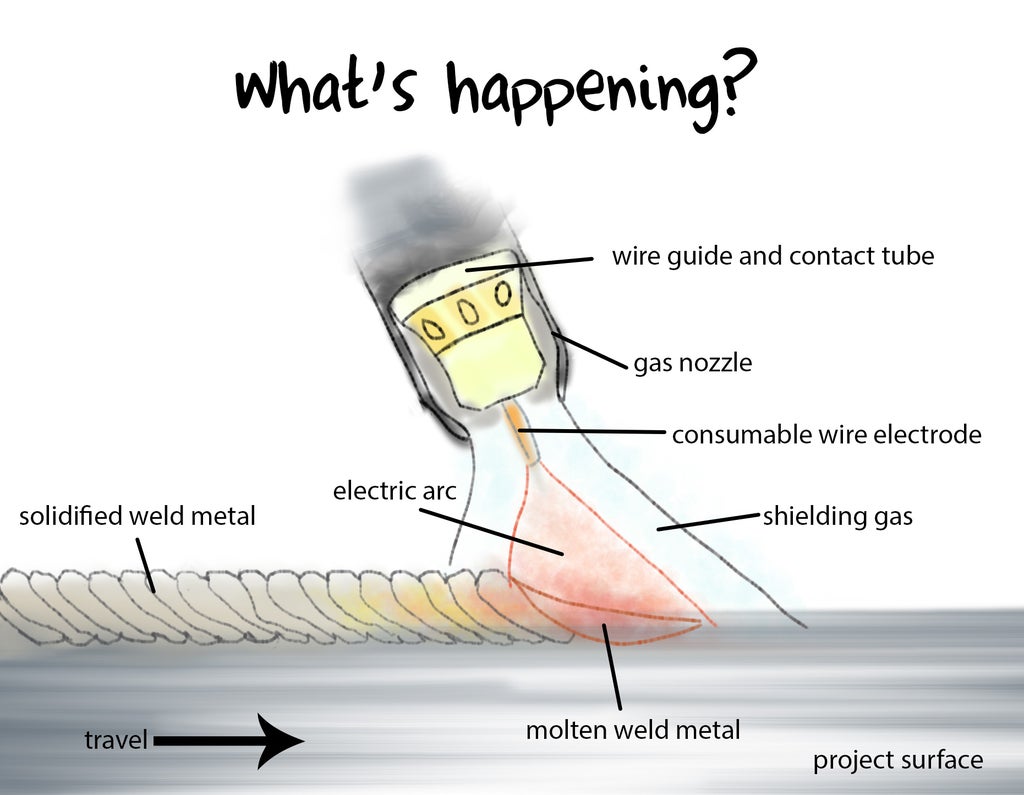
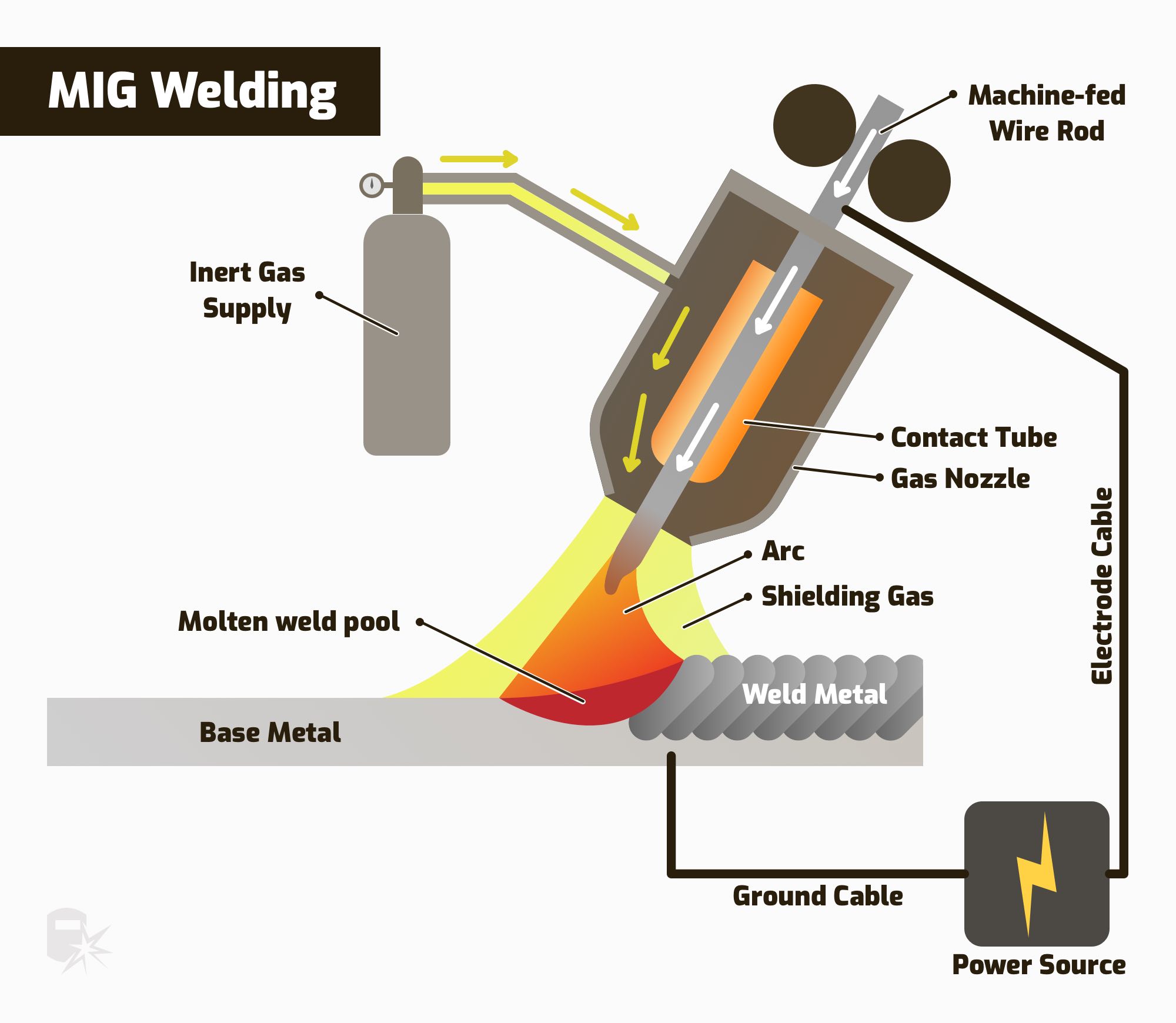
MIG welding means Metal Inert Gas welding. Some people also call it Gas Metal Arc Welding (GMAW). This process uses electricity to join metal pieces. A wire feeds through a special gun, melts, and fills the gap between metals. The welder holds the gun and controls the weld.
The “inert gas” part is important. The gun sprays gas over the weld to protect it from air. Without this gas, air would mix with the hot metal and make the weld weak or full of holes. Most people use argon or a mix of argon and carbon dioxide as the gas.
MIG welding works on many metals: steel, stainless steel, and aluminum. It is fast, clean, and easy to learn. Because of these strengths, factories and hobby welders both use MIG welding every day.
A Brief History Of Mig Welding
MIG welding is not new. Engineers first used it during World War II. They needed a fast way to build airplanes, tanks, and ships. The process grew popular because it could join aluminum and other light metals quickly.
In 1948, the Battelle Memorial Institute in the USA developed the modern MIG welding system. Early machines used only argon gas, but later, welders tried argon mixed with carbon dioxide for steel. This change made the process cheaper and more flexible.
Today, MIG welding is everywhere: car factories, shipyards, construction sites, and home garages.
Credit: www.instructables.com
Key Parts Of A Mig Welding System
A MIG welder is more than just a gun and some wire. Several parts must work together to make a safe, strong weld.
- Welding Power Source: This machine creates the electricity needed for welding. Most MIG welders use “constant voltage,” usually 110V, 220V, or 240V.
- Wire Feed System: This motor pulls welding wire from a spool and pushes it through the gun.
- Welding Gun: The welder holds this gun. It sends the wire, electricity, and shielding gas to the weld.
- Ground Clamp: This clamp connects to the metal being welded. It completes the electric circuit.
- Shielding Gas Cylinder: This tank holds the gas that protects the weld from the air.
- Regulator and Gas Hose: These parts control how much gas flows to the gun.
Each part is important. If one fails, the weld will not turn out right.
How Mig Welding Works: The Process Step By Step
MIG welding looks simple, but each step is important for safety and quality. Here’s how it usually works:
- Prepare the Metal: Clean the metal surface. Remove rust, paint, and oil. Dirty metal leads to weak welds.
- Set Up the Welder: Choose the correct wire type, wire size, and gas. Set the voltage and wire speed on the machine.
- Attach the Ground Clamp: Clip it to a clean part of the metal.
- Hold the Gun: Point the tip of the gun at the spot you want to weld. Keep the gun at a 10–15 degree angle.
- Press the Trigger: The wire feeds out, electricity flows, and the gas sprays out.
- Create the Weld: Move the gun slowly along the joint. The wire melts and fills the gap.
- Finish the Weld: Release the trigger. The wire stops, but gas will still flow for a moment to protect the hot weld.
If you follow these steps, you get a strong, neat weld.
What Makes Mig Welding Popular?
MIG welding is everywhere because it offers some big advantages:
- Speed: MIG welding is faster than stick welding or TIG welding.
- Ease of Use: Beginners can learn basic MIG welding in a few hours.
- Clean Welds: The gas keeps air away, so there is less spatter and cleanup.
- Versatility: Welders can join thin or thick metal, even aluminum.
- Continuous Welds: The wire feeds automatically, so you can make long welds without stopping.
These strengths make MIG welding the top choice for car repairs, home projects, and large factories.
Mig Welding Vs. Other Welding Types
Many people want to know how MIG welding compares with other methods. Here is a simple side-by-side view using common welding types.
| Welding Type | Shielding Method | Skill Level | Speed | Common Uses |
|---|---|---|---|---|
| MIG (GMAW) | External gas | Easy | Fast | Car repair, fabrication |
| TIG (GTAW) | External gas | Hard | Slow | Aerospace, art, thin metals |
| Stick (SMAW) | Flux coating | Medium | Medium | Construction, repairs |
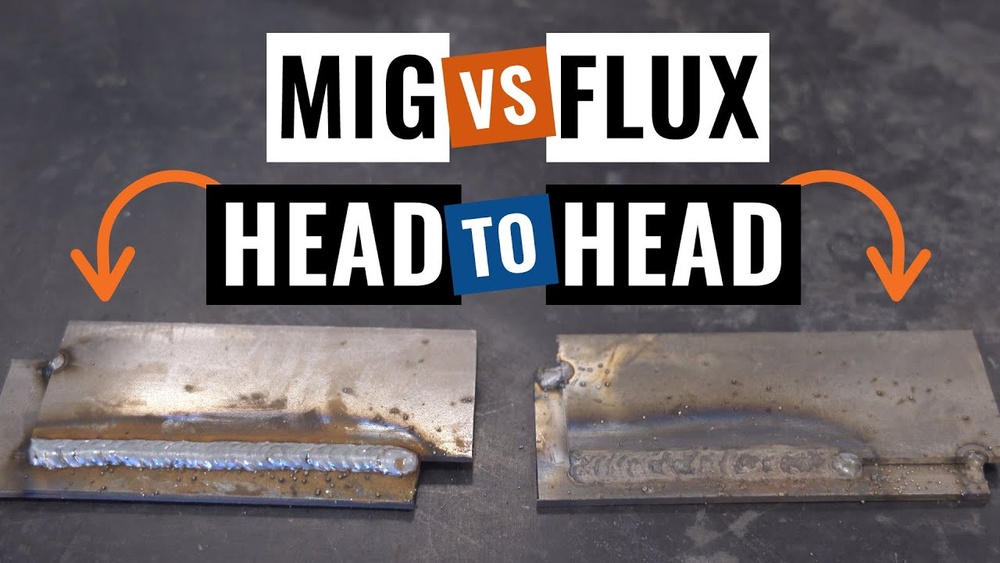
| Flux-Cored (FCAW) | Flux core in wire | Easy | Fast | Outdoor work, thick steel |
MIG welding is the easiest to learn and use for most people. TIG welding makes the nicest-looking welds but takes more skill and time. Stick welding works well outside but is messier.
The Main Types Of Mig Welding
There are two main types of MIG welding, and each one fits different jobs.
- Bare Wire MIG Welding: This uses a plain wire and an external gas. It is common for clean, new metal. Most car repairs and home welding use bare wire.
- Flux-Cored MIG Welding: The wire has flux powder inside. It makes its own gas when melted, so you do not always need an external gas tank. This method works better outside or on dirty metal.
Some MIG welders can switch between both types by changing the wire and settings.
Choosing The Right Mig Welding Wire
The wire is the main ingredient in MIG welding. The right choice depends on the metal and the job.
- For mild steel, use ER70S-6 wire. It comes in sizes like 0.023″, 0.030″, 0.035″, and 0.045″.
- For stainless steel, use ER308 or ER316 wire.
- For aluminum, use ER4043 or ER5356 wire.
Thinner wire is good for thin metal. Thicker wire works on heavy steel. Always match the wire to the metal you are joining.
Shielding Gas Choices In Mig Welding
Shielding gas keeps the weld clean and strong. The most popular gases are:
- 100% Argon: Good for aluminum and TIG welding.
- 75% Argon / 25% CO2: The most common mix for steel. It makes smooth welds with little spatter.
- 100% CO2: Cheaper, gives deeper welds, but makes more spatter.
Some welders use helium or oxygen in small amounts for special jobs. Always use the right gas for your wire and metal.
Mig Welding Power Settings
MIG welders let you adjust two key settings: voltage and wire feed speed.
- Voltage controls how hot the weld gets. More voltage means more heat.
- Wire feed speed changes how fast the wire feeds out of the gun.
You must match these settings to the metal thickness. Too little heat makes a weak weld. Too much melts through the metal. Most welders include a chart showing the best settings for each job.
How To Set Up A Mig Welder
A good setup makes welding easier and safer. Here is what you need to do before starting:
- Place the welder on a flat, stable surface.
- Install the wire spool and feed it through the gun.
- Connect the gas cylinder to the machine and set the flow rate (usually 20–25 cubic feet per hour).
- Attach the ground clamp to clean metal.
- Plug in the welder and turn it on.
- Set the voltage and wire speed based on the metal thickness and wire size.
Check all connections before welding. Leaks or loose wires can cause problems.
Mig Welding Techniques For Beginners
Anyone can pull the trigger, but skill improves the weld. Here are basic techniques:
- Gun Angle: Hold the gun at a 10–15 degree angle toward the weld.
- Travel Speed: Move the gun slowly and steadily. Too fast leaves holes. Too slow builds up too much metal.
- Stickout: Keep 1/4 to 1/2 inch of wire sticking out from the tip.
- Weaving: For wide joints, move the gun in a small zigzag.
Practice on scrap metal before working on a real project.
Common Problems And How To Fix Them
MIG welding is simple, but mistakes are common. Here are some frequent issues and solutions.
- Porosity: Small holes in the weld. Cause: not enough gas or dirty metal. Fix: Clean metal, increase gas flow.
- Burn-Through: Hole in the metal. Cause: too much heat or slow travel. Fix: Lower voltage, move faster.
- Wire Jamming: Wire stops feeding. Cause: kinked liner or too much tension. Fix: Check the liner, adjust tension.
- Spatter: Drops of melted metal around the weld. Cause: wrong gas or settings. Fix: Use the right gas mix, adjust settings.
Always check your work and adjust as needed.
Safety Tips For Mig Welding
MIG welding is safer than some methods, but it still has risks. Always follow these rules:
- Wear a welding helmet with a proper shade lens.
- Use welding gloves and a long-sleeve shirt to stop burns.
- Work in a space with good ventilation.
- Keep a fire extinguisher nearby.
- Never weld near flammable liquids or gases.
Welding can cause eye damage, burns, and fires if done carelessly.
Essential Mig Welding Equipment And Accessories
Besides the welder and gas, you need some basic tools for safe and clean welding.
- Welding helmet with auto-darkening lens
- Welding gloves and flame-resistant jacket
- Wire brush and grinder to clean metal
- Chipping hammer to remove slag (for flux-cored welding)
- Clamps to hold metal pieces together
- Measuring tape and marker for accurate work
Good tools make a big difference in weld quality.
Mig Welding On Different Metals
MIG welding works on many metals, but each one has special needs.
Welding Mild Steel
This is the easiest metal for MIG welding. Use ER70S-6 wire and argon/CO2 gas. Clean the metal before welding.
Welding Stainless Steel
Use stainless steel wire and a gas mix with more argon. Stainless steel heats up fast, so use lower voltage.
Welding Aluminum
Aluminum needs 100% argon gas and special wire. You must use a “spool gun” to feed the wire, or it will jam. Aluminum melts quickly, so practice first.
Welding Other Metals
You can MIG weld copper, bronze, or magnesium, but these are rare. Each one needs the right wire and gas.
Credit: weldguru.com
Mig Welding Joints And Positions
Welders must join metal in many ways. MIG welding works for all common joints:
- Butt joint: Metal edges face each other.
- Lap joint: One piece overlaps the other.
- T-joint: Pieces form a “T” shape.
- Corner joint: Pieces meet at a corner.
- Edge joint: Edges line up side by side.
You can weld in several positions: flat, horizontal, vertical, and overhead. Flat is easiest. Overhead is hardest and takes more skill.
Mig Welding Settings For Different Metal Thicknesses
Finding the right settings for your project is important. Here’s a quick reference for steel using 0. 030″ wire and argon/CO2 gas.
| Metal Thickness (inches) | Voltage (Volts) | Wire Speed (ipm) | Gas Flow (CFH) |
|---|---|---|---|
| 1/16 | 16–17 | 220–260 | 20–25 |
| 1/8 | 18–19 | 300–350 | 20–25 |
| 1/4 | 20–21 | 400–450 | 20–25 |
| 3/8 | 22–24 | 480–520 | 20–25 |
Always test on scrap metal before starting your final weld.
Pros And Cons Of Mig Welding
MIG welding is powerful, but it is not perfect. Here are some main pros and cons.
Pros
- Fast and efficient for most jobs
- Easy for beginners to learn
- Clean welds with little spatter
- Works on thin and thick metals
- Good for long, continuous welds
Cons
- Needs clean metal for best results
- Not ideal for outdoor work (wind blows away gas)
- Equipment is more expensive than stick welding
- Gas cylinders are heavy and must be handled with care
Knowing both sides helps you decide if MIG welding fits your needs.
Tips For Better Mig Welding Results
Even small changes can improve your work. Here are some tips that most beginners miss:
- Keep your tip clean: Spatter builds up on the gun tip and blocks the wire. Clean it often.
- Check your gas flow: Too little gas lets air in. Too much wastes gas and causes turbulence.
- Use proper extension cords: A thin cord can cause voltage drop and weak welds.
- Replace worn parts: The contact tip and liner wear out over time. Change them for smooth welding.
- Store wire dry: Moisture causes rust, which leads to bad welds.
Attention to detail leads to better, stronger welds.
Mig Welding In Industry
Many industries rely on MIG welding every day. Here are some examples:
- Automotive: Car frames, exhausts, and body panels are MIG welded for speed and strength.
- Construction: Steel beams and supports use MIG welding for quick assembly.
- Shipbuilding: MIG welding helps build large ships from thick steel plates.
- Manufacturing: Factories use robots with MIG welders for mass production.
MIG welding’s speed and repeatability make it a top choice for all these jobs.
The Future Of Mig Welding
MIG welding continues to improve. New machines offer more precise settings, smart sensors, and even automatic adjustments. Some welders connect to computers or smartphones for easier setup.
Robots now use MIG welding in large factories, building cars and machines 24 hours a day. These advances mean more jobs, better safety, and higher quality.
But basic skills remain important. Good welders are always needed.
Learning Mig Welding: How To Start
Anyone can learn MIG welding with practice and the right tools. Most people start in high school shop class or at a trade school. You can also find online videos and classes.
Practice is the key. Start with small projects and work up to bigger jobs. Always focus on safety and quality.
Cost Of Mig Welding
The cost of MIG welding depends on the equipment, gas, and wire.
- A small hobby MIG welder costs $200–$500.
- A gas cylinder (full) is $50–$100.
- Wire costs $20–$40 per spool.
- Safety gear (helmet, gloves, jacket) is $100–$200.
Professional machines for large jobs cost much more. But for home use, the price is affordable.
Environmental Impact Of Mig Welding
MIG welding produces fumes and uses gases made in factories. Always weld in a well-ventilated area. Some gases, like argon, are safe, but others (like pure CO2) can build up indoors.
Some companies use recycling programs for old wire and gas cylinders. Technology continues to make welding greener and safer.
Practical Examples Of Mig Welding Projects
MIG welding is not just for factories. Here are some projects you can try at home or in a workshop:
- Build a metal table or chair frame
- Repair a broken car fender
- Make a custom bike rack
- Restore a garden gate
- Join metal art pieces
Each project teaches new skills and builds confidence.
Common Mistakes Beginners Make
Most new welders repeat some common errors. Watch for these:
- Using the wrong wire or gas for the metal
- Not cleaning the metal well enough
- Moving the gun too fast or too slow
- Not checking settings before starting
- Forgetting safety gear
Fixing these problems early saves time and money later.
How To Troubleshoot Mig Welding Problems
If your welds look bad, do not give up. Here’s how to find and fix problems:
- Weld is too tall: Lower wire speed or move gun slower.
- Weld is too flat: Raise voltage or use thicker wire.
- Gaps or cracks: Clean the metal and check for drafts blowing away gas.
- Wire burns back into tip: Reduce wire speed or check for a blocked tip.
Patience and careful checking solve most issues.
Mig Welding Certification And Careers
Many jobs require welders to have a certificate. You can earn this at a trade school, community college, or through work. Certified MIG welders can work in car repair, shipbuilding, construction, and factories.
Pay depends on skill and location. In the US, the average welder earns $44,000 per year. Skilled welders can earn much more.
Find more information about welding careers at the Wikipedia Welder page.
Frequently Asked Questions
What Does Mig Stand For In Welding?
MIG stands for Metal Inert Gas. It describes the process of using a wire and an inert gas to join metal pieces.
What Is The Difference Between Mig And Tig Welding?
MIG welding uses a wire that feeds automatically and is easy to learn. TIG welding uses a hand-held rod and is much slower and harder. TIG welding makes neater welds but takes more practice.
Can I Use Mig Welding Outdoors?
You can, but wind can blow away the gas that protects the weld. For outdoor work, use flux-cored wire or shield the area from the wind.
Is Mig Welding Safe For Beginners?
Yes, if you use proper safety gear and follow rules. Always wear a helmet, gloves, and work in a well-ventilated area.
What Metals Can Mig Welding Join?
MIG welding works on steel, stainless steel, aluminum, and some other metals. Each metal needs the right wire and gas.
MIG welding is fast, flexible, and easy to learn. With the right tools and practice, anyone can create strong, neat welds for work or home projects. Start small, stay safe, and build your skills step by step.
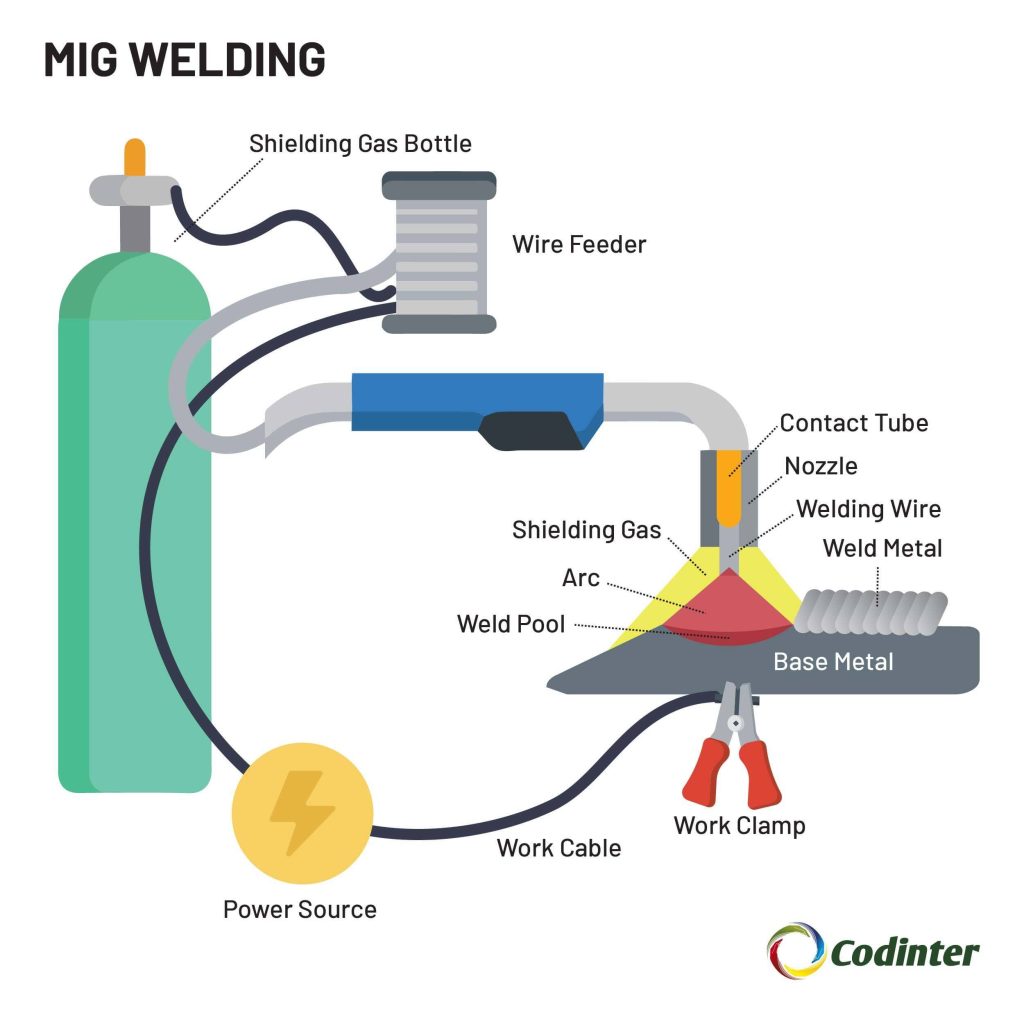
Credit: www.codinter.com