Disclosure: This post contains affiliate links and I will be compensated if you make a purchase after clicking through my links. Learn More
MIG and TIG welding are two of the most popular methods for joining metal. Each method has its own strengths, weaknesses, and specific uses. Many people want to know which one is better, but the right choice depends on your project, skill level, and type of metal.
This article explains MIG vs TIG welding in detail, covering how each works, their differences, best uses, costs, and what you need to know before you start. Whether you are a hobbyist, a student, or a professional, you will find clear explanations and practical insights here.
What Is Mig Welding?
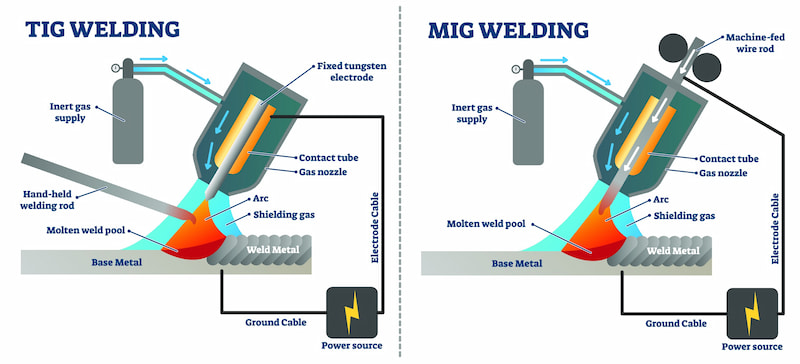
MIG welding stands for Metal Inert Gas welding. Some people also call it GMAW (Gas Metal Arc Welding). In MIG welding, a wire electrode feeds through a welding gun and melts to join two pieces of metal. A shielding gas protects the weld from air, keeping it clean and strong.
MIG welding is popular because it is easy to learn and works fast. Most car factories, metal workshops, and even some home garages use MIG welders for many jobs. You can weld thin steel, aluminum, and even some stainless steel with the right setup.
How Mig Welding Works
- The machine feeds a solid wire through the welding gun automatically.
- The welder pulls the trigger, and the wire melts as it touches the metal.
- The machine also releases a shielding gas (often a mix of argon and CO2) to protect the weld.
- The melted wire forms a pool, which cools and becomes the joint.
MIG welding is usually semi-automatic. The machine handles the wire feed and gas, while you control the gun movement.
Common Uses For Mig Welding
MIG is great for:
- Car repairs: It quickly welds car body panels and frames.
- General fabrication: Many workshops use MIG for making tables, frames, and gates.
- Home projects: DIYers often pick MIG for making shelves, carts, and repairs.
- Production welding: Factories use robotic MIG welders because it is fast and repeatable.
Benefits Of Mig Welding
- Easy to learn: Beginners can often start welding after a short lesson.
- Fast: MIG works quickly on most metals.
- Clean welds: With the right setup, you get little spatter and a neat finish.
- Versatile: It works on many metals and thicknesses.
Drawbacks Of Mig Welding
- Equipment can be bulky: MIG welders and gas bottles take up space.
- Welds may not be as strong as TIG: For very thin or critical joints, TIG is often better.
- Sensitive to wind: The gas can blow away outside, making outdoor welding hard.
What Is Tig Welding?
TIG welding stands for Tungsten Inert Gas welding. The technical name is GTAW (Gas Tungsten Arc Welding). TIG uses a non-consumable tungsten electrode to make an electric arc. You hold a filler rod in your other hand and add it to the weld pool. A shielding gas (often pure argon) protects the weld.
TIG welding is known for making the cleanest and strongest welds. It is slower and harder to learn than MIG, but it gives you more control over heat and weld quality.
How Tig Welding Works
- The welder holds a torch with a tungsten electrode.
- Pressing a foot pedal or trigger starts the electric arc.
- The welder feeds a filler rod into the arc as needed.
- Shielding gas flows out of the torch to keep air away.
This method is manual. The welder controls the torch, filler rod, and often the heat with a pedal.
Common Uses For Tig Welding
TIG is ideal for:
- Precision work: Like bicycle frames, aerospace parts, and medical tools.
- Thin metals: TIG can join very thin aluminum, stainless steel, and titanium.
- Artistic welding: Many artists use TIG for detailed sculptures and metal art.
- Food industry: TIG welds are clean enough for kitchen and food equipment.
Benefits Of Tig Welding
- Highest weld quality: TIG makes strong, clean joints with no spatter.
- Fine control: You adjust the heat and filler for perfect results.
- Works on most metals: Even magnesium and titanium.
- No spatter: The process is clean, with little smoke or mess.
Drawbacks Of Tig Welding
- Harder to learn: TIG takes longer to master.
- Slower: TIG welding is not as fast as MIG.
- Requires both hands: You need to control the torch and filler rod at once.
- Equipment can be expensive: TIG machines cost more, and you need pure argon gas.
Mig Vs Tig Welding: Key Differences
MIG and TIG both use an electric arc and shielding gas, but the details are quite different. Understanding these differences helps you choose the right method.
| Feature | MIG Welding | TIG Welding |
|---|---|---|
| Electrode Type | Consumable wire | Tungsten (non-consumable) |
| Filler Material | Wire fed automatically | Rod fed by hand |
| Shielding Gas | Argon/CO2 mix (usually) | Pure argon (usually) |
| Process Speed | Fast | Slow |
| Skill Required | Beginner-friendly | Advanced |
| Best For | Thicker metals, quick jobs | Thin metals, precise work |
| Typical Cost | Lower | Higher |
How They Compare In Real Use
- Speed: MIG is much faster for most jobs. TIG is slower but more precise.
- Quality: TIG usually makes a stronger, more attractive weld.
- Learning Curve: MIG is easier for beginners. TIG needs more practice and coordination.
- Cleanliness: TIG welds are cleaner, with less spatter and smoke.
- Equipment Cost: A basic MIG welder is often cheaper than a TIG setup.
Choosing Between Mig And Tig Welding
Picking MIG or TIG depends on your project, budget, and experience. Here are the main points to help you decide.
1. Type Of Metal
- MIG welding works well on mild steel, some stainless steel, and aluminum.
- TIG welding works on almost any metal including thin aluminum, titanium, magnesium, and more.
2. Metal Thickness
- MIG is best for thicker pieces (above 1/16 inch or 1.6 mm).
- TIG is best for thin metals (down to 0.010 inch or 0.25 mm).
3. Weld Appearance
- TIG welds look smoother and more professional.
- MIG welds are strong but usually not as neat.
4. Speed And Productivity
- For quick repairs and long seams, MIG is faster.
- For careful, detailed joints, TIG is better.
5. Learning And Skill
- MIG is easier for most people to start with.
- TIG takes more practice, but gives more control.
6. Cost
- MIG welders are cheaper to buy and run.
- TIG welders cost more, and pure argon gas is pricier.
7. Environment
- MIG does not work well outside if it is windy (gas blows away).
- TIG is even more sensitive to air movement.
8. Maintenance
- MIG guns need regular cleaning, but are simple.
- TIG torches need care, and tungsten must be shaped and replaced.
Detailed Look At Mig Welding
Mig Welding Process Steps
- Set up the welder: Choose the right wire and gas. Set voltage and speed.
- Clean the metal: Remove rust, oil, and paint.
- Attach the ground clamp: Connect to clean metal.
- Pull the trigger: The wire feeds out and starts the arc.
- Move the gun: Travel at a steady pace and keep a short distance from the work.
- Watch the weld pool: Keep it even for a strong joint.
- Stop and inspect: Release the trigger, let the weld cool, and check for defects.
Mig Welding Wire Types
- ER70S-6: Most common for mild steel.
- ER308L: For stainless steel.
- ER4043 or ER5356: For aluminum.
Choosing the right wire is important. The wrong wire can cause weak welds or even cracks.
Mig Shielding Gas Types
- 75% Argon / 25% CO2: Best all-around for steel.
- 100% CO2: Cheaper, more spatter.
- 100% Argon: Needed for aluminum.
Common Mistakes In Mig Welding
- Wrong settings: Too much or too little voltage makes a bad weld.
- Dirty metal: Paint, oil, or rust causes weak welds.
- Holding the gun too far: Leads to poor arc and spatter.
- Moving too fast/slow: Causes poor penetration or burn-through.
Practical Tips
- Test your settings on scrap metal before starting.
- Keep a steady hand; even speed gives even welds.
- Change tips and liners regularly to prevent jams.
Detailed Look At Tig Welding
Tig Welding Process Steps
- Prepare the torch: Install the right tungsten and set gas flow.
- Clean the metal: Especially important for aluminum or stainless.
- Hold the torch steady: Keep the tungsten close, but don’t touch the metal.
- Start the arc: Use a pedal or a button.
- Feed the filler rod: Add rod as needed into the weld pool.
- Control heat: Adjust the pedal for perfect flow.
- Let cool: Stop the arc and keep the gas flowing for a few seconds.
Tig Filler Rods
- ER70S-2 or ER70S-6: For mild steel.
- ER308L: For stainless steel.
- ER4043 or ER5356: For aluminum.
Types Of Tungsten Electrodes
- 2% Thoriated (red): For steel.
- 2% Lanthanated (blue): For aluminum and steel.
- Pure tungsten (green): For AC welding (mainly aluminum).
Tig Shielding Gas
- Argon: Pure argon is best for most TIG work.
- Argon/Helium mix: For thicker aluminum or deeper penetration.
Common Mistakes In Tig Welding
- Touching the tungsten: This contaminates the weld.
- Too much heat: Can burn through thin metal.
- Bad filler rod angle: Makes the weld uneven.
- Poor gas coverage: Causes porosity (bubbles in the weld).
Practical Tips
- Practice hand control with the torch and rod before you weld.
- Use both hands and rest your arms if possible for steadiness.
- Keep the tungsten sharp for a focused arc.

Credit: www.youtube.com
Safety In Mig And Tig Welding
Both methods create high heat, bright light, and fumes. Always follow safety rules.
Essential Safety Gear
- Welding helmet: Use auto-darkening for comfort.
- Gloves: Heavy-duty for MIG; lighter for TIG (more control).
- Long sleeves and pants: Protects from sparks and UV light.
- Boots: Leather, no open toes.
- Respirator: If you weld indoors or on coated metals.
Special Precautions
- Ventilation: Welding fumes can be dangerous. Work in a well-ventilated area.
- Fire safety: Remove flammable items from your workspace.
- Electrical safety: Keep hands dry and check all cables.
Noise And Light
- Arc rays can damage your eyes and skin. Never look at the arc without a helmet.
- MIG welding is usually louder than TIG, so ear protection helps.
Costs: Equipment And Operation
Welding costs depend on the process, materials, and tools. Here’s a breakdown to help you plan.
Mig Welding Costs
- Machine: Basic MIG welders cost around $300–$700 USD. Industrial models are more.
- Gas: 75% argon/25% CO2 tanks cost about $50–$100 to fill.
- Wire: About $20–$50 per 10-pound spool.
- Tips and accessories: $5–$30 per set.
Tig Welding Costs
- Machine: TIG welders start at $600 and go up to $3,000+ for advanced models.
- Gas: Pure argon is around $70–$150 per tank.
- Tungsten rods: $10–$30 per pack.
- Filler rods: $20–$40 per pack.
- Foot pedal and torch parts: $50–$200 extra.
Operating Costs
- MIG welding uses more wire and gas, but the jobs are faster.
- TIG welding uses less filler, but takes more time and pure gas.
Repair And Maintenance
- MIG: Replace tips, liners, and clean the gun often.
- TIG: Sharpen tungsten, replace cups, and check for leaks.
Applications: Where Mig Or Tig Is Best
Some jobs are better for MIG, others for TIG. Here’s how they fit in real work.
Mig Welding Applications
- Automotive repair: Fast for patching car bodies and frames.
- Farm equipment: Repairs on tractors, fences, and machinery.
- Metal gates and fences: Strong joints for outdoor use.
- Furniture making: Fast for steel tables and chairs.
Tig Welding Applications
- Aircraft and aerospace: High strength, no contamination allowed.
- Bicycle frames: Thin metal, precise welds.
- Food-grade tanks: Clean, smooth welds for hygiene.
- Art and sculpture: Precise control for fine details.
Hybrid Or Both Methods
Some shops use both MIG and TIG. For example, they may start with MIG for tacking parts together, then finish with TIG for a strong, clean seam.
Common Beginner Questions And Misconceptions
Many people think MIG is always weaker or TIG is always slow. This is not true. Both methods can make strong, neat welds if used correctly.
- MIG is not always messy. With proper settings and clean metal, MIG can look very good.
- TIG is not always slow. Skilled welders can move quickly, especially on thin parts.
- You do not need expensive machines. Many hobby welders use entry-level gear with great results.
Non-obvious insight: Shielding gas quality is often ignored, but poor gas or leaks cause more weld problems than most beginners realize.
Non-obvious insight: For aluminum, using the wrong polarity or tungsten type in TIG will ruin the weld, even if your technique is good.
Which Is Right For You?
Ask yourself these questions:
- What metal and thickness will I weld most?
- Do I need speed or perfect appearance?
- How much can I spend on tools and gas?
- Will I weld indoors or outside?
If you are starting out and want quick results, MIG is often the best first step. If you care about fine detail and have patience, TIG will give you the highest quality.
Real-world Comparison Example
Imagine you want to repair a steel car fender and also build a custom stainless steel sink.
- For the car fender (mild steel, medium thickness), MIG is faster and easier. You can finish the job in an afternoon.
- For the custom sink (stainless, thin), TIG is better. The welds will not rust, and you can make smooth, leak-proof joints.
Credit: fractory.com
Industry Statistics
- About 60% of welding in car factories uses the MIG process because it is fast and can be automated.
- TIG welding is used for over 80% of aerospace and medical welds, where quality is most important.
- According to the American Welding Society, more than 500,000 people work as welders in the U.S., and MIG is the process they use most.
Useful Resources
If you want more details, the American Welding Society offers guides, safety info, and certification details. Visit their site at Wikipedia: Welding for more background.
Frequently Asked Questions
What Is The Main Difference Between Mig And Tig Welding?
The main difference is that MIG welding uses a wire that feeds automatically and melts to join the metal, while TIG welding uses a tungsten electrode and a hand-fed rod. MIG is quicker and easier for beginners, while TIG offers more control and the highest quality welds.
Which Method Is Better For Aluminum?
TIG welding is usually better for aluminum, especially if the metal is thin. You get more control and a cleaner weld. MIG can work for thicker aluminum but needs the right wire and machine settings.
Can I Use The Same Gas For Mig And Tig Welding?
Not always. MIG welding often uses a mix of argon and CO2 for steel, but TIG welding usually needs pure argon, especially for aluminum and stainless steel. Using the wrong gas can cause bad welds.
Is Mig Welding Strong Enough For Structural Work?
Yes, MIG welding is strong enough for many structural jobs, like building frames and supports. The key is proper settings, clean metal, and full weld penetration. For critical joints, TIG may be chosen for extra quality.
Which Welding Process Is Safer For Beginners?
Both are safe with the right gear and training. MIG welding is a bit simpler to learn, so beginners may make fewer mistakes at first. Always use a helmet, gloves, and work in a well-ventilated area.
Final Thoughts
MIG and TIG welding each have clear strengths. MIG is fast, simple, and works well for many common jobs. TIG gives you the best control and cleanest welds, but takes more time and skill. The choice depends on your needs, metal type, and experience.
Start with MIG if you want quick, strong joints and easy setup. Choose TIG if you want to create the smoothest, strongest welds for detailed or thin metal work. Both methods are valuable skills for anyone working with metal. With practice and the right equipment, you can get great results from either process.

Credit: ssmalloys.com