Disclosure: This post contains affiliate links and I will be compensated if you make a purchase after clicking through my links. Learn More
Welding stands as one of the most critical processes in pressure vessel fabrication. Pressure vessels are containers designed to hold gases or liquids at a pressure different from the ambient environment. They are used in industries such as oil and gas, chemical processing, power generation, food, and pharmaceuticals. These vessels face extreme conditions, including high internal pressures and sometimes rapid temperature changes. Even a small failure can lead to serious accidents, so every step of making a pressure vessel must follow strict quality standards.
Welding is the backbone of joining metal parts during fabrication. It affects the vessel’s strength, reliability, and lifespan. Good welding keeps the vessel safe under pressure, while poor welding can lead to dangerous leaks or explosions. This article explains how welding is used in pressure vessel fabrication, covering the main welding processes, key design factors, inspection methods, and common mistakes.
You’ll also find data, examples, and answers to frequent questions. By the end, you’ll understand why welding is so important in pressure vessel work and how professionals ensure every weld is strong and safe.
Understanding Pressure Vessels
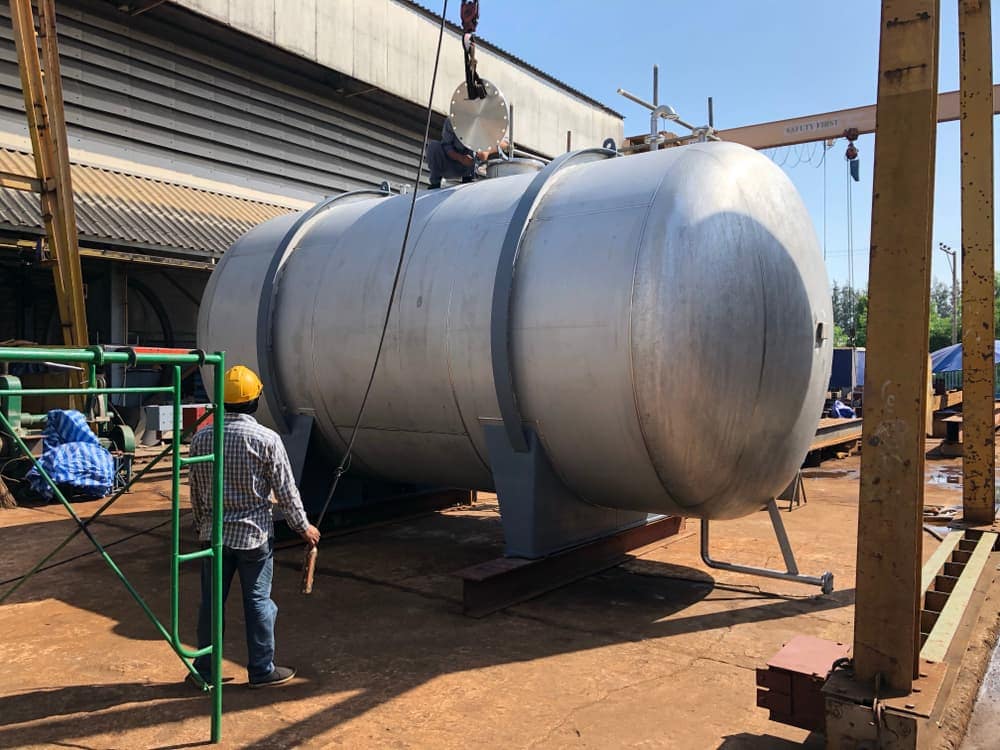
Pressure vessels come in many shapes and sizes, but their purpose is always to contain substances at a pressure higher or lower than outside air. Common types include:
- Storage tanks for gases like oxygen or hydrogen
- Boilers for steam production
- Reactors in chemical plants
- Heat exchangers in power stations
Regulations, such as the ASME Boiler and Pressure Vessel Code, set rules for how these vessels must be built, tested, and used. Materials often include carbon steel, stainless steel, or special alloys, chosen for their ability to handle pressure and resist corrosion.
The design involves calculating the right thickness, shape, and materials. But even the best design can fail if the welding is weak or defective.
Why Welding Is Essential In Pressure Vessel Fabrication
Welding fuses separate metal pieces into one solid structure. In pressure vessel fabrication, welding connects parts like shells, heads, nozzles, and flanges. The quality of these welds directly affects the vessel’s ability to resist pressure without leaking or breaking.
Welded joints must be as strong as, or stronger than, the base metal. This is because stress from pressure, temperature changes, and vibration often concentrates around the welds. If a weld fails, the result can be catastrophic.
Some reasons welding is so important in this field:
- Structural integrity: Welds must handle constant pressure and sometimes temperature changes without cracking.
- Safety: Any weakness can cause leaks or explosions, risking lives and property.
- Compliance: Welds must meet legal codes and pass inspections to be used in industry.
- Longevity: Good welding reduces the need for costly repairs and downtime.
Main Welding Processes Used In Pressure Vessel Fabrication
Fabricators use several welding processes, choosing the right one based on the vessel’s material, thickness, and use. The most common welding methods include:
Shielded Metal Arc Welding (smaw)
Also called stick welding, SMAW uses a covered metal electrode. When the electrode touches the metal, it creates an arc that melts both the electrode and the workpiece. The electrode coating provides a gas shield to protect the weld.
- Good for thick materials and outdoor work
- Simple equipment, portable, and reliable
- Slower and more labor-intensive than automated methods
Gas Tungsten Arc Welding (gtaw/tig)
TIG welding uses a non-consumable tungsten electrode. The welder feeds filler metal by hand, if needed. An inert gas (usually argon) shields the weld from air.
- Produces high-quality, clean welds
- Excellent for thin materials and stainless steel
- Requires skilled operators and is slower than some other processes
Submerged Arc Welding (saw)
In SAW, an electric arc forms between a wire electrode and the workpiece. The arc is hidden under a layer of granular flux, which protects the molten weld from contamination.
- Fast and efficient for long, straight seams
- Used for thick plates and large vessels
- Limited to flat or horizontal positions
Gas Metal Arc Welding (gmaw/mig)
MIG welding uses a continuous wire electrode and a shielding gas. The process is semi-automatic or automatic.
- Faster than SMAW and TIG
- Good for mild and stainless steels
- Less skill needed than TIG, but equipment is more complex
Flux-cored Arc Welding (fcaw)
Similar to MIG, but the wire electrode contains flux. This allows for welding outdoors, where wind might blow away shielding gases.
- Good for thick materials and high-speed welding
- Useful where gas shielding is hard to maintain
Comparison Of Welding Processes
Here is a comparison of the main welding methods used in pressure vessel fabrication:
| Process | Speed | Quality | Material Suitability | Common Use |
|---|---|---|---|---|
| SMAW | Low | Medium | Thick steel | Repairs, fieldwork |
| GTAW (TIG) | Low | High | Thin & specialty metals | Critical joints, stainless |
| SAW | High | High | Thick plates | Main seams, large vessels |
| GMAW (MIG) | Medium-High | Medium | Most steels | General fabrication |
| FCAW | Medium-High | Medium | Thick materials | Outdoor, heavy work |
Each process has strengths and weaknesses. The choice depends on the vessel’s requirements, the shop’s equipment, and the skills of the welders.
Key Steps In Pressure Vessel Welding
Welding a pressure vessel is not just about joining metal; it is a detailed process with many steps to ensure safety and quality.
1. Preparation Of Materials
Materials must be clean and free from oil, rust, and dirt. Edges are shaped (beveled) for better weld penetration. The correct type and grade of metal must be used, as mixing metals can cause weak joints.
2. Fit-up And Assembly
Parts are aligned and held together with clamps or tack welds. Precise fit-up is crucial. Even a small misalignment can cause stress and lead to failure. Fixtures and jigs help keep everything in the right position.
3. Welding Procedure Specification (wps)
A Welding Procedure Specification is a document that lists all the details about the weld, such as:
- Type of welding process
- Electrode or filler metal to use
- Welding position (flat, vertical, etc.)
- Preheat and post-weld heat treatment
- Welding speed and current
Welders must follow the WPS strictly to ensure repeatable, high-quality welds.
4. Welding Execution
Skilled welders follow the WPS to make the joints. They watch for signs of defects, such as porosity (gas bubbles), cracks, or lack of fusion. For large vessels, welding may happen in stages to control heat and prevent warping.
5. Inspection And Testing
After welding, each joint is checked using methods like:
- Visual inspection for surface defects
- X-ray or ultrasonic testing for hidden flaws
- Dye penetrant or magnetic particle testing for cracks
If defects are found, repairs are made before the vessel moves to the next stage.
6. Post-weld Heat Treatment
Some materials need heating after welding to remove stresses and improve strength. This step, called post-weld heat treatment (PWHT), helps prevent cracking.
7. Final Assembly And Testing
After all welding and testing, the vessel is assembled. A final pressure test (hydrostatic or pneumatic) ensures it can handle its working pressure without leaking.
Types Of Welded Joints In Pressure Vessels
Different parts of a pressure vessel need different types of joints. The most common are:
- Butt joints: End-to-end joining of plates or shells, common in main seams.
- Fillet joints: Used for attachments like supports or nozzles.
- Corner and edge joints: Less common, used for special shapes.
The joint design affects how stress is distributed. Butt joints, when properly made, are as strong as the base metal and are preferred for high-pressure areas.
Welding Positions And Their Impact
Welds can be made in several positions:
- Flat position: Easiest and produces the best quality.
- Horizontal, vertical, and overhead: More difficult, require skilled welders, and increase the chance of defects.
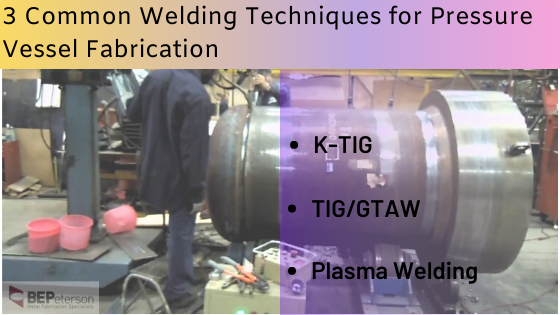
For large vessels, shops often rotate the workpiece so that most welding is done in the flat position.
Credit: www.bepeterson.com
Common Defects In Pressure Vessel Welding
Even skilled welders can face defects. The most common include:
- Porosity: Small holes caused by trapped gas. Weakens the weld and may cause leaks.
- Cracks: These can develop during or after welding. Even tiny cracks can cause failure under pressure.
- Undercut: A groove melted into the base metal next to the weld. Reduces strength.
- Lack of fusion: The weld metal does not properly join with the base metal.
- Slag inclusion: Non-metallic material trapped in the weld. Weakens the joint.
Defects often result from poor technique, dirty materials, wrong settings, or using the wrong electrode.
Inspection And Quality Control
Inspection is a vital part of pressure vessel fabrication. Codes demand that each weld meets strict standards. Inspectors look for:
- Visual flaws: Cracks, undercut, or poor shape
- Internal flaws: Using X-ray, ultrasonic, or other non-destructive testing
- Dimensional accuracy: The vessel must match the design exactly
If inspectors find a defect, welders must repair it and retest the area.
Non-destructive Testing Methods
Non-destructive testing (NDT) allows checking welds without damaging them. Main methods include:
| Method | Detects | Typical Use |
|---|---|---|
| X-ray (Radiographic) | Internal cracks, porosity | Main seams, critical joints |
| Ultrasonic | Internal flaws | Thick sections, large vessels |
| Magnetic Particle | Surface and near-surface cracks | Ferro-magnetic materials |
| Dye Penetrant | Surface cracks | Non-magnetic materials |
| Visual Inspection | Surface defects | All welds |
Using the right NDT method ensures defects are found early, reducing risk.
Credit: bugo.com
Welding Materials And Consumables
The choice of welding materials affects the vessel’s quality and durability. Main factors include:
- Base metal: Most vessels use carbon steel, but stainless steel or special alloys may be needed for corrosion or temperature resistance.
- Filler metal: Must match or exceed the base metal’s properties.
- Shielding gases: Protect the weld from air, preventing contamination.
- Fluxes: Used in some processes to clean and protect the weld.
For example, a vessel for food processing needs stainless steel for hygiene and corrosion resistance, while a vessel for high-pressure hydrogen may need special alloys.
Welding Challenges In Pressure Vessel Fabrication
Welding pressure vessels presents many challenges:
1. High Thickness Plates
Some vessels use plates over 50 mm thick. Welding such materials requires multiple passes, careful heat control, and sometimes preheating to avoid cracking.
2. Dissimilar Metals
Sometimes, different metals must be joined, like stainless steel to carbon steel. Special filler metals and procedures are needed to avoid problems like cracking or corrosion.
3. Distortion And Residual Stress
Welding heats the metal, which can cause parts to move or warp. Skilled welders use techniques like back-stepping or sequence welding to minimize distortion.
4. Access And Position
Large vessels can be hard to weld inside or in tight spaces. Automation helps, but some areas still require manual welding by skilled workers.
5. Code Compliance
All welding must meet codes such as ASME, which means extensive documentation, qualification of welders, and strict inspection.
Automation And Modern Welding Technology
Automation is becoming more common in pressure vessel fabrication. Robots and automatic welding machines:
- Make welds more consistent
- Speed up production
- Reduce human error
For example, submerged arc welding is often automated for long seams on large vessels. Advanced systems can monitor the weld in real time and adjust settings as needed.
Weld tracking systems and sensors can detect defects early, saving time and money. Some shops use computer-controlled welding to ensure every weld meets exact standards.
But automation does not eliminate the need for skilled welders. Many areas, especially repairs or special joints, still need human expertise.
Safety Considerations In Pressure Vessel Welding
Safety is critical. Welding involves high heat, sparks, and sometimes toxic fumes. Workers must:
- Wear protective gear (helmets, gloves, jackets)
- Work in well-ventilated areas
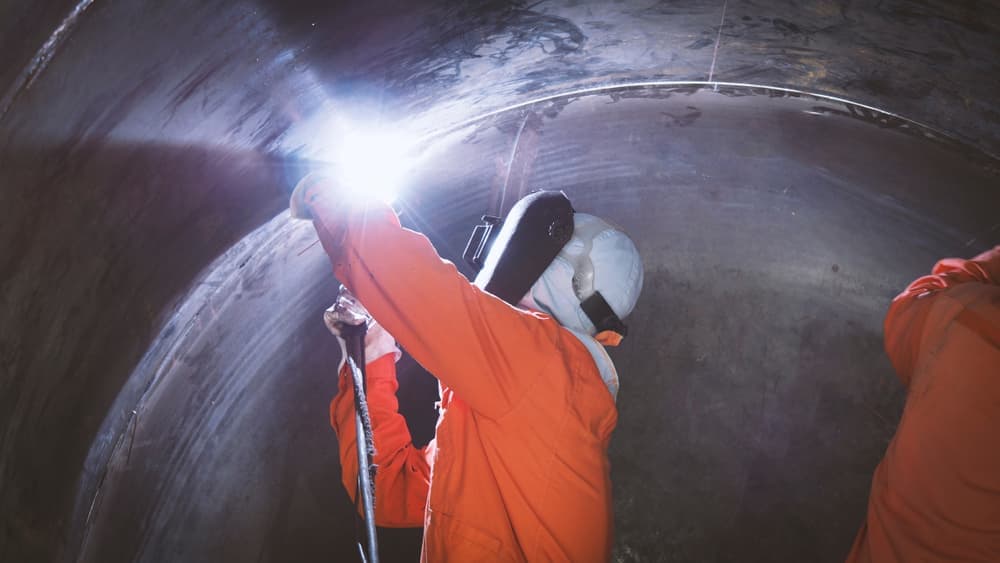
- Follow safety procedures, especially when working inside vessels
For example, welding inside a closed vessel can lead to a build-up of gases. Proper ventilation and gas monitoring are essential to prevent accidents.
The Role Of Welding Qualification And Certification
Not everyone can weld pressure vessels. Welders must be qualified and often certified according to standards like ASME Section IX.
Welding qualification includes:
- Written tests on theory and safety
- Practical tests on real welds
- Regular renewal and testing
Shops must also qualify their procedures (WPS) and keep records for inspectors.
Cost Factors And Efficiency In Welding
Welding is a major cost in pressure vessel fabrication, often making up 30–50% of total cost. Factors that affect cost include:
- Welding speed: Faster methods like SAW reduce labor costs.
- Material use: Good planning reduces waste.
- Rework: Repairs and rejected welds increase costs.
Efficient shops use automation, skilled workers, and strict quality control to keep costs down while ensuring safety.
Common Mistakes In Pressure Vessel Welding
Some errors can lead to dangerous failures or costly repairs:
- Poor preparation: Dirty or misaligned parts lead to weak welds.
- Ignoring the WPS: Using the wrong settings or filler metal causes defects.
- Rushing inspection: Missing defects early means bigger problems later.
- Skipping post-weld heat treatment: Leads to cracking or reduced strength.
A non-obvious insight: Many shops overlook the effect of ambient temperature and humidity. Welding in a cold or damp shop can introduce moisture, leading to porosity and weak welds.
Real-world Example: Pressure Vessel Failure
A famous case happened in Texas in 2007, when a pressure vessel exploded at a chemical plant. Investigators found a weld crack that had grown over time. The original weld did not follow the WPS, and inspections missed the defect.
This accident killed several workers and caused millions in damage. It highlights why each weld must be done and checked with care.
Latest Trends And Future Of Welding In Pressure Vessel Fabrication
The industry is moving toward greater automation, data-driven quality control, and new materials. Trends include:
- Laser welding: Offers high precision and speed, especially for thin materials.
- Advanced NDT: New methods can find smaller defects faster.
- Digital tracking: Shops use software to track every weld, making audits easier.
Research is ongoing into new alloys for better strength and corrosion resistance. As regulations become stricter, the demand for skilled welders and inspectors will grow.
A useful source for further reading is the Wikipedia Pressure Vessel page.
Frequently Asked Questions
What Is The Most Common Welding Process For Pressure Vessels?
The most widely used process is submerged arc welding (SAW) for long, straight seams. For smaller or complex joints, TIG or MIG welding is common. The choice depends on the vessel size, material, and required quality.
How Are Welds Inspected In Pressure Vessel Fabrication?
Welds are checked using visual inspection, X-ray, ultrasonic, magnetic particle, and dye penetrant testing. The method depends on the weld’s importance and the type of material. Critical joints often get multiple inspections.
Why Is Post-weld Heat Treatment Important?
Post-weld heat treatment (PWHT) reduces stress and improves strength. It helps prevent cracks, especially in thick or high-strength materials. Skipping PWHT can make the vessel unsafe.
Can Dissimilar Metals Be Welded In Pressure Vessels?
Yes, but it requires special procedures and filler metals. For example, welding stainless steel to carbon steel needs careful control to avoid cracking or corrosion. Not following the right process can lead to early failure.
What Are The Main Causes Of Weld Failure In Pressure Vessels?
Most failures come from poor preparation, wrong welding procedures, or missed defects during inspection. Environmental factors, like moisture or temperature, can also play a role. Regular training and strict quality control reduce these risks.
Pressure vessel fabrication depends on skilled welding, careful inspection, and strict following of standards. By understanding each step and avoiding common mistakes, fabricators can produce vessels that are safe, reliable, and long-lasting.
Credit: bugo.com