Disclosure: This post contains affiliate links and I will be compensated if you make a purchase after clicking through my links. Learn More
Can you run a 120V welder on a generator? Yes, you can run a 120V welder on a generator, but only if the generator meets the welder’s power needs. Choosing the right generator size, wattage, and features is key for safe and effective welding.
If you need portable welding power, using a generator with a 120V welder can be a game-changer. Many welders work in places with no standard power outlets: construction sites, remote farms, outdoor repairs, or disaster recovery. But not every generator can handle a welder, and picking the wrong one can damage your machine or produce weak welds.
This guide explains how to match your 120V welder with a generator, what features matter, and how to avoid common mistakes. You’ll learn what to check, how to calculate wattage, and the best practices for a reliable setup. No more guesswork — get the facts, keep your tools safe, and weld anywhere you need.
Understanding 120v Welders And Their Power Needs
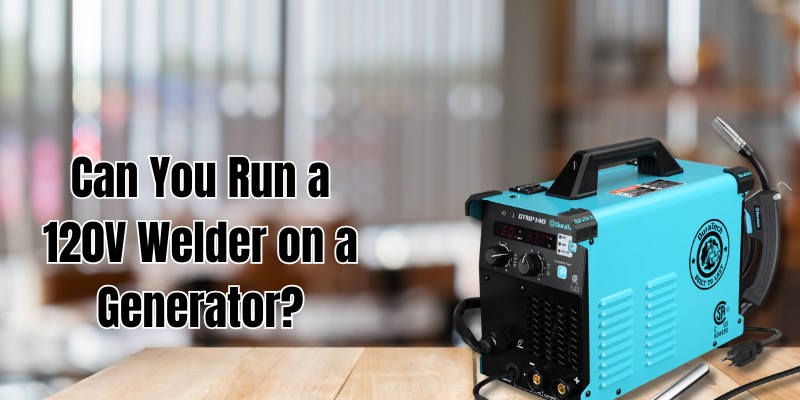
120V welders are designed to run on standard household electricity in the USA. Most plug into a regular wall outlet. They’re popular for hobbyists, DIYers, and even pros who need portability. But these welders still have serious power requirements.
120V welders are often chosen for their convenience and mobility. You can use them in your garage, on a farm, or even in a small shop. Because they use the same voltage as most household appliances, you don’t need special wiring.
However, welding, even at 120V, pulls a lot more current than basic tools like drills or saws. That means you must be sure your power source—generator or outlet—can safely handle the load.
Typical 120v Welder Specs
Most 120V welders are MIG, stick, or TIG models for light to medium jobs. They usually need:
- Input voltage: 120V AC
- Amperage draw: 15A to 30A (depends on the model and welding power setting)
- Wattage: 1,800W to 3,600W (watts = volts x amps)
- Duty cycle: 10%–30% at max output (how long you can weld before resting the machine)
- Power surges: Welders pull more power when you strike an arc or when starting up.
For example, a hobby MIG welder might draw 20A at full power. If you weld at a lower setting, the amperage and wattage will drop. But if you crank it up for thicker metal, the power demand jumps. Duty cycle is also important: if your welder lists a 20% duty cycle at max power, you can weld for 2 minutes, then must let the machine rest for 8 minutes to cool down. This protects the internal parts from overheating.
Some welders have additional features like wire feeders or digital controls. These also require steady power. If your generator “sags” or voltage drops, these controls might not work right, or the wire feed can become inconsistent—leading to poor weld quality.
Why Power Matching Matters
If your generator can’t deliver enough watts and amps, the welder may:
- Fail to start or shut off suddenly
- Produce weak or unstable arcs
- Overheat or trip safety circuits
- Suffer long-term damage
If the generator is too small, you risk both your tools and your safety.
A common mistake is thinking that “if it plugs in, it will work. ” But welders are different from lights or fans. They draw high current in short bursts, especially when you start a weld. If the generator can’t keep up, you’ll notice the arc “sputtering” or the machine shutting off.
Over time, this can damage sensitive electronics inside inverter welders or burn out transformer windings in older machines. It’s not just about getting the welder to turn on—you want it to run well, make strong welds, and last for years.
How Generators Work With Welders
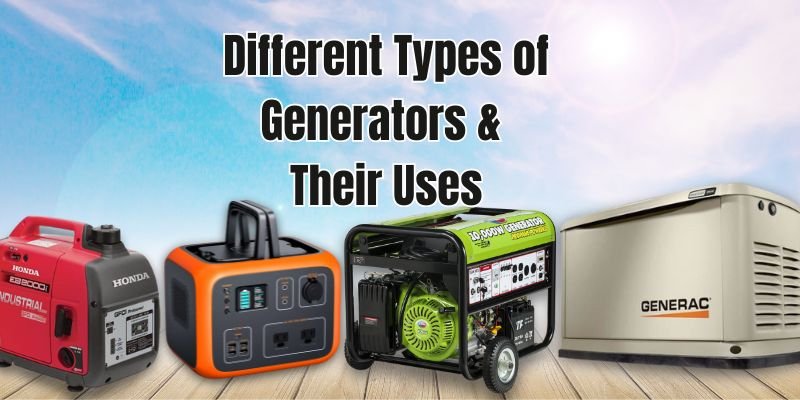
Generators create electricity by running a gas, diesel, or propane engine. Portable generators range from small, quiet inverters to big construction models. Not all are built for high-demand tools like welders.
The generator’s engine spins an alternator that produces AC power. The quality of that power—how steady the voltage is, how “clean” the waveform, and the total available amperage—matters a lot for welding. Some generators can handle big surges in power demand, while others can’t.
Key Generator Specs For Welders
- Rated (running) watts: Power the generator can supply continuously
- Surge (starting) watts: Extra capacity for short bursts (like starting a welder)
- Output voltage: Must match your welder (120V for most home welders)
- Amperage capacity: The generator’s max amperage output
- Power quality: Stable voltage and clean sine wave (important for electronic welders)
Let’s break these down:
- Rated (running) watts tells you what the generator can handle all the time. If your welder uses 2,400W, the generator must supply at least that much, preferably more.
- Surge (starting) watts are for short periods, like when you first strike an arc. Welders may draw 1.5 to 2 times their normal current for a moment. If your generator can’t handle this, the circuit breaker may trip.
- Amperage capacity is often overlooked. Some generators have a 15A, 20A, or 30A outlet. Match this to your welder’s plug. If your welder has a 20A plug and your generator only offers 15A, you’ll have problems.
Sine Wave And Clean Power
Welders, especially inverter models, need stable, clean power. Poor quality from a cheap or overloaded generator can cause:
- Flickering arc
- Unstable weld bead
- Damage to welder electronics
Look for inverter generators or those labeled “clean power” (THD under 5%).
Why does “clean power” matter? Welders with digital controls, microprocessors, or inverter technology are sensitive to “dirty” power. Dirty power means voltage or frequency changes rapidly or has “spikes. ” These spikes can fry components or make your welder behave unpredictably.
Older transformer welders are more forgiving, but even they work better with a steady voltage. If you notice the arc “wandering,” the bead looking strange, or the welder shutting off, dirty power is a likely cause.
Calculating The Generator Size For Your 120v Welder
Choosing the right generator size is essential. Too small, and you can’t weld. Too large, and you waste money and fuel.
Step 1: Check Your Welder’s Input Requirements
Look at your welder’s nameplate or manual. Find these numbers:
- Input voltage: 120V
- Input amperage: Usually 15A–30A (depends on setting)
- Wattage: Volts x Amps
Example: If your welder draws 20A at 120V, that’s 2,400W (120 x 20).
If your welder has variable power settings, always use the highest amperage listed. This ensures your generator won’t be overloaded if you turn up the welder for thicker material. Some welders list “input power” in both amps and watts, but always do the math yourself to double-check.
Step 2: Add A Safety Buffer
Welders pull more amps when striking an arc, and generators lose power at higher altitudes or temperatures. Add 25%–30% extra wattage as a buffer.
For a 2,400W welder:
2,400w X 1.3 = 3,120w Minimum Generator Size
This buffer isn’t just about startup surges. Generators lose efficiency with age, or when running in hot weather or at high elevations. Most people forget that a generator rated for 3,000W at sea level may only produce about 2,700W at 5,000 feet elevation.
Always round up, not down.
Step 3: Account For Other Loads
If you run grinders, lights, or fans at the same time, add their wattage too.
For example, a 4.5” angle grinder may pull 800W and a work light may draw 100W. If you weld and grind at the same time, your generator must handle the total: 2,400W (welder) + 800W (grinder) + 100W (light) = 3,300W. Add your safety buffer on top.
Step 4: Compare To Generator Ratings
Check both running watts and starting watts. Your generator must handle both.
Many generators advertise their “peak” or “surge” wattage. This number is higher than the “running” wattage, but it’s only available for a few seconds. Your welder’s continuous power demand should never exceed the generator’s running watts rating.
Example Generator Sizing
| Welder Input Amps | Input Voltage | Required Running Watts | Recommended Generator Size |
|---|---|---|---|
| 15A | 120V | 1,800W | 2,300W–2,500W |
| 20A | 120V | 2,400W | 3,000W–3,500W |
| 25A | 120V | 3,000W | 3,800W–4,000W |
Notice that as the input amps go up, the recommended generator size increases quickly. If you’re not sure, go with the next size up. An underpowered generator will not only struggle—it could ruin both your generator and your welder.
Step 5: Check Generator Amperage
Some generators have a 20A or 30A 120V outlet. Your welder’s plug must match the generator’s outlet and handle the required amps.
If your welder has a 20A plug, but your generator only has standard 15A household outlets, you may not be able to plug in safely. For a 30A welder, you’ll need a generator with a matching 30A outlet and a heavy-duty cord.
Never “cheat” by modifying plugs or using adapters not rated for the amperage—this is a fire risk.
Types Of Generators For 120v Welders
Not all generators are created equal. Here are the main types you’ll find:
1. Conventional Portable Generators
- Pros: Lower cost, high wattage available
- Cons: Noisy, heavy, sometimes poor power quality
These work for basic stick or transformer welders. They often have a THD (total harmonic distortion) above 5%, which can be risky for inverter welders.
Conventional generators are usually built for construction or emergency backup. They can run lights, saws, or pumps with no problem. But the “dirty” sine wave they produce may cause trouble for inverter welders or welders with advanced electronics. If you use one, make sure your welder is compatible, or stick with transformer-based models.
2. Inverter Generators
- Pros: Clean, stable power (THD < 5%), quiet, fuel efficient, lighter weight
- Cons: More expensive per watt, lower max output
Best choice for inverter welders or jobs where quiet operation matters. Perfect for sensitive electronics.
Inverter generators are popular for camping and RVs because they’re quiet and portable. For welding, their clean power is a big plus. You can run a modern inverter MIG or TIG welder with no worries about voltage spikes. The downside is cost—an inverter generator costs more for the same output, and most models top out at 3,000–4,500W.
3. Generator Welders
- Pros: Built-in welder and generator, designed for job sites, can run other tools
- Cons: Expensive, heavy, usually 220V or higher output
Usually overkill for small 120V welders but great for pro contractors.
Generator welders are common on construction sites and for pipeline work. They offer huge output, but are heavy and costly. If you’re a homeowner or hobbyist, a dedicated generator is usually a better value.
Key Features To Look For
- 120V output with correct amperage
- Clean sine wave (for inverter welders)
- Low THD (under 5% for safety)
- GFCI outlets for protection
- Sturdy frame for job site use
Other helpful features include electric start, fuel gauge, and wheels for mobility. For outdoor work, a weather-resistant cover or canopy can keep your generator dry.
Real-world Examples: Can You Run Your Welder On This Generator?
Let’s look at popular 120V welders and see what size generator you’d need.
Example 1: Lincoln Electric 140 Mig Welder
- Input: 120V, 20A max
- Wattage: 2,400W
- Recommended generator: 3,000W running, 3,500W surge
You’ll need a generator with at least a 20A 120V outlet. For best results, use an inverter generator with low THD, especially if you use the welder’s highest settings.
Example 2: Hobart Handler 125
- Input: 120V, 20A
- Wattage: 2,400W
- Recommended generator: 3,000W minimum
This welder is popular for farm repairs and auto work. Many users run these off portable generators at job sites. Make sure to use a heavy-duty cord and keep the generator well-fueled during longer jobs.
Example 3: Forney Easy Weld 140 Fc-i
- Input: 120V, 20A
- Wattage: 2,400W
- Recommended generator: 3,000W minimum inverter generator
Because this is an inverter welder, you should pair it with an inverter generator for maximum reliability. This setup is ideal for field repairs or fence building, where you need portability.
Example 4: Titanium 125 Flux-core
- Input: 120V, 20A
- Wattage: 2,400W
- Recommended generator: 3,000W–3,500W
Many off-roaders and DIYers use this welder for trail repairs. A 3,500W generator gives you enough headroom for occasional grinder use, too.
Generator Models That Work
- Honda EU3000iS (inverter, 3,000W, clean power)
- Champion 3500W Dual Fuel (conventional, reliable)
- Westinghouse iGen4500 (inverter, quiet, 3,700W running/4,500W peak)
These models are proven by welders in the field. The Honda is famous for quiet, clean power, but comes at a higher price. The Champion offers more watts per dollar. The Westinghouse is a good middle ground—quiet, portable, and powerful enough for most 120V welders.
Common Mistakes And How To Avoid Them
Running a welder on a generator is simple if you know what to avoid. Here are the top errors beginners make:
- Choosing a generator that’s too small: Never run your welder at max power on a generator that can barely handle the load.
- Ignoring surge watts: Welders need more power to start the arc than to run. Always check both running and surge ratings.
- Not checking outlet type: Your generator needs a 20A or 30A outlet (NEMA 5-20R or L5-30R) to match the welder’s plug.
- Skipping the clean power requirement: Inverter welders and machines with electronics need low THD (< 5%). Cheap generators can damage them.
- Overloading with extra tools: Add up all watts if running grinders, lights, or compressors at the same time.
- Running at high altitude or extreme heat: Generators lose power at altitude/heat. Derate by 3% per 1,000 feet over sea level.
- Using long, thin extension cords: Voltage drop can cause arc instability. Use thick, short cords (10–12 gauge).
Another mistake is not monitoring fuel. Running out mid-weld can ruin your work and may damage the welder if the arc stops suddenly. Always bring extra fuel and check levels before each job.
How To Set Up Your 120v Welder With A Generator
Follow these steps for a safe, effective setup:
1. Place The Generator Safely
Set your generator on a flat surface, outside in a well-ventilated area. Never run indoors or in a closed garage: Carbon monoxide kills.
If you’re working in a field or remote area, position the generator upwind from your workspace so exhaust doesn’t blow toward you. Leave at least 10 feet of space around the generator for airflow and cooling.
2. Check Fuel And Oil
Fill the generator with fresh gasoline or propane. Check oil level before starting. Use stabilizer if fuel sits for long.
Generators work best with fresh, clean fuel. Old gasoline can cause hard starting or poor engine performance. If you plan to store the generator for months, run it dry or add fuel stabilizer to keep the carburetor clean.
3. Connect Your Welder
Plug your welder into the correct generator outlet. If your welder has a 20A plug, use a 20A-rated outlet. For a 30A welder, use a 30A outlet with a matching cord.
Double-check all connections. Loose or dirty plugs can cause heat buildup and even start fires. If you need an extension cord, keep it as short as possible, and always use a heavy-duty cord rated for the load.
4. Start The Generator
Let the generator warm up for a few minutes. This stabilizes voltage and frequency for safe welding.
A cold generator may not provide stable power. Warming up also gives you a chance to listen for any strange noises or check for leaks before starting your work.
5. Set Welder Power Levels
Start at a lower setting and test the arc. If the generator struggles, reduce power or use a smaller electrode.
Watch the generator’s behavior. If the engine sounds strained or you hear the welder’s arc sputtering, you may be overloading the system. Back down on power settings if needed.
6. Use Proper Extension Cords
If you need an extension cord, use a heavy-duty cord rated for 20A or 30A. Shorter is always better.
Voltage drop is a hidden danger. For every extra 25 feet of cord, you can lose 1-2 volts. This makes your arc less stable and your welds weaker. Use 10-gauge cords for 20A loads, and 8-gauge for 30A.
7. Watch For Overloads
If the generator trips or the engine bogs down, turn off the welder immediately. Check for overload, short circuits, or improper setup.
Don’t try to restart a tripped generator until you’ve checked all connections. Repeated overloads can damage both the generator and your welder.
Safety Tips For Welding With A Generator
Welding and generators both have risks. Follow these safety rules:
- Ground the generator: Use a ground rod if required by your welder’s manual.
- Keep the generator dry: Never weld in rain or snow. Water and electricity don’t mix.
- Use GFCI outlets: Prevent shocks and electrical fires.
- Inspect cords and plugs: Look for damage before every use.
- Don’t refuel while running: Gasoline vapors ignite easily. Turn off and let cool before refueling.
- Keep children and pets away: Both welders and generators are dangerous.
You can add extra safety by using a spark arrestor on the generator’s exhaust if working in dry grass or forested areas. This reduces fire risk. Always have a fire extinguisher nearby, just in case.
How Generator Performance Affects Weld Quality
Poor generator performance can ruin your welds. Here’s what to watch for:
Low Power Output
If your generator can’t deliver steady power, you’ll see:
- Weak or sputtering arc
- Poor penetration
- Slag that won’t chip off easily
A weak arc makes it hard to weld thicker metal or to get a smooth bead. If you notice your welds looking rough or not sticking well, check your power source first.
Voltage Fluctuations
Unstable voltage causes:
- Arc “hunting” or flickering
- Unpredictable bead shape
- More spatter
Voltage changes make it hard to control the weld. You may see the arc lengthen and shorten without changing your torch position. This leads to ugly, weak welds that may fail under stress.
Dirty Power (high Thd)
High total harmonic distortion damages inverter welders and can lead to:
- Fried circuit boards
- “Noisy” arc (unsteady)
- Shortened welder life
If your welder has a display or digital controls, dirty power can make them glitchy or kill them completely. Always use clean power for modern welders.
How To Fix
- Always use a generator with at least 25% more wattage than needed
- Prefer inverter generators for electronic welders
- Keep the generator well maintained for steady output
Routine maintenance—changing oil, filters, and spark plugs—can keep your generator running at full capacity. Weak generators often have dirty air filters, old fuel, or worn-out spark plugs.
Pros And Cons Of Running A 120v Welder On A Generator
There are clear benefits and some drawbacks. Here’s how they compare:
| Pros | Cons |
|---|---|
|
|
If you need to weld in the middle of a field or at a disaster site, a generator is the only practical solution. But for routine garage work, grid power is easier and quieter.

Credit: www.youtube.com
Tips For Getting The Best Results
- Choose the right generator size: Always go bigger than your welder’s max wattage.
- Use inverter generators for sensitive welders: Less risk of damage, better arc stability.
- Keep fuel fresh and generator maintained: Dirty air filters or old fuel reduce output.
- Test before field jobs: Try your welder with the generator at home first.
- Bring spare fuses and cords: Field repairs are easier if you’re prepared.
- Watch for weather: Keep generator dry; use a canopy if needed.
- Monitor generator output: A plug-in voltmeter can warn you of voltage drops.
- Let the generator cool after long runs: Prevents engine wear.
A non-obvious tip: Run the generator under light load for 5–10 minutes after heavy welding to let it cool down gently. Shutting down under full load stresses the engine and alternator.
What To Avoid With Welders And Generators
- Never use a worn-out generator: Weak output can ruin welders fast.
- Don’t plug a 120V welder into a 240V-only generator: This will fry your machine instantly.
- Skip cheap extension cords: Thin cords cause voltage drop and poor welds.
- Don’t exceed generator load: Overloading leads to shutdowns or fires.
- Never backfeed power from a generator into a building: This is dangerous and illegal without proper transfer switches.
If you’re not sure about your generator’s compatibility, contact the manufacturer or a professional electrician. Guesswork can be costly.
Generator Maintenance For Reliable Welding
A well-maintained generator gives you reliable power. Here’s what to do:
- Change oil regularly: Every 50–100 hours, or as manual states.
- Replace air filters: Dirty filters choke the engine and lower output.
- Check spark plug: A fouled plug causes hard starting and low power.
- Test output: Use a voltmeter to check for steady 120V output.
- Run the generator monthly: Keeps fuel fresh and parts lubricated.
- Inspect fuel lines and tank: Look for leaks or cracks.
- Tighten bolts and connectors: Vibration can loosen parts over time.
- Keep it clean: Dust and debris can clog cooling vents.
A well-cared-for generator can last for years and deliver full power when you need it most. Neglect leads to surprises—and not the good kind.
Cost Considerations: Generator Vs. Extension Cord
Some wonder if it’s cheaper to just run a long extension cord from a house or shop. Here’s the truth:
- Generators cost more upfront, but give full freedom and let you work anywhere.
- Long extension cords (over 100 feet) cause serious voltage drop, weak arcs, and safety risks.
- For remote jobs, a generator is the only real choice.
- Renting a generator can be an option if you only weld off-grid occasionally. Just be sure the rental unit meets your power needs.
- If you weld near a building, installing a dedicated 20A or 30A outlet may be cheaper long-term.
When Not To Use A Generator For Welding
While generators are great for remote work, sometimes it’s better to use grid power:
- High-volume shop work: Grid power is more stable and cheaper long-term.
- Heavy-duty welding: Big welders (over 30A input) need larger 240V generators.
- Poor weather: If you can’t keep the generator dry, wait for better conditions.
- Noise-sensitive areas: Generators can disturb neighbors or violate local noise rules.
If you’re running a welding business, consider investing in a shop with dedicated power rather than relying on generators for all work.
Environmental Impact And Fuel Choices
Generators use gasoline, propane, or diesel. Gasoline is common, but propane burns cleaner. Diesel generators last longer but are noisy and heavy.
- Propane generators: Lower emissions, fuel stores longer, less carbon monoxide.
- Gasoline generators: Easier to refuel, more portable.
- Diesel generators: Industrial, for big jobs only.
For the environment, consider an inverter propane generator for light welding.
If you work in national parks, forests, or protected areas, check local fuel and noise rules. Some areas ban gasoline generators or require spark arrestors for fire safety.

Credit: www.hobartwelders.com
The Bottom Line: Can You Run A 120v Welder On A Generator?
Yes — as long as your generator matches or exceeds your welder’s power needs, and you use proper setup and safety steps. Many welders use generators every day for repairs, construction, and emergencies. Focus on clean, stable power, and your 120V welder will perform just as well as on grid power.
Choose wisely, maintain your tools, and you can weld wherever you need.
For more technical details on generator sizing, see the Wikipedia entry on electric generators.
Frequently Asked Questions
What Size Generator Do I Need For A 120v Welder?
You need a generator with at least 25% more wattage than your welder’s maximum input. Most 120V welders need a generator rated at 3,000 to 3,500 running watts with a 120V, 20A or 30A outlet for safe use.
Can I Use Any Portable Generator With My 120v Welder?
No, not all generators work. Your generator must supply enough watts and amps, and for inverter welders, it should provide clean power (low THD under 5%). Always check your welder’s requirements before plugging it in.
Will Running A Welder On A Generator Damage It?
If the generator is too small or produces dirty power, it can damage your welder. Use a generator that matches or exceeds wattage needs and has a clean sine wave output, especially for inverter-based welders.
Can I Run Other Tools While Welding With A Generator?
Yes, but you must add up the total wattage of all tools, including your welder. Never exceed the generator’s rated output, or you risk tripping the breaker, damaging equipment, or causing fire hazards.
Is It Better To Use An Inverter Generator For Welding?
Inverter generators provide cleaner, more stable power and are quieter than traditional models. They are best for sensitive inverter welders, but may cost more per watt than conventional generators with the same output.