Disclosure: This post contains affiliate links and I will be compensated if you make a purchase after clicking through my links. Learn More
Welding is a key process in many industries, from construction to aerospace. Two advanced welding methods often used for high-quality work are Plasma Arc Welding (PAW) and Tungsten Inert Gas (TIG) Welding. Both create strong, precise welds, but they use different techniques, equipment, and offer unique advantages. Understanding the difference between plasma arc welding and TIG welding is important for anyone who works with metals or wants to choose the right process for a project.
This article explains each method in detail, compares their features, and shows how they perform in real-world situations. By the end, you will know how these two methods work, their strengths and weaknesses, and when to use each one.
What Is Tig Welding?
TIG welding, also known as Gas Tungsten Arc Welding (GTAW), uses a non-consumable tungsten electrode to produce the weld. An inert gas, usually argon, shields the weld area from air. This process allows for precise control and creates clean, strong welds.
TIG welding is often used when a high-quality finish is important. It works well with many metals, such as stainless steel, aluminum, magnesium, copper, and titanium. Welders can use filler material or weld without it, depending on the job.
One key point about TIG welding is the need for skill. The welder must use both hands—one for the torch and one for the filler rod. This makes TIG welding slower than some other methods, but it produces excellent results, especially on thin materials.
What Is Plasma Arc Welding?
Plasma arc welding is similar to TIG welding but uses a different approach to create the arc and control the heat. In PAW, a plasma torch creates a focused, high-temperature arc by forcing gas (usually argon) through a small nozzle. The plasma gas becomes ionized and creates a narrow, intense arc that can reach temperatures above 25,000°C (45,000°F).
The plasma arc is more concentrated than the arc in TIG welding. This allows for deeper penetration and faster welding speeds. Plasma arc welding also uses a non-consumable tungsten electrode, but the arc is separated from the shielding gas by the nozzle, offering more control.
PAW is common in industries that require automation and high precision, such as aerospace, electronics, and medical device manufacturing. It can weld thin or thick metals and often works well with difficult materials.

Credit: blog.thepipingmart.com
How Plasma Arc Welding Works
Plasma arc welding uses a special torch with a constricted nozzle. Here’s a simple breakdown of the process:
- The welder starts an electric arc between the tungsten electrode and the workpiece.
- Argon gas flows through the torch, becoming ionized and forming plasma.
- The narrow nozzle focuses the plasma, creating a hot, high-speed arc.
- The welder can add a filler material if needed, or weld without it.
There are two main modes:
- Transferred arc: The arc goes from the electrode to the workpiece.
- Non-transferred arc: The arc stays within the torch, used mostly for cutting or spraying.
This focused arc gives better penetration, faster speeds, and high-quality welds, especially on thick or tricky metals.
How Tig Welding Works
TIG welding uses a torch with a tungsten electrode and a shielding gas flow. The process follows these steps:
- The welder starts the arc between the tungsten electrode and the metal.
- Argon or helium gas flows around the arc, protecting it from air.
- The welder moves the torch and, if needed, feeds a filler rod into the weld puddle.
- The molten metal cools and forms a strong, clean joint.
TIG welding gives precise control over the weld pool, making it perfect for thin metals and complex shapes. Because the electrode does not melt, there is no contamination of the weld.
Key Differences Between Plasma Arc Welding And Tig Welding
Both methods use a tungsten electrode and shielding gas, but they have important differences in their operation, equipment, and applications.
Arc Formation
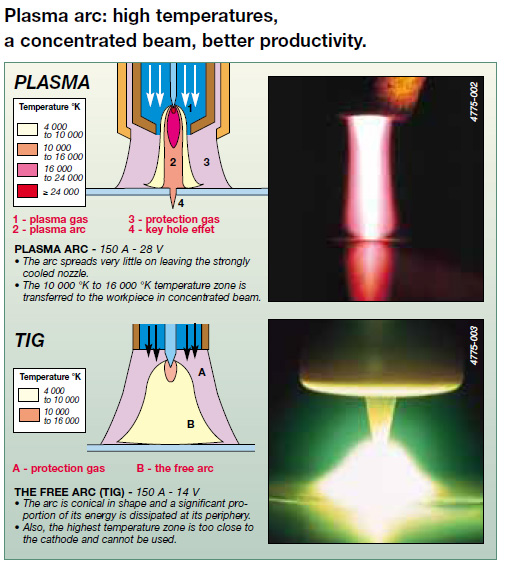
- TIG Welding: The arc forms directly between the tungsten electrode and the workpiece. The arc is wide, and the heat is less concentrated.
- Plasma Arc Welding: The arc passes through a small orifice (nozzle), creating a narrow, high-energy plasma jet. This results in higher temperatures and deeper penetration.
Torch Design
- TIG Torch: Simple design with a tungsten electrode, ceramic nozzle, and shielding gas line.
- Plasma Torch: More complex, with a special nozzle to constrict the arc and separate plasma and shielding gas flows.
Shielding Gas
- Both use argon as the primary shielding gas. Sometimes, helium or gas mixtures are used, especially in TIG for deeper penetration or faster welding.
Heat Input And Control
- TIG Welding: Offers fine control, but the heat is spread over a larger area.
- Plasma Arc Welding: Delivers more heat to a small area, allowing for deeper, faster welds.
Penetration And Speed
- TIG Welding: Works best for thin materials and slower welding speeds.
- Plasma Arc Welding: Handles thick materials and higher speeds due to the intense plasma arc.
Equipment Cost And Complexity
- TIG Equipment: Less expensive, easier to set up and maintain.
- Plasma Equipment: Higher cost, needs more maintenance, and is more complex.
Skill Requirements
- TIG Welding: Requires high skill, especially for thin materials or tricky joints.
- Plasma Arc Welding: Also needs training, but automation is common, which can reduce the need for manual skill.
Applications
- TIG Welding: Used in automotive, art, repair, and small manufacturing jobs.
- Plasma Arc Welding: Preferred for industrial, robotic, or high-precision tasks.
Direct Comparison: Plasma Arc Welding Vs. Tig Welding
To make the differences clearer, see the comparison below:
| Feature | TIG Welding | Plasma Arc Welding |
|---|---|---|
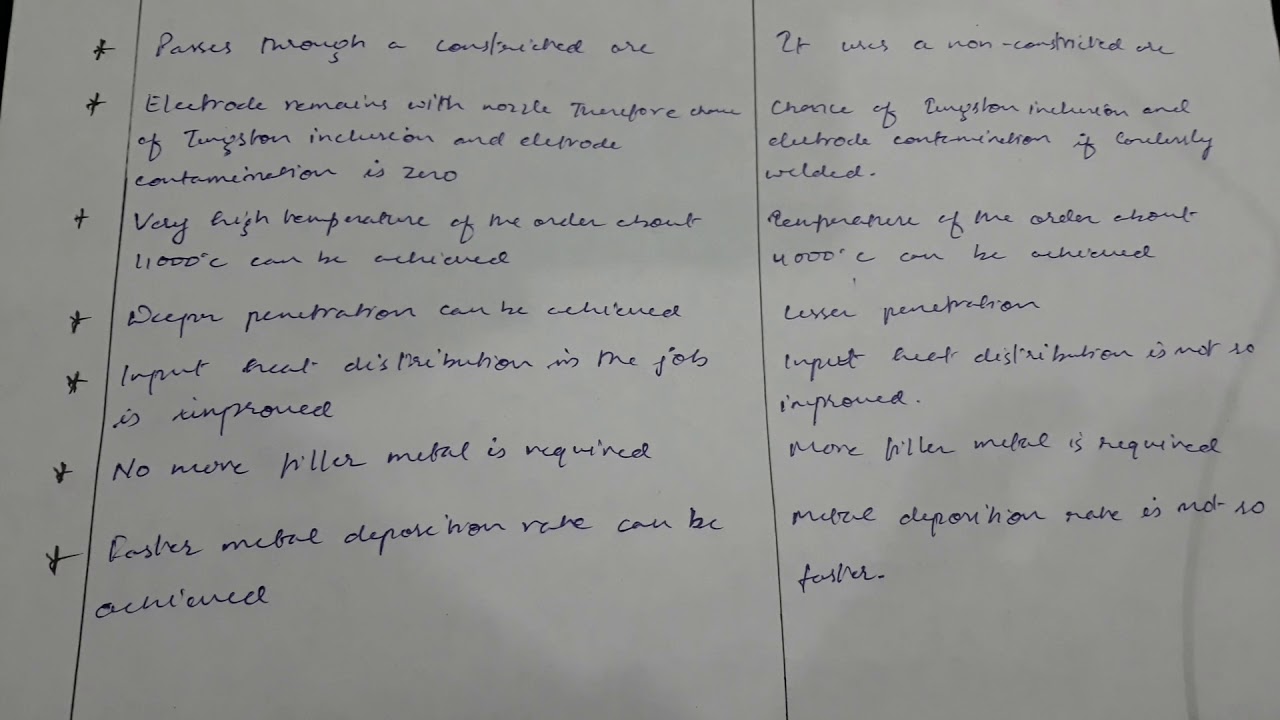
| Arc Type | Open arc | Constricted plasma arc |
| Temperature | Up to 11,000°C | Up to 25,000°C |
| Welding Speed | Slower | Faster |
| Penetration | Shallow to medium | Deep |
| Equipment Cost | Moderate | High |
| Automation | Mostly manual | Often automated |
| Best for | Thin or delicate metals | Thick or hard-to-weld metals |
Credit: www.youtube.com
Advantages And Disadvantages
Understanding the pros and cons of each method helps you select the right process for your project.
Advantages Of Tig Welding
- High weld quality: Produces clean, strong, and neat welds with good appearance.
- Precision: Allows exact control over heat and filler material.
- Versatile: Works on many metals and alloys.
- No spatter: Clean process, with minimal smoke or sparks.
- Control: The operator can adjust settings for each job.
Disadvantages Of Tig Welding
- Slow process: Not ideal for thick materials or mass production.
- Skill needed: Requires good hand-eye coordination and steady hands.
- Manual operation: Fatiguing for long welds.
- Equipment cost: More expensive than simple arc welding, but cheaper than plasma.
- Not suited for dirty or rusty metals: Needs clean surfaces for best results.
Advantages Of Plasma Arc Welding
- High speed: Faster than TIG due to the intense plasma arc.
- Deep penetration: Can weld thick or hard materials in one pass.
- Automation ready: Suits robotic and automated systems.
- Stable arc: Less affected by arc length changes.
- Low distortion: Focused heat reduces warping.
Disadvantages Of Plasma Arc Welding
- High equipment cost: More complex and expensive to buy and maintain.
- Training needed: Operators must understand settings and safety.
- Gas supply: Uses more shielding and plasma gas.
- More setup time: Needs careful adjustments.
- Not ideal for field work: Best used in controlled environments.
Applications Of Plasma Arc Welding
Plasma arc welding is the top choice for certain high-tech or demanding applications:
- Aerospace industry: Used for welding jet engine parts, fuel tanks, and structural components. The deep, precise welds are crucial for safety and performance.
- Medical devices: Used to join stainless steel and titanium for surgical tools and implants.
- Electronics: Makes tiny, accurate welds for sensors, connectors, and micro-components.
- Automotive: Used for high-strength welds in transmissions, axles, and exhausts.
- Pipe and tube welding: Efficient for long, straight welds on stainless steel pipes.
Example: In aircraft engine manufacturing, plasma arc welding ensures joints are strong enough to handle high heat and pressure. The process can be automated, reducing human error and ensuring repeatable results.
Applications Of Tig Welding
TIG welding is trusted for tasks where appearance, precision, and quality matter:
- Art and sculpture: Used for stainless steel art pieces, furniture, and decorative items.
- Automotive repair: Fixing aluminum radiators, exhausts, or fuel tanks.
- Bicycle frames: Joins thin-walled tubing without burning through.
- Food industry: Welds stainless steel kitchen equipment, tanks, and pipes.
- Aerospace and defense: Used for small, high-precision welds where strength and reliability are critical.
Example: Many custom car builders use TIG welding for roll cages and body panels because the welds are neat and easy to grind and polish.
Detailed Equipment Comparison
Both methods need power supplies, torches, and gas, but there are key differences.
| Component | TIG Welding | Plasma Arc Welding |
|---|---|---|
| Power Supply | AC/DC, 5–300 amps | DC, 5–300 amps (sometimes higher) |
| Torch | Simple, air or water cooled | Complex, always water cooled |
| Electrode | Tungsten, non-consumable | Tungsten, non-consumable |
| Nozzle | Ceramic | Metal, small orifice |
| Shielding Gas | Argon, helium, or mix | Argon (plasma) and argon/hydrogen (shielding) |
| Filler Material | Manual feed | Manual or automatic feed |
| Control System | Foot pedal or hand control | Electronic control, often CNC |
Non-obvious Insights For Beginners
- Arc Stability: Plasma arc welding is less sensitive to changes in arc length. In TIG, keeping a steady hand is essential. In plasma, the nozzle design keeps the arc stable, which helps in automated systems.
- Fume Generation: Plasma arc welding produces fewer fumes than TIG when welding stainless steel. This is important for health and safety, especially in enclosed spaces.
- Electrode Life: The tungsten electrode in plasma arc welding can last longer because the arc is shielded inside the nozzle, reducing oxidation and contamination.
- Micro-Welding: TIG is better for ultra-small welds on thin wires or foils, while plasma arc welding excels at small but deeper welds.
Safety Considerations
Both methods need attention to safety:
- UV radiation: Both processes produce strong ultraviolet light, which can cause burns and eye damage. Welders must wear proper helmets and protective clothing.
- Hot metal: Welded parts stay hot for a long time. Gloves and caution are necessary.
- Fumes: Good ventilation is important, especially for metals like stainless steel, which can release harmful gases.
- Electrical hazards: Both processes use high currents. Proper grounding and insulation are critical.
- Noise: Plasma arc welding is louder, so ear protection is sometimes needed.
Costs: Setup, Operation, And Maintenance
Initial Costs
- TIG welding setup: $2,000–$5,000 for a professional-grade system.
- Plasma arc welding setup: $8,000–$20,000 or more, depending on automation and power.
Operating Costs
- TIG welding: Lower gas use, fewer consumables, but slower speed means higher labor costs.
- Plasma arc welding: Higher gas consumption, more expensive spare parts (nozzles, electrodes), but lower labor costs due to speed and automation.
Maintenance
- TIG torches: Simple to maintain; mainly clean the nozzle and replace the tungsten.
- Plasma torches: More maintenance, especially for the nozzle and cooling system.
Credit: www.euroshl.com
Choosing Between Plasma Arc Welding And Tig Welding
When choosing which method to use, consider:
- Material thickness: TIG is best for thin metals; plasma is better for thick or tough metals.
- Weld quality: Both give high-quality welds, but TIG is preferred for visible, cosmetic welds.
- Production speed: Plasma is faster, so it suits mass production.
- Budget: TIG is more affordable for small shops or repairs.
- Automation: Plasma is easier to automate for repeatable, high-volume work.
- Skill level: TIG needs more manual skill; plasma reduces this through automation.
Common Mistakes To Avoid
- Using TIG on thick metals: TIG struggles with thick workpieces, leading to incomplete welds.
- Using plasma for detailed, cosmetic welds: Plasma can be too aggressive for thin, visible joints.
- Poor gas choice: Using the wrong shielding gas can ruin weld quality in both processes.
- Ignoring safety: Both processes are dangerous without proper gear and ventilation.
Process Parameters And Settings
Each method has settings that affect the weld:
- Current (Amps): Higher current for thicker materials.
- Gas flow rate: Too low causes contamination; too high can blow away the weld pool.
- Torch angle: Incorrect angle can cause poor fusion or burn-through.
- Travel speed: Moving too fast or slow affects bead shape and penetration.
- Nozzle size (plasma): Affects the arc focus and quality.
Careful adjustment is key. For example, plasma arc welding often needs precise control over plasma gas pressure to maintain a steady arc.
Real-world Examples
Aerospace
A company building jet engines uses plasma arc welding for turbine blades. They need deep, reliable welds and fast production. The process is automated, with robots handling the torch.
Custom Motorcycles
A workshop making custom frames uses TIG welding for its precise control and clean finish. Each weld is visible, so appearance matters.
Food Processing
A factory installs stainless steel pipes for milk. TIG welding creates smooth, easy-to-clean joints that prevent bacteria growth.
Medical Devices
A manufacturer welds tiny titanium parts for implants. Plasma arc welding creates deep, narrow welds without overheating the metal.
Technical Specifications
Below is a summary of technical differences:
| Parameter | TIG Welding | Plasma Arc Welding |
|---|---|---|
| Electrode Type | Tungsten (pure or alloyed) | Tungsten (thoriated, ceriated, etc.) |
| Shielding Gas Flow | 5–20 L/min | 10–30 L/min (plasma + shielding) |
| Typical Arc Voltage | 10–20 V | 25–40 V |
| Manual vs. Automated | Mostly manual | Mainly automated |
| Weld Thickness Range | 0.5–6 mm (best) | 0.1–12 mm (best) |
| Power Efficiency | Moderate | High |
Environmental Impact
Both processes are cleaner than some other welding methods, but there are differences:
- TIG welding: Produces little smoke, low fume levels, and minimal waste.
- Plasma arc welding: Produces some ozone and metal fumes, especially at high currents. Good ventilation is essential.
Both need proper disposal of used electrodes and cleaning chemicals.
Training And Certification
Welders need specific training for each process:
- TIG welding courses: Focus on hand control, joint types, and basic metallurgy. Certification is available through organizations like the American Welding Society.
- Plasma arc welding courses: Cover machine setup, safety, and programming for automation. Certification is less common but important for industrial work.
Skilled welders are in high demand, especially those who can work with both methods.
Future Trends
- Automation: Plasma arc welding is leading in automated production lines, especially for high-volume tasks.
- Smaller torches: Both TIG and plasma torches are becoming smaller and more efficient, allowing for micro-welding in electronics and medical fields.
- Hybrid methods: Some companies combine TIG and plasma for special applications, using the strengths of each.
Frequently Asked Questions
What Metals Can Tig And Plasma Arc Welding Handle?
Both methods can weld steel, stainless steel, aluminum, titanium, copper, and more. TIG is better for thin metals, while plasma can handle both thin and thick sections.
Which Is Easier For Beginners To Learn: Tig Or Plasma Arc Welding?
TIG welding is harder to master due to manual skills needed. Plasma arc welding is more complex to set up, but automation makes it easier for beginners in a factory setting.
Is Plasma Arc Welding Always Better Than Tig Welding?
No. Plasma arc welding is faster and better for thick metals, but TIG gives more control and a better finish for thin or cosmetic welds.
How Do I Choose The Right Shielding Gas?
Argon is common for both processes. Sometimes helium or hydrogen is mixed in for special jobs. The right gas depends on the metal, thickness, and weld quality needed.
Where Can I Learn More About Welding Processes?
You can find reliable information on welding methods from trusted sources like the Welding Wikipedia page.
Welding is both science and art. Choosing between plasma arc welding and TIG welding means understanding your needs and the strengths of each process. With the right knowledge, you can produce strong, clean, and reliable welds for any project.