Disclosure: This post contains affiliate links and I will be compensated if you make a purchase after clicking through my links. Learn More
Choosing the best welding process for automotive body panels can feel confusing if you’re not a professional. Body panels use thin metal, usually steel or sometimes aluminum. The wrong welding method can cause warping, weak joints, or ugly results. But the right method can make repairs or custom work look smooth and last for years.
Today’s cars use many materials and manufacturing techniques. That’s why it’s important to know what works for your car, your tools, and your skill level. In this article, you’ll find a clear comparison of all common welding processes for body panels.
You’ll learn how each works, where they fit, and what to avoid. You’ll also get real examples, tips, and answers to common questions. By the end, you’ll know which welding process gives the best results for automotive body panels.
Understanding Automotive Body Panels
Automotive body panels are the outer parts of a car, like doors, fenders, hoods, roofs, and quarter panels. Most body panels are made from thin sheets of steel (often 0.6 to 1.2 mm thick). Some modern cars use aluminum or even plastic composites. These panels need strong, neat welds that don’t distort the metal. They must also resist rust and stand up to vibration and weather.
Welding body panels is different from welding thicker parts or frames. Thin metal heats quickly and can burn through or warp if you use the wrong technique. That’s why you must choose a process that gives you control, low heat, and clean welds.
Key Welding Processes For Body Panels
Several welding methods are used in automotive repair and fabrication. Each has strengths and limits for thin sheet metal. The most popular processes are:
- MIG Welding (GMAW)
- TIG Welding (GTAW)
- Spot Welding (Resistance)
- Oxy-Acetylene Welding (Gas Welding)
- Flux-Cored Arc Welding (FCAW)
- Soldering (Lead or Tin-Based)
- Brazing (Silicon Bronze, etc.)
Let’s look at each process in detail, including how they work, their benefits, and their challenges.

Credit: www.youtube.com
Mig Welding (gmaw)
MIG welding (Metal Inert Gas) is the most popular process for automotive bodywork. It uses a wire electrode fed through a gun and shielded by a gas (usually CO₂ or argon/CO₂ mix).
How Mig Welding Works
You hold a torch and pull a trigger. Wire feeds out and melts, joining the panels. The shielding gas protects the weld from air.
Benefits Of Mig Welding
- Easy to learn: Many hobbyists and pros use MIG because it’s simple and fast.
- Good speed: You can make long welds quickly.
- Works on thin steel: With the right settings, you can weld even 0.6 mm panels.
- Clean welds: If you use gas shielding, the weld area stays clean.
Challenges With Mig Welding
- Heat control: High heat can warp or burn through thin metal if you’re not careful.
- Equipment cost: You need a MIG welder, gas cylinder, and safety gear.
- Not ideal for aluminum panels: Special wire and gas are needed for aluminum.
Practical Tips For Mig On Body Panels
- Use small diameter wire (0.6 mm or 0.8 mm) for thin steel.
- Weld in short bursts (“stitch welding”) to avoid warping.
- Keep the panels tight together for a flat seam.
- Clean off paint, rust, and grease before welding.
Example
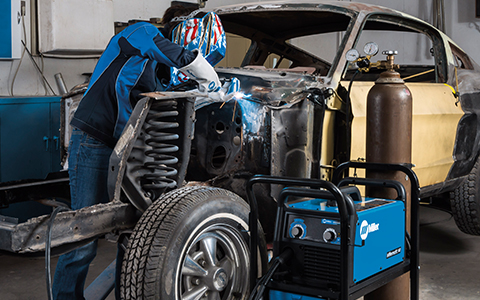
Many body shops use MIG welders like the Miller or Lincoln 140A to repair doors and fenders. These machines handle thin gauge steel well. A skilled user can make almost invisible welds with minimal grinding.
Tig Welding (gtaw)
TIG welding (Tungsten Inert Gas) offers the most precise welds. It uses a non-consumable tungsten electrode and a filler rod, with argon gas for shielding.
How Tig Welding Works
You hold a torch with a tungsten tip. You add filler metal by hand. The arc melts the base metal and filler together.
Benefits Of Tig Welding
- High control: You can make tiny, neat welds with almost no spatter.
- Low heat input: Easier to avoid warping or burning through thin panels.
- Works for aluminum and stainless steel: Change filler rods and settings for different metals.
- Strong, clean welds: Good for high-quality restorations.
Challenges With Tig Welding
- Takes skill: TIG is harder to learn and slower than MIG.
- Slower speed: Not ideal for large production work.
- Sensitive to surface prep: Metal must be very clean.
- Equipment cost: TIG machines and accessories are more expensive.
Practical Tips For Tig On Body Panels
- Use a small diameter tungsten (1.6 mm or less).
- Use low amperage (20-40A) for thin steel.
- Use a pedal to control heat if possible.
- Clean the panels with a wire brush before welding.
Example
High-end restorers use TIG welding for classic car sheet metal. It gives a factory-like seam with almost no grinding or filler needed.
Spot Welding (resistance Welding)
Spot welding is a common factory method for joining body panels. It uses two copper electrodes to squeeze sheets together and pass electric current, melting a small spot.
How Spot Welding Works
You clamp two panels with electrodes. The current heats and melts the metal at the contact point, making a round weld.
Benefits Of Spot Welding
- Fast and repeatable: Used in car factories for seams and flanges.
- No filler metal needed: The panels fuse directly.
- Low risk of warping: Heat is very focused.
- Strong joints: Especially on overlapping seams.
Challenges With Spot Welding
- Needs access to both sides: Not always possible in car repairs.
- Special tool required: A spot welder is needed.
- Only works for overlap joints: Not for butt joints.
Practical Tips For Spot Welding
- Clean metal surfaces for good contact.
- Use proper pressure and dwell time for a strong weld.
- Use copper electrodes and keep them clean.
Example
Spot welders are used to attach new quarter panels or floor pans where the original spot welds were drilled out. Portable spot welders are sold for home and pro use.
Oxy-acetylene Welding (gas Welding)
Oxy-acetylene welding was widely used before MIG and TIG became popular. It uses a torch fueled by oxygen and acetylene gas, with a filler rod.
How Oxy-acetylene Welding Works
You melt the base metal and filler rod with a hot flame. The weld pool joins the panels.
Benefits Of Oxy-acetylene Welding
- Good for thin steel: With practice, you can weld very thin panels.
- No electricity needed: Useful in shops without power.
- Can heat and shape panels: Useful for metal forming.
Challenges With Oxy-acetylene Welding
- Heats a wide area: Risk of warping panels.
- Slower than MIG or TIG: Takes more time and skill.
- Hard to control on aluminum: Not usually used for aluminum panels.
- Fire risk: Use caution with open flames.
Practical Tips For Oxy-acetylene
- Use a #0 or #1 welding tip for thin metal.
- Adjust the flame to neutral (not oxidizing or carburizing).
- Move quickly to avoid overheating.
Example
Many older car restorers still use gas welding for repairing classic steel panels, especially on vehicles built before the 1970s.
Flux-cored Arc Welding (fcaw)
Flux-cored arc welding uses a wire with a flux core instead of solid wire and gas. The flux creates a shield as it melts.
How Fcaw Works
You use a similar machine to MIG, but the wire contains flux. Some machines use gas (dual shield), others do not (self-shielded).
Benefits Of Fcaw
- No gas needed (self-shielded): Good for outdoor work.
- High speed: Can weld quickly.
- Penetrates rust and paint better: Flux helps clean the weld pool.
Challenges With Fcaw
- More spatter: Welds need more cleanup.
- Risk of burn-through: Not ideal for very thin panels.
- Not as neat as MIG: Welds may be rougher.
Practical Tips For Fcaw
- Use the thinnest wire possible.
- Weld in short bursts to reduce warping.
- Clean the weld area for best results.
Example
Some budget welders use FCAW on thicker auto body parts, but it’s rare for thin panels unless MIG is not available.
Soldering And Brazing
Soldering (using lead or tin) and brazing (using silicon bronze, brass, or other alloys) are not true welding but are used in body repair.
How Soldering And Brazing Work
You melt a filler metal at a lower temperature than the base metal. The filler bonds to the panel, but does not melt the panel itself.
Benefits
- Low heat: Less risk of warping.
- Fills gaps and seams: Good for smoothing joints.
- Works on steel and some aluminum: With the right filler.
Challenges
- Not as strong as a weld: Filler can crack under stress.
- Skill needed: Spreading lead solder takes practice.
- Health risk: Lead solder is toxic; use proper safety.
Practical Tips
- Use a torch or soldering iron.
- Clean panels well and use flux.
- Wear gloves and mask for lead solder.
Example
Lead solder was used in car factories for decades to smooth seams. Some restorers still use it, but most modern shops use plastic filler after welding.
How Do These Processes Compare?
Here’s a side-by-side look at the main welding processes for body panels:
| Process | Best For | Main Benefits | Main Challenges |
|---|---|---|---|
| MIG Welding | Most steel body panels | Easy, fast, clean | Heat control, gas needed |
| TIG Welding | High-end steel, aluminum | Precise, neat, low heat | Skill, slower, cost |
| Spot Welding | Overlap seams | Factory-like, fast, strong | Access, special tool |
| Oxy-Acetylene | Classic car restoration | No power needed, shaping | Wide heat, slow |
| FCAW | Outdoor, rougher work | No gas, fast | Spatter, not for thin |
| Soldering/Brazing | Gap filling, seam smoothing | Low heat, fills gaps | Less strength, skill needed |
Choosing The Right Welding Process
Picking the best process depends on your project, metal type, tools, and skill. Here are key points to help you choose:
1. Metal Type
- Steel panels: MIG and spot welding are usually best.
- Aluminum panels: TIG is preferred. MIG can work with the right setup.
- Stainless steel: TIG is best for neat results.
2. Panel Thickness
- Most body panels are 0.6-1.2 mm thick. MIG and TIG work best at these sizes. FCAW is riskier due to higher heat.
3. Weld Location
- Long seams: MIG or TIG for butt joints, spot welding for overlap.
- Hidden joints: Spot welding if you can reach both sides.
- Curved or shaped panels: TIG or gas welding gives control.
4. Equipment And Budget
- MIG welders are affordable and widely available.
- TIG machines cost more but give top results.
- Spot welders are a good investment for frequent panel work.
- Oxy-acetylene kits are cheaper but slower.
5. Skill Level
- MIG is easiest for beginners.
- TIG and gas welding need practice.
- Spot welding is simple if you have the tool.
Credit: www.millsupply.com
Common Mistakes To Avoid
Many beginners make simple mistakes when welding body panels. Avoid these to get better results:
- Too much heat: Causes warping and burn-through. Use low settings and short welds.
- Welding over rust/paint: Always clean the area to bare metal.
- Long continuous welds: Weld in short stitches and let the metal cool.
- Poor fit-up: Gaps make welding harder and weaker.
- No test welds: Practice on scrap panels first.
Real-world Examples
Professional Body Shop
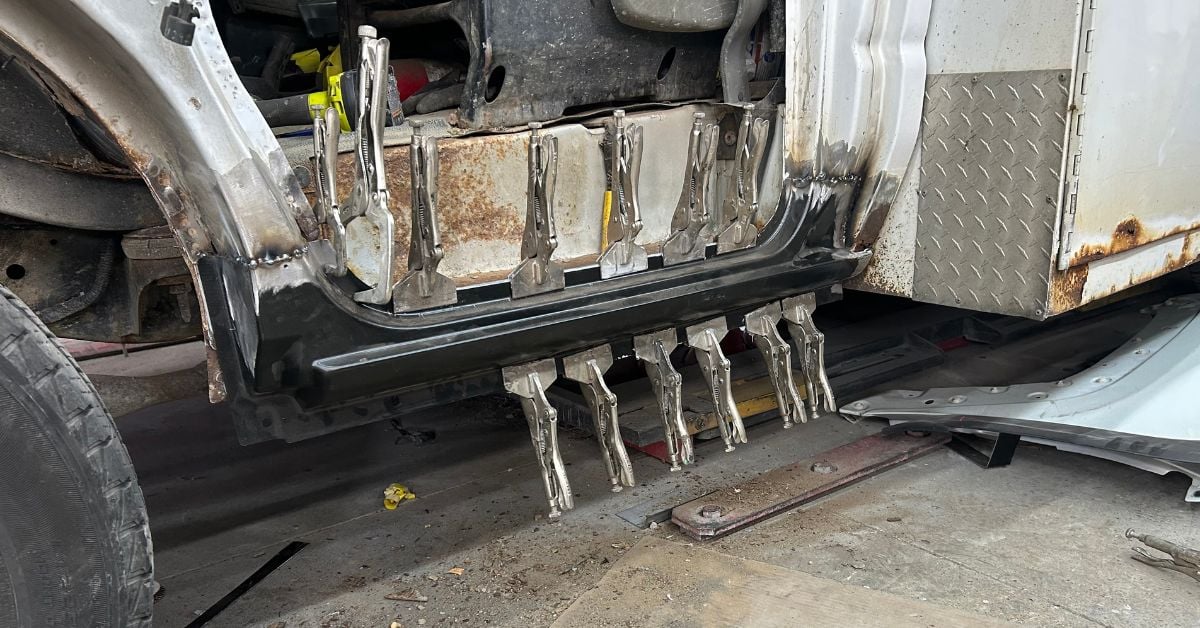
A repair shop replaces a rusted rocker panel on a steel car. They use MIG welding because it’s quick, gives neat welds, and handles thin steel well. After welding, they grind the seam, check for pinholes, and apply seam sealer and primer to stop rust.
Classic Car Restoration
A restorer is fixing a 1950s car with thin, curved panels. They use TIG welding for precise seams and minimal grinding. In some places, they use oxy-acetylene to shrink and stretch metal for a perfect fit.
Home Garage Repair
A DIYer wants to fix a fender. They use a small MIG welder with. 023” wire and CO₂ gas. They weld short beads, let the panel cool, and grind the weld smooth. The result is a strong, clean seam.
Practical Comparison: Mig Vs Tig For Body Panels
For most modern automotive bodywork, the choice comes down to MIG vs TIG. Here’s a closer comparison:
| Feature | MIG Welding | TIG Welding |
|---|---|---|
| Ease of Use | Beginner-friendly | Advanced skill needed |
| Speed | Fast | Slower |
| Finish Quality | Good, needs grinding | Excellent, minimal grinding |
| Aluminum Welding | Special setup needed | Best choice |
| Cost | Lower | Higher |
Welding Aluminum Body Panels
More cars now use aluminum panels because they are light and resist rust. Welding aluminum is tricky because it melts at lower temperatures and reacts with air.
- TIG welding is best for aluminum. It gives low heat, neat seams, and strong welds.
- MIG can be used with special wire (ER4043 or ER5356) and pure argon gas. You need a spool gun or push-pull gun for smooth wire feed.
- Spot welding works if both panels are clean and fit well.
Always clean aluminum panels with a stainless brush before welding. Remove all paint and oxide.
Welding Stainless Steel Panels
Some high-end cars use stainless steel panels. TIG is best here because it avoids contamination and gives a clean, strong seam. Use a dedicated stainless filler rod and 100% argon gas.
Welding Galvanized Steel Panels
Galvanized panels have a zinc coating for rust resistance. Welding burns off zinc, releasing dangerous fumes. Always grind off the zinc where you’ll weld, wear a respirator, and clean the area after welding. Use MIG or spot welding for best results.
Welding Plastic And Composite Panels
Some cars use plastic or fiberglass panels. You cannot weld these with standard metal welding processes. Plastic welding uses special hot air tools and plastic rods. For most repairs, use adhesives or plastic welding kits designed for auto body use.
Rust Repair Welding
When fixing rust, cut out all weak metal before welding. Overlap the new patch slightly and use spot or plug welds every 25 mm for strength. Seal and paint both sides to stop new rust.
Welding Safety For Body Panels
Welding is dangerous if you ignore safety. Here’s what you need:
- Welding helmet: Protects your eyes from UV light.
- Gloves and long sleeves: Stop burns from sparks and hot metal.
- Respirator: Filters fumes, especially with galvanized steel or paint.
- Fire extinguisher: Always keep one close.
Never weld near fuel lines, batteries, or flammable materials. Work in a clean, ventilated space.
Which Welding Process Is Best For Automotive Body Panels?
For most people, MIG welding is the best all-around process for automotive body panels. It’s easy to learn, works well on thin steel, and is affordable. With the right setup, you can get factory-quality repairs and modifications.
TIG welding gives the highest quality seams, especially for aluminum or custom work, but takes more skill and money. Spot welding is great for replacing original seams, if you have the tool. Oxy-acetylene and flux-cored welding are less common, but still useful in special cases.
No process is perfect for every job. The best choice depends on your panels, tools, and skill. Always practice on scrap metal before working on your car.
Credit: www.millerwelds.com
Frequently Asked Questions
What Is The Easiest Welding Process For Beginners On Body Panels?
MIG welding is the easiest for most beginners. The process is forgiving, the equipment is widely available, and you can get good results with basic practice.
Can I Weld Aluminum Body Panels With A Mig Welder?
Yes, you can weld aluminum with MIG if your machine supports it. You need a spool gun, pure argon gas, and special aluminum wire. TIG welding is usually better for neat results.
How Do I Prevent Warping When Welding Thin Panels?
Use short welds (“stitch welding”), allow the metal to cool between welds, and use the lowest heat setting possible. Clamp the panels tightly and avoid long, continuous beads.
Is Spot Welding Strong Enough For Body Panels?
Yes, spot welding is very strong for overlap seams. It’s the same method used in car factories. Make sure the welds are close enough together (about every 25 mm) for strength.
Should I Use Lead Solder On Seams?
Lead solder was common in the past but is less used now because of health risks. Modern body fillers (like polyester putty) are safer and easier. If you use lead, wear a respirator and gloves, and work in a ventilated space.
—
For further learning about welding methods and industry standards, visit the Welding Wikipedia page.
Choosing the right welding process for automotive body panels makes a big difference in your results. With the right knowledge, tools, and practice, you can repair, restore, or customize any car safely and professionally.