Disclosure: This post contains affiliate links and I will be compensated if you make a purchase after clicking through my links. Learn More
Choosing between an inverter and transformer welder depends on your needs. Inverter welders are lightweight, portable, and energy-efficient, making them great for versatile work. Transformer welders are heavier but more durable and affordable, ideal for heavy-duty shop use.
Picking the right one affects your welding results, budget, and even your safety. Many people focus only on price or power, but there are several other factors that matter.
This article will guide you through everything you need to know to make a confident choice. You will understand the key differences, how each machine works, and which one suits your needs best. You will also learn about practical things like maintenance, long-term costs, and what mistakes to avoid.
What Is A Transformer Welder?
A transformer welder uses a large, heavy transformer to change high-voltage electricity from the wall into lower, safer voltage for welding. These machines have been used for decades and are known for their simple design. Most transformer welders use alternating current (AC), but some can switch to direct current (DC).
How A Transformer Welder Works
The transformer takes in high voltage and reduces it to the right level for welding. You can often adjust the current by turning a dial or moving a lever. The technology is basic, which makes these welders very reliable.
Key Features
- Heavy and bulky: Transformer welders usually weigh a lot, sometimes over 50 kg.
- Durable: They last many years with simple care.
- Basic controls: Fewer electronic parts mean fewer things can break.
- Lower cost: The upfront price is usually lower than inverter models with the same power.
Typical Uses
Transformer welders are common in workshops, factories, and construction sites. People use them for jobs that need long welding times or high power, like fixing large metal structures or making gates.
What Is An Inverter Welder?
An inverter welder uses advanced electronics to convert power. Instead of a large transformer, it uses small, fast-switching electronic parts. These machines are much lighter and more compact. Inverters can use both AC and DC, and some models offer both outputs.
How An Inverter Welder Works
The inverter first changes the incoming AC power to DC. Then, it uses electronics to turn that DC into high-frequency AC. A small transformer lowers the voltage, and another part changes it back to DC for welding. This process is more efficient and allows the welder to be much smaller.
Key Features
- Lightweight: Most inverter welders weigh less than 10 kg.
- Precise control: They offer finer adjustments and often have digital screens.
- Energy efficient: They use less electricity for the same welding job.
- Portable: You can easily carry them to different places.
- Advanced functions: Many have features like anti-stick, hot start, and arc force.
Typical Uses
Inverter welders are popular with hobbyists, small workshops, and mobile welders. They are good for quick repairs, art projects, and places where you need to move around a lot.
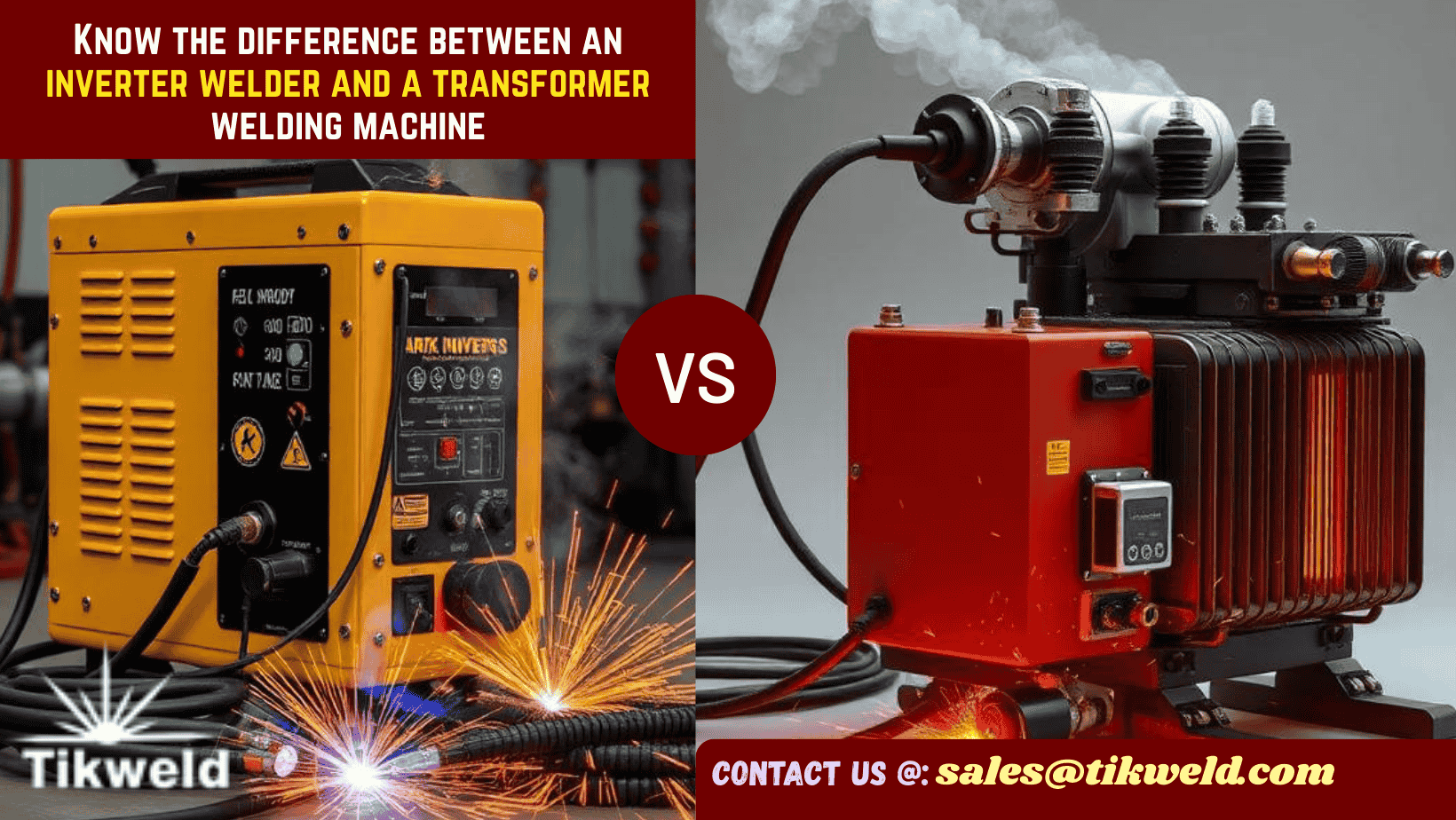
Main Differences Inverter Vs Transformer Welders
Understanding the main differences will help you match the welder to your needs. Here is a simple comparison:
| Feature | Transformer Welder | Inverter Welder |
|---|---|---|
| Weight | Heavy (often 20–50+ kg) | Light (4–10 kg) |
| Size | Large and bulky | Compact, portable |
| Efficiency | Lower (about 60%) | High (80–90%) |
| Power Usage | Draws more electricity | Uses less electricity |
| Arc Stability | Basic | Smoother, more stable |
| Price | Lower initial cost | Higher initial cost |
| Maintenance | Rarely needs service | More sensitive electronics |
| Durability | Very robust | Can be sensitive to dust/moisture |
| Welding Quality | Good for thick metals | Better for thin metals, precise work |
Advantages Of Transformer Welders
Transformer welders remain popular for several strong reasons. Here is what makes them a good choice:
- Simple and reliable: The design is straightforward, with few parts that can fail. Many transformer welders last 20 years or more.
- Can run for long periods: They handle heavy use without overheating. This is important for big jobs or continuous welding.
- Easier to repair: If something breaks, parts are usually cheap and easy to find. Many technicians can fix them.
- Lower upfront cost: You pay less at the start compared to an inverter with the same power.
- Resistant to rough conditions: They work well in dusty, wet, or hot environments.
Example Scenario
If you run a small workshop fixing farm equipment, a transformer welder will handle hours of work every day without much trouble.
Non-obvious Insight
A transformer welder will keep working even if the voltage from your power source changes. This is helpful in places with unstable electricity.
Advantages Of Inverter Welders
Inverter welders offer many benefits, especially for people who value control and portability.
- Very portable: Most models weigh less than 10 kg and fit in a small bag. You can easily take them to different job sites.
- Saves electricity: They use less power for the same work, which can lower your electric bill.
- Precise arc control: You can adjust the settings very finely, which helps make cleaner welds.
- Works with generators: Many inverters work well with small generators, making them suitable for remote areas.
- Advanced features: Many have digital displays, memory settings, and special functions for easier welding.
Example Scenario
If you are a mobile welder fixing fences in different locations, an inverter welder is easy to carry and works well with portable generators.
Non-obvious Insight
Some inverter welders can run on both 110V and 220V. This dual voltage support makes them flexible for use in different countries or locations.
Disadvantages Of Transformer Welders
No tool is perfect, and transformer welders have some clear downsides.
- Heavy and hard to move: Moving a 50 kg machine is not easy, especially if you work alone.
- Less precise control: The settings are usually basic, which can make thin metal welding tricky.
- More power needed: They draw more electricity, which can trip circuit breakers if your wiring is old.
- Can make rough welds on thin metal: They are best for thick pieces.
- Noise: Some transformer welders hum loudly during use.
Example
If you need to weld car body panels, a transformer welder may burn through the thin metal, making your work harder.
Credit: www.thefabricator.com
Disadvantages Of Inverter Welders
While inverter welders have many strengths, they also have some important drawbacks.
- Sensitive to damage: The electronics inside can fail if the welder is dropped or exposed to dust and moisture.
- Harder to repair: Fixing an inverter welder often means replacing circuit boards, which can be expensive.
- Higher initial price: You pay more at the start, especially for well-known brands.
- Shorter lifespan in tough conditions: They may not last as long in hot or dirty places.
- Can be affected by power spikes: Sudden changes in power can damage the electronics.
Example
If you work on a construction site with a lot of dust and vibration, an inverter welder could stop working much sooner than a transformer model.
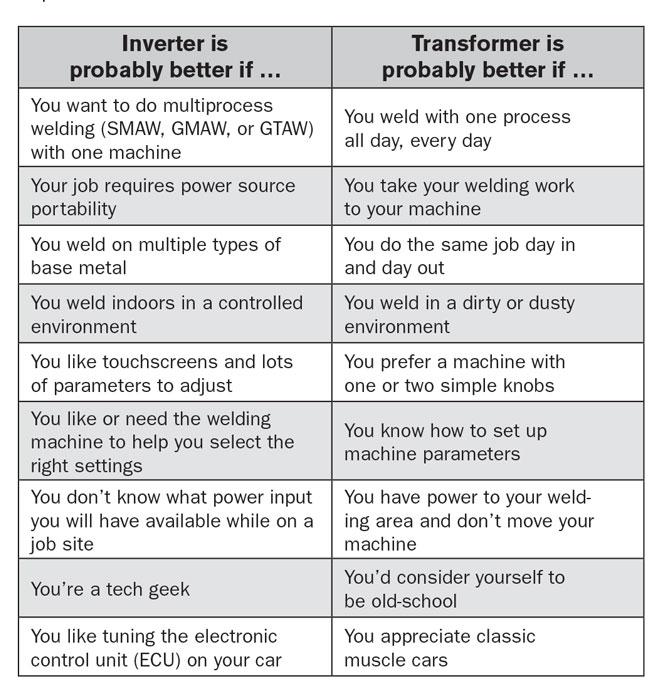
Key Factors To Consider Before Choosing
Before you decide, you should look at your real needs, not just the marketing claims. Here are the main things to consider:
1. How Often Will You Use It?
If you weld every day for hours, a transformer welder may be better because it handles heavy use. If you weld now and then, an inverter could be more convenient.
2. Where Will You Weld?
- Fixed location: If your welder stays in one place, weight is less important.
- Moving around: If you move often, portability is key—choose an inverter.
3. What Will You Weld?
- Thick steel: Transformer welders can handle thick, heavy metals well.
- Thin sheets: Inverter welders give you better control for thin metals and delicate work.
4. Your Power Supply
- Stable power: Both types work well.
- Unstable power: Transformer welders handle voltage drops better.
- Generators: Many inverters are designed for generator use.
5. Your Budget
- Upfront cost: Transformer welders are cheaper to buy.
- Long-term cost: Inverter welders save money on electricity.
6. Repair And Maintenance
- Easy to repair: Transformer welders win here.
- Hard to repair: Inverters often need special service.
7. Features You Need
- Simple welding: Basic transformer is enough.
- Special functions: Go for an inverter for options like pulse, hot start, or digital readouts.
8. Noise Levels
- Transformer welders can be noisy. If you work in a quiet shop, this might matter.
9. Safety
- Inverter welders have built-in protection features like anti-stick and overload shut-off.
10. Space
- Inverter welders take less room, which helps in small workshops.
Practical Example
A metal artist who works alone in a small studio will benefit more from an inverter welder. Someone repairing farm machinery outdoors all day will find a transformer welder more reliable.
Credit: tikweld.com
Common Mistakes When Choosing
Many people make the same errors when picking a welder. Avoid these traps:
- Choosing by price only: The cheapest machine may not last or suit your real needs.
- Ignoring power supply limits: Some welders need special wiring or high-amperage outlets.
- Overlooking repair costs: Inverter welders may cost more to fix if they break.
- Not checking duty cycle: This shows how long a welder can run before it needs to cool down. Pick a welder with a duty cycle that matches your work.
- Buying more power than needed: Higher amps are not always better, especially if you only weld thin metal.
- Missing out on warranty: Always check the warranty length and what it covers.
- Neglecting safety features: Make sure your welder has basic safety systems.
Cost Comparison: Upfront Vs. Long-term
Cost is more than the price tag. You should think about upfront cost, operating cost, and repair cost over time.
| Cost Type | Transformer Welder | Inverter Welder |
|---|---|---|
| Purchase Price | Lower (e.g., $200–$500) | Higher (e.g., $300–$800) |
| Electricity Use | High (less efficient) | Low (more efficient) |
| Maintenance | Low cost, simple repairs | High if electronics fail |
| Lifespan | Often 15+ years | 5–10 years (varies by use) |
Real-world Example
Suppose you weld a few hours each week. The inverter welder will save enough on electricity to cover its higher price in a few years. For daily, heavy work, the transformer welder’s longer life may save money.
Who Should Choose A Transformer Welder?
A transformer welder is a good fit if you:
- Need a machine that runs all day without stopping.
- Mostly weld thick steel or iron.
- Work in a fixed location.
- Want a tool that is easy to repair and will last many years.
- Work in dusty, hot, or wet conditions.
Tip: Many large repair shops and factories still use transformer welders for these reasons.
Who Should Choose An Inverter Welder?
An inverter welder is better if you:
- Move your welder often or work in small spaces.
- Weld thin metals or need fine control.
- Value advanced features and digital controls.
- Have limited power supply or use generators.
- Want to save on electricity costs.
Tip: Artists, home users, and mobile welders often prefer inverters.
Case Studies: Real-life Examples
Heavy Equipment Repair Shop
A farm repair shop bought a transformer welder 15 years ago. It runs daily for hours with little downtime. The staff like its simple controls and tough build. They only do basic repairs when needed.
Mobile Welding Business
A welder who fixes fences uses an inverter welder. He carries it in his small van and powers it with a generator. The machine’s light weight and fine controls help him work quickly and neatly, even on thin wire fences.
Home User
A hobbyist tried both types. He found the transformer too heavy and noisy for his garage. The inverter welder was quiet, easy to store, and did not trip his home breakers.
Advanced Features: Do You Need Them?
Inverter welders often have extra functions. Here are a few you might see:
- Hot Start: Makes starting the arc easier.
- Arc Force: Keeps the arc stable, even if your hand shakes.
- Anti-Stick: Reduces the chance of the rod sticking to the metal.
- Digital Display: Shows exact settings for repeatable results.
- Pulse Function: Useful for aluminum and thin metals.
Most transformer welders do not have these features. If you weld only thick steel, you may not need them.
Reliability And Service: What To Expect
Transformer welders can take a lot of abuse. If they break, most parts are mechanical and easy to swap. With inverter welders, problems often mean a trip to a special repair shop. Electronic parts can be expensive and sometimes hard to find, especially if the brand is not well-known.
Non-Obvious Insight: Some inverter welders stop working if you use them with a poor-quality generator. Always check the manual for power requirements.
Environmental Impact
Inverter welders use less electricity, so they produce fewer greenhouse gases if your power comes from fossil fuels. They also make less heat and noise, which is better for your work area. On the other hand, they use more electronic parts, which are harder to recycle.
Safety
Both types are safe if you follow the rules. Inverter welders often have extra safety features, like automatic shut-off if they get too hot. Transformer welders are so simple, there is little that can go wrong, but they are heavier and may be harder to move safely.
Tip: Always wear proper gear and keep your work area dry.
How To Test Before You Buy
If possible, try both types before you decide. Here’s what to check:
- Start the arc: Is it easy or does it stick?
- Adjust settings: Do you have enough control?
- Listen to the noise: Will it bother you during long jobs?
- Check the weight: Can you lift and move it alone?
- Test on real metal: Try both thick and thin pieces.

Credit: www.thefabricator.com
What About Multi-process Welders?
Some inverter welders can do MMA (stick), TIG, and MIG welding in one machine. This is great if you want to try different types of welding. Transformer welders are usually single-process only.
Final Checklist Before You Decide
Here are the last things to review:
- List your main tasks: What will you weld most?
- Check your power supply: Is it strong enough?
- Decide on portability: Do you need to carry it?
- Think about noise: Will you use it in a shared space?
- Read real reviews: Look for user stories, not just ratings.
- Check for a warranty: Longer is better, especially for inverters.
- Ask about service: Is there a repair shop nearby?
- Consider total cost: Price, electricity, repair, and parts.
If you follow these steps, you will pick the right welder for your real needs, not just the one with the best ad.
Frequently Asked Questions
What Is The Main Difference Between An Inverter And A Transformer Welder?
The main difference is how they change electricity for welding. Transformer welders use a heavy coil to lower voltage, making them large but simple. Inverter welders use electronic parts, making them light, efficient, and full of features.
Which Welder Is Best For Beginners?
Many beginners start with an inverter welder because it is light, easy to adjust, and safer for home use. The fine controls help avoid mistakes. If you plan to weld thick metal for long hours, a transformer welder may suit you better.
Can Inverter Welders Handle Heavy Work?
Some high-end inverter welders can handle heavy jobs, but most are better for medium or light work. If you weld all day or work in rough conditions, a transformer welder will usually last longer.
Are Transformer Welders More Durable Than Inverters?
Yes, transformer welders are usually more durable. Their simple design means fewer things can break. Inverter welders have many electronic parts that may fail in tough conditions.
Where Can I Learn More About Welding Technology?
You can find trusted information about welding technology at the Wikipedia Welding page. This source covers welding types, history, and safety tips.
Choosing the right welder affects your results, costs, and even safety. Think about what you will weld, where you will work, and how much you want to spend. Both inverter and transformer welders have strong points. By understanding these differences, you can make a smart choice that fits your needs for years.